
Five of Swords Tarot Card Meaning (Upright & Reversed)

- Arcana
- Minor Arcana, Suit of Swords
- Element
- Air
- Yes or no
- No
conflictdefeatwinning at a cost
confusionrecoveryrelease of mental strain
The Five of Swords is the tarot card of conflict and hollow victory. It shows a fight that someone has won at a price that is higher than it looks: lost trust, damaged pride, or people who no longer want to be near you. Upright, it points to arguments, rivalry and winning at any cost. Reversed, it points to the aftermath: reconciliation, apology, or a decision to stop fighting.
This guide covers the card’s meaning in love, feelings, career, money and health, how to read the figures in the image, what the card says about timing and yes or no questions, and how it changes when it appears next to other cards. If you want to go deeper on the reversed position, there is a separate page on the Five of Swords reversed.
The Five of Swords at a glance
The Five of Swords is the fifth card of the Suit of Swords, the suit of thought, words, truth and conflict. Where the Four of Swords offers rest, the Five arrives with a jolt: a clash of wills, and someone left standing in the wreckage.
Here are the core associations:
- Upright keywords: conflict, tension, hollow victory, defeat, pride, competition, betrayal of trust
- Reversed keywords: reconciliation, making amends, letting go of resentment, walking away, regret
- Element: Air
- Golden Dawn title: Lord of Defeat
- Astrology: Venus in Aquarius
- Number: 5 (disruption and change)
- Answer to yes or no questions: usually no
You can see the other cards of the suit on the Suit of Swords page, which helps put this card in context.
What you see in the Rider-Waite-Smith image
Pamela Colman Smith’s drawing has a clear story. A figure in the foreground wears a smug smile and holds one sword on his shoulder. Two more swords lie on the ground, or are being gathered up, and two other figures walk away toward the water with their backs to us. They have lost their weapons, and perhaps something more than their weapons.
The setting adds to the mood. The sky is torn and windy, the water is rough, and the ground is bare and rocky. Nothing here feels like a celebration. The winner holds the swords, but he stands alone, and the image asks whether he really got what he wanted.
Notice that the card is never about the fight itself. The fight is over. What we see is the moment after, when winners and losers are sorted out and the damage is clear. That is why the card works so well as a prompt for honest self-questioning.
Five of Swords upright meaning
Upright, the Five of Swords describes a conflict in which winning matters more than the relationship, the principle or the people involved. Someone is pushing to get their way, maybe through sharp words, maybe through tactics that bend the rules. Even if the pushing works, the victory feels thin because of what was sacrificed along the way.
The card is not always about a loud argument. It can describe passive aggression, point-scoring, gossip, a cold silence or a competition that has turned unkind. Often the real issue is pride: a need to be right, to have the last word, or not to lose face.
The card also carries a quieter message about perspective. It asks whether this is a battle worth fighting at all. Sometimes the strongest move is to leave the field, and sometimes the card is simply confirming that a conflict has already cost more than anyone should have to pay.
Try this: Write down the conflict you are thinking about, then finish this sentence three different ways: “If I win this, I will get…” Then finish this one: “If I win this, I will lose…” If the second list is longer, that is the card talking.
Read Five of Swords for your question
Upright: An argument is being treated as a contest, and even if one of you wins it, the relationship pays the price.
Reversed: Both people are tired of fighting and ready to apologise, or one of you is quietly leaving the argument unresolved.
Upright: They feel competitive, defensive or determined to be right, and may care more about winning than about your feelings.
Reversed: They feel regret about how things were said and may be working up to an apology, or they have emotionally withdrawn.
Upright: Office politics, credit-grabbing or rivalry are in play, and a win here may cost you allies and goodwill.
Reversed: Workplace tension is cooling, a dispute is being settled, or you are choosing to leave a toxic contest behind.
Upright: A dispute over money, an unfair deal or a win at someone else's expense leaves you worse off than it looks.
Reversed: A financial disagreement moves toward settlement, or you drop a fight that was costing more than it was worth.
Upright: Ask what you actually want from this conflict, and let go of the fight if being right is the only prize.
Reversed: Own your part, make the apology or boundary that is due, and put the swords down for good.
Upright: Constant tension, anger and rumination are wearing on your sleep, nerves and body.
Reversed: Stress eases as a conflict resolves, though lingering resentment can still keep you wound up.
Five of Swords reversed meaning
Reversed, the Five of Swords usually shifts from the fight to the aftermath. The anger has cooled enough for regret, guilt or fatigue to show up. You may be ready to apologise, to forgive, or to admit that something said in anger went too far. This is the more hopeful face of the card.
Reversed does not always mean tidy peace, though. It can point to conflict that has been pushed underground, where resentment keeps simmering because nobody said the hard thing out loud. In that reading the swords are still within reach, and the quiet is only a pause. The surrounding cards will help you tell which version you are looking at.
A third meaning is the decision to disengage. Sometimes the reversed card shows someone who has finally seen that the argument cannot be won and chooses to step away without needing the last word. For more on how to weigh upside-down cards in general, see our guide to reading reversed tarot cards.
Which figure are you in the card?
One of the most useful ways to read the Five of Swords is to ask which of the three figures you are. There is no single right answer, and in a real conflict you may be more than one of them at different moments.
If you are the winner, the card asks whether you have taken more than you needed. You may be right on the facts and still be wrong in how you went about it. If you are one of the figures walking away, the card says the hurt is real, but it also suggests you have the freedom to leave a fight that was never going to be fair. Walking away is not always defeat.
The card can also describe a third position: the one watching. If you are being asked to take sides in someone else’s quarrel, the Five of Swords can warn that joining in will only add weapons to the pile. Stay curious about your own role before you decide which figure you are.
Five of Swords in love
In a love reading, the upright Five of Swords points to arguments, power struggles and a relationship where winning has become the point. One partner may always need the last word, or a small disagreement may keep turning into a big one. It can also describe cruel humour, point-scoring or old hurts being used as ammunition.
For singles, it can show a bruising dating experience, mind games or a connection where one person plays to win. It is a reminder not to treat attraction as a contest. If you are single and the card appears, look at whether you are carrying defensiveness from a past breakup into new meetings.
Reversed in love, the card suggests a chance to repair things, with a sincere apology or a calmer conversation. It can also mark the end of a painful pattern, either because both people finally soften or because one decides they have had enough. If the card sits near the Three of Swords, the argument has probably left a deeper wound than either person has admitted.
Five of Swords as feelings
When the Five of Swords describes what someone feels about you, it rarely points to warm affection. Upright, it suggests they feel competitive, defensive or threatened, and may be more concerned with protecting their pride than with how you feel. They may see the relationship as a place where they have to defend themselves.
It can also mean they feel they have lost something, or that they are still hurting from an earlier argument. A person showing this card is often not indifferent. They are tangled up in an emotional contest and haven’t found a way out.
Reversed, their feelings tend to soften. There may be regret, embarrassment or a wish to make things right. Be careful though: regret is not the same as willingness to change, so look for actions as well as words.
Five of Swords in career
At work, the Five of Swords describes office politics, rivalry, credit-stealing and competition that has turned ugly. A colleague may be undermining you, or you may be tempted to win a promotion or argument by methods you would not be proud of later. Workplace bullying and unfair tactics also fit this card.
The card gives practical advice in this setting. Pick your battles, keep records if you are being treated unfairly, and think about the long-term effect on your reputation before you hit back. A win that costs you the goodwill of your team is rarely a win.
Reversed, tension at work begins to ease. A dispute is settled, a manager steps in, or you decide that the job is not worth the fight and begin to look elsewhere. It can also be a sign to apologise to a colleague you have wronged. If the card is showing sneaky behaviour, compare it with the Seven of Swords, which deals with deception more directly.
Five of Swords in money
In a financial reading, the Five of Swords warns of disputes over money, unfair deals or someone taking advantage. It can describe a legal or contractual argument, a business partnership turning sour, or a negotiation where one side is playing too hard. It can also describe a win that leaves you worse off, such as a settlement that costs more in time, stress and relationships than it brings in.
The advice is to read the fine print, stay calm in negotiations and ask honestly whether a financial victory is worth what you are giving up. If you are the one pressing for advantage, consider what a fair outcome would look like.
Reversed, money disputes move toward resolution. A settlement is reached, a debt is forgiven, or you walk away from a fight that was draining you. This is often a relief card for finances, as long as you learn what the conflict taught you.
Five of Swords card symbols
Choose a symbol to read what it means on the card.
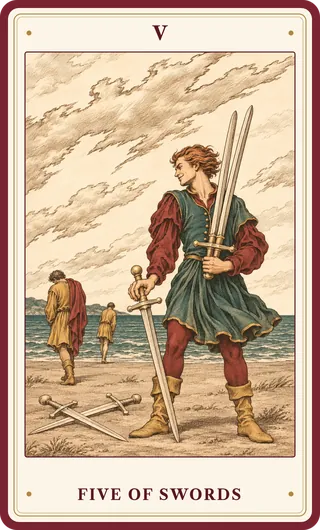
The smirking figure in the foreground
He stands with one sword on his shoulder and two more in his grasp or at his feet, looking pleased with himself. He is the winner who has taken everything and is only beginning to see what that cost.
The three swords
One is held, two lie on the ground, and together they show weapons collected from opponents who have given up the fight. They also show that conflict leaves a mess behind even for the one still armed.
The two retreating figures
They walk away toward the water with their heads bowed and their swords gone. They show defeat, hurt pride and the choice to leave rather than keep fighting.
The stormy, ragged sky
Torn clouds sweep across the sky and give the scene an unsettled, restless mood. It reflects the tension in the air and the sense that nothing has been truly resolved.
The choppy water
The sea behind the figures is rough and cold, which suggests emotions churned up by the quarrel. It is also the open space the defeated figures are heading toward.
The rocky, barren shore
Nothing grows on the ground where the fight took place. This is the lasting result of a battle won without care for what it damaged.
The smile on the winner's face
His expression is smug rather than joyful. It hints at a victory built on pride, and at how lonely it can be to stand alone on the field.
Five of Swords and health
In a health reading, the Five of Swords usually reflects the effect of conflict on your body and mind. Chronic tension, anger, rumination and sleepless nights are all in the card’s territory. Where an argument keeps replaying in your head, the stress it creates is a health matter too.
Reversed, the card can show stress easing as a conflict is resolved, though lingering resentment may still keep you on edge. It is worth looking at what you do to release tension, such as exercise, rest or talking to someone you trust.
Tarot is not a replacement for medical advice, so take real symptoms to a qualified professional. Use the card as a prompt about the emotional load you are carrying, not as a diagnosis.
Five of Swords as a person
As a person, the upright Five of Swords is someone competitive, quick with words and focused on winning. They may be charming in a debate and cold when they lose. At worst they are manipulative, a bully or a person who treats every conversation as a game. At best they are fiercely driven and simply need to learn that other people are not opponents.
This person might also be you in a stressed moment. If you have been unusually combative lately, or feel the urge to prove a point at all costs, the card may be describing your own behaviour rather than an outsider’s.
Reversed, the person is more reflective. They may be admitting they were wrong, softening their approach or recovering from a defeat. If you want a calmer Swords personality for comparison, look at the Queen of Swords, who uses truth without needing to crush anyone, or the King of Swords, who values fairness and clear reasoning.
Is the Five of Swords a yes or no card?
For yes or no questions, the Five of Swords leans toward no. The card is about conflict and cost, so it answers poorly for questions like “Will we get back together?” or “Will this negotiation go smoothly?” Upright, expect friction or a result that carries a hidden price.
Reversed, the answer softens. The conflict is easing, so a “yes” may be possible, though usually a “yes, after some repair work.” Pay attention to how the question is framed. If you ask “Can I win this argument?”, the card might say yes and still be warning you about what it will cost.
Our dedicated page on the Five of Swords as a yes or no answer covers this in more detail, including how to read it in different kinds of questions.
Element, astrology and numerology
The Five of Swords belongs to the element of Air, which rules thought, speech and communication. That fits the card well, since most of its conflicts are fought with words, ideas and arguments. Air can be clear and clean or sharp and cold, and this card shows the sharp side.
In the Golden Dawn system the card is called the Lord of Defeat and linked to Venus in Aquarius. Venus is the planet of love, values and harmony, and Aquarius is detached and independent, so the pairing suggests a loss of harmony through stubborn, cool-headed principle. It is an odd mix, and it explains why the card is about relationship damage caused by ideas and pride.
Numerologically, five is the number of disruption, change and instability, found in the middle of the run from one to nine. In every suit the fives mark a crisis point. Compare it with the Five of Wands, which is a messy squabble over competing ideas, and the Five of Cups, which is grief. The Five of Swords sits between them as the conflict that leaves a person with nothing but the win.
Five of Swords with other cards
Neighbouring cards tell you whether the fight is ongoing, ending or worth having at all. Here are a few useful pairings:
- With the Tower: a conflict that blows up suddenly and breaks things that cannot easily be repaired.
- With the Six of Swords: moving away from a fight to calmer waters, a sensible exit.
- With Justice: a dispute that needs an honest, fair settlement rather than a victory.
- With the Two of Cups: a conflict that can still be healed through real mutual care.
- With the Seven of Swords: deception or sneaky tactics sit behind the argument.
The card is also worth reading by position in a spread. In the past position it shows a fight that is still shaping the present. As the outcome, it warns that the path you are on leads to a costly win. In a Celtic Cross it can reveal the hidden pride behind a challenge you are facing.
Try this: Pull one extra card as a “what would peace look like?” card and place it beside the Five of Swords. Write one sentence about what it suggests you could do this week.
What to do when the Five of Swords appears
The card works best as a prompt for honest questions, and these are the ones that help most:
- What do I actually want out of this conflict: to be right, to be heard, or to repair something?
- If I win, what will I lose, and am I willing to lose it?
- Is my pride speaking, or is there a real principle at stake?
- What would a fair outcome look like for everyone involved?
- Is there a better time or way to have this conversation?
If you answer these honestly, the card tends to resolve itself. You may discover that you want an apology more than a victory, or that you are fighting the wrong person. You might also find that the fight is worth having, but needs a calmer approach.
After you have answered, choose one concrete action. That might be an apology, a boundary, a calm email, or a clean decision to let the matter go. The card wants movement rather than more rumination.
Common misreadings of the Five of Swords
A frequent mistake is assuming the card always means you are the victim. It can just as easily show you as the one doing harm. Looking only for the person who wronged you can miss the lesson in the card, which often involves your own behaviour.
Another misreading is that the card means the conflict is hopeless. It is a hard card, but it is also honest, and honesty is the first step in any repair. Where it appears with softer cards, the situation is often more workable than it seems.
Finally, be careful with the assumption that reversed always means peace. As noted above, reversed can mean suppressed conflict or even an escalation. Read the cards around it, and trust the question you asked. If you want to practise on your own spreads, you can draw a card with the random tarot card generator and see how the Five of Swords feels in a context of your own.
Try this: The next time you feel the urge to win an argument, pause for ten seconds and name what you are protecting. Then decide whether the argument serves it.
Questions readers ask
What does the Five of Swords mean in tarot?
The Five of Swords means conflict, hollow victory and the cost of winning at any price. It often shows up after or during an argument where someone has put being right ahead of keeping the peace.
Is the Five of Swords a bad card?
It is a difficult card, but it is a useful one. It does not predict doom: it shows you a conflict clearly and asks whether the fight is worth what it is costing. Reversed, it often points toward reconciliation or relief.
What does the Five of Swords mean for love?
In love, it points to arguments, power struggles or a relationship where one person needs to win. It asks both people to look at whether the fighting is protecting the bond or slowly wearing it away.
What does the Five of Swords reversed mean?
Reversed, the card usually means the fight is ending: you may be ready to make amends, forgive, or walk away. It can also warn of resentment that has gone quiet rather than been resolved.
Is the Five of Swords a yes or no card?
It leans towards no, especially for questions about harmony, fair outcomes or relationships. Reversed, the answer softens, because the conflict is easing and a way forward is opening.
Who is the Five of Swords as a person?
As a person, it describes someone competitive, sharp-tongued and focused on winning, who may be manipulative or insensitive to the damage they leave. It can also describe you in a moment when you are fighting harder than the situation deserves.