
Four of Swords Tarot Card Meaning (Upright & Reversed)

- Arcana
- Minor Arcana, Suit of Swords
- Element
- Air
- Yes or no
- Maybe
restrecoverycontemplation
confusionrecoveryrelease of mental strain
The Four of Swords means rest, recovery and a deliberate retreat from conflict or stress. It shows a knight lying still in a church, and it tells you to stop fighting for now, step back and let your mind and body recover before you decide what comes next. It is the tarot’s clearest sign that rest is a task in its own right.
Upright, it is a calm and healing card. Reversed, it tends to describe exhaustion you have ignored, or a retreat that has run past its purpose. Below you will find the imagery, the meaning in love, feelings, work, money and health, how to read it as a yes or no, and how to tell real rest from avoidance.
Four of Swords upright meaning
Upright, the Four of Swords says that you need a break and you are allowed to take it. The card usually arrives after a period of strain: a breakup, an illness, a long stretch of overwork, a conflict that drained you. The message is not to solve anything yet. It is to get quiet, sleep, and let the dust settle until you can see the situation clearly.
Keywords for the upright card are:
- Rest and recovery
- Retreat and solitude
- Meditation and contemplation
- Mental reset
- Convalescence
- Peace after pressure
It is a Swords card, so the trouble is usually in the mind: worry, overthinking, arguments you keep replaying. The Four asks you to stop feeding that loop. The retreat is strategic, not a defeat, because a person who has rested makes better decisions than one who is pushing on while depleted.
What the Four of Swords card shows
In the Rider-Waite-Smith deck, drawn by Pamela Colman Smith, a knight lies on a stone tomb inside a church, hands joined in prayer. He looks like a carved effigy, completely still. Three swords hang on the wall above him with their points down, and a fourth lies on the slab beneath. Behind him a stained glass window shows a kneeling figure being blessed, and the word PAX, Latin for peace, appears in the glass.
Read it from top to bottom. The three swords are your troubles, kept in view but out of reach. The one beneath is your clear thinking, held ready for when you wake. The window is comfort: you are sheltered, and you are not required to fight today.
The tomb does not mean death, which is a different card entirely (see Death). It is a sign of full surrender to rest, with the body still and the mind quiet. The knight is not dead, only off duty.
Four of Swords reversed meaning
Reversed, the Four of Swords usually points to one of three situations. The first is burnout: you have ignored your need to stop, and your body or mind is forcing the issue through exhaustion, insomnia or irritability. The second is restlessness, where you cannot switch off even though you are finally free to rest. The third is the end of a retreat, when you are ready to return to the world.
It can also show retreat that has gone stale. Some people withdraw after a hard time and then stay withdrawn long after the healing is done, because staying hidden feels safer than rejoining life. Context and your own honesty decide which reading fits. The full breakdown is on the Four of Swords reversed page, and the general method is covered in how to read reversed tarot cards.
If you are unsure, check how the card feels. Reversed and heavy, with dread about stopping, usually means burnout. Reversed and light, with a sense of readiness, usually means you are coming back.
Try this: Ask yourself where in your body you feel tired, not just where you feel busy. Write down one thing you could cancel this week and cancel it before you finish your tea.
Read Four of Swords for your question
Upright: A pause that heals: space, quiet and honest rest after conflict or heartbreak, whether you are single or partnered.
Reversed: Withdrawal that has gone on too long, or a return to dating or to a difficult conversation before you have recovered.
Upright: They feel drained and calm at once, and they are processing in private rather than pulling away from you.
Reversed: They feel restless, avoidant or overwhelmed, and the silence may be hiding anxiety rather than peace.
Upright: Take leave, step back from the pressure and recover before you make any big professional decision.
Reversed: Burnout is close or already here, or you are rushing back to work before you are well.
Upright: Hold still with your finances, review your accounts and avoid big moves while you gather your thoughts.
Reversed: Stress is driving rash spending or avoidance of the numbers, and a plan can no longer wait.
Upright: Rest first. You do not need to solve anything today, and you will think more clearly after sleep and silence.
Reversed: Stop hiding in rest, or stop ignoring your need for it. Either way, the pause is overdue.
Upright: Recovery, sleep, convalescence and mental calm: give your body and mind the time they are asking for.
Reversed: Exhaustion, insomnia or stress that has been pushed aside, and a good reason to see a professional.
Four of Swords in love
In a love reading, the upright Four of Swords is a breather. If you are in a relationship, it suggests that you both need quiet: less talking, fewer arguments, more rest and room to think. It does not predict a breakup. It says the relationship will do better after a pause than under more pressure. After a stormy patch, it can show a couple taking time to recover before they talk things through.
If you are single, it tells you to heal before you date. This is especially likely when it follows a breakup or a painful ending, the kind of pain you may recognise from the Three of Swords. You do not have to be over it in a week. The card asks you to stop forcing yourself into new connections while you are still tender, and to be gentle with your own pace.
Reversed in love, the card can describe someone shutting themselves off emotionally, or a partner who withdraws every time things get difficult. It can also mean you are rushing back into dating or into a hard conversation before you are ready. Either way, the cure is honest rest and, when it is time, honest communication.
Four of Swords as feelings
When the Four of Swords describes how someone feels about you, the answer is mostly about their state of mind, not about you. They are tired, careful and withdrawn. They may be recovering from something painful or simply overloaded, and they need time alone to think. Their silence may be self-protection and nothing more.
That does not mean they are not interested. It means they have little to give right now. If you push for answers or attention, you will probably get less of what you want. Give them space, stay kind and watch whether they come back when they have rested. People who care usually do.
Reversed as feelings, the card can show someone who is restless, anxious or avoiding the subject, and whose quiet is not peace at all. They may want to engage but feel too overwhelmed to start. A clear, low-pressure invitation to talk is more likely to work than an ultimatum.
Four of Swords in career
At work, this is the card of the strategic pause. It tells you to step back before a stressful job turns into a breakdown. That might mean taking leave, handing off a project, going quiet for a week or simply closing your laptop on time. It also advises against making big decisions, like quitting or accepting a new post, while you are depleted.
The card has an association with quiet, recovery-focused work: healthcare, therapy, counselling, administration, research, and anywhere calm and reflective suits you. If you are job hunting, it can show a gap or a waiting period before the next step, which you can use to rest and plan.
Reversed, it often means burnout is near or already here. You may have been ignoring the warning signs, and the cost is rising. It can also show a premature return to work after illness or leave. Take the hint and renegotiate your load before the deck has to say it louder. If the next card feels like a collapse, see the Ten of Swords.
Four of Swords in money
With money, the upright Four of Swords advises stillness. It is a good time to review your accounts, read the small print and think through your options, but a poor time to take big financial risks or sign anything in a hurry. Wait for a clear head.
It can also show a quiet financial period, a plateau with no big gain or loss, where the best strategy is to hold steady and let things settle. If you have had a financial shock, the card says to stabilise first and make bold plans later.
Reversed, stress may be pushing you towards rash spending or towards avoiding your finances altogether. Both are ways of escaping the discomfort. A short, calm look at the real numbers will help more than either. For a spread aimed at this, try the money tarot spread.
Four of Swords in health
Health is where this card is at its most literal. The Four of Swords can point to sleep, convalescence, recovery from illness or surgery, and the need to slow down while your body heals. It is especially connected with mental health, stress and nervous exhaustion, since Swords rule the mind. It asks you to treat rest as part of your treatment.
Reversed, it can show insomnia, chronic fatigue or stress that you have put off dealing with. Tarot cannot diagnose anything, and no card replaces a doctor. If you are persistently exhausted, anxious or sleeping badly, take it as a prompt to get proper medical or professional support.
Spiritually, the card favours meditation, silence, prayer, time in nature and any practice that quiets thinking. It is a close cousin of The Hermit, though the Hermit withdraws to find wisdom while the Four of Swords withdraws to recover.
Try this: Spend ten minutes today with no phone, no music and no task. Sit or lie down, breathe slowly, and when a worry appears, say “later” and go back to breathing.
Four of Swords card symbols
Choose a symbol to read what it means on the card.
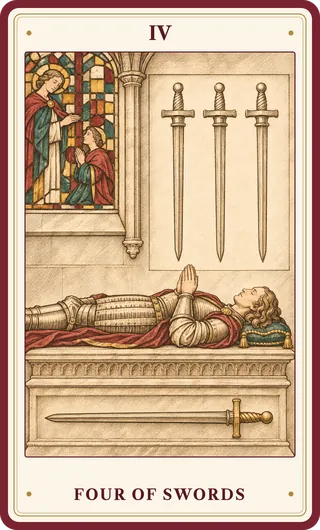
Knight effigy on the tomb
A figure lies on a stone tomb with his hands pressed together in prayer, like a carved memorial. It shows rest so complete that the fighter has put down everything, if only for a while.
Three swords on the wall
Three swords hang above the figure, pointing downward and out of reach. They stand for the pain, conflict and mental noise (see the Three of Swords) that you can look at from a distance without being cut.
Single sword beneath the tomb
One sword lies flat under the bier, close at hand but untouched. It is your clear thinking, held in reserve until you are ready to use it again.
Stained glass window
The window shows a kneeling figure receiving a blessing, with the word PAX (peace) written in the glass. It points to comfort, faith and the sense that you are held while you rest.
Folded hands
The prayer position shows surrender, stillness and trust. The mind is not working on a problem here, only quietly waiting.
Church interior
The setting is a hushed, enclosed sanctuary, away from the world and its demands. It is the place you go to be safe while you recover.
Muted palette
The cool, soft colours make the scene feel dim, quiet and sheltered. Nothing in the image asks for action.
Four of Swords as advice
As advice, the card is simple: rest, then decide. Do not make the big call tonight. Do not reply to the difficult message while you are raw. Let your mind settle, and trust that clarity returns more easily after sleep than after another hour of worry.
It also asks you to accept that stopping is not failure. Many people only rest when they have collapsed. The Four of Swords is the invitation to do it earlier, on purpose. The knight in the picture has not given up his swords. They hang within reach, and he will take them back up when the time comes.
If the card arrives in a question about whether to act, the practical advice is to set a time limit. Rest for a defined period, such as a weekend, a week or a month, and then review the situation. That keeps the pause healing instead of drifting into avoidance.
Four of Swords yes or no
As a yes or no answer, the Four of Swords leans towards “not yet” or “wait”. It does not forbid what you are asking about, but it says the timing is off because you or the situation need rest and clarity first. If your question is about whether to rush into something, the answer is no for now.
If you are asking whether you should rest, take time off or step back, the answer is a clear yes. The card is at its most positive when the question is about recovery.
You can read a full yes or no breakdown on the Four of Swords yes or no page. Reversed, the answer is usually still “wait”, but with a warning that you may be stalling or burning yourself out.
Four of Swords as a person
When the card stands for a person, it describes someone calm, quiet and inward. They tend to prefer a simple life, avoid crowds and noise, and need plenty of solitude to feel like themselves. They are often thoughtful and restful to be around, though they can seem distant or hard to reach.
It can also describe someone who is currently recovering: from illness, grief, a breakup or exhaustion. In that case it is less about their character and more about where they are right now. They need patience and space.
Reversed, the person may be restless, overworked or unwilling to admit they need a break. Or they may be a person who retreats from every conflict and stays out of reach when you need them.
Four of Swords in the suit of Swords
The Swords suit deals with the mind: thoughts, communication, truth and conflict. You can see all fourteen cards in the suit of Swords. The Four of Swords sits in the middle of a rough sequence. The Three of Swords is the heartbreak, the Five of Swords is the aftermath of a conflict that left damage (Five of Swords), and the Four is the quiet room between hurt and what comes after.
Numerically, four is the number of structure and stability, a foundation. In the Swords suit that means the mind gets a stable place to rest after pain. The traditional astrological link is Jupiter in Libra, which suggests peace and balance with a sense of grace.
Compare it with the Four of Cups, another four about withdrawal. The Four of Cups is disengaged and bored, turned away from what is offered. The Four of Swords is deliberately resting and recovering. One is a mood, the other is a remedy.
Four of Swords with other cards
Context changes the shape of the pause. With the Three of Swords, it shows recovery after heartbreak. With the Nine of Swords (see Nine of Swords), it says that the sleepless worry has to be met with real rest. With the Ten of Swords, it shows the quiet after a painful ending, and the first sign of recovery.
With cards of action, such as the Eight of Wands, it describes a strategic pause before a rush. With the Hermit, the retreat becomes deeper and more spiritual. With Strength or the Star, it points to healing that is working. With the Devil or the Moon, it may suggest that avoidance or anxiety is part of what keeps you from resting.
Read neighbouring cards for the cause of the exhaustion and for what happens next. The card before the Four usually tells you what you are recovering from, and the card after tells you what you are recovering towards.
How to tell rest from avoidance
The Four of Swords is only helpful when the pause has a purpose. These signs separate healing rest from hiding:
- You feel a little better each week, not the same or worse.
- You can name what you are recovering from.
- You have an approximate end point or review date.
- You are still in touch with at least one trusted person.
- Basic things like sleep, food and movement are improving.
If none of these apply, you may be avoiding something. Avoidance feels like relief at first and then like dread, as the thing you are hiding from grows. In that case, the reversed card’s message applies: the pause is overdue, or it has outstayed its use. A small, concrete step towards the problem, such as a short call, a single email or a ten-minute walk, usually breaks the freeze.
Genuine rest, by contrast, is slow and often a bit dull. You may feel guilty or bored. That is normal, and it does not mean you are doing it wrong.
Working with the Four of Swords
You can use the card in a reading, but also as a practice. Draw it, or find it with the random tarot card generator, and sit with the image for a few minutes. Notice what your body does when you look at the knight lying still. Relief, resistance or guilt all tell you something about your relationship with rest.
For a short reading of your own, try a three card spread with the following positions: what is draining me, what I need to rest from, and what is ready when I return. If the Four of Swords lands in the middle, you have your answer.
Try this: Choose one real rest day in the next two weeks and put it in your calendar in ink. On the day, do one calm thing only, and write down one decision you will postpone until after it.
If you are new to the system, the tarot card meanings list is a useful place to see how the Four fits with the rest of the deck. Come back to this card whenever you feel stretched too thin. It will tell you, kindly and without fuss, to lie down and let the swords hang.
Questions readers ask
What does the Four of Swords mean in tarot?
The Four of Swords means rest, recovery and a deliberate retreat from stress or conflict. It usually follows a hard period and asks you to pause, think calmly and regain your strength before you act again.
Is the Four of Swords a good or bad card?
It is a gentle, mostly positive card, though not an exciting one. It shows that healing is available and asks you to take it. It becomes unhelpful only when rest turns into avoidance, or when you ignore your need for it.
What does the Four of Swords mean in love?
In love it points to a breather, a time of healing after a breakup or a calm pause inside a relationship. Single, it says to recover before you date again. Partnered, it asks for space and quiet, not for an ending.
What does the Four of Swords mean as feelings?
As someone's feelings, it describes a person who is tired, careful and withdrawn while they sort out what they think. They have not necessarily lost interest. They may simply have no energy to spare right now.
What does the Four of Swords reversed mean?
Reversed, it often warns of burnout, restlessness or insomnia from refusing to rest. It can also mean you are coming out of a retreat and are ready to re-engage, or that you are hiding in withdrawal for too long.
Is the Four of Swords a yes or no card?
It leans towards 'not yet' or 'wait'. The card does not forbid the thing you are asking about, but it says the timing is wrong and you need rest and clarity first.