
10 of Swords Tarot Card Meaning (Ten of Swords)

- Arcana
- Minor Arcana, Suit of Swords
- Element
- Air
- Yes or no
- No
painful endingrock bottomrelease
confusionrecoveryrelease of mental strain
The 10 of Swords (also written Ten of Swords) is the tarot card of painful, final endings. It stands for rock bottom, betrayal, defeat and the moment a situation collapses so completely that there is nothing left to defend. Reversed, it means recovery: the worst is behind you and you are slowly getting back up.
The image looks like disaster, but the card is not a prediction of doom. The sky is dark, yet the sun is rising on the horizon. Something has ended, usually something that needed to, and the card tells you the pain has already happened. Below you will find what it means upright and reversed, in love, work, money and health, how to read it as a yes or no, and how to respond when it turns up.
10 of Swords at a glance
The Ten of Swords is a Minor Arcana card in the suit of Swords, which rules the mind, thought, truth and conflict. As the tenth card of the suit it closes a cycle that began with the Ace of Swords, the first spark of an idea or insight. By the tenth card, that mental energy has been pushed as far as it can go, and it has ended in overload and collapse.
- Upright: painful ending, betrayal, defeat, burnout, hitting bottom, accepting the truth
- Reversed: recovery, survival, slow healing, or refusing to let an ending be final
- Element: Air
- Number: 10, completion (and 1+0, a new start)
- Yes or no: no upright, a cautious yes reversed
- Key message: it is over, and you survived
If you want the wider picture of the suit, the suit of Swords page covers all 14 cards and how they build towards this one.
The imagery of the Ten of Swords
In the Rider-Waite-Smith deck, a man lies face down on a shore with ten swords standing in his back, from his head to his lower spine. A red cape covers the lower half of his body as a sign of dignity. The sky above him is almost black, and the water beside him is flat and still. Behind it, low hills sit under a strip of yellow dawn.
Every part of the picture carries a contradiction. The swords are an absurd number, far more than needed to end anyone, which tells you the card is about the feeling of total overwhelm and the way a mind keeps stabbing at a wound. The figure is entirely still, yet the sea is calm and the sun is rising. Pain and peace sit in the same frame. His right hand also shows a small gesture, two raised fingers, which many readers see as a blessing or a sign of surrender.
The best way to read the card is to look at what is dark and what is lit, and to notice that the light is behind him. He cannot see it yet, but it is there. That is why the card feels so different depending on whether you are the one lying down or the one looking at the sky.
Try this: Look at the card for one minute and cover the black sky with your hand. Then cover the dawn instead. Notice how your reading changes, then ask which half of the picture your question is really about.
Ten of Swords upright meaning
Upright, the Ten of Swords marks the end of something, and the end is final. A relationship is over, a plan has failed, a job is gone, or a hard truth can no longer be avoided. There is often a feeling of betrayal or of being blindsided, as if the ending came from behind. Other times you saw it coming for months and the card simply says the wait is over.
The card also describes exhaustion. After long stress, conflict or effort, the mind reaches a point where it cannot keep going, and that breaking point is what the ten swords stand for. Some readers describe this as the card of surrender, not defeat. You stop trying to rescue something that cannot be rescued.
There is a shadow side worth naming. Some readers see this card as a sign of someone playing the victim or exaggerating a situation, since the image itself is so theatrical. It can indicate someone playing the victim or martyr, being overly dramatic, or seeking attention. If the card lands in a reading about a small problem, ask honestly whether the drama matches the facts.
Read Ten of Swords for your question
Upright: A relationship ends, a betrayal comes to light, or you finally admit that a painful pattern is over.
Reversed: You are healing after heartbreak, or you are holding onto a finished relationship and reopening the wound.
Upright: Someone feels defeated, betrayed or emotionally exhausted, with nothing left to fight with.
Reversed: Someone is recovering and slowly trusting again, or is still replaying an old hurt.
Upright: A job loss, a failed project or burnout shows that the current situation cannot go on.
Reversed: You are rebuilding after a setback, or you are staying in a role that has already ended.
Upright: A financial collapse, debt crisis or major loss forces a full reset of how you handle money.
Reversed: Your finances are stabilising after the worst, though caution and a slow rebuild are still needed.
Upright: Stop fighting what is finished, accept the loss and let yourself rest.
Reversed: Get up gradually, learn from what happened and do not go back for another wound.
Upright: Exhaustion, stress and burnout have reached a limit, and the body and mind need real rest and support.
Reversed: Recovery is under way, but pushing too hard too soon could set you back.
Is the 10 of Swords a bad card?
It is one of the hardest images in the deck, but hard and bad are not the same thing. The Ten of Swords does not cause pain, it reports it. By the time it appears, the damage is done and the card is describing where you stand afterwards. That is a better position than the Nine of Swords, where the worry is still going round at night (see the Nine of Swords for that stage).
The card also brings a strange relief. Nothing more can be taken from you, and there is no longer anything to brace against. Many people describe the moment after a major ending, the end of the argument or the end of the waiting, as the first time in months they could breathe. The Ten of Swords holds that moment.
On the question of death, the card does not mean literal death. If you want a card that deals with transformation and endings in a more structural way, read the Tower, which describes sudden collapse from outside. The Ten of Swords is quieter. The collapse has happened and the damage is mostly mental and emotional.
Ten of Swords reversed meaning
Reversed, the Ten of Swords shows the first stage of getting back up. The swords are coming out. You may still be sore, but the danger has passed, and energy is slowly returning. In a breakup reading, it often marks the point where the hurt stops getting worse, and in a work reading it shows rebuilding after a failure.
The reversal can also mean that you are refusing to let an ending be an ending. Recovery may be underway, or you may be resisting an ending and prolonging the strain. That might look like keeping contact with someone who has already left, applying the same effort to a project that has failed, or replaying the story in your head long after the facts stopped changing. The wound stays open because you keep picking at it.
Which meaning applies depends on the cards around it and on how you feel when you read the question. If your first reaction is relief, it is recovery. If your first reaction is a tight, stubborn no, it is resistance. For a fuller breakdown of the reversed card, including timing and love questions, see Ten of Swords reversed, and for the general method see how to read reversed tarot cards.
Ten of Swords in love
Upright in a love reading, the Ten of Swords usually shows a relationship that has ended or reached a breaking point. That might be a breakup, a divorce, the discovery of infidelity, or a final argument that proves nothing can be repaired. It can also mean the end of an illusion, such as the belief that a partner will change, rather than the end of the relationship itself.
If you are in a relationship and this card appears, it does not automatically mean a breakup is coming. Ask whether the relationship is already finished in practice, even if neither of you has said so. The card tends to describe something that has already happened emotionally. If you are single, it often points to old heartbreak you are still carrying, and it invites you to put it down.
Reversed in love, it shows healing: a slow return to trust, the first morning you did not think about the person, or the decision to date again. It can also describe someone who will not accept a relationship is over and keeps returning to it. In that case the reversed card is a gentle push to let it be finished.
Try this: Write down the one thing in your relationship you already know is over. Do not write what you wish, only what you know. Then write one small action that fits that truth.
Ten of Swords as feelings and as a person
As feelings, the Ten of Swords describes someone who is drained, hurt or defeated. If it stands for what a partner feels, it often means they are overwhelmed by the situation, perhaps ashamed of a betrayal, or simply exhausted by conflict and unwilling to continue. It rarely means indifference. It means a person who has stopped having the energy to try.
If it describes your own feelings, it says you may feel finished, as though you have taken all the hits you can. That feeling is real, but it is also temporary. The card asks you to feel it without turning it into a permanent identity.
As a person, the Ten of Swords is not a court card, so it does not describe a personality in the usual way. It can describe someone who has just been through a major loss, or someone who tells the story of their suffering dramatically and often. Read the surrounding cards: the Queen of Swords beside it suggests someone who has survived loss and speaks plainly about it, while a Page of Swords could point to a sharp-tongued person stirring up trouble.
Ten of Swords in career
In a career reading, the upright Ten of Swords points to a job loss, a redundancy, a failed project or a workplace that has become impossible. It can also show betrayal by a colleague or manager, a public failure, or burnout so deep that continuing is no longer realistic. Sometimes it indicates office politics that have left you defeated, perhaps with colleagues spreading gossip.
The practical meaning is often that a role or plan has reached its natural end. If you have been pushing a project that no one wants, or doing the work of three people, the card tells you the effort has hit its limit. That can be devastating, but it also clears the way. What ends here frees time and energy for something that suits you better.
Reversed, it shows recovery after a professional setback: rebuilding a reputation, finding a new role, or learning from a failed launch. It can also mean staying in a job that is already over, hoping it will somehow recover. If you get this card reversed while you are considering a change, it does not say stay or go. It says look honestly at whether the situation has already ended.
Ten of Swords card symbols
Choose a symbol to read what it means on the card.
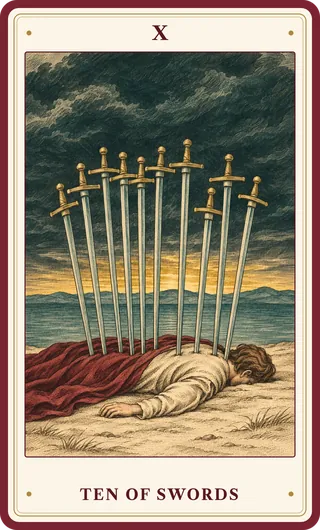
Ten swords
Ten is more than any single wound needs, so the image exaggerates overwhelm on purpose. It shows a mind and a situation that have taken every possible hit, with nothing left to come.
Face-down figure
He lies still on the ground, past the point of resisting. The card shows surrender and finality rather than a struggle still in progress.
Red cloak
A red cloth covers part of his body, a small sign of dignity amid the damage. It suggests that life and feeling have not been entirely lost.
Black sky
The dark sky stands for grief, shock and the heaviest part of the experience. It fills most of the card, which is how the ending feels while you are inside it.
Dawn on the horizon
A band of yellow light rises behind the dark clouds. It is the card's promise that the lowest point has passed and recovery can begin.
Still water
The calm sea behind him shows that the storm is over and nothing more is coming. It points to quiet, relief and the space where healing happens.
Distant mountains
The far hills mark the road ahead, still a long way off but clearly there. They suggest that new ground exists beyond this ending.
Ten of Swords in money
In a money reading, the card usually points to a significant financial loss: a collapse in income, a debt problem, a failed investment or a business that has run out of road. It can also point to a realisation, such as finally seeing how deep a financial hole is. That is painful, but it is also the first step to dealing with it.
The card is not about small dips. It describes the moment when a financial plan has clearly failed and a reset is needed. The most useful reading is practical: face the real numbers, stop putting more into what has failed, and get advice. If you want stability afterwards, the Ace of Pentacles is the kind of card that signals a clean financial start.
Reversed, it shows the recovery stage: paying down what you owe, rebuilding savings, or the first stable month after a crisis. Slow progress is the pattern here, and the card does not promise a quick fix.
Health and wellbeing
For health, the Ten of Swords links most strongly to stress, burnout, sleeplessness and emotional exhaustion, because Swords rule the mind. The ten swords are a picture of a nervous system that has been under strain for too long. It can also reflect back pain or tension, which is one reason the swords sit along the spine, though the card is a symbol and not a diagnosis.
If this card appears in a health question, treat it as a prompt to rest and ask for help, not as a medical statement. Tarot cannot diagnose anything, and if you feel overwhelmed or in distress, speak to a doctor, a therapist or someone you trust. The card’s own advice is the same: stop pushing, accept support, and let the recovery start.
Reversed, it shows physical and mental recovery, with energy coming back gradually. It also warns against rushing back to full speed before you are ready.
Spiritual meaning, astrology and numerology
Spiritually, the Ten of Swords stands for the death of an old belief, identity or way of seeing the world. It is the end of an ego story, the moment when a long-held idea about who you are or how life works falls apart. Many people find that what comes after is lighter and more honest.
Its element is Air, the element of thought, speech and truth. In the Golden Dawn system the card is linked to the Sun in Gemini and carries the traditional title Lord of Ruin. That pairing is useful: ruin of the mind’s constructions, with the Sun still present on the horizon. If you use astrology in your readings, the tarot and astrology page explains these correspondences.
In numerology, ten is the number of completion. It contains the full cycle from one to nine and then resets, since 10 reduces to 1. That is why the card holds both an ending and a restart. You can read more about this pattern in tarot numerology.
Ten of Swords as a yes or no answer
Upright, the Ten of Swords is a no. It represents a closed door, a finished plan or a result that will not go your way in its current form. If your question is whether a relationship, a job or a project will work out, the card suggests it will not continue as it is.
Reversed, the answer softens to a cautious yes, or at least a not-yet that leans towards improvement. The worst is behind you, and recovery is starting. You can look at the dedicated Ten of Swords yes or no page for specific question types, including those about love and timing.
Remember that the card often answers a different question from the one you asked. If you ask whether you will get a job and draw this, it may be telling you to look at whether the current search method is dead. A clear no is a useful answer, because it stops you wasting energy.
Past, present, future and as advice
In the past position, the Ten of Swords shows a major ending that still shapes your current situation, such as a betrayal or a burnout you have not fully processed. In the present, it describes you at the low point right now, and it asks you to stop resisting. In the future position, it warns that a situation will end or collapse, and it asks you to prepare rather than panic.
As advice, the upright card says to call it finished and stop fighting. Do not try to revive what has no life left. Reversed, the advice is to get up slowly, to take it one step at a time, and to avoid going back for another wound.
Used in a spread, the card works well in positions about what must end or what you need to accept. In a Celtic Cross or any tarot card spread, look at where it sits and what is next to it. The card next to the Ten of Swords often shows what grows from the ruin.
Ten of Swords combinations
The cards around the Ten of Swords decide whether the story is one of collapse or recovery. A few useful pairings:
- With The Sun: the ending is over and a bright new phase is arriving. See The Sun for that energy.
- With the Three of Swords: grief and heartbreak, with a clear cause. The Three of Swords shows the wound, and the Ten shows its final form.
- With the Eight of Swords: feeling trapped before the collapse, a sign that the ending could have been avoided by leaving earlier. See the Eight of Swords.
- With the Ace of Swords: a hard truth that finally cuts through confusion and starts a new chapter.
Two Swords cards together tend to intensify the mental side of the story, so be careful about reading too much catastrophe into the pair. Check the rest of the spread for a card of support or change.
What to do when the Ten of Swords appears
When this card comes up, the best response is practical and gentle. Name what has ended. Let yourself feel it without making it worse. Then take one small step towards the next stage.
- Say out loud, or write, what has actually ended, in one sentence.
- Stop actions that keep the wound open, such as checking someone’s social media or rereading old messages.
- Rest properly, even if it feels unproductive.
- Talk to one person who will listen without trying to fix things.
- Pick one small, concrete step for tomorrow.
The Ten of Swords is not a sentence, it is a turning point. It shows that you have reached the bottom, and that every direction from here is up. If you want to practise with it, draw a card for the day with the random tarot card generator and write down how the lesson of the Ten shows up in your own week.
Try this: Take a sheet of paper and draw ten short lines. Name one thing you have survived on each line. Then circle the one you are proudest of, and add the date next to it.
Wait, I must output only the markdown file.
Questions readers ask
What does the 10 of Swords mean in tarot?
The 10 of Swords means a painful, final ending: betrayal, defeat, burnout or rock bottom. It also says the worst has already happened, and the sunrise in the image points to recovery.
Is the 10 of Swords a bad card?
It is a hard card, but not a bad omen in the sense of doom. It shows pain that has already landed and a situation that is finished, which often brings relief and a fresh start.
Does the 10 of Swords mean death?
No. It almost never predicts literal death. It describes the end of a relationship, job, belief or way of life, and the drama of the image is exaggerated to show how overwhelming it feels.
Is the 10 of Swords a yes or no card?
Upright, it is a no, because it shows an ending or a closed door. Reversed, it leans towards a cautious yes, since recovery has begun.
What does the 10 of Swords mean in love?
Upright, it points to a breakup, a betrayal or a relationship that has clearly run its course. Reversed, it shows healing after heartbreak or a refusal to let a finished relationship go.
What does the 10 of Swords reversed mean?
Reversed, it usually means recovery: the worst has passed and you are getting back up. It can also warn that you are resisting an ending and prolonging the pain.