
The Hanged Man Tarot Card Meaning (Upright & Reversed)

- Arcana
- Major Arcana, card 12
- Element
- Water, Neptune
- Yes or no
- Maybe
pausesurrendernew perspectiveletting go
stallingresistanceindecision
The Hanged Man tarot card means pause, surrender and a new perspective. It is card 12 of the Major Arcana, and it shows a figure hanging calmly upside down from a living tree. Upright, it asks you to stop forcing progress, let go of control and look at your situation from the opposite side. Reversed, it points to stalling, needless sacrifice, or finally getting free.
Most people feel a small groan when this card appears, because nobody enjoys being told to wait. But the image is gentler than it looks. The figure is not struggling, and a halo glows around the head. This guide explains what the card means in every area of a reading, how to tell a useful pause from a stuck one, and what to do when it turns up.
The Hanged Man upright meaning
Upright, the Hanged Man describes a pause that changes how you see things. Something is on hold, and your instinct may be to push harder, but the card says the answer will not come from effort. It will come from stillness and a different viewpoint. The key word is surrender, and it means putting down the fight with the situation, not giving up on your goals.
Keywords for the upright card:
- Pause and suspension
- Surrender and letting go
- A new perspective
- Willing sacrifice for a greater gain
- Patience and trust
The card also carries a trade. You give up something (time, control, a familiar way of doing things) and you receive understanding. That is why it sits among the cards of initiation: you are changed by the waiting. If you have been asking “why is nothing moving?”, the Hanged Man replies that movement is not the point right now.
What the card shows
In the Rider-Waite-Smith deck, a man hangs by one ankle from a wooden beam, head down, with his other leg bent behind the first to form a rough figure four. His hands are tucked behind his back. He wears a blue top and red leggings, and the background is plain and pale. What strikes most readers first is his face: it is relaxed, even content, with light around the head.
That light changes the meaning of everything else. A trapped or tortured figure would not glow. The rope is real, but the stillness looks like a decision. Pamela Colman Smith drew him as someone who has accepted the position because the position is teaching him something.
The tree is also not a gallows. It is a living T-shaped frame, and in many readings it stands for the idea that sacrifice and growth belong together. Notice what is missing too: there is no crowd, no landscape and no deadline. The card strips away outside pressure so the only thing left to do is look.
Where the Hanged Man comes from
The card has a darker history than its modern reading. In early Italian decks it was often called the Traitor, and it showed a man hanging by the foot. In medieval Italy, traitors and debtors were sometimes painted upside down on public walls as a form of shaming, which is where the old image comes from. In the Tarot de Marseille it is Le Pendu, “the hanged one”, and the figure is usually more plain than haloed.
The modern meaning took shape in the early twentieth century, when Arthur Edward Waite and Pamela Colman Smith turned the image toward voluntary sacrifice and spiritual insight. Many readers link it to the Norse god Odin, who hung from the world tree for nine nights to gain knowledge of the runes. Others connect it to the idea of the sacrificed god or to the practice of inversion in meditation. You do not need any of this to read the card, but it explains why the figure looks serene: the tradition behind it is about gaining something by giving something up.
Read The Hanged Man for your question
Upright: A relationship is in a pause, and waiting or seeing your partner from a new angle will serve you better than pushing for answers.
Reversed: You are waiting for someone to change, or giving up your own needs for so long that the sacrifice has stopped helping anyone.
Upright: They are uncertain and thinking hard about you, taking time rather than acting on impulse.
Reversed: They feel stuck or frustrated, unwilling to commit, or tired of waiting for you to move.
Upright: A project, promotion or decision is on hold, and the pause is a good moment to rethink your direction.
Reversed: Stalled work, wasted time, or staying in a role out of fear when you already know it is over.
Upright: Hold off on big financial moves until you can see the whole picture from a fresh angle.
Reversed: Indecision is costing you, or you are making sacrifices for money that are no longer paying off.
Upright: Stop forcing the outcome, let go of control, and look at the problem from the opposite side.
Reversed: The pause has done its work, so name what you are avoiding and release the rope.
Upright: Real rest is the medicine: slow down, stop pushing through, and let your body and mind recalibrate.
Reversed: Ignoring the need to rest, or putting everyone else first until you are depleted.
The Hanged Man reversed meaning
Reversed, the pause has turned into a problem. The Hanged Man reversed often shows someone who is stalling, resisting an obvious change, or sacrificing without any return. The upright card asks you to wait with purpose. The reversed card asks whether you are still hanging there after the useful insight has already arrived.
Two situations come up most often. In the first, you know you should stop and rethink, but you keep pushing and refusing to let go, which only prolongs the stress. In the second, you are being held up by other people or circumstances, and the delay feels imposed rather than chosen. A third reading is the martyr: giving and giving because it has become part of your identity, not because it helps.
There is good news in the reversal too. If you have already been waiting for a long time, the reversed Hanged Man can signal that the pause is ending and you can move on with a new angle and fresh energy. For a fuller breakdown, see The Hanged Man reversed. If you are new to upside-down cards in general, how to read reversed tarot cards explains the different ways to approach them.
Try this: Ask yourself one question: “Is this waiting still teaching me something?” If you can name what you have learned in the last week, the pause is upright and working. If you cannot, treat it as stalling and pick one small action for tomorrow.
The Hanged Man in love
In a love reading, the upright Hanged Man usually describes a waiting period that is more productive than it feels. A relationship may be on hold, a decision may be unresolved, or you may be seeing a partner from an unfamiliar angle for the first time. The advice is to stop pressing for a definition and let the situation show itself. If you are single, it can mean taking a break from dating to rethink what you want.
The card also asks you to look at your own habits. Are you giving up something real for the relationship, and is it chosen? Willing compromise is part of the Hanged Man. Resentful compromise is not.
Reversed in love, it points to a stalemate. One of you may be avoiding a decision, or you may be waiting for a person to change who has shown no sign of it. It can also describe a relationship where one person does all the sacrificing. The kind answer is to name the stall, because a pause with no end date is a decision made by default.
The Hanged Man as feelings
When you ask what someone feels about you, the Hanged Man describes a person who is undecided and thinking carefully. They have not lost interest, but they are not ready to act. Often it means they are unsure of what they want, are working through something else first, or are looking at the situation from every side before committing.
Reversed, the same person may feel stuck. They could be unwilling to commit, frustrated with the delay, or holding back out of fear. If you want the full picture across several situations, read The Hanged Man as feelings.
One caution: this card describes a state of mind, not a promise. A person who is “thinking about it” may or may not arrive at yes. Pair it with a clarifying card, and use the Hanged Man as a signal to give them space instead of pushing.
The Hanged Man in career
In work questions, the upright Hanged Man appears when a situation needs patience, not action. A promotion may be delayed, a project may be paused, or you may be in a stretch where nothing you do speeds things along. It can also describe a sabbatical, a career break, or a decision to step back and rethink where you are heading.
Use the pause well. This is a good time to study the problem from another side: what would your manager, client or competitor see? What would you do if the goal were different? Many people find that the stuck project is solved by changing the question, not by working longer hours.
Reversed, the card shows wasted time and stalled work. You might be staying in a job out of fear, taking on unpaid effort for someone who will never reward it, or avoiding a choice you have already made privately. The reversal says the sacrifice has outlived its value.
The Hanged Man in money
With money, the Hanged Man advises waiting. It is rarely the card of a quick purchase, a sudden investment or a rushed negotiation. Upright, it suggests holding off until you can see the whole picture, and it supports a deliberate decision to give up a short-term gain for a longer-term one, such as saving instead of spending.
It can also show a financial situation that is out of your hands for now, such as a payment that is delayed or a deal that is waiting on someone else. Use the time to review your numbers and consider a different approach. Compare this with the active building energy of the Ace of Pentacles, which is about a fresh start rather than a pause.
Reversed, the card points to indecision that is costing you. It may be a choice you keep postponing, or a sacrifice, such as an unpaid role or a loan to a friend, that is no longer worth it.
Health and spirituality
For health, the Hanged Man is a card of real rest. Not the guilty kind of rest taken while checking messages, but a full stop that lets the body and mind recalibrate. If you have been pushing through exhaustion, it is a strong nudge to slow down. It can also describe recovery that takes longer than you want, where patience is the treatment.
Reversed, it can point to ignoring the need for rest, or giving so much to others that you are depleted. Tarot cannot diagnose anything, so treat it as a prompt to listen to your body and talk to a professional about real concerns.
Spiritually, this is one of the most meditative cards in the deck. It speaks of surrender, inversion and seeing from the other side. Many readers use it as a symbol for stopping the usual chatter and letting insight arrive without effort.
Try this: Sit for five minutes with the card in front of you and no phone. Then lie on your back with your head hanging slightly off a pillow edge or simply close your eyes and imagine the world flipped. Write down one thing you see differently.
The Hanged Man card symbols
Choose a symbol to read what it means on the card.
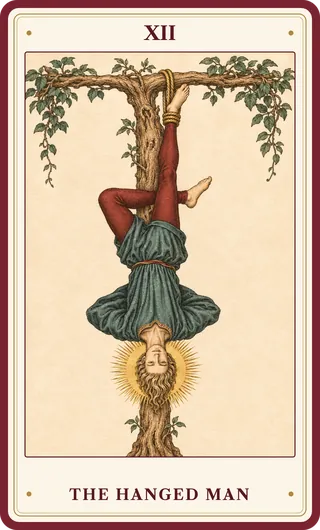
Upside-down figure
Hanging head down turns the usual view of the world over. It stands for a changed perspective and a willing break from normal habits.
Calm face and halo
The expression is peaceful, not pained, and light glows around the head. This shows that the suspension is chosen and that it brings insight.
Living tree (T-shaped cross)
The wood is alive and shaped like a Tau cross, not a gallows. It points to growth, sacrifice with a purpose, and a link between earth and spirit.
Single bound ankle
One foot is tied while the other leg crosses behind it. The figure is held in place, yet the stillness reads as consent, not punishment.
Hands behind the back
The arms form a downward triangle behind the figure. This suggests giving up control and turning attention inward.
Red leggings and blue top
Red often reflects passion and the body, while blue reflects intellect and calm. Their reversed arrangement hints at a mind and body being rearranged by the pause.
Plain pale background
There is no scenery, no crowd and no clock. The card removes outside pressure so that the only thing left is the new view.
Is the Hanged Man a yes or no?
Usually the Hanged Man is a maybe, or more precisely “not yet”. It does not say the answer is no. It says the answer is not ready, and that rushing will not make it come sooner. Upright, the yes tends to arrive after you have waited and thought it through. Reversed, it leans toward no until you stop stalling and decide.
That makes it a poor card for questions that need a fast, clean answer, and a good card for questions about timing and readiness. If you ask “should I do this now?”, it replies “wait”. For the full breakdown, including how it reads in different question types, see The Hanged Man as a yes or no answer.
How long does the pause last? The card gives no fixed time. In practice it often marks the period between a decision point and its resolution, so look to the surrounding cards. A Wands card of movement nearby suggests the wait is short, while a heavy Swords card suggests it will feel longer.
The Hanged Man as a person
When the Hanged Man describes a person, it is someone with an unusual capacity for patience and self-possession. They are often thoughtful, a little unconventional, and comfortable seeing things from an angle most people miss. They may be someone who has deliberately stepped back from a normal path.
The flip side is a person who seems to be waiting forever. They can be indecisive, passive, or attached to being the one who makes sacrifices. Reversed, the portrait sharpens: a martyr, a procrastinator, or someone who resists change while insisting they are being patient.
If you are the Hanged Man in a situation, the question is always the same. Is the stillness giving you something, or is it just easier than moving?
The Hanged Man compared with similar cards
Several cards also involve pause or withdrawal, and they are easy to confuse. The difference is almost always about choice and purpose.
- The Hermit withdraws to seek wisdom and keeps walking with a lantern. The Hanged Man is still and gains insight by letting go of control.
- The Four of Swords is rest and recovery, usually after strain. The Hanged Man is suspension, a pause in the middle of a question.
- Death is a definite ending that clears the way. The Hanged Man comes just before it in the sequence and is the waiting that comes before the change.
Another useful comparison is the Two of Swords, where the stillness comes from refusing to look at something. The Hanged Man’s stillness is open-eyed, and he sees more, not less.
Card combinations with the Hanged Man
The Hanged Man changes depending on the cards next to it. A few pairings come up often:
- With Justice or Judgement: a pause before a ruling or a decision that cannot be rushed.
- With the Eight of Cups: you may be waiting while knowing you need to walk away.
- With the Wheel of Fortune: events are outside your control and the pause is part of a larger turning.
- With the Seven of Swords or Four of Cups: stagnation and avoidance, so the reversed reading becomes more likely.
- With the Ace of Wands: a sudden spark that ends the wait.
As a general rule, an active card after the Hanged Man shows what happens once the pause is over, and a stuck card before it shows what the pause was avoiding. In a past, present, future layout, the Hanged Man in the middle position is a very clear picture of a person in transition. A simple 3 card tarot spread is the easiest place to see this.
Astrology and numerology
The Hanged Man is traditionally linked to the element of water, and many modern readers also connect it to Neptune. Both fit the card’s themes of surrender, dissolving boundaries, intuition and spiritual insight. Some systems link it to Pisces, which carries the same mood of letting go and trusting what cannot be controlled.
In numerology the card is 12, which reduces to 3 (1 plus 2). Three is the number of creation and expression, which adds a quiet note: this pause is creative, not empty. The number 12 also suggests completion of a cycle, so the Hanged Man can mark the end of one way of doing things before a new one begins.
Within the Major Arcana, it follows Justice (XI), where you weigh the facts, and comes before Death (XIII), where something finishes. That placement is useful: after you have judged what is true, you may need to wait and see differently before the change arrives.
What to do when the Hanged Man appears
The card does not ask for nothing. It asks for a particular kind of effort, and the steps are simple:
- Name what is on hold, in one sentence.
- Ask whether the pause was chosen or imposed, and be honest.
- Write down how someone on the other side of the situation would describe it.
- Decide what you are willing to give up, and what you are not.
- Set a date to review, so the pause has an end point.
That last step matters most. A pause with a review date stays upright, and a pause without one drifts toward the reversed meaning. If you are drawing the card for a daily reading, it can simply mean “do not force today”, and the right response is to take things at a slower pace.
Finally, resist the urge to read it as a verdict on your worth. The Hanged Man is not a punishment, a failure or a sign that you are doing something wrong. It is a sign that you are in the middle of something, and that your view is about to change.
Try this: Pick one situation where you have been pushing hard. For three days, take no new action on it. Each evening, write one new way of seeing it. On day four, decide whether you now want to act or keep waiting.
Frequently confused points
A few misunderstandings come up often. The Hanged Man is not a death card and does not predict harm. The figure is not being punished, and the card does not mean you are a victim. It is also not always about waiting: sometimes the “sacrifice” is the main message, and the question is what you are giving up and why.
It is also worth saying that the card is not a reason to do nothing indefinitely. If the Hanged Man keeps appearing across several readings on the same question, the likely message is that you have not yet accepted the pause, or that you have stayed in it too long. Either way, the first step is the same: be honest about which of the two you are in.
For a wider view of how this card fits with the rest of the deck, browse the full list of tarot card meanings.
Questions readers ask
What does the Hanged Man mean in tarot?
The Hanged Man means a pause, willing surrender and a new perspective. Progress stops for a reason, and the stillness shows you something you could not see while rushing. It is card 12 of the Major Arcana.
Is the Hanged Man a bad card?
No. It is uncomfortable because it asks you to wait, but the figure on the card is calm and haloed, not punished. It becomes a warning only when the pause turns into stalling, which is how it reads reversed.
What does the Hanged Man mean in love?
Upright, it describes a relationship on hold, a period of reflection, or a need to see things from your partner's side. Reversed, it points to a stalemate, waiting for someone to change, or sacrificing your needs for too long.
Is the Hanged Man a yes or no card?
Usually it is a maybe, or more exactly a "not yet". Upright, the answer depends on waiting and rethinking first. Reversed, it leans toward no until you stop stalling.
What does the Hanged Man mean as feelings?
It suggests someone who is undecided and giving the matter careful thought, not someone who has lost interest. Reversed, the person may feel stuck, unwilling to commit, or impatient with the delay.
What is the difference between the Hanged Man and the Hermit?
The Hermit walks away on purpose to seek wisdom and keeps moving with a lantern. The Hanged Man is still, suspended, and gains insight by giving up control and being turned around, not by searching.