
Death Card Tarot Meaning: Upright, Reversed, Love and More

- Arcana
- Major Arcana, card 13
- Element
- Water, Scorpio
- Yes or no
- No
endingstransformationtransitionrelease
resisting changestagnationfear of endings
The Death card in tarot means an ending that makes change possible. It is card XIII of the Major Arcana, and it almost never refers to physical death. Upright, it says a chapter has finished and asks you to let it go. Reversed, it points to resistance, a delayed ending or a transformation happening out of sight.
The card looks frightening, which is why people flinch when it turns up. But its message is closer to a changing season than a warning: something has run its course, and the space it leaves is where the next thing grows. This guide covers the upright and reversed meanings, love, career, money and health, the symbols in the Rider-Waite-Smith image, and how to tell Death apart from the cards it is most often confused with.
The Death card at a glance
Death is numbered 13 in the Major Arcana. In the Golden Dawn system that shaped most modern decks, it is linked to Scorpio and the element of water. That pairing suits it: Scorpio is the sign of depth, endings and renewal, and water is the element of emotion and passage.
- Upright keywords: endings, transformation, transition, closure, letting go, rebirth
- Reversed keywords: resistance, stagnation, delayed endings, fear of change, private transformation
- Number: XIII (13)
- Element and sign: Water, Scorpio
- Reads as: a necessary and natural ending, not a punishment
You can see where Death sits among the other trumps on the tarot card meanings list. It follows the pause of the Hanged Man and comes before the balancing act of Temperance, and that order matters when you read it in a spread.
Death upright meaning
When Death appears upright, a chapter is closing. A job, a relationship, a belief or an old version of yourself has reached its natural end. The card asks you to stop propping it up and let it finish properly.
What separates Death from more chaotic cards is its pace. It is not a shock. The figure on the horse moves steadily and everyone in the image sees it coming. Often you already know what is ending, and the card simply confirms it and gives you permission.
Upright Death also asks you to treat the ending as real. Grief belongs here. Trying to jump straight to the bright side skips the part where you honor what is gone, and that usually makes the transition last longer. The renewal in this card is genuine, but it comes after the ending, not instead of it.
Symbols in the Rider-Waite-Smith Death card
Pamela Colman Smith’s image is full of detail, and most of it points toward renewal. A skeleton in black armor rides a white horse and carries a black flag with a white rose. A bishop in a tall fish-mouth mitre raises his hands, a king lies fallen under the horse, a maiden turns away and a child offers flowers.
The figures are the key. Death meets each of them in a different way: the king is overcome, the bishop pleads, the maiden looks away and the child faces it calmly. Your own reaction to an ending probably matches one of them, and noticing which one is a useful way into a reading.
Behind it all, a sun rises between two towers over a quiet river. That is the promise hidden in the card. The ground is dark in front, but the horizon is lit. If you only remember one detail, make it the sun.
Try this: Look at the card and ask which figure you most resemble right now: the king, the bishop, the maiden or the child. Write one sentence about what that figure is doing, and what it would look like to respond like the child.
Read Death for your question
Upright: A phase of the relationship is ending and something more honest is ready to replace it, whether together or apart.
Reversed: You are clinging to a dynamic that is already over, or the same breakup and reunion keeps repeating.
Upright: They feel that something between you has run its course and they are ready, or getting ready, to let it change.
Reversed: They are afraid of the change they know is coming and are stalling rather than saying it.
Upright: A role, project or professional identity is finishing, and a different direction is opening behind it.
Reversed: You know the job or path no longer fits but you are staying put, and the stagnation is starting to show.
Upright: An old money habit, debt or source of income is closing, and a new system takes its place.
Reversed: You keep repeating a financial pattern you already know is not working.
Upright: Let it end cleanly, grieve what needs grieving, and stop trying to revive what is finished.
Reversed: Name what you are resisting and take one small step toward releasing it.
Upright: An old routine or habit has run its course and a fresh approach is ready (never a medical prediction).
Reversed: Resistance to changing a habit is keeping you stuck, so a small and steady shift is worth trying.
Does the Death card mean physical death?
Almost never. The reading tradition has mostly moved on from the old fortune-telling idea that Death predicts a literal death. Waite’s 1911 list does open with end and mortality, but modern readers treat the card as symbolic: a threshold, not a forecast.
There are good reasons to hold that line. Tarot does not predict the timing of anyone’s life or death, and answering a question like “will my relative die?” with a card is unreliable and can cause real harm. If someone is anxious about this, the honest answer is that this card is about change, and no card is a medical or mortality prediction.
If a reading comes during a real bereavement, Death can be a gentle mirror rather than a prophecy. It can reflect the sense that a life has changed shape. Even then it is describing the experience of loss and transition, not announcing it.
Death reversed meaning
Reversed, Death usually shows resistance. The ending is on its way, or already here, and you are holding it off. That can look like staying in a job you have outgrown, keeping in touch with someone you have already left, or refusing to admit that a plan has finished.
It can also describe a quieter situation: a big internal change that nobody around you can see yet. In that case the reversal does not mean you are stuck. It means the work is happening beneath the surface and has not yet arrived in your daily life.
The practical question is which of those two you are in. If you feel tired and trapped, it is probably resistance. If you feel unsettled but also curious, it may be private transformation. For a fuller breakdown, see Death reversed in love, work and life, and for the general method, how to read reversed tarot cards.
Death in love and relationships
In a love reading, Death usually means a phase of the relationship is ending or transforming. That can be a breakup, but it is just as often the end of a pattern: long distance, an undefined stage, a recurring argument or a way of relating that the two of you have outgrown.
For a couple, the useful question is what needs to change for the connection to feel honest. Death does not tell you to leave, and it is better read as a prompt for a real conversation than as a verdict. Sometimes the old version of the relationship ends and a stronger one begins.
For singles, Death asks you to release an old attachment. It does not promise that someone new appears right away. It says you are reclaiming emotional space, and that this has to come first.
Reversed in love, Death can point to a relationship kept in limbo, on-and-off cycles, or unresolved grief shaping a current bond. If the same breakup keeps repeating, the card is often asking what has never been properly finished.
What Death means as someone’s feelings
When Death describes how a person feels about you, it suggests that they sense something between you has reached an end point. They may be in the middle of a major change in how they see the relationship, or in their own life, and that change affects you.
This is not necessarily rejection. It can mean they are letting go of an old idea of you, a past hurt or a version of the relationship that was not working. What matters is the surrounding cards and the person’s actions.
Reversed, Death as feelings often shows fear. They know the relationship needs to change or end and are avoiding saying so. For more on reading the card this way, see Death in love and as feelings.
Death in career and work
At work, Death often marks the end of a role, project, contract or professional identity. It can show up as a resignation, a redundancy, a restructure or a quiet realization that you have outgrown the work. The card asks one clean question: what work have you already finished?
It is also a strong card for career changes. If you have been circling the idea of switching fields, Death says the old path has run its course and a new one is available. It does not mean you must quit tomorrow, but it does suggest that staying where you are is no longer neutral.
Reversed, Death at work shows hesitation about a change you already know is coming. The risk is stagnation: staying in a job past its useful life because the alternative feels uncertain. A small, concrete step such as updating your CV or having one exploratory conversation is usually better than waiting for certainty.
Death in money and finances
Financially, Death rarely signals a windfall or a disaster. It points to a change in the system: an old habit, debt, subscription or source of income closing, and a different way of handling money starting.
That can feel uncomfortable at first. It might be a loss, such as an income stream ending, or a relief, such as a debt finally cleared. Either way, Death asks you to look at what you do with money once it is in your hands, not just how much you have.
Reversed, it can describe a pattern you keep repeating even though you know it is not working: overspending, avoiding the numbers or holding on to a plan that no longer fits your circumstances. A fresh budget or a reset of your priorities is a typical response.
Death card symbols
Choose a symbol to read what it means on the card.
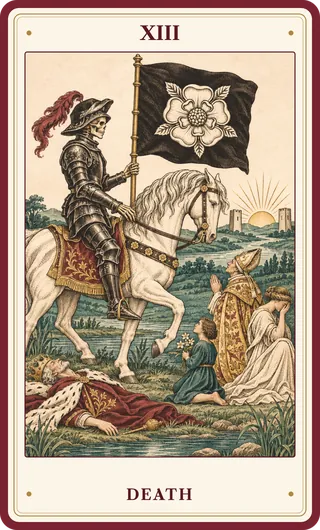
Skeleton in black armor
Death is shown fully armored and unstoppable, which says that endings are not personal and cannot be bargained with. The armor also suggests that this is a force, not a villain.
White horse
White usually stands for purity and clarity, so the horse carries the ending forward with calm rather than cruelty. It moves at a steady pace, which is why Death feels inevitable rather than sudden.
Black flag with a white rose
The rose is a symbol of beauty and life, and it sits on the black banner of death. Together they say that renewal is carried inside the ending itself.
Bishop in a fish-mouth mitre
The religious figure stands with hands raised and pleads, yet he must yield like everyone else. Faith can help you face an ending, but it does not exempt you from it.
Fallen king, maiden and child
The king lies beneath the horse while the maiden turns away and the child offers flowers. Rank, beauty and innocence all meet the same threshold, and each responds in a different way.
Rising sun between two towers
On the horizon the sun rises (or sets) between two towers, a quiet promise that the ending is a passage. It is the part of the card people most often miss.
River and boat
The water behind the figures points to crossing over from one state to another. It echoes the card's link to Scorpio and the element of water.
Death in health and spirituality
For health, Death is about habits and routines, not diagnosis. It can mark the end of an old approach to your wellbeing and the start of a new one: giving something up, changing a pattern or recovering from a difficult phase. It is not a prediction of illness or recovery.
Please do not use a tarot card to judge whether a health concern is serious. If something is worrying you, speak to a qualified professional. Tarot can help you reflect on how you feel about a situation, but it cannot answer medical questions.
Spiritually, Death is one of the most meaningful cards in the deck. It speaks to dissolving old beliefs, shedding an identity and being reborn into a truer one. Reversed, it can point to a spiritual transition brought on by loss, often a slow one.
Is Death a yes or no card?
Death is usually a no to things staying the same and a yes to change. That makes it more of an answer about direction than a plain yes or no. If you ask whether a situation will continue as it is, expect a no. If you ask whether something is going to end or transform, the answer leans yes.
Reversed, the answer shifts toward delay: the change is coming, but resistance is slowing it down. Whatever the question, the card is often answering a different one, which is that something needs to finish.
For a detailed breakdown by question type, see Death as a yes or no answer.
Death as a person
When Death represents a person, it usually describes someone going through a major transformation, or someone who brings endings and change into your life. They might be at a turning point, leaving a role or a relationship, or reinventing themselves.
It does not describe a menacing or dangerous person. If anything, it describes someone who is not afraid of endings and who may seem intense, deep or quietly unmovable. The Scorpio association fits here.
Reversed, it can describe someone who resists change, clings to the past or has trouble finishing things. They may be stuck in a cycle that they cannot quite leave.
Death compared with the Tower, the Hanged Man and Judgement
Death is often confused with a few cards that also deal with big change. The differences are in pace and in how much choice you have.
- Death: a natural, steady ending. You usually see it coming, and the focus is on release and renewal.
- The Tower: a sudden shock that breaks something apart. See The Tower for how disruption differs from transition.
- The Hanged Man: a pause before the change, where you wait and see things differently. Read more on The Hanged Man.
- Judgement: a call to rise into a new phase after reflection. Compare it with Judgement.
A useful way to think about it is that the Hanged Man is the pause, Death is the ending and Judgement is the answer to the call that follows. The Tower comes without warning, while Death is more like a tide turning.
How long does Death take to play out?
Death is a process, not a date. It tends to describe a transition measured in weeks or months, not an overnight event, and the card will not tell you exactly when. If you want to explore timing in a reading, tarot timing covers the methods readers use.
One reasonable approach is to ask where you are in the process. Is the ending still approaching, happening now or already behind you? The surrounding cards often make that clear. A card from the Hanged Man’s side of the deck suggests it is still coming, and a card like Temperance suggests the ending has already passed.
Because Death is tied to Scorpio, some readers connect it to the autumn period when that sign is active. That is a tradition rather than a rule, and it is only worth using if it feels meaningful to you.
Death in combination with other cards
Death takes its flavor from the cards around it. With The Lovers, it can suggest a relationship choice or the end of one bond to make way for another. With the Star, it suggests healing and hope after a loss. With the Sun, it points to an ending that brings relief and clarity.
With the Tower, you are looking at a major upheaval where the ending is forced rather than chosen. With the Ten of Swords, the combination describes a painful finish that is also final, which means the worst has passed and recovery can begin. With the Eight of Cups, it is a deliberate walking away.
When two or more cards agree, the message gets stronger. When they point in different directions, trust the one that fits your question most closely. The Celtic Cross is a good spread for seeing how Death sits in the middle of a larger story.
What to do when Death shows up in your reading
Death is a call to action, but the action is usually small. You do not need to burn down your life. You do need to be honest about what has ended.
- Name what is finishing, in one sentence, without softening it.
- Decide what you need to grieve or acknowledge before moving on.
- Choose one concrete step that releases it: a conversation, a resignation, a clear-out or a boundary.
- Notice what space the ending opens, and leave some of it empty for now.
If you drew the card reversed, ask what the resistance is protecting. Fear, loyalty and habit are common answers, and each one can be addressed once you know which it is.
Try this: Write down something you suspect has already ended in your life. Then write one thing you will stop doing this week because of it. Keep it small enough that you can actually do it.
If you want to see how the card shows up for you, pull another one with the random tarot card generator and ask what comes after the ending.
Questions readers ask
Does the Death card mean someone will die?
Almost never. In a reading, Death stands for an ending, a transition or the closing of a chapter. Tarot is not a tool for predicting physical death, and a thoughtful reader will not use it that way.
Is the Death card good or bad?
It is neither. Death is a neutral card about necessary change, and it can feel painful or like a relief depending on how much you were holding on. Most readers see it as a healthy sign that something stuck is finally moving.
What does Death mean in a love reading?
It usually means a phase of the relationship is ending or transforming, not automatically the relationship itself. For singles, it points to releasing an old attachment so that you can love again from a clearer place.
What does the Death card reversed mean?
Reversed, Death points to resistance, a delayed ending or change happening privately before it shows. It often means you are clinging to something that has already finished.
Is Death a yes or no card?
Death is usually a no to things staying the same and a yes to change. If your question is about holding on to the status quo, expect a no; if it is about moving on, the answer leans yes.
Why is the Death card number 13?
Death is the thirteenth card of the Major Arcana, numbered XIII. The number 13 comes straight after the completion of 12, so it reads as the start of a new cycle rather than a symbol of bad luck.