
Death as a Yes or No Answer

- Arcana
- Major Arcana, card 13
- Element
- Water, Scorpio
- Yes or no
- No
endingstransformationtransitionrelease
resisting changestagnationfear of endings
Death is a yes in a yes or no reading, but it is a yes that comes with a price: something has to end first. Upright, it says yes to change, to closing a chapter and to a new beginning. Reversed, it leans to no or “not yet,” because you are resisting a change that is already moving.
That makes Death one of the more honest cards in the deck. It does not flatter your hopes and it does not deliver doom. It tells you that the situation will not stay as it is, and that your answer depends on whether you are willing to let the old version go.
The short answer: Death is a yes with a condition
If you ask a question about change, growth, a fresh start or leaving something behind, Death answers yes. The ending you are asking about is already part of the picture. The card does not predict a pleasant or easy road, only that the road leads somewhere new.
If you ask a question that depends on things staying the same, Death answers no. Will my job stay secure exactly as it is? Will this routine keep working? Will we go on as we have been? Death rarely backs those hopes, because it is the card of what cannot be preserved.
So the practical rule is to read Death as “yes, and something must end first.” The more your question welcomes change, the clearer the yes. The more it asks for stability, the more the card leans no.
Why Death is a yes and not a no
Death is card thirteen in the Major Arcana, and its image is heavy: a skeleton on a white horse, a fallen king, a praying bishop. It is easy to see why some people take it as a warning and call the answer no. But the card’s actual meaning is transformation, and transformation is a forward movement. Nothing in the picture shows loss that stays lost, since the sun is rising in the background.
In a yes or no reading, you are asking whether something will happen or whether you should go ahead. Death answers that the old situation is finished and the next one is coming. That is a movement, and movement is a yes. You can read the full background on the Death card meaning page, including its place in the Major Arcana and its link to Scorpio.
The yes is not a promise that you will get the outcome you want. It is a yes that the change will occur. If the question names a specific result, ask yourself whether that result is something that arrives through an ending. A new job comes through leaving the old one. A new relationship often comes through closing the last one. In those cases the yes is strong.
Death upright as a yes or no answer
Upright Death is a yes to transformation, to endings and to renewal. It is strongest when you have already sensed that something is over and you are asking permission to move on. Should I leave? Is it time to start again? Is this phase done? The card says yes to all of these.
It is also a yes with a warning attached: you cannot keep one foot in the old life. Death asks for a full release. If your question is “Can I do both, keep the old and add the new?” the card answers no. The rider does not negotiate, as the bishop in the image discovers.
A good way to hold the upright answer is as “yes, after the ending.” Success is possible, but the change comes first, and the card asks you to cooperate with it.
Try this: Before you draw, write your yes or no question in one line. After you draw Death, underline the word in your question that describes what is staying the same. That is the thing the card is asking you to let go of.
Read Death for your question
Upright: Yes, if the question is about growth or a fresh start, because this relationship or pattern is changing whether you resist it or not.
Reversed: No or not yet, because one or both of you is clinging to something that has already run its course.
Upright: They feel that something between you has already shifted and they are ready, or being forced, to let the old version go.
Reversed: They feel stuck and afraid of change, so feelings may be present but go unspoken and unresolved.
Upright: Yes to a change of role, field or direction, but not to staying exactly as you are.
Reversed: No for now, since you are holding onto a job or plan that needs to end before anything better can arrive.
Upright: Yes to restructuring, closing an account or dropping an old strategy, with the payoff coming after the clear-out.
Reversed: No, because you are protecting a failing arrangement out of fear and delaying the reset you need.
Upright: Say yes to the ending, finish it cleanly and make room for what follows.
Reversed: Stop postponing the decision, name what you are afraid to lose and look at it honestly.
Upright: Yes to changing a habit or routine that no longer serves you; this is almost never a literal warning.
Reversed: No progress until you stop resisting the change, so ask for support rather than waiting it out.
Death reversed as a yes or no answer
Reversed, Death leans to no, or to “not yet.” The change has been identified but is being held back by fear, habit or denial. Nothing is wrong with the situation itself. The block is the refusal to let something end.
This is not a permanent no. The reversed card is describing a standoff between you and a change that is already in motion. Once you stop fighting it, the answer tends to flip. That is why the reversed meaning is better read as a delay than as a final refusal. The Death reversed page goes deeper into stagnation, avoidance and the fear of the unknown.
If you are not sure how to treat an upside-down card in a quick-answer reading, the guide to reversed tarot cards explains the options, including whether to read reversals at all. Keep your approach consistent: if you decide reversals count, then reversed Death counts as a no or not yet every time.
Why some readers call Death a no
You will see sources that give Death a flat no, and others that call it a yes. The disagreement comes from method rather than from the card. Some decks and systems assign each card a fixed yes or no based on how it feels: gentle, sunny cards are yes, and cards with dark imagery are no. Death looks grim, so it gets a no.
The meaning-based method works differently. It asks what the card is actually saying about the situation, and Death is saying that a change is coming and is necessary. That reads as yes to the change. This is the approach used here, and it is why Death is a conditional yes rather than a rejection.
If you use a fixed system with a deck of your own, stay consistent with it. The best yes or no practice is one where you decide in advance how you read each card and then stick to it, so the answers mean something over time. A quick way to try this is the yes or no tarot reading tool on this site.
Death yes or no in love
For love questions about growth or fresh starts, Death says yes. Should we move forward? Should I finally leave a relationship that has been over for months? Will I meet someone new? Each of these involves an ending, and Death backs the change.
For questions that depend on a relationship continuing unchanged, Death is more difficult. Will he stay? Will things go back to how they were? The card often answers that the old form of the relationship is over, even if a new form is possible. That might be a breakup, or it might be a deep reset between two people who stay together.
Reversed in love, Death warns of holding on after the end, or of staying in something out of fear of being alone. If you want to know what the card says about another person’s heart, see Death in love and as feelings, which covers what it means when someone is going through an ending themselves.
Death yes or no in career
In a career reading, Death is a yes to leaving, changing direction, being restructured or starting over in a new field. It is a good card to see when you are asking about quitting a draining job, closing a failing project or retraining. The ending is not a failure here, it is the necessary first step.
It is a no when your question is about staying put. Will my role stay the same? Will this company keep going the way it has? Death rarely supports that, and it can hint at a layoff, a merger or a change in your own priorities.
Reversed, Death at work means you know the job or plan is finished and you are putting off the decision. Ask what you are protecting. Often it is the comfort of a paycheque or the image of who you thought you would be.
Death yes or no in money
For money questions, Death is a yes to clearing out. Closing an account, dropping a bad investment, cancelling subscriptions, restructuring debt or ending a financial habit all fit. The yes is not about a windfall. It is about the reset that makes better finances possible.
If you ask whether a specific amount will arrive, or whether a specific investment will pay off, read Death as a sign that the current arrangement will change, not as a prediction of profit. The result may be good, but it comes after an ending.
Reversed, Death in money matters points to holding on to a plan that is not working. Perhaps you keep pouring money into something out of pride, or avoid looking at a budget because you fear what it will show. The no here is really a prompt to face the numbers.
Death card symbols
Choose a symbol to read what it means on the card.
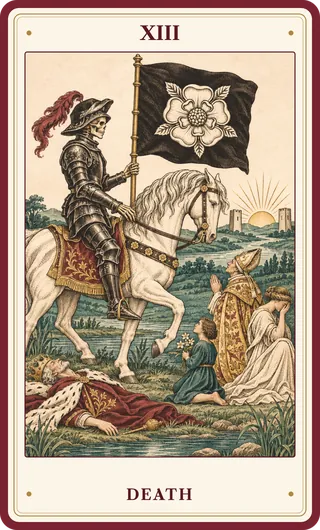
Skeleton in black armour
The rider is death itself, wearing armour because nothing stops it. It treats everyone the same, which is why the card is about change that cannot be bargained with.
White horse
White stands for purity and for a steady, unhurried pace. The ending is not chaos, it is moving forward in a straight line.
Black flag with white rose
The five-petaled rose is a symbol of beauty and life carried on a banner of death. It says that renewal is built into the ending.
Fallen king
The king lies beneath the horse, showing that rank and power do not protect anyone from change. What you hold with authority can still end.
Praying bishop
The bishop faces death and asks for mercy, but it does not come. This is the human urge to bargain with something that is already decided.
Child and maiden
The child gazes at death with curiosity while the maiden turns away. They show the two ways people meet an ending: with openness or with denial.
Rising sun between two towers
The sun rises in the distance between two towers, which suggests a threshold. Whatever ends here opens onto a new day.
When Death gives a surprising answer
Death often seems to answer a different question from the one you asked. You ask whether you will get the promotion and it shows up, and that feels like nothing. But the card is answering something deeper: that the situation you are in is about to change shape.
Take it seriously as a reframe. When Death answers your yes or no question with a yes, it is usually pointing at the ending you have been circling. When it answers with a no, it may be telling you that what you want to preserve cannot be preserved. In both cases, the card is more useful as a signal than as a verdict.
It helps to compare Death with a similar-looking card. The Tower as a yes or no is a sudden, forced upheaval, while Death is a slower and more natural ending that you can choose to meet with grace. Both are about change, but Death gives you more room to cooperate.
Does Death mean literal death?
Almost never. This is the most common fear, and the answer is calming: Death is the card of transformation, not of mortality. Readers who work with the card for years rarely meet a literal death in it, and it would take very strong supporting cards and a question that directly asks about it.
When someone asks a yes or no question about health and draws Death, it usually points to a change in routine, treatment, lifestyle or outlook. It may suggest that an old habit needs to end. It is never a diagnosis and it should not replace medical advice.
If a reading about someone’s health leaves you frightened, put the cards down and speak to a doctor or someone you trust. Tarot is a tool for reflection, and no card can tell you what a medical professional can.
Timing: how soon does Death’s answer arrive?
Death is a threshold card. It usually describes a change that has already started, so the answer tends to show up in the next few weeks to a few months rather than years. The ending may be visible before the new beginning is.
If your question includes a time frame, Death suggests that the sequence is more important than the date. First the ending, then the clearing, then the next stage. Rushing it does not help, and neither does delaying it. For more on reading time in a spread, see tarot timing.
A useful habit is to note the date of the reading and check back after a month. You will often find that Death’s change had already begun when you drew the card.
Confirming the answer with a follow-up card
One card is enough for a clean yes or no. If Death leaves you unsure, you can draw a single clarifying card and ask a specific question: what needs to end, or what comes after? That is a better use of a second card than asking for a different verdict.
A 3 card tarot layout also works well with Death. Use the cards for what is ending, what is changing, and what is beginning. The result usually reads more clearly than a lone yes or no, and it gives the card’s message a shape you can act on.
Here are three simple ways to add context:
- Draw one card for “what must I let go of?”
- Draw one card for “what comes next?”
- Look at whether the clarifying card is upright or reversed and read it the same way you read Death
Try this: Draw Death alone, then draw one more card and ask, “What is the first ending I should make?” Write the answer in a single sentence and do that one thing this week.
How to ask a better yes or no question for Death
Death works best with questions about change. “Should I leave this job?” gets a clear answer. “Will I be happy?” does not. Questions about outcomes you cannot control also lead to muddy readings, so shape the question around a decision you can make or a change you are facing.
Avoid questions that already assume the answer. “Will he come back, since I know he loves me?” gives the card no room to speak. Keep it simple and open: “Is it time to end this?” or “Should I begin something new?”
If you want ideas, the list of questions for tarot reading has examples that suit one-card answers. A good question is specific, personal and about a choice rather than a fixed outcome.
Common mistakes when reading Death for yes or no
The biggest mistake is reading Death as bad news and answering no on reflex. That ignores what the card actually says. The second is reading it as a plain yes and forgetting that the answer comes with a cost. If you hear only “yes” and skip the ending, you miss the point.
Another mistake is drawing again and again until you get a more comfortable card. If you do that, the first draw was the real answer, and the rest is a way of avoiding it. Accept the first card, then use a single clarifying draw if you need one.
A final mistake is using the card to decide for you. Death gives you a direction, not a command. If it says yes to ending something, you still have to weigh the reality of your own life.
A quick reference for Death yes or no
If you want something to keep on hand, here is how the card reads at a glance:
- Death upright: yes to change, endings and new beginnings, after something is released
- Death reversed: no or not yet, because you are resisting a change already underway
- Questions about staying the same: leans no, even upright
- Questions about starting over or leaving: strong yes
Once you know this, the card becomes less frightening and more practical. Death is not the end of your question. It is the answer that tells you what comes first.
Try this: Pull Death from your deck, or use the random tarot card generator to draw a card, and write down one ending you already know is coming. Notice whether you feel relief or dread. That feeling tells you which way your own yes or no is leaning.
Questions readers ask
Is Death a yes or no card in tarot?
Death is a yes with a condition. It says yes to change, endings and a new chapter, but not to keeping things exactly as they are. When your question is about staying the same, it leans to no.
Is Death reversed a yes or no?
Death reversed is usually a no or a not yet. It points to resisting a change that is already underway, so the answer improves once you accept what has to end.
Does the Death card mean someone will die?
Almost never. Death is the card of endings and transformation, and literal death is a very rare reading that would need strong support from the surrounding cards and your question.
Does Death mean a relationship will end?
It can mean the current form of a relationship is ending, which may be a breakup or may be a deep reset that the two of you survive. Check the neighbouring cards to tell the difference.
How soon will the Death card's answer happen?
Death usually describes a change that has already begun, so the answer tends to unfold within weeks to a few months. It is a threshold card, not a slow-burn one.
Should I pull another card if I get Death for a yes or no question?
A single clarifying card is fine, especially to ask what needs to end or what comes next. Pulling card after card until you get a yes only muddies the answer.