
The Tower Yes or No: What This Card Answers

- Arcana
- Major Arcana, card 16
- Element
- Fire, Mars
- Yes or no
- No
sudden changeupheavalrevelationawakening
avoiding disasterdelayed changefear of change
The Tower is a no in a yes or no reading. Upright, it gives a firm no to the plan as it stands, because something in the question is built on weak ground and is about to give way. Reversed, it softens to not yet: the upheaval is delayed, avoided or already behind you, and a yes depends on repairs you have not made.
That sounds harsh, but The Tower is one of the most useful cards you can draw for a direct question. It does not leave you guessing. It points at the part of your plan that cannot carry the weight and says so plainly. This guide covers how to read it upright and reversed, how it answers love, work, money and health questions, and what to do with a no that actually feels like relief.
Why The Tower is a no
In the Rider-Waite-Smith image, a tall tower on a mountain peak is hit by lightning, its crown is blown off and two figures fall from the windows. Nothing in that picture says “go ahead.” A yes in tarot usually means things are lined up, supported and ready to grow. The Tower shows the opposite: a structure that looked fine from the outside, and is suddenly shown not to be.
When you ask a yes or no question, you are really asking whether a situation will continue in a certain direction. The Tower says it will not continue as it is. That is why it counts as a no even when the eventual outcome is better. The answer is about the plan in front of you, not about whether good things can happen to you later. For the full picture of the card beyond yes and no, see the Tower tarot card meaning.
The Tower also speaks about speed. Most no cards suggest slow blocks or delays. The Tower implies something sudden, a revelation or event that you did not schedule. A useful way to hold it is that the answer is no, and the reason may arrive faster than you expect.
The Tower upright as a yes or no
Upright, treat The Tower as a clear no, and a strong one. It is not the gentle no of a card that says wait and see. It tells you that the thing you are asking about will not work out as imagined, or will be interrupted by a change you cannot control.
The no usually comes with a reason built in. There is a hidden problem, an assumption you have not tested, a lie someone has told (possibly yourself), or a foundation that was never finished. The question to ask next is not “Why is the card against me?” but “What am I leaning on that cannot hold?” Often you already half know.
Upright Tower also covers questions where the honest answer is that something will end. “Will this arrangement last?” gets a no. “Is a big change coming?” gets a yes, and a loud one. Read the verb in your question carefully, because The Tower answers yes to disruption and no to stability.
The Tower reversed as a yes or no
Reversed, The Tower is less final. Most readers settle on not yet, a conditional answer that lies between yes and no. The collapse may be postponed, softened or already over, or you may be holding up a structure that should come down. The Tower reversed page goes deeper into each of these readings.
The practical reading depends on your question. If you ask “Will I lose this job?” a reversed Tower can mean you narrowly escape, or that you will survive it. If you ask “Is this plan ready?” it means no, not until the weak point is dealt with. Some people read a reversed Tower as a plain yes because the worst is over. I would be careful with that. The crack in the wall is usually still there, and a yes only holds if you rebuild deliberately.
If you are unsure how a flipped card changes a reading in general, reading reversed tarot cards explains the main approaches. For yes or no work, pick one method before you draw and stay with it. If you do not read reversals at all, treat every Tower as upright.
Try this: Write your question, then add one sentence beginning “The part I am most avoiding looking at is…” Draw one card. If it is The Tower, read the sentence aloud and decide whether it is the crack the card is pointing at.
Read The Tower for your question
Upright: A relationship built on a false picture is about to come apart, so the answer to 'will this work as it is' is no.
Reversed: The crisis is being delayed or already survived, and a yes only comes if both people stop avoiding the real problem.
Upright: Shock, panic and a sense that the floor has gone, often with a truth you can no longer ignore.
Reversed: Dread of a change you can feel coming, or the shaky relief of having got through it.
Upright: A job, plan or company is not stable enough to carry your hopes, so expect sudden change or a no to the current route.
Reversed: A layoff, failure or reorganisation is postponed or softened, which gives you time to prepare properly.
Upright: A financial plan has a hidden weakness, so the answer is no until the foundations are rebuilt.
Reversed: A money shock is avoided or already behind you, but the underlying problem still needs fixing.
Upright: Stop defending what is already falling and decide what you want to rebuild.
Reversed: Do the hard repair now, before events force it on you.
Upright: A sudden jolt or wake-up call about stress, habits or burnout, best met with rest and proper advice rather than panic.
Reversed: A scare passes or a warning sign has been ignored, so use the breathing room to get things checked.
When a no from The Tower is good news
Many questions are really about wanting something to stop. “Will I finally leave this job?” or “Will this situation come to a head?” are questions where yes means change. The Tower answers these with a confident yes, because it is the card of breakthrough as much as breakdown.
A no can also be protective. If The Tower appears when you ask whether you should sign, invest or commit, the card is warning you before you build more on weak ground. Many people say a Tower came before something fell apart, and they were glad of the warning later. A no that stops you putting more energy into a flawed plan is a form of help.
It helps to separate the answer from the feeling. The Tower may feel awful and still be accurate. A shock is not proof that the card is wrong, and relief is not proof that it is right. Judge the answer by whether it names something real.
The Tower yes or no in love
For most love questions, The Tower means no to the relationship continuing in its present form. Something hidden is about to surface, such as dishonesty, a mismatch of needs, an ignored problem or a fantasy that cannot survive contact with reality. For a new connection, it can mean the spark is real but the foundation is not, or that the situation will be disrupted quickly.
Questions where The Tower gives a different answer:
- “Will we break up?” Yes, or the relationship will change beyond recognition.
- “Are they hiding something?” Yes, and it is likely to surface.
- “Will this relationship stay the same?” No.
- “Is this relationship going to be tested?” Yes, hard.
Reversed, the story shifts to a crisis that is avoided, delayed or already past. The answer for a rebuild is then a conditional yes, but only if both people stop propping up the old version. To understand the emotional side of the card beyond yes or no, read The Tower as feelings.
Reconciliation and “will they come back”
If you ask whether an ex will return and you draw The Tower, the answer is no to a return as things were. The Tower does not rebuild the same tower. If there is a reconciliation at all, it comes after a real reckoning, and it produces something that looks different from the first relationship.
This is also a card of timing. Reversed, it can mean the breakup has already done its damage and the worst is over, so you are not waiting for another blow. That is not the same as a yes. It means the question may be less useful than “What do I want to build now?”
If you are asking because you want to send a message, the card suggests you check whether you are reaching out to restore the old structure. If you are, expect the same cracks. Pair The Tower with a clarifying card about what each person would need to change, and let that guide your decision, not hope.
The Tower yes or no for career and money
For work questions, The Tower means no to stability and yes to sudden change. A job, project or business that looks solid may be disrupted by a layoff, restructure, scandal or collapse of a client. If you ask “Is this the right job?” and draw The Tower, the card suggests the role is built on something unstable, or that leaving is likely to happen faster than planned.
The money answer is similar. “Will this investment pay off?” is a no, or at least a strong warning that the underlying assumption is weak. “Is my financial situation about to change?” is a yes. The Tower is a bad sign for speculative leaps and a good prompt for a frank review of debts, contracts and anything you have not read closely.
Reversed, a career or money Tower often means a narrow escape, a delay or a reorganisation you survive. Use that window. A reversed Tower in finance is the card that tells you to repair the budget while there is still time. If your question is about starting something fresh, compare it with an upward card such as the Ace of Pentacles, which signals a stable seed rather than a shaky structure.
Try this: Take the money or work question you asked and list the three assumptions it depends on. Cross out any you cannot prove. That is where The Tower is pointing.
Health, moving and big decisions
The Tower is not a medical prediction and should never replace professional advice. In a health question it usually points to stress, burnout or a habit that has reached its limit, a wake-up call that asks you to act. If a health worry is genuine, see a qualified professional regardless of what any card says.
For questions about moving house, changing country or making a major life decision, The Tower says no to doing it the way you planned. It does not mean the move is wrong. It means the plan has a weakness, possibly the timing, the finances or the reason behind it. Look for the weak point before you commit.
For legal questions, exams and anything where you are waiting on an outcome, treat The Tower as a warning to prepare for an unexpected twist. It does not mean disaster. It means do not rely on the situation going exactly as you expect.
The Tower card symbols
Choose a symbol to read what it means on the card.
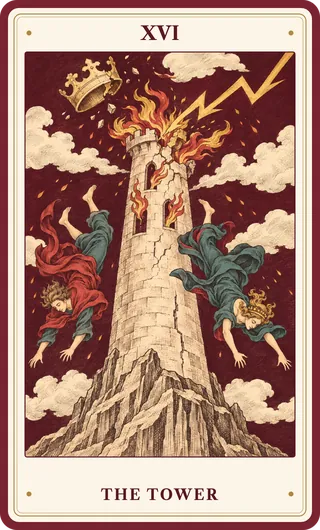
Lightning bolt
A sudden strike from above, the moment truth breaks in without permission. It shows change that cannot be negotiated or scheduled.
Crown knocked from the tower
The crown stands for ego, status and the belief that you are in control. Losing it shows that a position built on pride or illusion cannot last.
Two falling figures
Two people tumble headfirst from the building, leaving everything they thought was safe. They show the shock of being forced out of a story you were committed to.
Flames in the windows
Fire pours from the windows, burning away what was kept inside. It represents purification as well as loss.
Tall tower on a rocky peak
The tower is built high on a narrow crag, tall but poorly supported. It stands for a structure that looks impressive and rests on very little.
Falling flames (yods)
Small flame shapes drift through the air, often counted as 22, matching the 22 major arcana cards. They suggest that the breakdown is part of a larger pattern and carries energy for what follows.
Dark night sky
The black background shows that this happens when you are not looking and not ready. It also makes the lightning stand out as the one source of light.
How to phrase your question so The Tower helps
The Tower works best when your question has a clear subject. “Should I take the job?” can be answered by a card. “What will happen in my life?” cannot. Because the card describes stability, ask questions that test stability: “Will this plan hold?” “Is this relationship on solid ground?” “Is this business ready to launch?”
Avoid questions that hide two answers. “Will I be happy and secure if I move?” asks two things at once, and The Tower may be answering only one of them. Split it up and draw separately. For ideas on well-formed questions, see questions for tarot reading.
It also helps to decide in advance what a no would mean. If you cannot imagine acting on a no, you are not ready to ask the question. Draw only when you are willing to hear the answer.
Reading The Tower in a multi-card yes or no spread
Many readers use three cards for a yes or no. They count upright cards as yes and reversed cards as no, or they sort the cards by whether each is generally positive or negative. In a method like that, The Tower counts as a strong no, and it usually carries the most weight in the spread.
A simple method for a three-card draw:
- Draw three cards and mark each as yes, no or maybe.
- Count the totals, giving The Tower extra weight because it is so blunt.
- Read the other cards as the reason or the way through, not as a vote.
For a tool that does the drawing and sorting for you, the yes or no tarot reading page is a quick way to try this. If you want a layout with more detail, a 3 card tarot spread of past, present and future shows what led to the shaky ground and what comes after it.
Cards that soften or confirm The Tower
A Tower rarely arrives without context, and its neighbours change how heavy the no feels. When The Tower lands next to The Star, the collapse leads to healing and hope. The Star as a yes or no card is the clearest yes in the major arcana, so the pair reads as no to the old way and yes to what grows afterward.
With Death, The Tower confirms an ending. The Death yes or no answer is also a firm no to continuation, so together they say the current form is over. Pair it with a card of rest like the Four of Swords and the message is to stop, recover and plan. Pair it with the Ten of Swords and you have an ending that has already happened, so the question becomes how to rise again.
In a long spread, check what sits beside The Tower for cause and for result. The card before it often shows what was ignored. The card after it shows how you respond. If the next card is calm and grounded, you can handle this. If it is a card of denial, expect more pressure.
Reading The Tower without panic
The Tower looks frightening, and many people draw it and brace for catastrophe. A card is not a forecast of literal disaster. It describes a pattern: an unstable structure meeting a force strong enough to move it. In most readings that means a conversation, a decision, a loss of a plan or a revelation, not an emergency.
The best response is to move your attention from the fall to the foundation. Ask what you built this on, who you built it with and what you still believe about it that you have never tested. People who respond to The Tower by reinforcing the old structure usually find it falls again. People who respond by clearing space and rebuilding honestly tend to come out better off.
If the card leaves you shaky, ground yourself first. Sleep, eat, talk to someone you trust, and avoid making large decisions in the first hour after a hard draw. The Tower is quick, but your reply does not need to be.
Follow-up questions after drawing The Tower
One extra card can turn a blunt no into something you can use, as long as you do not use it to argue with the first answer. Ask for more information, not a second opinion.
Good follow-up questions:
- What is the weak point in this plan?
- What do I need to let go of?
- What can I safely rebuild?
- What will help me through this?
Draw one card for each, and read them as advice. If the follow-up is The Tower again, the message is that you have not yet acknowledged the problem. Close the spread, write down what you think is unstable, and come back after you have acted on it.
Try this: After a Tower draw, sit for five minutes and write down one thing you already suspected was not working. Then write the smallest step you could take today to test it.
The short version
Upright, The Tower is a no: the plan is unstable and change is coming quickly. Reversed, it means not yet: the crisis is delayed or past, and any yes needs repairs first. It answers yes to endings and breakthroughs, and no to anything that depends on staying the same.
Use it as information. A direct no from The Tower saves time, protects effort and points at the one thing that needs your attention. If you want to know more about how the card works across a whole reading, start with the Tower tarot card meaning page and take what helps from there.
Questions readers ask
Is The Tower a yes or no card?
The Tower is a no card. Upright it gives a firm no, because the thing you are asking about is unstable or about to change suddenly. Reversed it softens to not yet, meaning the collapse is delayed or already past.
Does The Tower reversed mean yes?
Not automatically. Reversed, The Tower often reads as not yet or a narrow escape, so a yes is possible only if you repair the weak point first. Treat it as a conditional answer, not a green light.
Is The Tower a bad omen in a yes or no reading?
No. The Tower is a blunt answer, not a curse. It tells you the current plan will not hold, which can save you from building further on a weak base.
What does The Tower mean for a yes or no love question?
For most love questions it means no, at least in the current form. Something false, hidden or unsustainable is about to be exposed, and the relationship may end or have to change completely.
Can The Tower mean yes if I want something to end?
Yes. If your question is 'Will this toxic situation finally break?' then The Tower answers yes. The card says yes to collapse and no to continuation.
Should I pull another card after The Tower?
You can pull one clarifying card to ask what is unstable, or what to rebuild. Avoid redrawing the same question hoping for a different answer, because that only waters down a clear message.