
The Tower in Love & as Feelings

- Arcana
- Major Arcana, card 16
- Element
- Fire, Mars
- Yes or no
- No
sudden changeupheavalrevelationawakening
avoiding disasterdelayed changefear of change
The Tower as feelings means someone is shaken. They are in shock, overwhelmed or hit by a sudden truth, and the way they saw you or the connection has been knocked loose. It is not a card of hatred or coldness. It is a card of impact, and it describes a person who has not yet worked out what to do with what just landed.
That makes it one of the harder feelings cards to read, because the emotion is real but its direction is open. The shock could come from attraction, from fear, from a betrayal or from a confession. This guide explains what Tower feelings look like from a crush, a partner and an ex, how upright and reversed differ, how to tell the Tower from similar cards, and what to do once you have drawn it.
How the Tower feels when it describes someone’s emotions
Most feelings cards describe a steady emotion. The Tower describes an event inside a person. Something has broken through, and the emotion is the reaction: a jolt, a rush, a sense that the ground has moved. If you asked how someone feels about you and drew this card, the honest reading is that they are not calm about you.
The feeling usually has two layers. On top is the intensity, which can show up as nervous energy, anger, tears, silence or a burst of honesty. Underneath is a loss, even when the change is a good one. The person is giving up a tidier version of things, such as the idea that you were just a friend, that the relationship was fine or that they had everything under control.
The Tower is also a fire card, traditionally linked to Mars. That gives it speed and force. Tower feelings rarely build slowly, and they are rarely quiet. They arrive all at once, and the person often needs time to catch up with their own reaction.
Why the card’s picture explains the feeling
The Rider-Waite-Smith image is the best guide to the emotion. A tall tower on a narrow crag is hit by lightning, the crown flies off the top, flames burst from the windows and two figures fall. Nothing in the picture is gentle, but nothing in it is aimed at a person either. The structure fails because it was built on weak ground.
Read as feelings, the tower is the story someone has been telling themselves about you or about the relationship. It might be “I am not interested,” “we are only friends,” “this is fine” or “I do not need anyone.” The lightning is whatever finally contradicts that story. The falling figures are the person in free fall, and the dark sky is a reminder that they did not see it coming.
This is why the card describes shock more than rejection. The Tower removes a false structure. What remains underneath may be love, relief, fear or something harder, and the card leaves that open. For the full card in every context, see The Tower tarot card meaning.
The Tower upright as feelings
Upright, the Tower shows feelings that have become impossible to hold back or ignore. A person may be stunned by how much they care, rocked by an argument, or suddenly aware that the relationship is not what they believed. The common thread is a before and after: they were thinking one way, and now they cannot.
In practice, upright Tower feelings often look like this:
- Sudden intensity: a confession, an outburst or a late-night message that comes out of nowhere.
- Disorientation: they seem confused, say contradictory things or cannot explain how they feel.
- Pulling back to cope: they go quiet or keep their distance because they are overwhelmed, not because they are indifferent.
- Relief mixed with grief: they feel freer and sadder at the same time.
The Tower is not automatically negative here. Sometimes the old structure was a cage, and its collapse lets honest feeling out. The card is better described as disruptive than as bad.
Read The Tower for your question
Upright: A sudden truth, confrontation or shake-up forces the relationship to change shape, and a false version of it falls away.
Reversed: A strain that has not broken yet: both people sense the problem but avoid the conversation, or a crisis is narrowly avoided.
Upright: They feel shocked, overwhelmed or exposed, as if a certainty about you or the connection has just been knocked loose.
Reversed: They are shaken but holding it in, gripping a calm surface while strong emotion pushes underneath.
Upright: A sudden change such as a restructure, loss of role or exposed problem breaks an unstable setup and forces a rebuild.
Reversed: You feel a collapse coming and resist it, or you escape the worst of a shake-up but still need to fix the weak foundations.
Upright: A financial shock or a plan built on shaky assumptions comes apart and shows you the real numbers.
Reversed: A money problem is being delayed or hidden, and putting off the reckoning will make it larger.
Upright: Stop propping up what is false, tell the truth, and start rebuilding on something you can trust.
Reversed: Do not keep bracing against change: let the pressure out in small, honest steps before it breaks all at once.
Upright: A sudden jolt such as a scare, burnout or panic demands attention, and your body is asking you to stop and listen.
Reversed: Stress and tension are being pushed down, so rest and support matter before your system forces a stop.
The Tower reversed as feelings
Reversed, the Tower describes the same shake-up with the lid held down. The person feels the ground moving and is gripping hard. They may look composed, change the subject or insist everything is fine while strong emotion strains underneath. This is feeling that wants to come out but has not been allowed to.
It can also describe avoidance of a conversation they know is needed. They sense that being honest would change everything, so they delay, and the delay becomes its own source of tension. You may notice mixed signals: warmth one day, distance the next, with no clear reason. If you want a fuller look at how this position works, read The Tower reversed, and for the general method, how to read reversed tarot cards.
One caution applies. Reversed Tower feelings show that someone is shaken. They do not tell you whether that person will come closer, pull away or say anything. The suppression is the message, and the outcome depends on what happens next.
Try this: Write down what you assumed about this person before you drew the card. Then write one thing that could have broken that assumption for them. Reading the Tower against a specific “false structure” makes the feeling much clearer than a general sense of drama.
Tower feelings from a crush or someone new
When the Tower describes a crush, it usually means you have disrupted their routine in a way they did not plan for. They may have been comfortable not wanting a relationship, or happy keeping you in the friend category, and the attraction has overturned that. The result is excitement tangled with alarm.
From the outside this can look inconsistent. They might be intensely present one week and unreachable the next, or flirt and then retreat. That pattern fits the card, because they are managing a reaction that feels bigger than they expected. It does not mean they dislike you.
If you are not sure the attraction is mutual, the Tower is a mixed answer. It says the feelings have power, but it says nothing about whether they will act. Cards like the Page of Cups or the Ace of Cups nearby would lean it toward a real emotional opening, while swords cards would point toward overthinking and fear.
Tower feelings from a partner
Inside a relationship, the Tower as feelings suggests that something your partner has been containing can no longer stay contained. It might be doubt, resentment, a secret, a fear of commitment or simply a feeling they have not yet put into words. The pressure has built past the point where it can be managed quietly.
This does not mean the relationship is over. A Tower moment can be a hard conversation that finally clears the air, a realization that deepens commitment, or the first honest look at a problem both people were avoiding. It can also be the moment someone admits they are unhappy. What it does mean is that the relationship will not return to its previous form.
Pay attention to the lead-up. Tower feelings rarely appear from nowhere, even when they feel sudden. Small signs such as irritation, withdrawal, changed routines or unexplained tension usually came first. If you can name those, you have a better chance of meeting the moment calmly.
Tower feelings from an ex
For an ex, the Tower often describes the emotional impact of how things ended, or a realization that arrived after the ending. They may be shaken by what the breakup revealed about them, about you or about what they lost. They may also still be living in the aftermath, with the shock not yet settled.
It is tempting to read this as a sign they will return. The Tower alone does not say that. A person can be thoroughly rocked by an ending and still not want to reopen it. The card shows the emotional reaction, not the plan. If you are looking for reconciliation signals, look to cards like the Six of Cups for nostalgia or the Star for renewed openness, and treat the Tower as the shock that preceded them.
If you are the one who drew it for yourself after a breakup, the card may be naming your own state. Feeling stunned, unmoored or unable to think straight is a normal Tower response and tends to ease as the dust settles.
The Tower and the Three of Swords: shock versus grief
These two cards are often confused in feelings readings because both involve pain. They describe different moments. The Tower is the lightning: sudden, loud and disorienting. The Three of Swords is the rain afterward: sorrow, heartbreak and the ache of a wound that has already happened.
A simple way to tell them apart is to ask whether the person is still absorbing the hit or already mourning it. If they seem stunned, defensive, erratic or dramatic, that leans Tower. If they seem sad, tender and clearly hurting, that leans Three of Swords. When both appear together, the shock has been followed by real grief, and the situation has moved from event to aftermath.
The Tower also differs from Death as feelings. Death describes a more gradual, accepted ending and a transformation that is already underway. The Tower is abrupt and unwelcome, and the person did not choose it.
Is the Tower as feelings a good or bad sign?
It is neither, and that is the honest answer. The Tower is a high-intensity card, which makes it uncomfortable, but intensity is not rejection. When someone is overwhelmed by you, the feeling can be a sign you matter a great deal. When someone is overwhelmed by a problem in the relationship, it can be a sign that the truth is finally surfacing.
What the card reliably says is that the situation is unstable and will not stay as it is. Whether that is good depends on what was holding it together. If the old setup was built on pretending, then the collapse is a relief. If the old setup was healthy, the Tower more likely describes an outside shock or a mistake that needs repair.
For a quick, simple answer to a direct question, see the Tower as a yes or no answer. It is usually a hard no to “will things stay the same,” and a more complicated answer to nearly everything else.
The Tower card symbols
Choose a symbol to read what it means on the card.
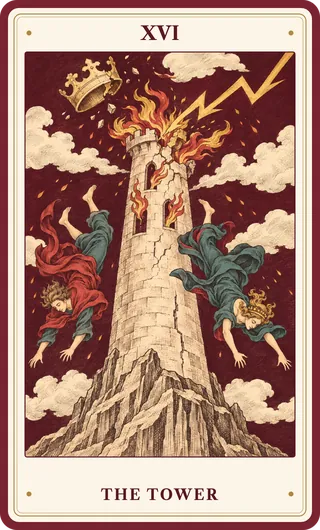
The Tower
A tall structure built on a rocky peak stands for the stories and defences a person builds to feel safe. Because it is built high on a narrow base, it cannot withstand real pressure.
Lightning bolt
The bolt is the moment of truth, arriving without warning and from outside the structure. It does not create the weakness, it only exposes it.
The crown
The golden crown blown off the top shows ego, pride and certainty being knocked loose. In a feelings reading it points to someone's self-image or control being disturbed.
Falling figures
Two people tumble headfirst from the windows, caught mid-fall with no time to prepare. They show shock and loss of control, and also the release of leaving a space that was too confining.
Flames and falling sparks
Fire pours from the windows and drops of flame fall through the air, often counted as 22 to match the Major Arcana. They show pent-up energy and emotion that has finally found a way out.
Dark sky
The black night behind the tower shows how little warning there was. The situation was already in darkness, which is why the truth feels so sudden.
Rocky crag
The narrow mountain top is the shaky foundation the whole structure rests on. It reminds you that what falls is the part that was never well supported.
Does the Tower mean a breakup?
Not by itself. This is the most common misreading, and it comes from the card’s dramatic image. The Tower says a structure falls. In a relationship, that structure could be a comfortable routine, a lie, a power imbalance, an unspoken rule or the relationship itself. Which one depends on the reading.
A breakup becomes more likely when the Tower sits beside cards of ending or separation, such as the Ten of Swords or Death, or when your question is already about whether to stay. A deeper commitment becomes more likely when it sits beside cards like the Lovers or the Ten of Cups. Many Tower moments are neither: a fight, a confession or a hard truth that changes the terms but not the connection.
If you are anxious about this, remember that the Tower does not cause the collapse. It shows that something was already unsound. Seeing it earlier gives you a chance to respond with some care rather than panic.
Cards that change the Tower’s meaning
Neighbouring cards tell you which way the shock leans. Here are some of the most useful combinations for feelings readings:
- Tower and The Star: shock giving way to honest warmth and hope, with the fallen version making room for something real.
- Tower and The Moon: shock turning into confusion and uncertainty, with feelings that are hard to read.
- Tower and Ace of Cups: the upheaval opens space for a completely new emotional beginning.
- Tower and Ten of Swords: a painful ending that feels final and exhausting.
- Tower and Two of Cups: a sudden surge of attraction or connection that turns a situation upside down.
The principle is simple. Read the Tower as the event, then let the next card describe the aftermath. A hopeful card after it suggests recovery or honesty. A cloudy or heavy card suggests the confusion or pain will last longer.
Try this: Draw the Tower and one card beside it, then say aloud: “The shock is the Tower, and the response is ___.” Fill in the blank only from the second card. This stops you from pouring your own fears into the Tower.
When the Tower is your own feelings
Sometimes the Tower describes you. If you drew it for your own emotions, it often means you have been holding something together that is starting to give way. Maybe you have been telling yourself you are fine, that you do not care, or that you can keep going as you are. The card says that story is under strain.
This can feel frightening, but it is also the moment of greatest honesty. Many people draw the Tower right before they admit something they have known for months. The discomfort is real, and so is the relief that tends to follow once the pretending stops.
Be gentle with yourself while it settles. A Tower moment is not the time for major, permanent decisions made in the heat of shock. Let the first wave pass, tell the truth to yourself first, and then decide what to rebuild.
What to do after drawing the Tower
The best response is steady, not dramatic. Because the card describes a jolt, the most useful thing you can bring is calm. Here is a practical sequence:
- Do not act on the shock. Give the situation a day or two before sending messages or making decisions.
- Name the false structure. What assumption, story or pretense is being broken? Write it down plainly.
- Observe behavior, not just feeling. Words said in shock are less reliable than patterns over time.
- Offer honesty and space. If you speak to them, be direct and kind, and leave room for them to catch up.
- Rebuild slowly. Whatever comes next should rest on what is true, not on what you wish were true.
If it helps to see the whole situation rather than one card, a layout such as the relationship tarot spread shows what each person feels, what stands between you and where things may go, giving the Tower context rather than letting it stand alone.
Reading the Tower in different spread positions
Position matters. In a “how do they feel about me” slot, the Tower describes their shock and intensity. In a “what is blocking us” slot, it points to an unstable foundation or a truth that has not been faced. In an outcome slot, it suggests the situation will change in a sudden and decisive way, and other cards should tell you whether that leads to rebuilding or an ending.
In the past position, the Tower describes a rupture that has already happened and still colors the present. In the future position, it is a warning that something unsound is likely to give way, and you may have time to reinforce it or release it more gently. In a 3 card tarot layout, the card sitting after the Tower is especially important, because it shows what grows from the aftermath.
When in doubt, ask what is changing rather than who is to blame. The Tower is rarely about fault. It is about what can no longer hold.
Common mistakes when reading Tower feelings
The first mistake is assuming the Tower means anger or dislike. Plenty of Tower moments come from deep attraction, deep care or a long-hidden truth. The second is treating it as a prediction of disaster. It is a description of disruption, and disruption can lead to a better arrangement than the one that fell.
The third mistake is ignoring the “false structure.” Many readers focus on the lightning and forget what was struck. Asking what was unstable before the shock turns the card from a scare into a diagnosis. The fourth is rushing to fix it. The Tower asks you to see clearly first, then respond.
Finally, do not use one card to decide a relationship. Tower feelings are intense, but intensity changes quickly. Check them against what the person actually does over the following weeks, and treat the card as one signal among several, not a verdict.
A grounded way to hold the Tower
If you remember one thing, make it this: the Tower removes what was not real so that something truer can stand. It is uncomfortable because it takes away comfort, but it is honest because it will not let a shaky story continue. As feelings, it shows a person at the exact moment that honesty arrives.
That person may be you, someone you love, or someone you are trying to understand. In each case, the helpful response is the same: stay calm, look at what is actually true, and build from there. For more cards that cover emotions and attraction, see the Lovers in love and as feelings, which often shows what the Tower makes room for.
Questions readers ask
What does the Tower mean as feelings?
The Tower as feelings means shock, overwhelm or a sudden realization. The person is dealing with something that has shaken their view of you or of the connection, and the old emotional setup no longer holds.
Does the Tower mean they love me?
Not directly. The Tower shows that strong feeling has broken through, but it does not say whether that feeling is love, fear, anger or attraction. Look at the cards around it and at how they behave to learn which it is.
Does the Tower as feelings mean they want to break up?
No, not on its own. It means the relationship cannot continue exactly as it was, which could lead to an ending, a confession, a fight or a deeper commitment. The surrounding cards decide the direction.
What does the Tower reversed mean as feelings?
Reversed, the Tower describes someone who feels the shake-up but is holding it in or putting off dealing with it. They may look calm while struggling inside, or avoid a conversation they know is coming.
What does the Tower mean for a crush?
It usually means the attraction has unsettled them more than they expected. They may be excited and frightened at once, which can look like hot and cold behavior from the outside.
What is the difference between the Tower and the Three of Swords as feelings?
The Tower is the shock itself: sudden, loud and disorienting. The Three of Swords is the grief that follows, a clean and sorrowful heartbreak after the event has already happened.