
The Moon Tarot Card Meaning: Upright, Reversed, Love, Work and More

- Arcana
- Major Arcana, card 18
- Element
- Water, Pisces
- Yes or no
- No
illusionintuitionuncertaintydreams
clarity returningreleased fearconfusion lifting
The Moon is card XVIII of the Major Arcana, and it stands for illusion, intuition, fear and the unconscious mind. When it appears upright, it tells you that things are not yet clear. You are seeing only part of the situation by dim light, and dreams, worry and projection may be coloring what you think you know.
It is not a doom card, though it can feel unsettling. The Moon asks you to slow down, notice what you feel and wait for more light before you commit to anything big. This guide covers the upright and reversed meanings, the imagery, the card in love, work, money and health, and how to tell fear apart from real intuition.
The Moon at a glance
The Moon is the eighteenth card of the Major Arcana, placed between The Star and The Sun. Its element is water, and its traditional astrological link is Pisces. Its number reduces to 9 (1 + 8), which ties it to endings, inner work and the end of a long stretch of searching.
- Keywords upright: illusion, intuition, dreams, anxiety, uncertainty, the subconscious, hidden things
- Keywords reversed: confusion clearing, released fear, suppressed intuition, truth coming out
- Element and sign: water, Pisces
- Yes or no leaning: unclear, wait
If you only remember one thing, remember this: the Moon gives you light, but it is borrowed light. You can walk by it, but you should walk carefully.
What The Moon means upright
Upright, The Moon describes a time when nothing is quite what it seems. Information is missing, other people may not be telling you everything, and you may not be fully honest with yourself either. The mind fills in blanks, and under stress it fills them with the worst version of events.
This is why the card is so often tied to anxiety, restless nights and vivid dreams. Old fears that you thought were settled can rise again, like the crayfish coming up from the pool. The card does not say those fears are true. It says they are active and worth looking at.
There is a second, gentler side. The Moon is also the card of intuition, imagination and creative sensitivity. It can mean you are picking up on something real before you can explain it. The skill it asks for is separating a quiet inner knowing from a loud anxious story, and the sections below show how to do that.
The imagery of The Moon card
In the Rider-Waite-Smith deck, a large full moon hangs over a landscape at night. Inside the moon is a face in profile, and small drops of light fall from it. Below, a dog and a wolf sit on either side of a path and howl upward. In front of them, a crayfish climbs out of a pool of water.
The path begins at the pool, runs between the two animals and winds off toward a pair of towers and a range of mountains. Everything on the card points toward the same idea: you move from the depths of the unconscious, past the tame and wild parts of yourself, toward a goal you can only just see. The route exists, but you get it one stretch at a time.
The card is also a study in reflected light. The sun is the source of everything bright in the deck, and the moon only returns a pale version of it. That is why the card is linked to perception that is partly right and partly distorted. See the symbols summary above for what each element adds.
Try this: Look at the card for two minutes and name each creature or object aloud. Then ask which one you identify with most today: the dog, the wolf, the crayfish or the path. Your answer usually points to the part of the situation you are most reactive about.
Read The Moon for your question
Upright: Something in the relationship feels unclear, and anxiety or old fears may be filling the gaps, so slow down and ask direct questions before drawing conclusions.
Reversed: Confusion starts to lift and hidden feelings come into the open, though you may still be sorting real concerns from imagined ones.
Upright: Their feelings are mixed, private or not yet understood, even by them, and what they show may not match what they feel.
Reversed: Mixed feelings are settling into something clearer, or a person who was hiding how they felt is finally ready to say it.
Upright: Information is incomplete and office politics or vague communication cloud the picture, so gather facts before you commit.
Reversed: Mixed messages at work clear up, a rumor is exposed for what it was, or you stop talking yourself out of a good opportunity.
Upright: Your finances are not fully visible: avoid speculation, unclear deals and decisions made out of fear until you can see the numbers.
Reversed: Hidden costs or errors come to light and you can finally plan with real figures, though old money anxiety may linger.
Upright: Wait for more light, trust your gut but test it against facts, and do not make major moves while you are afraid.
Reversed: Fear is losing its grip, so act on what you now know, and do not bury the feelings that surfaced.
Upright: Sleep, stress, anxiety and mood deserve attention, and your body may be telling you something your mind keeps explaining away.
Reversed: Anxious patterns ease and rest improves, but check that you are not avoiding something that needs proper care.
The Moon reversed
Reversed, The Moon generally means the fog is lifting. Fears that felt huge begin to shrink, confusing situations start to make sense, and secrets or misunderstandings come out. You may feel real relief as the story you were telling yourself falls apart. For a full breakdown, read The Moon reversed.
There is a darker reading too. A reversed Moon can show someone who is shutting down their intuition, ignoring a gut feeling or refusing to look at something uncomfortable. In that case the anxiety does not go away. It goes underground and shows up as avoidance, numbness or sleeplessness.
How do you tell which version you are dealing with? Look at how the card lands emotionally and at the cards beside it. Relief and clarity suggest the fog is clearing. Tension and a sense of “I do not want to look” suggest suppression. Our guide to reversed tarot cards explains how to approach both readings.
The Moon in love and relationships
In a love reading, The Moon points to uncertainty. Two people may not be fully open with each other, or one person may be reading too much into silence and mixed signals. It can also point to insecurity that was there long before the current relationship and has been triggered again.
For couples, the card is a prompt to talk about what is not being said. Feelings that stay hidden tend to turn into assumptions, and assumptions turn into distance. If you suspect dishonesty, The Moon does not prove it. It tells you to look for patterns over time and to ask clear questions instead of building a case in your head.
For singles, The Moon can mean attraction mixed with fantasy. You may be falling for an idea of someone, or you may be unable to tell whether a connection is real. Give it time and see how the person behaves when the glow wears off.
The Moon as feelings
When The Moon describes what someone feels about you, the answer is usually “they do not fully know yet” or “they are not showing it.” Their emotions may be strong but confused, or guarded for reasons that have little to do with you. They may be working through something private and unable to explain it.
This is not a card of clear devotion or clear rejection. It tends to show mixed signals, hot-and-cold behavior and a fair amount of emotional fog on both sides. Our page on The Moon as feelings goes deeper on reading it for a specific person, including how it changes with different surrounding cards.
If you are the one feeling it, treat the card as a sign to name your feelings in plain words before you try to explain them to anyone else. Writing three honest sentences often clears more than hours of rumination.
The Moon in career and work
At work, The Moon shows a situation with missing information. There may be rumors, unclear expectations, vague promises or a project whose real goal nobody has explained. Decisions made now can look different once more facts come in.
The practical response is to document things, ask for specifics and avoid committing to major changes while the picture is blurry. If you are thinking about leaving a job or accepting an offer, The Moon says to read the details and trust questions that keep nagging at you.
The card also has a creative side. For writers, artists, designers, counselors and anyone whose work relies on imagination or sensitivity, The Moon can be a sign of strong, original ideas. The caution is to keep those ideas grounded with a plan, so they do not stay vague.
The Moon and money
In money readings, The Moon warns against making decisions in the dark. That can mean unclear contracts, investments you do not understand, a deal that sounds too good to be true or finances you have been avoiding looking at. Anything with hidden terms deserves a second look.
It can also describe emotional spending and financial anxiety. If worry about money has you checking and rechecking accounts or avoiding them completely, the card is asking you to bring real numbers into the picture. A clear budget is an excellent antidote to a foggy mind.
The advice is simple: postpone big financial commitments, get independent advice if you need it, and do not let fear or excitement push you into a quick move. Light usually arrives within a few weeks, and the same decision will still be there.
The Moon and health
The Moon is closely linked with the mind, sleep and mood. In a health reading, it can point to anxiety, stress, restless nights, vivid or disturbing dreams, or emotional patterns that deserve attention. It can also show that you are sensitive to cycles, including hormonal ones and seasonal changes in mood and energy.
It may also suggest that your body is telling you something your mind keeps explaining away. Trusting that instinct means getting it checked, not trying to diagnose yourself from a card. Tarot is a reflective tool, and it does not replace medical or mental health care.
If The Moon shows up repeatedly when you ask about wellbeing, look at your sleep, your screen time at night and how much emotional load you are carrying alone. Small changes there often help more than any big intervention.
Try this: Keep a notebook by your bed for one week. As soon as you wake, write down any dream fragments, feelings or worries, even if they seem silly. At the end of the week, circle the themes that repeat.
The Moon as a yes or no answer
As a yes or no answer, The Moon leans toward “not yet” or “unclear.” It does not say no in a hard way. It says you lack enough information, or your emotional state is too distorted to judge well. If the question is about a decision, wait.
There are exceptions. If you are asking whether to trust your gut about something, The Moon can mean your instinct is picking something up and deserves a hearing. And if you are asking whether a secret will come out, the card suggests it is rising closer to the surface.
For a quick answer with more detail, see The Moon as a yes or no answer. It also helps to pull a clarifying card after The Moon and ask what information you are missing.
The Moon card symbols
Choose a symbol to read what it means on the card.
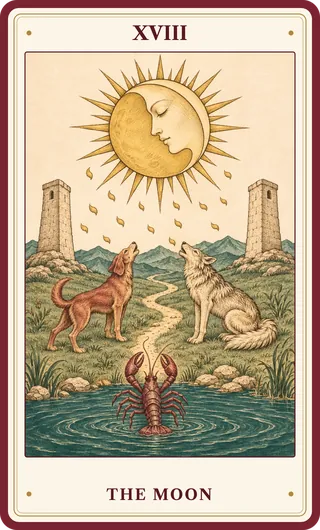
The full moon
The moon is a source of light, but it is only reflected light, so what you see is real yet incomplete. It stands for intuition, dreams and the unconscious mind.
The dog and the wolf
They howl at the moon from either side of the path, one tame and one wild. Together they show the civilized and instinctive parts of you reacting to the same unease.
The crayfish
It crawls out of the pool at the bottom of the card, from the deepest and oldest layer of the mind. It shows buried feelings and primitive fears beginning to surface.
The pool of water
The water is the unconscious from which everything on the card rises. It is where dreams, memory and half-formed instincts live.
The two towers
They stand in the distance on either side of the path like a gateway. They mark a threshold you must cross while you are still uncertain.
The winding path
The road leads from the pool, between the animals, toward the mountains. It says the way forward exists but it is only visible a short stretch at a time.
The falling drops
Small drops fall from the moon toward the earth like dew. They suggest that intuition and insight reach us in small pieces rather than all at once.
What to do when The Moon appears
The Moon is a card about conditions, and the best response is a change in how you proceed rather than a particular action. The simplest approach is to slow down and gather real information before you decide.
- Name the fear or doubt in one sentence, without justifying it.
- Separate what you know from what you are guessing.
- Ask one direct question to the person or source that can answer it.
- Delay any major decision until you have replies, or until a few good nights of sleep have passed.
- Notice what stays consistent in your gut feeling after you have done all of the above.
That last step matters most. Fear tends to shift and escalate with every retelling, while real intuition is usually quieter, steadier and calmer in tone. When the same quiet signal remains after the facts are in, that is the part worth trusting.
Fear versus intuition
The Moon sits right on the line between anxiety and insight, and the two feel similar at first. Both come as a gut response. Both can arrive without a clear reason. Telling them apart is the real skill the card teaches.
Fear is usually loud, urgent and repetitive. It tells stories about what could go wrong and demands that you act quickly to make the feeling stop. Intuition tends to be quiet and neutral. It arrives as a simple sense of “this is off” or “this is right,” and it does not need you to rush.
A useful test is to ask whether the feeling is about something happening now or a movie your mind is playing about the future. If you can point to a specific observation, such as a changed tone, a missing detail or a pattern you have seen before, you are probably dealing with intuition. If you cannot, treat the feeling as information about your stress level first.
The Moon and astrology
The Moon card is traditionally linked to Pisces, the last sign of the zodiac. Pisces is a mutable water sign known for empathy, imagination, dreams and a tendency to absorb the moods around it. This fits the card well, since both deal with fluid boundaries, intuition and the pull of the unseen.
Because it carries the name of the actual moon, many readers also use the lunar cycle with the card. A new moon is a good time to set intentions and begin quietly, while a full moon is a good time to notice what has come to light and what you are ready to release. If you like to work this way, our overview of tarot and astrology correspondences shows how the sign and planet links fit across the deck.
Some modern decks and readers also connect the card with Neptune, the planet associated with Pisces, which rules illusion, dreams and the dissolving of boundaries. The imagery is the same either way: a world where edges blur.
Where The Moon sits in the Major Arcana
The Moon comes right after The Star and just before The Sun. The Star is a card of hope and healing after the upheaval of The Tower. Then The Moon arrives and tests that hope against the fears that remain, and the story ends in the clarity of The Sun.
Seen this way, The Moon is the last dark stretch before daylight. It is the time of doubt that often follows a moment of renewed faith, when old anxieties rise to see if the healing was real. Getting through it means staying with the unease without being ruled by it.
The Moon also has a kinship with The High Priestess, another card of intuition and hidden knowledge. The difference is tone. The High Priestess sits calmly at the threshold of the unconscious and keeps her secrets, while The Moon is out on the road, unsure of the way, with the whole thing still in motion.
Cards that pair with The Moon
Surrounding cards show whether the fog is likely to clear or deepen. A few pairings are especially useful to know, though context always matters more than any formula.
- The Moon and The Sun: clarity follows confusion, and fears turn out to be smaller than they looked.
- The Moon and the Seven of Swords or Eight of Swords: secrecy, self-deception or feeling trapped in your own thoughts.
- The Moon and The High Priestess: strong intuition, dreams and messages worth writing down.
- The Moon and the Nine of Swords: anxiety and sleepless nights are the central issue.
If you want to explore combinations in more detail, the tarot card combination calculator can help you see how two cards interact.
Common mistakes when reading The Moon
The first mistake is reading it only as deception. Yes, the card can mean someone is hiding something, but it far more often points to confusion, uncertainty and the reader’s own projections. Jumping to accusations based on a single card is likely to make a foggy situation worse.
The second mistake is treating it as purely negative. The Moon is also the card of imagination, creative sensitivity and psychic awareness. Many people draw it during periods of deep intuitive or artistic growth, and a reading that only talks about fear misses half the card.
The third is expecting a neat answer. The Moon does not provide one, and that is the point. A good reading of this card ends with an action that suits uncertainty: wait, observe, ask, rest and check. If you want a framework for reading any card with this kind of nuance, start with our guide on how to read tarot.
Try this: Draw The Moon on a piece of paper and write “What I know” on one side and “What I am guessing” on the other. List at least three items on each. Circle one item from the guess side that you can check this week.
When The Moon appears again and again
If The Moon keeps turning up across several readings, treat it as a persistent message instead of a coincidence. Usually it means a part of you is processing something that has not yet been put into words. Dreams, unexplained moods and recurring thoughts are all useful clues.
Ask a more specific question each time. Instead of “What is happening with this person?”, ask “What am I afraid of in this situation?” or “What am I not seeing?” Specific questions give the card something concrete to answer.
It also helps to slow down your reading practice. Pull one card a day for a week, note when The Moon returns and what was happening each time. Patterns tend to show up quickly, and they often point to the exact area of life that needs attention.
Questions readers ask
What does The Moon mean in a tarot reading?
The Moon means illusion, intuition, fear and the unconscious. It shows a situation where you do not have the full picture, so feelings and imagination fill the gaps. The advice is to move slowly, pay attention to your instincts and check them against facts.
Is The Moon a good or bad card?
It is neither. The Moon is a card of uncertainty, and it is uncomfortable because it takes away easy answers. It is also useful, since it warns you to slow down and often points to intuition you have been ignoring.
What does The Moon mean in love?
In love, The Moon points to confusion, insecurity or things left unsaid between two people. It can mean someone is hiding something, but just as often it shows your own fear creating a story. Ask clear questions and watch actions over time.
What zodiac sign is The Moon tarot card?
The Moon is traditionally linked to Pisces, a mutable water sign associated with dreams, empathy and the unconscious. Some modern decks also connect it to Neptune, the planet that rules Pisces, and to the actual moon through the lunar cycle.
What does The Moon reversed mean?
Reversed, The Moon usually means confusion is lifting and fears are losing their hold. It can also mean you are suppressing intuition or avoiding something you do not want to face. The surrounding cards show which one applies.
Is The Moon a yes or no card?
The Moon is usually a not yet or unclear answer rather than a clean yes or no. It suggests you lack information or are too anxious to judge well. Wait, gather facts and ask again when the situation is clearer.