
The Moon Yes or No: What This Card Answers

- Arcana
- Major Arcana, card 18
- Element
- Water, Pisces
- Yes or no
- No
illusionintuitionuncertaintydreams
clarity returningreleased fearconfusion lifting
The Moon is not a clean yes or no. Upright, it answers not yet, leaning to a cautious no, because something important is hidden or misunderstood. Reversed, it leans yes, because fog is lifting and the truth is coming into view. In a one-card draw, read it as a request for clarity before you commit.
That can feel frustrating when you wanted a straight answer, but it is useful. The Moon tells you the question cannot be answered well yet, and it usually shows why: fear, assumption, missing information or a gut feeling you have been ignoring. The sections below cover how to read it for love, work and money, how reversal changes things, and how to get an answer you can use.
The short answer
For a quick reading, use this: upright is “not yet” or “probably no”, and reversed is “probably yes, once the facts are out”. Many readers file the upright card under “maybe”, and that is fair if you remember what kind of maybe it is. It is not an evenly balanced maybe. It is a maybe caused by missing information, so the answer depends on what you learn next.
If you want a number, think of upright as about 30 percent yes and reversed as about 65 percent yes. That is not a scientific measure, just a way to remember which way it leans. The upright card sits below the middle because decisions made under illusion tend to go badly. The reversed card sits above it because the illusion is breaking.
Your own question matters as much as the card. A fear-driven question (“Will he leave me?”) gets a different Moon than a practical one (“Should I accept this contract?”). The same card can be a stern warning in one and a gentle nudge to wait in the other.
Why The Moon will not give a clean answer
Most yes or no cards have a clear energy. The Sun is warm, open and successful. The Tower is sudden and disruptive. The Moon is the card of night, and the point of night is that you cannot see well. Shapes look bigger than they are, small noises seem threatening, and your imagination fills the gaps.
So when The Moon appears, it is describing your conditions for deciding, not the outcome. It says the situation involves illusion, anxiety, secrets or intuition that has not yet turned into knowledge. Asking whether to say yes under those conditions is like asking whether to cross a field in the dark. The honest reply is that you should wait for light, or at least find a torch.
This is also why the card splits tarot readers. Some see it as a yes because it honours intuition and the unseen. Others see a no because it warns of deception and fear. Both camps are reading the same image. The most reliable approach is to treat it as a conditional answer: yes if the unknowns turn out well, no if you commit blindly. For the full picture of the card beyond yes or no, see The Moon tarot card meaning.
The Moon upright as a yes or no
Upright, The Moon answers not yet. If your question is “Should I do this now?”, the answer leans no. If your question is “Will this work out in the end?”, the answer is more open: it might, but you will not know until what is hidden comes to light.
Upright is also the version that often carries a warning about self-deception. People draw this card when they are anxious, and anxiety can distort a question. Before you take it as a verdict, ask whether you are afraid of a real problem or an imagined one. The card does not say which. It asks you to find out.
Here is how upright tends to read depending on the type of question:
- A question about a decision you must make today: wait if you can, since a delay costs less than a mistake made in the dark.
- A question about whether something is true: the answer is probably more complicated than you think.
- A question about a creative or spiritual choice: more open, because The Moon favours imagination and intuition.
- A question about a deal, a promise or a contract: no until you see everything in writing.
Read The Moon for your question
Upright: Upright, the answer is not yet: mixed signals or unspoken feelings mean you do not have the full picture.
Reversed: Reversed, the answer leans yes: confusion lifts, honesty arrives and you can finally see where you stand.
Upright: Upright, the other person's feelings are real but hidden or muddled, even to them.
Reversed: Reversed, feelings come into the open and what felt like a riddle becomes plain.
Upright: Upright, hold off: details are missing, so do not sign or commit until the picture sharpens.
Reversed: Reversed, a cautious yes: the missing facts surface and a decision becomes safe to make.
Upright: Upright, a no for now: hidden costs or unclear terms make a financial leap unwise.
Reversed: Reversed, a yes once you have checked the figures: surprises come out before they can hurt you.
Upright: Upright, slow down, check one fact and listen to your gut before you answer.
Reversed: Reversed, act on what you have just learned and let go of the fear that clouded your view.
Upright: Upright, anxiety, poor sleep or unclear symptoms need attention, and a professional opinion will give you clarity.
Reversed: Reversed, worry eases and answers arrive, though this card never replaces medical advice.
The Moon reversed as a yes or no
Reversed, the card becomes more hopeful. The moon sets, and daylight comes. Whatever was confusing starts to make sense, a fear proves smaller than you expected, or a secret comes out. In a yes or no reading, that usually points to yes, because the main obstacle was not knowing, and that obstacle is going away.
There is a caveat, and it matters. A reversed Moon can also mean you are avoiding the truth and have pushed your fear down instead of facing it. In that case the clarity has not arrived yet, and you are the one blocking it. If you suspect that is true, treat the answer as “yes, after an honest look at what you have been avoiding”. Our guide to The Moon reversed goes deeper into both readings.
If you want to be careful with reversals in general, remember that they do not simply flip a card into its opposite. Some readers use them for yes or no, others do not. If you are unsure how to handle them, how to read reversed tarot cards explains the main approaches so you can pick one and stay consistent.
Try this: Draw The Moon and write down the one fact you most wish you knew about your question. If you can find it out within a week, do that before you decide anything.
The Moon yes or no for love
In love questions, The Moon often shows mixed signals, hidden feelings or a connection with a haze around it. Upright, the answer to “Is this person right for me?” or “Do they love me?” is not yet clear. It is not a flat no. It suggests that one or both of you are holding something back, or that you are reading the situation through hope or fear instead of facts.
For a new romance, it can mean the feelings are real but the details are fuzzy, and you should let things unfold slowly. For an established relationship, it can point to something unspoken that needs an honest conversation. For an ex, upright says reconciliation is unclear and the pain or confusion from the past has not settled. Reversed, all of these improve: honesty returns, doubts fade and a yes becomes reasonable.
If your question is about what someone feels, the card also works as a description of their inner state, not just an answer. Read The Moon as feelings if you want to know what it says about another person’s heart.
Does The Moon mean someone is lying?
This is the most common worry, and the honest answer is: sometimes, but far less often than people fear. The Moon shows that the full truth is not visible. That could mean deception, but it could also mean someone is confused about their own feelings, you are filling silence with worst-case stories, or there are circumstances neither of you has explained.
A good test is to ask who has the missing information. If it is the other person, a direct conversation is the next step. If it is you, perhaps because you are avoiding something or reading too much into small signs, the card is turned toward your own mind. Either way, the card is not an accusation. It is an invitation to check before you conclude.
Avoid using a Moon draw to confirm a suspicion you already have. That is the trap: the card is ambiguous enough to fit any story. Use it instead to prompt a question you can actually ask out loud.
The Moon yes or no for career and money
At work, The Moon upright suggests incomplete information. A job offer might be missing key details, a boss might be vague about expectations, or you might sense something is off without being able to name it. The reading is a cautious no for now, which really means ask more questions. Do not sign, resign or invest until what is hidden has been brought into the open.
For money, the card flags unclear terms, hidden fees, speculative ventures and decisions made from fear instead of facts. A yes or no about a large purchase, a loan or an investment should lean no while the picture is murky. Reversed, it becomes more positive: figures come out, an error is caught or a risk turns out to be manageable, so you can move ahead with eyes open.
There is one area where The Moon is friendlier. Creative, artistic, intuitive and spiritual work is at home under this card. If you ask whether to start a painting, a writing project or a practice that draws on imagination, upright can lean yes, since the unknown is part of the work.
Pregnancy, health and big life questions
Many people ask yes or no questions about pregnancy or health, and The Moon is the card most likely to unsettle them. The honest reading is that it does not confirm or deny. It points to uncertainty, waiting and worry, and it asks you to get proper information instead of relying on a card.
For health, The Moon is linked with anxiety, sleep, dreams and the mind-body connection. Upright, it suggests unclear symptoms or heightened worry. Reversed, it suggests relief as answers arrive. Please treat tarot as reflection only: for any health concern, including pregnancy, a doctor or test will give you a real answer.
For big life questions such as moving, changing direction or leaving a place, The Moon says you are in a transition and your sense of the path is not yet reliable. It is better to wait for more signs than to force a decision.
The Moon card symbols
Choose a symbol to read what it means on the card.
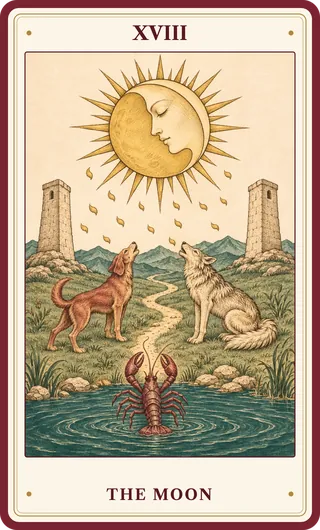
The Moon with a face
The large moon is full yet shown with a crescent profile, so it is both lit and shadowed. It stands for light that is reflected, not direct, which is why everything looks half-true.
The dog and the wolf
One is tame and one is wild, and both howl at the moon. They show the civilised self and the instinctive self reacting to the same unsettling pull.
The crayfish
It crawls out of the pool at the bottom of the card. It is an old, deep fear or truth rising slowly from the unconscious.
The two towers
The pair of towers marks the edge of the known world. You can see the gate, but you cannot yet see what lies beyond it.
The winding path
A path leads between the animals and past the towers into the distance. It says the way forward exists, but you must walk it step by step without a clear view.
The falling drops
Small drops of light fall from the moon toward the ground. They are insight and intuition, arriving in pieces instead of one clear message.
The distant mountains
Far off, the land rises into mountains where the path seems to lead. Clarity and a destination are there, but only dawn will show them.
What the symbols tell you about the answer
The image on The Moon in the Rider-Waite-Smith deck holds the whole yes or no logic. A dog and a wolf howl at the moon from either side of a path, showing that your tame side and your wild side are both reacting. A crayfish climbs out of a pool, a fear rising from deep in you. Two towers stand ahead, marking the edge of what you can see.
Notice that the path continues. This is the key to reading the card as a yes or no. The path is there, so there is a way forward, but nothing on it is lit clearly. The drops falling from the moon are small pieces of insight, not a full message. The card says to go slowly, collect what you are given, and not mistake a shadow for a wall.
The distant mountains matter too. There is a destination, and dawn will show it. That is why reversed, when the moon is setting, leans yes: you are close to the point where the land becomes visible.
How to turn The Moon into an answer you can use
A Maybe is not a useful end point, so here is a method for getting something practical from it:
- Name the unknown. Write one sentence beginning “I do not yet know…” about the exact thing that is unclear.
- Decide if you can find it out. If yes, set a date to do so. If no, ask what you would need to feel safe going ahead anyway.
- Separate fear from fact. List what you know for certain and what you are guessing.
- Re-ask the question in a form that includes the unknown, such as “Will this work out if I have the full information?”
- Decide after the unknown is resolved, not before.
This turns the card from a vague shrug into a short plan. In most readings, the person who follows these steps finds that the Moon’s “not yet” changes into a clear yes or no within days or weeks.
Try this: Ask your yes or no question again with a time frame, such as “Will this feel clearer in two weeks?”, and compare the new card to your first Moon.
The Moon with other cards in a yes or no reading
When The Moon appears with other cards, they tell you what kind of clarity is coming. If you are using a 3 card tarot layout for a yes or no question, read The Moon as the middle card to show what stands between you and the answer.
Some useful combinations:
- The Moon with the Sun: a yes after clarity arrives. A Sun beside it is one of the strongest signs that the fog will clear; see The Sun as a yes or no answer for how that card behaves on its own.
- The Moon with The Star: a delayed yes, where hope grows as confusion softens.
- The Moon with Justice: an honest reckoning that cuts through the haze.
- The Moon with the Nine of Swords: anxiety feeding itself, so the answer is not yet and rest comes first.
- The Moon with The Tower: a sudden truth that shatters an illusion, uncomfortable but clarifying.
As a rule, positive cards around The Moon soften it toward yes, and heavy or anxious cards push it toward no or wait. If The Moon is the only card you drew, remember it is describing the state of the question, so what you do next matters more than the card itself.
How long until it clears?
People often ask how long The Moon’s confusion lasts. There is no fixed answer, but the Moon moves through a cycle of about a month, and many readers use that as a rough guide: expect clarity within a lunar cycle, with early signs sooner. Reversed, the time is shorter, often days to a couple of weeks, because the fog is already thinning.
Do not treat this as a promise. Clarity comes when the missing information arrives, which depends on conversations, documents and your own willingness to look. If you want a more detailed sense of timing, ask a separate question about it rather than stretching a single Moon draw.
Questions that work well and badly with The Moon
The Moon gives its best answers to questions that are open about the unknown. “What am I not seeing about this job offer?” will get you more than “Will I get the job?” The first invites the card to do what it does well, and the second pushes it into a verdict it does not give.
Questions that start with “should I” and need an immediate answer tend to produce a wait or a no. Questions about whether something will be revealed, or whether your instinct is correct, tend to produce more helpful responses. If you want ideas for wording, the list of questions for tarot reading is a good place to find phrasing that suits a card like this one.
If you want a cleaner binary answer, you can also use the yes or no tarot reading tool, which is built for quick verdicts. The Moon will still show up as a maybe there, which tells you something about how rarely this card behaves like a switch.
Should you redraw if you get The Moon?
It is tempting to pull another card the moment The Moon appears, hoping for something plainer. Resist this for a day at least. Drawing repeatedly until you get a yes is a way of ignoring what the first card said, and it tends to produce more confusion, which is the Moon’s own theme.
A better habit is to follow up with a different kind of question. Instead of repeating “yes or no?”, ask “What is hidden here?” or “What do I need to know before I decide?” A fresh card answering that question is a continuation of the same reading, not a redraw. If you want a random card for that, you can draw a random card and read it as an answer to your new, more specific question.
Trusting your intuition with The Moon
The Moon is the card most closely tied to intuition, so it is fair to ask what you already feel about your question. Often the card appears because part of you already knows the answer and the rest of you is arguing with it. Notice your first reaction to the card. Relief, dread and irritation all say something.
Intuition is not the same as anxiety, though, and The Moon blurs the two. A useful difference is that anxiety is loud, repetitive and focused on worst cases, while intuition is quiet, steady and often calm even when the message is unwelcome. If your “gut feeling” is racing, wait for it to settle before you treat it as guidance.
When you put the card, the question and your instinct together, the answer is usually clear enough to act on. If it is not, that itself is The Moon’s answer: wait, gather one more fact, and come back when the light has changed.
Questions readers ask
Is The Moon a yes or no card?
The Moon is neither: upright it usually means not yet, or a cautious no, because the facts are unclear. Reversed it leans yes, since the confusion is lifting.
Does The Moon mean no?
Upright, it often reads as a soft no or a wait, but it is a no about the current picture, not a final verdict. It means you do not have enough information to say yes safely.
Is The Moon reversed a yes?
Usually, yes, with some patience. Reversed, the illusions fall away and the truth comes out, so a yes becomes possible once you have seen what was hidden.
Is The Moon a yes or no for love?
Upright, it says the situation is unclear, with mixed signals or secrets, so treat it as not yet. Reversed, it leans yes because honesty and clarity are returning.
Does The Moon mean someone is lying to me?
Not necessarily. The Moon points to confusion, assumptions and things unsaid, which can include deception but just as often include someone's own uncertainty or your own projection.
What should I do after drawing The Moon for a yes or no question?
Pause, find one concrete fact you are missing and get it. Then ask the question again in a different form or wait a few days before deciding.