
The Hermit Tarot Card Meaning (Upright & Reversed)

- Arcana
- Major Arcana, card 9
- Element
- Earth, Virgo
- Yes or no
- Maybe
solitudereflectioninner guidancesearching
isolationlonelinesswithdrawal
The Hermit tarot card means deliberate solitude, inner guidance and the kind of wisdom that only arrives when you step away from the noise. Upright, it asks you to slow down, trust your own judgment and follow a small steady light instead of demanding the full map. Reversed, the same retreat can harden into isolation, avoidance or a refusal to accept help you need.
It is the ninth card of the Major Arcana, and one of the most misread. Many people see an old man alone on a mountain and assume loneliness or a breakup. A better reading is chosen withdrawal with a purpose. Below you will find the meaning upright and reversed, how it reads in love, feelings, career, money and health, the symbolism in the Rider-Waite-Smith image, yes or no answers, card combinations and a few ways to work with it.
The Hermit at a glance
Think of The Hermit as the card of the quiet hour. Nothing is wrong, nothing is being punished. You are being invited to listen to yourself because the answer is not in the crowd.
- Card number: 9 (IX), Major Arcana
- Upright keywords: solitude, introspection, inner guidance, soul-searching, patience, wisdom
- Reversed keywords: isolation, loneliness, withdrawal, avoidance, ignoring your own wisdom
- Astrology: Virgo (ruled by Mercury)
- Element: Earth in most modern systems
What the card shows
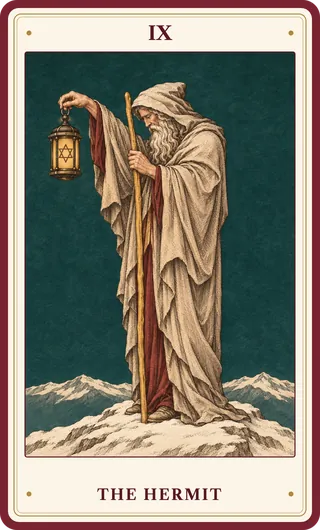
In the Rider-Waite-Smith deck, painted by Pamela Colman Smith, an old man in a grey hooded robe stands alone on a snow-covered peak. He holds a lantern in one hand with a six-pointed star glowing inside it, and leans on a long staff with the other. His head is bowed and the sky behind him is a flat, empty grey.
Nothing else is in the frame. There is no path, no town and no audience. That emptiness is the point of the card: it is the image of a person who has stopped performing and started paying attention.
Notice also that the lantern is held out in front of him. He is not hiding the light. In the traditional reading, the Hermit has climbed ahead and now lights the way for anyone who wants to follow. That detail matters when you read the reversed card, where the light is kept hidden or goes out.
The Hermit upright meaning
Upright, The Hermit tells you that the answer you are looking for will not come from asking around. It comes from stepping back, thinking clearly and trusting what you already know. This is a card for the season after a big decision, a loss, a burst of busyness or a stretch of too many opinions.
The mood is steady, not sad. The Hermit has nothing left to prove to anyone, so he looks for solutions that can only be found inside. He values depth over speed, and quality of attention over quantity of contact.
The card also speaks of maturity. It can mean you have reached a point where you want what is true more than what is impressive. If you have been wondering whether to slow down, this card says yes, and that doing so is productive, not lazy.
Try this: Spend 20 minutes alone with no phone, music or screen. Take a notebook and write the one question you keep asking other people. Then write what you would answer if nobody could judge you.
Read The Hermit for your question
Upright: You or your partner need space to understand what you really want, and slow, thoughtful connection beats rushing.
Reversed: Distance has become a wall, with emotional withdrawal, loneliness inside a relationship or a refusal to open up.
Upright: A person is quietly reflecting on their feelings and taking them seriously before they speak or act.
Reversed: A person is shutting down, avoiding the conversation, or hiding behind the need for space.
Upright: Independent, focused work such as research, study, planning, writing or mastering a craft, and a pause to ask whether your path is the right one.
Reversed: Isolation at work, stubborn solo methods, burnout, or avoiding a decision you already know you must make.
Upright: Simple, careful spending, a calm review of your finances and decisions made without outside pressure.
Reversed: Hiding money worries out of embarrassment, harsh self-denial, or avoiding the numbers altogether.
Upright: Step back, turn down the noise and trust your own steady judgment for the next few steps.
Reversed: Stop hiding, ask for help, and bring what you have learned back into the world.
Upright: Rest, quiet and time alone restore you, and a slower routine supports your wellbeing.
Reversed: Too much isolation is wearing you down, or you are ignoring the signals that you need to slow down.
The Hermit reversed meaning
Reversed, solitude tips into isolation. The card can describe withdrawing not to reflect but to avoid: people, a hard conversation, a decision or a reckoning that is overdue. “I just need space” becomes a polite way of not showing up.
It can also show the opposite problem. You may be staying busy and distracted precisely so you never have to sit with a difficult question. Or you may be refusing guidance because you feel you should handle everything alone. In both cases, the lantern has been put away.
The fix is not to force yourself into a crowd. It is to ask what the solitude is doing for you. If you are coming back from it clearer and calmer, it is healthy. If you are coming back more fearful, bitter or numb, it has gone too far. For a fuller breakdown by topic, see The Hermit Reversed.
The Hermit in love and relationships
In a love reading, The Hermit rarely means the relationship is over. It more often means someone needs space to think, or that the relationship is moving slowly and carefully. It favors depth over fireworks, and it works well for couples who are rebuilding trust or deciding what they want.
For singles, the upright card often marks a deliberate pause from dating. That might be time after a breakup, or time to work out what you actually want before meeting anyone new. It is not a sentence to be alone. It says that the person you become during this quiet stretch will shape the partner you choose next.
Reversed in love, distance has turned into a wall. One partner may be emotionally shut down, or you may feel lonely inside the relationship. For singles, it can mean hiding from connection because it feels risky. The advice is gentle: reach out a little at a time, and say what you need instead of vanishing.
The Hermit as feelings
When The Hermit describes what someone feels for you, it points to a person who is thinking hard about it. They are not ignoring you. They are processing, and they would rather be sure than say something half-formed. This person often seems quiet, reserved or hard to read, and their care shows up in small, steady ways more than grand gestures.
The card can also describe your own feelings. If you drew it for yourself, you may be more confused than you admit, and the answer is not going to arrive through more discussion. Your heart needs quiet to speak. You can read more in The Hermit in Love & as Feelings.
Reversed, the same person may be avoiding the question, going silent or using distance to dodge a conversation. Look at their actions over time. A Hermit who returns after thinking is healthy. A Hermit who never returns is avoiding.
The Hermit in career and work
At work, The Hermit favors independent, focused effort. It suits research, writing, programming, study for a hard exam, specialist craft, teaching, analysis and any task that needs long uninterrupted hours. Quiet mastery beats visibility right now.
It also shows up when you are questioning your path. You may be wondering whether the ladder you have climbed leans against the right wall. The Hermit says to take that question seriously before you make your next move, and to step back from office politics while you do. A mentor may also appear, or you may be ready to become one.
Reversed, you may feel isolated at work, or you may be sticking to your own methods and shutting out colleagues. It can also describe burnout, where you keep performing but the light inside has gone out. Ask for input, share what you know and get back into the flow of the team.
The Hermit in money
Financially, The Hermit points to simplicity. It describes modest needs, careful thought before spending and a period of reviewing your finances alone without hurry. It is a good card for budgeting, paying down debt quietly or declining a rushed investment pitch.
It also suggests learning before acting. If you are about to make a financial decision under pressure, The Hermit says to wait until the noise settles. Do your own research and trust the numbers in front of you more than the advice of whoever is loudest.
Reversed, frugality can shrink into denying yourself ordinary comforts, or you may be struggling with money in secret out of embarrassment. Avoiding your accounts does not make them smaller. Bring in a trusted person or a professional.
The Hermit in health and wellbeing
The Hermit supports rest, quiet and recovery. If you have been running on empty, it can be a clear nudge to cancel a few plans, sleep more, reduce stimulation and let your nervous system settle. Practices like journaling, walking alone, meditation and time in nature suit this card well.
Reversed, it can show that too much isolation is hurting your mood, or that you are ignoring signals from your body because stopping feels uncomfortable. Tarot is a reflective tool, not a medical one. If you are struggling with low mood, anxiety or physical symptoms, please talk to a doctor or a qualified professional as well.
The Hermit as a person and spiritual guide
When The Hermit stands for a person, it is often an older or wiser figure: a mentor, teacher, grandparent, counsellor or someone who has simply lived through a lot. It can also be an introvert, a researcher, a writer or anyone who recharges alone and thinks before speaking. They are rarely loud, and they tend to say less but mean more.
The shadow version is the false guru, the person who poses as wise to control others, or someone who has withdrawn so far that they have lost touch with other people. Notice whether the figure’s light helps you see or only makes them seem important.
Spiritually, The Hermit is the seeker and the teacher at once. He has gone alone to find something, and now he holds up what he found. It is a card of contemplation, study, prayer and meditation, and of the understanding that some answers only appear in silence.
Try this: Think of one person whose quiet judgment you trust. Send them a short message asking one specific question about a decision you are facing. Let the answer be short, and sit with it before replying.
The Hermit card symbols
Choose a symbol to read what it means on the card.
Lantern
The lantern is the Hermit's inner light, the wisdom he has earned and now carries. It lights only a small circle ahead, which tells you that you need the next step, not the whole map.
Six-pointed star
Inside the lantern burns a six-pointed star, often linked to the Seal of Solomon and to the union of opposites. It points to truth and guidance that comes from within and is shared with others who seek it.
Staff
The long staff is experience, steadiness and practical support. It shows that wisdom is something you lean on while walking, not only something you think about.
Snowy mountain peak
The Hermit stands high above the world on cold, quiet ground. The peak shows effort already made and the clear perspective that distance gives.
Grey robe
The plain grey cloak stands for humility and a life stripped of show. Grey is neither black nor white, so it also suggests balance and discernment.
Bowed head
His gaze turns downward and inward instead of outward at an audience. He is paying attention to what is right in front of him.
Grey, empty sky
There is no crowd, no landscape and no decoration behind him. The blank background removes distraction and leaves only the figure and his light.
The symbolism in detail
The lantern is insight, and its size is honest: it lights only a small circle. That is the card’s most practical lesson. You do not need to see the whole route to take the next step, and demanding certainty about the entire plan is often what keeps you stuck.
The six-pointed star inside the lantern is formed from two triangles, one pointing up and one pointing down. It is commonly read as a union of opposites, such as heaven and earth, spirit and matter. The staff is lived experience and steady support, the thing that keeps him balanced on uneven ground. The grey robe is humility, and the snowy peak is both achievement and cold, clear air.
Put together, the image says this: wisdom is earned slowly, it is modest in its light, and it is meant to be held up for others, not locked away. For a visual summary of each symbol, check the symbols section on this page.
Number nine, Virgo and the Earth element
The Hermit is card nine, which is the last single digit before the cycle of ten begins again with the Wheel of Fortune. Nine is a number of completion, gathered experience and finishing something before a new phase. In a sense, The Hermit is the long, quiet preparation before a big change.
In astrology, the card corresponds with Virgo and its ruling planet Mercury. Virgo brings the traits you see in the card: attention to detail, discernment, humility, service and a love of careful analysis. Many modern readers also link The Hermit with Earth and winter, a season of stillness and inner work. You can explore more connections on the Tarot & Astrology Correspondences page.
Historically, the card is much older than the Rider-Waite-Smith deck. In early Italian decks, the same figure appeared as an old man leaning on a crutch, sometimes holding an hourglass, representing time. Over the centuries, the hourglass became a lantern, and the old man became a guide. That history explains why patience and slow time are still central to the card.
The Hermit as a yes or no answer
As a yes or no card, The Hermit leans towards “not yet” or “wait.” It almost never says a flat no. It says that the answer will be clearer once you have stepped back, gathered information and stopped letting other people’s opinions drive you.
If your question is about whether to rush into something, the answer is usually no. If your question is about whether to take time to think, study or rest, the answer is yes. Reversed, the answer often shifts to “you already know, and you are avoiding it.” For a full breakdown, see The Hermit as a Yes or No Answer.
The Hermit in spread positions
In a past position, The Hermit describes a period of withdrawal, study or healing that has shaped you. In the present position, it says you are in a reflective phase now, and that is where you should be. In the future position, it predicts a quieter stretch ahead or the arrival of a mentor, and it advises preparing for it instead of fighting it.
As advice, it is clear: step back, simplify and listen. As an obstacle, it can show that isolation, shyness or too much going it alone is holding you back. As an outcome, it points to wisdom gained and a calmer, more self-assured you.
The card also works well as a single daily draw, particularly if you pull it on a day that feels overwhelming. It then reads as a reminder to take five quiet minutes before the next decision.
Card combinations with The Hermit
Cards beside The Hermit show what the retreat is for, or what it is avoiding. A few combinations come up often:
- The Hermit and The Moon: confusion or anxiety, with the lantern as your steady guide through the fog. Take small, careful steps and do not act on fear.
- The Hermit and the Eight of Cups: a deliberate walking away from something that no longer feels right. See Eight of Cups for the full story.
- The Hermit and the Four of Swords: rest and recovery are needed urgently. The Four of Swords adds that a pause is the healthiest choice.
- The Hermit and The Tower: a retreat after sudden upheaval, where you rebuild from the inside.
The Hermit compared with The Hanged Man
The two cards are often confused because both involve stillness. The difference is in the movement and choice. The Hermit withdraws on purpose, walks his own path and carries a light forward. The Hanged Man is suspended, surrenders control and gains insight by seeing things from a new angle.
Put simply, the Hermit says “I will go away and think.” The Hanged Man says “I cannot move, so I will let go and see differently.” One is a choice of solitude, the other a pause that is accepted.
Both ask you to stop pushing, but The Hermit is more likely to return with a plan. If both appear in the same reading, you may be in an extended period of waiting and reflection before action.
Questions to ask when you pull The Hermit
The card works best when you turn it into a few direct questions. These help you tell healthy solitude from avoidance, and give the reading something concrete to act on.
- What am I trying to hear that I can’t hear with so much noise?
- Is my time alone leaving me clearer or more afraid?
- Who has already walked this path and could guide me?
- What is the next step the lantern shows, not the final destination?
- What am I ready to share once I have thought it through?
Write the answers down. Often the first one is the most honest, and the last one is the one that gets you moving again.
How to work with The Hermit
Start small. Block out a regular quiet hour each week, even if it is just a walk without headphones. Keep a notebook to catch what comes up, and keep your phone out of reach. The aim is not to disappear from your life, but to create enough quiet that your own voice is audible.
Then decide when to return. The Hermit is a season, not a home. A good rule is to set an end point, such as a week or a month, and plan one conversation or action that follows. That keeps reflection from drifting into avoidance.
Try this: Place The Hermit card on your desk or by your bed for seven days. Each evening, write one line: what you learned in the quiet, and one small thing you will bring back into your day.
If you are new to reading single cards, the random tarot card generator is a simple way to practise drawing a card and asking the same questions. Over a few weeks you will see how often a quiet card like this one gives the most useful answer.
Questions readers ask
What does The Hermit mean in tarot?
The Hermit means chosen solitude, introspection and inner guidance. It appears when you need to step back from noise and outside opinions so you can hear your own judgment.
Is The Hermit a bad card?
No. Upright, it is a calm and constructive card about reflection and wisdom. Reversed, it can warn that solitude has turned into isolation or avoidance.
What does The Hermit mean in love?
In love, The Hermit usually points to a need for space, slow pacing and honest self-reflection. It does not automatically mean a breakup, and for singles it often marks a deliberate pause from dating.
Is The Hermit a yes or no card?
The Hermit leans towards not yet, or wait. It rarely says no outright, but it advises slowing down, gathering information and deciding from a quiet place.
What does The Hermit mean as feelings?
As someone's feelings, The Hermit shows a person who is thinking deeply and processing before they act. They may seem distant, but it is often reflection, not indifference.
What is the difference between The Hermit and The Hanged Man?
The Hermit withdraws by choice to seek wisdom and then carries a light forward. The Hanged Man is suspended in a pause and surrenders control to gain a new perspective.