
The Hermit in Love & as Feelings

- Arcana
- Major Arcana, card 9
- Element
- Earth, Virgo
- Yes or no
- Maybe
solitudereflectioninner guidancesearching
isolationlonelinesswithdrawal
When The Hermit appears as feelings, it means the person feels something real but private, and has gone quiet to work out what it is. They are looking inward, being careful, and need space before they can say or do anything. It is distance with a reason behind it, not automatic rejection and not automatic love.
That is the short answer, and the rest of this guide fills in the detail: what the card looks like when it describes a crush, a partner, an ex or yourself, how the upright and reversed positions differ, what the surrounding cards can change, and what to actually do when the person you are asking about has gone into the cave. For the full card profile, see The Hermit tarot card meaning.
Why The Hermit appears in the feelings position
Most cards in the feelings position describe an emotion you can name: joy, jealousy, desire, doubt. The Hermit describes something different. It describes what a person does with their feelings. They do not act on them, announce them or hand them to someone else. They hold them up to the light and look at them.
So when you pull The Hermit for “how does he feel about me” or “how does she feel about me”, you are not being told the feeling is weak. You are being told the feeling is being examined. The person is more likely to be thoughtful than careless, and more likely to be quiet than dramatic.
The Hermit is also a Major Arcana card, which in a love reading usually points to something that matters to the person, not a passing mood. If you want background on that distinction, the guide to major and minor arcana explains why these cards carry extra weight.
What the image tells you about the feeling
The picture does most of the work. A lone figure in a grey cloak stands on a snowy peak holding a lantern with a six-pointed star inside. There is no other person on the card. Nobody is being addressed, shown off to or reached for. That is the first thing to carry into a feelings reading: the attention is turned inward.
The lantern is small. It lights only a few steps ahead, which suggests that the person has partial clarity and is not ready to commit to a conclusion. The staff means the climb is deliberate. The snow and bare sky mean the place he has chosen is cold and exposed, so the card is not all comfort. Solitude gives perspective, but it costs something.
Put together, the image reads as a feeling that is serious, mature, guarded and slow. It does not read as a feeling that is absent. Someone with no interest in you would not be climbing a mountain to think about it.
The Hermit upright: how they feel about you
Upright, The Hermit usually describes a person who cares and is handling that carefully. They may be quieter around you than they used to be. They may take a long time to reply, step back from plans, or seem preoccupied. Underneath, they are asking themselves what they want and what the connection asks of them.
The tone is closer to respect and quiet attachment than to passion. This is not a card of butterflies and grand gestures. It suggests a feeling that grows slowly, the kind that someone does not say out loud until they are sure.
Two features usually separate a healthy Hermit from a cold one. First, the person is still turning up in small, consistent ways, such as remembering things you told them or answering when you reach out. Second, they say or show that they need time, and they do not simply vanish. A Hermit who explains himself is processing. A Hermit who disappears without a word is a different situation.
Read The Hermit for your question
Upright: Love is taken seriously and handled slowly, with a need for quiet, space and honesty before any big step.
Reversed: Solitude has turned into hiding, so affection goes unspoken and the relationship can feel shut.
Upright: They feel something real and private about you, and they are working out what it means before they speak.
Reversed: They are avoiding their own feelings, or feel too wary or lonely to share them.
Upright: You do your best work alone, and a period of study, planning or mentoring will serve you well.
Reversed: Working in isolation is holding you back, and you may need to ask for help or let people see your work.
Upright: Spend carefully, review your accounts quietly and make decisions from your own judgement, not from pressure.
Reversed: Avoiding your finances or refusing advice is causing problems, so look at the numbers and talk to someone you trust.
Upright: Step back, get quiet and listen to your own answer before you act.
Reversed: Come out of the cave: reach out, accept company and stop letting distance become a habit.
Upright: Rest, quiet and time away from noise restore you, and reflective practices such as journaling or meditation help.
Reversed: Loneliness, withdrawal or low mood may be affecting you, so reconnect with people and get support if it lingers.
The Hermit reversed as feelings
Reversed, the lantern dims. The solitude that was a choice becomes a habit, and the person may be lonely, closed off or afraid of being close. In a feelings position, a reversed Hermit often means they are avoiding what they feel instead of working through it.
This can look like emotional coldness, deflection, refusing to talk, or pulling away the moment things get serious. It can also look like someone who wants contact but cannot make the first move because they are embarrassed, hurt or unsure. Because the card sits between “processing” and “hiding”, the reversed version asks for more care in how you read it.
Reversals vary with the reader and the deck, so keep the context in view. Our guide on reading reversed tarot cards covers the different ways to approach them, and The Hermit reversed goes deeper into this card in particular.
Try this: Pull The Hermit upright and reversed side by side in your mind (or in a deck) and write one sentence for each: “They are quiet because…” Compare the two. The reason you find for the upright card is usually thought. The reason for the reversed card is usually fear or avoidance.
Does The Hermit mean they love me?
This is where readers disagree, and it is worth being straight about it. Some say The Hermit as feelings is deep, private love. Others say romance is not on the Hermit’s agenda at all and that the person may simply want to be left alone. Both readings can be right, because the card describes a manner of feeling and not a particular emotion.
A more reliable way to read it: The Hermit tells you the person is taking you seriously enough to think hard about you, or taking their own life seriously enough to need space from everyone. Which of those it is depends on the question, the neighbouring cards and what you already know about them. If other cards in the spread are warm, such as the Two of Cups or Ten of Cups, the quiet is likely tender. If they are cold or evasive, the quiet may be exactly what it looks like.
So the honest answer is “possibly, but not yet.” The Hermit shows depth and caution. It does not show a declaration. If you need to know, the most useful step is a clear conversation, not another card.
The Hermit in a new connection or situationship
In the early stages, The Hermit often shows someone who is interested but not ready to rush. They may be wary after a past hurt, busy with their own life, or simply someone who does not date casually. They may like you from a distance and need time before they allow closeness.
What you can expect is slow, steady contact with long gaps, not intense messaging. If you are used to quick, intense attraction, that pace will feel like disinterest. It may not be. It is worth asking yourself whether you can enjoy a slow build, because that is what this card offers.
It can also mean the person is not looking for a romantic connection at all at the moment. If someone is explicit about wanting to be alone, believe them. The card does not override what a person tells you.
The Hermit for a committed partner
Between two people already together, The Hermit rarely says the love has gone. More often it says one person needs space inside the relationship: time alone to think, recharge or work through something personal. It can follow stress, grief, a career change or a big decision.
The partner may seem distant without being unfaithful or unkind. They may spend more time on their own interests, say less than usual, or seem tired of social demands. If they still show care in small ways, this is most likely a healthy pause.
Trouble starts when the distance has no end and no explanation. Then the card is asking the couple to talk. A good way to explore it is to lay out a relationship tarot spread and look at what each person needs, not just what one person is doing.
The Hermit as an ex’s feelings
For an ex, The Hermit usually means they are alone and reflecting. They may be thinking about the relationship, about what went wrong, or simply about who they are now. It can suggest quiet missing, but it often also suggests they are enjoying the peace, or at least not seeking contact.
This card does not promise a return. It tends to show that your ex is not rushing to reach out, and that any decision about contact will be made slowly and privately. If you are hoping for a message, the Hermit says do not hold your breath.
Reversed, an ex may be stuck: lonely, avoiding their feelings, or refusing to look at what happened. They may think about you and say nothing because they are afraid or proud. In both positions, take the card as a description of their inner state, not a forecast of what they will do.
The Hermit for singles, and for your own feelings
Sometimes the person with the lantern is you. If The Hermit appears for your own feelings, it usually means you need time to listen to yourself before you decide anything about love. You may be tired of dating, unsure what you want, or recovering from a relationship and not ready for another.
For a single person, it can also say that the most useful thing right now is not meeting someone but knowing yourself. It is a card of self-knowledge, and love that comes after it tends to be steadier. If you want a structured way to think about this, the love tarot spread for singles is a good companion.
Reversed, it can show that you are hiding in solitude because closeness feels risky, and that you are calling it independence. That is worth being honest about, gently.
Try this: Sit somewhere quiet for ten minutes with no phone. Finish this sentence three times without censoring: “What I actually feel about them is…” Notice which answer comes fastest.
The Hermit card symbols
Choose a symbol to read what it means on the card.
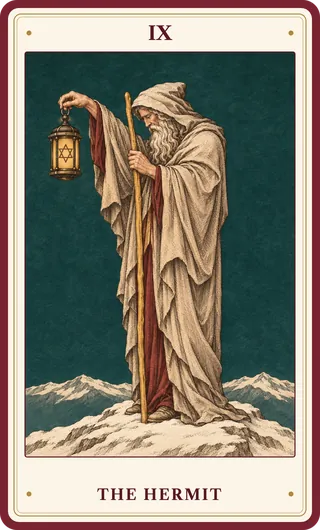
The lantern
The light he carries is small but steady, showing only the next few steps. It stands for guidance found through patient, personal insight, not through crowds or noise.
The six-pointed star
Inside the lantern sits a star formed from two triangles, a sign of wisdom that joins the earthly and the spiritual. In a feelings reading it says the emotion has been looked at with care.
The staff
He leans on a long wooden staff as he climbs. It shows that his solitude is a deliberate path with its own support, and that he is slow but sure.
The grey cloak and hood
The plain grey robe shows a person who has no wish to perform or impress. It points to privacy and modesty about what he feels.
The snowy mountain peak
He stands high on a summit under a cold, bare sky. Perspective comes from distance, but the cold also warns that solitude can chill the heart if it goes on too long.
The long white beard
His beard marks age and experience, the patience of someone who has lived through things. It suggests that the feeling is mature and not impulsive.
The grey, empty sky
There is no crowd, no landscape and no other person in the picture. The emptiness tells you the Hermit's attention is entirely on the inner world.
The Hermit compared with other quiet cards
Several cards can look like withdrawal, and telling them apart changes the reading. The Eight of Cups is someone walking away because something is missing. The Hermit steps aside to see clearly before deciding anything. One is leaving; the other is thinking.
The Four of Swords is rest after exhaustion. The person is too depleted to feel much. The Hermit has plenty of feeling and is handling it with care. The Four of Pentacles is guarded for a different reason: holding on, protecting what is theirs, afraid to let go.
A short way to remember it:
- Hermit: quiet because the feeling is deep and needs thought
- Eight of Cups: quiet because they are leaving
- Four of Swords: quiet because they are worn out
- Reversed Hermit: quiet because they are afraid
Cards that change the reading
The Hermit rarely stands alone in a good reading, and its neighbours shift it a great deal. Warm cards soften the distance. The Two of Cups beside it suggests mutual feeling that both people are treating gently. The Ten of Cups suggests the quiet is part of a stable, lasting bond.
Cool or restless cards sharpen it. The Eight of Cups suggests leaving is genuinely on the table. The Five of Swords or Seven of Swords suggest that the silence is tied to conflict or secrecy. The Moon suggests confusion and projection, so what you read as the Hermit’s feeling may partly be your own anxiety.
If you want to check combinations carefully, the tarot card combination calculator can help you think about how two cards interact, though the reading always has to make sense for the real situation.
How long does a Hermit phase last?
There is no exact figure, but The Hermit is a slow card. Think in weeks or months, not days. It is card number nine, a number tied to completion and the end of a cycle, which fits the idea that the person comes out when something has been worked through.
You cannot speed it up by asking more often. Pressure usually pushes a Hermit deeper into the cave. What helps is a clear, calm signal that you are available, then patience. If you are hoping to pin down timing for a specific situation, the guide to tarot timing explains the limits and options.
A sensible rule: give a quiet person reasonable time, and let your own patience have a limit too. If months pass with no contact, no explanation and no effort, the card has stopped being a pause and become an answer.
What to do when someone is in Hermit mode
The most useful response is to be steady and clear without crowding them. Say once, kindly, that you are around and that you understand they need time. Then actually leave them alone. Messages that ask “are you okay, are you mad, what did I do” repeatedly tend to feel like pressure.
Use the wait well. Spend time on your own life, friends and interests. A Hermit often comes back to someone who stayed grounded, and not to someone who waited by the phone.
Know what you need, too. If you can live with slow and quiet, say so. If you cannot, say that as well, and do not pretend. A reasonable request such as “I can give you space, but I would like to hear from you by the end of the month” is fair and clear.
When quiet is not depth
It is worth being honest that not every quiet person is a wise one on a mountain. The Hermit’s silence is meant to have a purpose, and some silence does not. Be cautious if the person is evasive, inconsistent, or gives you space only when it suits them.
Signs that the quiet is a Hermit, not a cover: they tell you they need time, they stay respectful, and they return with more honesty than before. Signs that it is something else: they disappear without explanation, they keep you hanging while seeing other people, or they come back only when they need something.
Tarot describes energy and tendency. It does not excuse behaviour that hurts you. If you feel anxious and ignored much more than calm and patient, trust that.
The Hermit as a yes or no answer
For a yes or no question about love, The Hermit leans toward “not yet” or “wait.” It rarely says an immediate yes, because its energy is about slowing down and thinking. If the question is whether someone will contact you, confess, or commit soon, the card suggests no, or later.
If the question is whether to take time alone before deciding, the answer is much more likely to be yes. The card supports reflection and caution. For a quick, simple reading, see The Hermit as a yes or no answer.
Use these as starting points, not verdicts. A yes or no pull is only as good as the question you ask, and a better question is often “what does this person need right now?” than “will they do this?”
A simple spread to read The Hermit clearly
If you want more than a single card, a small spread helps you separate their feelings from yours. Three cards is enough: one for what they feel, one for what they need, and one for the best way to respond. If The Hermit lands in the first position, the second and third cards tell you what the quiet is for and how to meet it.
You can also add a fourth card for what you need, which keeps the reading from becoming only about the other person. This matters, because the Hermit asks everyone involved to look inward.
Try this: Draw three cards for “what they feel, what they need, how I can respond.” If The Hermit appears, read the other two cards as an explanation of the quiet, and write down one concrete thing you will do or stop doing this week.
Questions readers ask
What does The Hermit mean as feelings?
It means the person has deep, private feelings and has gone quiet to understand them. They are processing, not performing, so expect distance and slow movement instead of displays of affection.
Does The Hermit mean he or she loves me?
Not by itself. It shows that the person is thinking seriously and privately about you, but it does not confirm love, so look at the surrounding cards and at how they behave over time.
Is The Hermit a good sign for how someone feels about you?
It is a mixed sign. The feeling may be genuine and thoughtful, but the pace is slow and the person is not ready to act on it yet.
What does The Hermit reversed mean as feelings?
It points to withdrawal that has become isolation, fear of closeness, or feelings that are being avoided instead of processed. The person may be lonely and still unable to reach out.
What does The Hermit mean for an ex's feelings?
Your ex is probably alone, reflecting on the relationship and on themselves. It can mean they still think about you quietly, but it does not predict contact or a return.
How long does a Hermit phase last?
There is no fixed time, but it is usually weeks or a few months, not days. The Hermit is card number nine, and the person comes back when they have an answer, not when they are pushed.