
The Tower Tarot Card Meaning (Upright & Reversed)

- Arcana
- Major Arcana, card 16
- Element
- Fire, Mars
- Yes or no
- No
sudden changeupheavalrevelationawakening
avoiding disasterdelayed changefear of change
The Tower tarot card means sudden, dramatic change that destroys something built on weak foundations. It brings a shock, a hard truth or a loss that you did not choose, and it clears the ground so something more honest can replace it. It looks frightening, but the Tower is mostly about truth arriving and false security ending, rather than about punishment or doom.
This guide covers the Tower’s upright and reversed meanings, its imagery, and how it reads in love, career, money, health and yes or no questions. You will also find how it differs from similar cards, how it behaves in different spread positions, and what to actually do when it lands in front of you.
The Tower at a glance
Before the detail, here are the basics that most readers agree on.
- Number: 16, Major Arcana
- Element: Fire
- Planet: Mars (in the Golden Dawn system, which most modern decks follow)
- Hebrew letter: Peh
- Upright keywords: sudden change, upheaval, revelation, awakening, collapse of illusion, release
- Reversed keywords: resisting change, delayed collapse, narrow escape, inner upheaval
- Yes or no: usually no
The Tower comes after the Devil and before the Star in the Major Arcana. That order matters, and it is explored further down. For a broader view of where this card fits among the 78, see the tarot card meanings list.
What the Tower card means upright
Upright, the Tower is the moment a situation can no longer be held together. Something that looked stable, whether a relationship, a job, a belief or an image of yourself, breaks apart quickly and with force. The change is usually unplanned. You may not have invited it, and you may not have seen it coming, though in hindsight the cracks were often visible.
The core message is that the structure was never as solid as it seemed. The Tower does not destroy things that are well built. It brings down what depended on denial, ego, avoidance or luck. That is why people often say they feel relief mixed with devastation once the dust settles.
There is also a second layer. The lightning is a flash of insight as much as a disaster, so the Tower can describe a sudden realisation that changes how you see your whole life. Many people draw it just before they finally admit what they have known for months.
The imagery of the Tower card
In the Rider-Waite-Smith deck, a tall grey tower stands on a rocky peak against a black sky. A bolt of lightning strikes the top and knocks off the crown. Flames burst from the windows, and two figures fall headfirst through the air, with small flame shapes drifting down around them.
Every part of the picture describes the same event from a different side. The crown is pride and false authority. The lightning is truth arriving without warning. The tower itself is whatever you built high and fast. The falling figures are caught in the moment where control is gone but the landing has not happened yet.
The peak is worth a second look. The tower is not rooted in soil, it sits on a narrow point of rock. The card is telling you that the problem was never the storm, it was the base. You can see the full list of symbols above and compare them with the Devil’s chained figures, since the Tower is often the answer to that card.
Try this: Look at the card for two minutes and place yourself in the picture. Are you still inside the tower, already falling, or standing on the ground watching? Write down which one feels true today, and what you would say to the person in that position.
Read The Tower for your question
Upright: A sudden truth, breakup or shock breaks open a relationship that was resting on illusion, and what survives is real.
Reversed: A couple avoids the hard conversation, or a painful ending is slowly worked through instead of arriving in one blow.
Upright: They feel shaken, overwhelmed or suddenly honest, as if something they held back has finally burst out.
Reversed: They are holding the lid on strong feelings and hoping the pressure will pass without anyone being hurt.
Upright: A redundancy, restructure, exposed mistake or abrupt resignation clears the ground whether you planned it or not.
Reversed: You sense the job or project is failing but keep propping it up, or you narrowly avoid a collapse.
Upright: A shock expense, loss or financial reality check shows where your security was never as solid as it looked.
Reversed: You delay facing a money problem, or you recover steadily from a loss without a dramatic crash.
Upright: Stop defending what is already falling, tell the truth, and start rebuilding on firmer ground.
Reversed: Do not wait for a crisis to force your hand: make the change on your own terms while you still can.
Upright: A warning, burnout or sudden event demands urgent attention to body and mind, so seek proper care without delay.
Reversed: Slow recovery after a health scare, or a habit of ignoring warning signs that needs to end.
Where the Tower sits in the Major Arcana
The Tower is card 16 of the 22 cards of the Major Arcana, the set that describes the big turning points of a life. It follows the Devil, the card of chains, addiction and self-imposed limits. The Devil shows a trap that people stay in by choice. The Tower is what breaks the lock, and it rarely does so politely.
After the Tower comes the Star, the card of hope, healing and quiet renewal. This sequence is one of the most useful ways to read the card. The Tower is not the end of the story. It is the painful middle that makes the Star possible, and a reader who sees all three side by side can tell a querent that the collapse leads somewhere.
Numerologically, 16 reduces to 7 (1 + 6), which links the Tower to questioning, testing and finding out what is true. That fits the card well: the Tower tests every structure at once.
The Tower in love and relationships
In a love reading, the Tower points to a shock. It can be a surprise breakup, an affair coming to light, a blazing argument that cannot be taken back, or a revelation that changes how you see your partner. It can also be a sudden, overwhelming attraction that overturns your sense of what you wanted.
Whether the relationship survives depends on its foundation. Partners who have been honest underneath the stress often grow closer after a Tower event, because the worst has finally been said. Relationships held together by pretence, control or avoided conversations usually do not last through it, and the Tower is simply the moment that becomes visible.
For singles, the Tower often means the collapse of an old pattern: a type you keep choosing, an ex you cannot let go of, a story about why love will not work for you. It can feel like losing something, but it clears space. Other cards in the spread will tell you whether the break is final or repairable. If you are unsure, look at the Tower alongside cards like the Three of Swords, which names the heartbreak, or the Ten of Cups, which shows what a lasting, honest bond looks like.
The Tower as someone’s feelings
When the Tower describes what another person feels about you, it usually shows overwhelm. They may feel shaken, exposed or out of control, and the feelings may be bigger than they can manage. It can describe a person whose view of you, or of themselves, has just been turned upside down.
It can also describe a volatile reaction. Someone with Tower energy may blow up, withdraw suddenly or say things they cannot take back. This is not always about you. Often it is a long-held pressure finally giving way, and it takes time for the person to recover enough to act clearly.
Read the cards around it to judge direction. With warm cards it can be a rush of intense attraction. With cold ones it points to a break. For a fuller breakdown, see the Tower as feelings.
The Tower in career and work
At work, the Tower is the redundancy letter, the failed launch, the restructure, the manager who leaves overnight, or the project that collapses because of an overlooked flaw. It can also be you walking out after years of silently putting up with something. The event is abrupt and the old routine ends.
The practical lesson is usually about foundations. Ask what the job or plan depended on: one client, one boss, one person who never took a holiday, a promise nobody wrote down. The Tower exposes the weak point, and the sooner you see it, the sooner you can rebuild with a sturdier base.
It is not always a disaster. A Tower in a career reading can describe a bold break from a role that was draining you, or a revelation that changes your direction entirely. For a cleaner starting point after the fall, the Ace of Pentacles is a good companion, since it shows the first solid seed of a new, grounded opportunity.
The Tower in money and finances
Financially, the Tower warns of a shock: an unexpected bill, a loss, a business failure, a scam or an investment that collapses. It often arrives when you have been relying on something that was never properly secure, such as a single income, borrowed money or a very optimistic forecast.
It is also the card of the financial reality check. If you have been avoiding your accounts, the Tower can mean the moment you finally have to look. That is uncomfortable, but it is better to find out what you actually have than to keep spending against an illusion.
Keep in mind that tarot does not replace professional advice. If the Tower appears in a money reading, it is a good prompt to build a buffer, diversify your income and check what would happen if one source stopped tomorrow.
The Tower in health and wellbeing
In health, the Tower suggests a sudden event or a body and mind that can no longer keep up with the load. Burnout, a panic attack, a flare-up or an unexpected diagnosis are the kinds of things it can point to. Often it follows a long stretch of ignoring early warnings.
Treat it as a signal to slow down and get proper medical support, not as a prediction. Tarot cannot diagnose anything, and anyone worried about symptoms should see a qualified professional. The Tower’s message here is about urgency and honesty with yourself.
The Tower also has a healing side. A breakdown can be the point where someone finally rests, asks for help or changes a pattern that was harming them. After the shock, the Star shows the recovery that follows.
What to do when the Tower appears
The most useful response is calm and practical, because the Tower rewards people who stop gripping the old structure. A few steps help in almost any context:
- Name what is actually collapsing, in plain words and without drama.
- Separate what you can save from what was already failing.
- Tell the truth, to yourself first and then to the people involved.
- Look after your basic needs: sleep, food, support from people you trust.
- Wait before rebuilding. Decisions made in the first shock are rarely your best.
If the Tower lands as a warning before anything has happened, you have a chance that most people do not get. You can see the cracks and act on them. Make the change on your own terms, have the hard conversation early, or repair the weak point before it gives way.
Try this: Draw a quick sketch of a tower and label each floor with something you currently rely on, such as income, a relationship, a belief or a routine. Then mark the one floor that feels least stable and write one small action that would strengthen it this week.
The Tower card symbols
Choose a symbol to read what it means on the card.
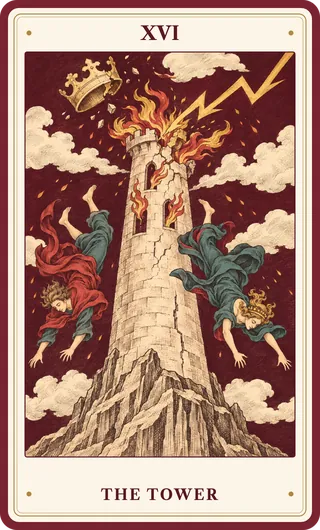
The tower
A tall stone structure built on a narrow peak stands for the beliefs, plans or relationships we have raised high. It looks strong but its foundation is thin, which is why one strike brings it down.
The crown
The crown is blasted off the top of the tower. It shows pride, ambition and false authority being knocked loose by something bigger than the ego.
The lightning bolt
The bolt is sudden truth, insight or crisis arriving without permission. It does not build the collapse, it only reveals that the structure was already unsound.
The falling flames
Twenty-two flame-like drops, each shaped like the Hebrew letter yod, fall around the tower. They are often linked to the 22 cards of the Major Arcana, and to sparks of divine energy released when the old form breaks.
The falling figures
Two people tumble headfirst from the windows, caught mid-fall. They show the loss of control and ego, and also a forced return to solid ground.
The dark sky
A black sky surrounds the scene, giving the card its tone of shock and night. It hints that this event happens in the dark, before understanding arrives.
The rocky peak
The tower balances on a cliff rather than rooted in earth. It tells you the issue is the foundation, not the weather.
The Tower reversed
Reversed, the Tower usually means the collapse is being resisted, delayed or softened. You may know something is wrong and keep patching it. You may have narrowly escaped a disaster and still feel shaken. In some readings it describes a slow breakdown that never has a single dramatic moment, just a long, grinding erosion.
It can also turn the energy inward. Instead of a crisis happening to you, the upheaval takes place inside your thoughts, with doubt, fear or an identity crisis that nobody else can see. The old structure may still stand outside, but you have already stopped believing in it.
The central question for the reversed Tower is whether avoiding the change is protecting you or just postponing the pain. For a full guide, including love and work, read the Tower reversed. If you are new to flipped cards in general, how to read reversed tarot cards explains the main approaches.
The Tower in past, present and future positions
In the past position, the Tower tells you that a major upheaval has shaped where you are now. Perhaps it was a loss, a betrayal or a sudden ending. The question is whether you have rebuilt properly or are still living among the debris, and the cards around it will help show which.
In the present, the Tower says you are in the thick of it, or very close. Things may feel unstable. This is a time to protect yourself, avoid big new commitments and focus on what is true. In the future position, it warns of a coming shake-up, and gives you the chance to prepare rather than be surprised.
In a Celtic Cross, pay attention to where the Tower lands. In the position of hidden influences it can show a pressure building out of view, and in the outcome position it points to a result that requires a clean break before anything new can grow. As an advice card, it asks you to stop defending what is already falling.
Tower yes or no
As a yes or no card, the Tower leans strongly to no. It means the hope or plan in your question is unstable, or that events will disrupt it. If you ask whether a shaky deal will go through, the Tower is a clear warning to look again.
There is an exception. If your question is about ending something, leaving a job or breaking a pattern, the Tower can be a yes, because it supports the break. The same card can mean opposite things depending on what you want to happen, so be clear about your question first.
For more on this, see the Tower as a yes or no answer.
The Tower compared with similar cards
The Tower is often confused with other endings, but each has its own flavour. These comparisons help in a spread:
- Death: a natural, complete ending that feels inevitable and leads to rebirth. See the Death card.
- The Devil: a trap you maintain yourself, with no sudden break.
- Ten of Swords: the pain of a final collapse, with the worst already over. See the Ten of Swords.
- Five of Cups: grief over what was lost, without the sudden shock.
The simplest way to tell Death and the Tower apart is by speed and choice. Death is a transformation you can often feel coming, and it has a quiet dignity. The Tower hits suddenly and takes the decision out of your hands. In a reading, both may appear together when a large ending is followed by a deeper change.
Timing, astrology and numerology
The Tower is associated with Mars, the planet of force, conflict and sudden action, and with the element of fire. That matches the card’s speed. When people ask about timing, the Tower usually points to something fast: days or weeks rather than months. The build-up, however, has often been slow, so the surprise is more about when people notice than when the cracks began. For more on this, see tarot timing.
Some readers link the Tower to the Hebrew letter Peh, which means mouth, and to the idea of truth finally spoken aloud. That is a useful lens for readings where the collapse comes through words: a confession, an argument or an announcement.
Numerologically, 16 reduces to 7, and the number points to testing and questioning. Combine that with fire and Mars and you get a card that puts everything to the test at speed, with no time to prepare.
Is the Tower a bad card?
It is the card people fear most, but the fear is mostly about the imagery. Lightning, flames and falling bodies look like pure disaster. In practice, the Tower rarely creates problems. It reveals them, and it makes it impossible to keep pretending.
Many readers describe the Tower as one of the most freeing cards in the deck. After the collapse there is nothing left to defend, and that is often when people feel light for the first time in years. The loss is real, but so is the clarity.
A fair way to see it is as a hard teacher. It does not soften its lesson, yet the lesson is usually one that the person needed. If you draw it, the best response is not panic, it is honesty, patience and a willingness to build again.
The origins of the Tower card
The Tower has an old and slightly different history from the one most people see today. In early European decks it was called the House of God, the House of the Devil or the Fire, and shows a tower struck by lightning or fire. Some versions show figures thrown from the building. The image was always one of divine intervention against human pride.
Many readers connect it to the Tower of Babel from the Bible, where a tower built to reach heaven was brought down, though that link is interpretive rather than documented. Either way, the theme is consistent: human attempts at security and status can be overturned in an instant.
Pamela Colman Smith’s version for the Rider-Waite-Smith deck is the basis for most modern readings. It added the crown, the falling yods and the dark sky, and it is the image this article describes. Other decks, such as the Thoth, show the same energy in a more abstract and fiery form, but the meaning stays the same.
How the Tower works with other cards
Pairings change the Tower’s tone dramatically. Beside the Star, it becomes a gentle recovery after a hard blow. Beside the Hermit, it can suggest a collapse that sends someone into solitude and reflection. With the Sun, it often means the truth turns out to be a relief.
Sword cards, such as the Eight of Swords, show the mental trap that comes before a Tower break, or the fear that follows it. Pentacles cards show the practical damage and the rebuilding. Cups cards bring the emotional side, whether grief or release.
If you want to try the card for yourself, pull one from a random tarot card generator and ask what in your life is built on a weak base. The answer is often quicker and more specific than people expect.
Try this: Pull the Tower and the next card in the Major Arcana, the Star. Write two sentences: one about what has to fall, and one about what you would like to grow in its place. Keep both where you can see them for a week.
Questions readers ask
What does the Tower mean in tarot?
The Tower means sudden upheaval, revelation and the collapse of something built on weak foundations. It is rarely gentle, but it clears away illusions so you can build something truer.
Is the Tower a bad card?
It is a hard card, but not a bad one. It describes a painful event or truth, yet it also frees you from situations that were already failing and often leads straight into healing.
What does the Tower mean in love?
In love, the Tower points to a shock, an exposed secret, a sudden breakup or a defining argument. If the relationship is honest at its core it can survive and grow stronger, but if it rested on denial it may not.
Is the Tower a yes or no card?
Usually it is a no, because it warns that your plan or hope is unstable or about to be disrupted. It can be a yes when your question is about ending something that no longer works.
What is the difference between the Tower and Death?
Death is a natural, complete ending that makes way for rebirth, and it often feels inevitable and calm. The Tower is a sudden, forced break that exposes truth, and it usually feels shocking.
What does the Tower reversed mean?
Reversed, the Tower often means resisting or delaying a necessary change, a slow collapse, or a crisis narrowly avoided. It can also mean the upheaval is happening inside you rather than in your outer life.