
Strength Tarot Card Meaning (Upright & Reversed)

- Arcana
- Major Arcana, card 8
- Element
- Fire, Leo
- Yes or no
- Yes
couragepatiencecompassioninner strength
self-doubtlow energyraw emotion
The Strength tarot card means quiet courage, patience and self-command. It shows that real power does not come from force. It comes from meeting fear, anger, desire or pressure with calm and compassion, so those feelings stop running the show. Reversed, Strength points to self-doubt, drained energy or emotions that have taken over.
In the Rider-Waite-Smith deck, Strength is card VIII of the Major Arcana. It shows a woman in white gently closing a lion’s mouth, and the lion looks relaxed. This guide covers the upright and reversed meanings, love, career, money and health, the imagery, the numbering puzzle with Justice, yes or no answers, and how to tell Strength apart from cards that look similar.
Strength at a glance
Strength is a card of emotional mastery. It asks you to stay present with something intense rather than push it away or let it flatten you. The card is often misread as “be tough”, but nothing in the picture looks tough. It looks steady.
Here are the core keywords:
- Upright: inner strength, courage, patience, compassion, self-control, resilience, gentle influence
- Reversed: self-doubt, low energy, insecurity, raw emotion, loss of control, giving in to fear
- Element and sign: Fire, Leo
- Number: VIII in Rider-Waite-Smith decks (XI in Marseille decks)
The Golden Dawn tradition also links the card to the Hebrew letter Teth, which means serpent. That fits a card about taming a powerful, instinctive force.
What the Strength card image shows
A woman in a white robe stands in an open landscape. She wears a crown of flowers and a belt of flowers, and a lemniscate (the infinity symbol) floats over her head. She rests her hands on the jaws of a lion, and the lion lowers its head with its tail tucked and its tongue showing. There is no struggle in the scene at all.
That is the whole message. The lion is strong enough to hurt her, and she knows it. She does not pretend it is harmless and she does not fight it. She stays calm, she keeps contact, and the lion trusts her for it.
Read the lion as whatever in your life has real force: temper, grief, attraction, ambition, a frightening deadline. Read the woman as the part of you that can stay present with that force. The card does not ask you to get rid of the lion, only to stop being ruled by it.
Why Strength is card 8 in some decks and 11 in others
If you own more than one deck, you may notice that Strength and Justice change places. In older Marseille style decks, Justice is VIII and Strength is XI. In the Rider-Waite-Smith deck, published in 1909, A. E. Waite swapped them so Strength became VIII and Justice became XI.
The reason is astrology. The Golden Dawn tied Strength to Leo and Justice to Libra, and the swap put the trumps in zodiac order: The Chariot (Cancer), Strength (Leo), The Hermit (Virgo), Justice (Libra). Aleister Crowley later kept the same astrological links but numbered the card XI again and called it Lust, so Thoth decks follow the older numbering. You can read more about how this works in tarot and astrology.
The numbering does not change the meaning of the card. It only changes where the lesson sits in the sequence. For the rest of this guide, Strength is VIII, following the Rider-Waite-Smith convention.
Read Strength for your question
Upright: A patient, warm bond where both people can stay honest and gentle under stress, or the courage to open your heart again.
Reversed: Insecurity, jealousy or a power struggle where control is being mistaken for care.
Upright: They feel steady, affectionate and committed, and they are trying to handle big emotions with care rather than drama.
Reversed: They feel unsure of themselves, overwhelmed or afraid of being vulnerable, so feelings come out sideways.
Upright: Calm leadership, resilience under pressure and influence earned through patience rather than force.
Reversed: Burnout, shaky confidence or emotional reactions at work that undercut your authority.
Upright: Steady discipline with spending and saving, and the nerve to stay the course through a tight patch.
Reversed: Impulsive spending, money fear or avoiding your finances because they feel too big to face.
Upright: Stay calm, be kind to yourself, and meet the problem with patience instead of pressure.
Reversed: Rest, stop forcing it, and rebuild your confidence in small steps before you act.
Upright: Good vitality, resilience and a body and mind that can recover well, especially when you pace yourself.
Reversed: Low energy, stress and emotional exhaustion that need rest and support rather than more willpower.
Strength upright meaning
Upright, Strength says you are braver and steadier than you think. It usually shows up when something is testing your composure: a difficult person, a strong feeling, a long stretch of pressure. The card reassures you that you can hold it without exploding or collapsing.
It is also a card of compassion, for others and for yourself. The woman does not shame the lion. Strength often asks you to treat your own fear, anger or shyness the same way, with firm patience instead of harsh self-criticism. This is the opposite of forcing yourself through something by gritting your teeth.
Waite’s own wording stressed fortitude, energy, action and courage, and the card carries that active side too. Strength is not passive. It is the willingness to stay in a hard situation, speak calmly, set a boundary kindly and keep going.
Try this: Think of one situation that makes you tense. Write down what the “lion” is (anger, fear, pride, worry). Then write one calm sentence you could say or do next that respects that feeling without letting it drive.
Strength reversed meaning
Reversed, Strength usually means the calm connection has slipped. You may feel depleted, afraid or doubting yourself, or a strong emotion may be pulling you around. The lion has the upper hand for now.
This is rarely a verdict on your character. It often means you are tired and running on willpower alone. Sometimes it shows the opposite problem: strength turning into control, where someone tries to dominate a situation or person instead of understanding them. Older readings of the card talk about abuse of power and weakness, and both fit this picture.
The advice is to restore your reserves before you try to fix anything. Rest, ask for support, and make the next step small. For a longer look at each area of life, see Strength reversed, and for the general method, how to read reversed tarot cards.
Strength in love and relationships
In a love reading, upright Strength describes a relationship where both people can stay kind during friction. It points to patience, loyalty, emotional safety and the courage to be honest. In an established couple, it often means you are getting through a rough patch by listening and not by winning the argument.
For singles, Strength suggests that confidence and self-acceptance matter more right now than technique. You do not need to be louder or more impressive. Being at ease with yourself, including the vulnerable parts, is the attraction. It can also show a new person who is warm, steady and not easily rattled.
Reversed, Strength in love often signals insecurity, jealousy, fear of being too much, or a power imbalance where one person controls the pace. It can also show someone swallowing their needs to keep the peace. The fix is gentle honesty, not an ultimatum.
Strength as someone’s feelings
When Strength stands for what another person feels, it usually points to deep care expressed with restraint. They are loyal and they want to do right by you. They may not be dramatic about it, but they show up. Read more on this in Strength as feelings.
Reversed, it suggests they are overwhelmed by what they feel, or afraid of it. That can look like pulling back, going quiet, or reacting harshly because they do not know how to hold the emotion. It does not automatically mean they care less. It means they are not handling it well yet.
If the card appears as your own feelings, ask which side of the picture you are on. Are you the calm woman, or the lion that wants to roar? Either answer is useful information.
Strength in career
At work, Strength is calm leadership. It shows someone who handles stress without passing it down, who persuades instead of bullying, and who earns respect by staying steady when things are tense. It is a strong card for negotiations, difficult conversations and managing people.
It also supports the long game. A demanding project, a hostile colleague or an unstable workplace can all be met with patience. You are not asked to give in. You are asked to hold your ground without turning aggressive.
Reversed, Strength at work can show burnout, a loss of nerve, imposter feelings, or an emotional reaction that costs you credibility. It can also point to a boss or colleague who leans on force. Use it as a prompt to slow down, protect your energy and rebuild your confidence with small wins before taking on a big challenge.
Strength in money matters
In money readings, Strength is about discipline and steadiness. It supports sticking to a budget, resisting an impulse purchase, or staying calm when your finances feel uncertain. The card does not promise a windfall. It describes the temperament that makes good money habits last.
It can also show the courage to look at the numbers. Many people avoid their finances because it stirs up fear or shame. Strength says you can face it, and that facing it calmly is half the work.
Reversed, it may point to money decisions driven by anxiety, impulse or pride, or to avoiding the subject entirely. If you want a structured way to look at this, try a money tarot spread and pay attention to where Strength lands.
Strength and health
For health, upright Strength is a good sign of vitality, resilience and recovery. It describes a person who can cope with stress, stay patient during treatment and rebuild step by step. It also supports emotional health: managing anxiety, anger or grief without suppressing them.
Reversed, it points to low energy, stress, fatigue and emotional exhaustion. This is the card telling you that willpower is not an endless supply. Rest and support are part of getting stronger.
Tarot is not a medical tool. If a reading raises a health concern, treat it as a prompt to talk to a doctor or therapist, not as a diagnosis.
Strength card symbols
Choose a symbol to read what it means on the card.
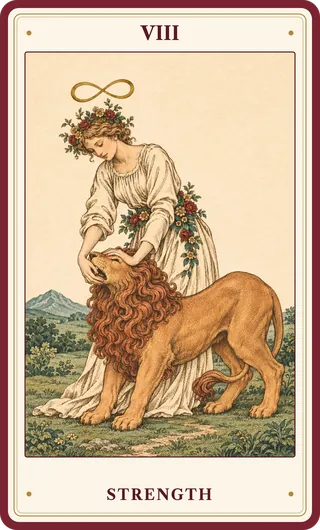
Woman in white
Her white robe stands for purity of intent and a calm, settled mind. She is not armed or armored, which tells you her power is internal.
The lion
The lion is raw instinct: anger, fear, desire and pride. Here it is not killed or beaten, only met and guided, so it can become an ally.
Lemniscate above her head
The infinity sign marks a strength that renews itself and does not run out. It also echoes the number 8, the card's place in the Rider-Waite-Smith deck.
Garland of flowers
A chain of flowers links woman and lion in place of a leash. It shows that connection and gentleness hold more securely than force.
Yellow sky
The warm yellow background points to the sun and to Leo, the sign tied to this card. It gives the scene a feeling of vitality and clear confidence.
Blue mountains
The far peaks suggest that the test is real but not out of reach. They also hint at the long view that patient people keep.
Strength and spiritual growth
Spiritually, Strength is about the relationship between your higher self and your animal nature. The woman does not reject the lion, and she does not give it the throne. This is a picture of integration: bringing instinct, emotion and body into harmony with awareness.
The Leo link adds warmth and heart. Leo’s strength is generous and confident, and it shines most when it is not trying to prove anything. In practice, the card encourages meditation, breathwork, gentle discipline and any habit that helps you stay present with feeling rather than escape it.
In the major arcana sequence, Strength follows The Chariot and comes just before The Hermit. After learning to drive forward with willpower, you learn to master what is inside, and then you are ready for quiet reflection.
Strength vs The Chariot
Both cards are about power and control, but they work differently. The Chariot is outer drive: you steer opposing forces with willpower, direction and determination. It is about winning through effort and focus.
Strength is inner mastery. There are no reins, no armor and no forward motion. The card is about understanding and befriending the force that would otherwise take over. You get through the situation by working with your reactions, not by overpowering them.
A useful rule of thumb: pick The Chariot when you need momentum, and Strength when you need composure. If both appear together, you likely have the drive and the steadiness to see something through.
Is Strength a yes or no card?
Strength leans yes. It supports the idea that you can handle the situation and that patience will pay off. If you ask whether you can get through something, whether you should speak up calmly, or whether a relationship can heal, the card is encouraging.
The yes comes with a condition. It depends on staying composed and kind rather than rushing or forcing. Reversed, the answer becomes “not yet” or “only after you regroup”, since the card is warning that fear or exhaustion is steering. For a quick reading, see Strength as a yes or no answer.
Strength in a reading: past, present, future and advice
Position changes the emphasis. As a past card, Strength shows a time when you endured something with grace, or a pattern of self-control that still shapes you. As a present card, it says this is a test of patience and composure. As a future card, it suggests you will soon be asked to show courage and stay steady.
As advice, Strength is one of the clearest cards in the deck: stay calm, be kind, keep going. As a challenge card, it can mean you are fighting your own reactions, or that you have confused being strong with being hard.
In a Celtic Cross or any spread, notice what sits next to it. Cards that stir up emotion, such as Swords or Cups with heavy themes, show what the lion is. Calm cards show what is already helping.
Try this: Pull Strength out of your deck and set it where you will see it. For one week, each time you feel a strong emotion, pause for three slow breaths before you respond. Note afterwards what changed.
Strength with other cards
Strength changes meaning depending on its neighbors. A few common pairings:
- Strength and The Chariot: drive plus composure, a strong sign for a goal that needs both.
- Strength and Justice: firm, fair decisions and authority guided by a clear rule.
- Strength and The Hermit: quiet, solitary inner work and gradual healing.
- Strength and The Star: confidence returning after a hard period, with hope behind it.
For more ways to read cards together, try the tarot card combination calculator and compare how pairs shift the story.
Common misreadings of Strength
The biggest misreading is that Strength means toughness. It does not. It does not ask you to suppress feelings, stay silent or put up with bad treatment. A person who keeps calm while being mistreated is not showing Strength. Real strength includes boundaries.
Another mistake is treating the lion as the enemy. In the image, the lion is a partner. If you read the card as “defeat your anger” or “crush your desire”, you miss the central idea that those energies become useful when you work with them.
Finally, do not read reversed Strength as weakness in character. It usually reflects fatigue, stress or fear that has a cause. Look at what is draining you and what support would help, and the card turns from a criticism into a plan.
Try this: Name your “lion” in one word. Then write two things you can do this week to treat it with firm kindness: one that gives it space (a walk, a conversation) and one that sets a limit (a boundary, a pause before replying).
How to work with Strength
Strength is a card to carry into daily life. You can pull it as a daily draw when you know a tense day is coming, or use it in a 3 card tarot reading to look at the lion, the calm response and the likely outcome. Journaling on the lion’s role in your life is also a good starting point.
When you draw it, ask three simple questions:
- What strong feeling or situation is in front of me?
- What would a calm, kind response look like?
- What do I need, such as rest or support, to stay steady?
If you are new to the deck, the tarot for beginners guide covers how to build the habit of reading cards in context. Strength is a gentle teacher, and the lesson is the same each time: steady beats loud.
Questions readers ask
What does the Strength card mean in tarot?
Strength means inner courage, patience and compassion. It shows that you can meet a strong emotion or a hard situation by staying calm and kind instead of forcing the outcome.
Is Strength a good card in tarot?
Yes, it is a positive card. It tells you that you have more resilience than you think. It can still be a challenge card, because it appears when something has real intensity that needs steady handling.
Is the Strength tarot card number 8 or 11?
In the Rider-Waite-Smith deck and most modern decks, Strength is VIII and Justice is XI. In older Marseille style decks the numbers are swapped, so Strength is XI and Justice is VIII.
What zodiac sign is the Strength card?
Strength belongs to Leo in the Golden Dawn system that the Rider-Waite-Smith deck follows. The lion on the card and the warm yellow sky both point to Leo's courage and heart.
What does Strength mean for someone's feelings?
Upright, it suggests the person feels loyal, caring and steady, and wants to handle things gently. Reversed, it suggests they feel insecure or overwhelmed and may be hiding that behind distance or control.
What is the difference between Strength and The Chariot?
The Chariot is outer drive: willpower, direction and winning through effort. Strength is inner mastery: calm, patience and winning by understanding what is going on inside you.