
Strength Reversed (Meaning in Love, Work & Life)

- Arcana
- Major Arcana, card 8
- Element
- Fire, Leo
- Yes or no
- Yes
couragepatiencecompassioninner strength
self-doubtlow energyraw emotion
Strength reversed means your inner steadiness is under strain. It most often points to self-doubt, low energy and raw emotion, and sometimes to force or control used where patience would work better. The card is not saying you are weak. It is saying the calm confidence you normally have is not reaching you right now, and that you need to look at why.
In the Rider-Waite-Smith deck, upright Strength shows a woman calming a lion with gentle hands. Turn that image upside down and the balance is lost: the lion is louder, or the woman is tired, or she is gripping too tightly. Below you will find what that looks like in love, work, money and health, how to read it as someone’s feelings, and what to do when it turns up in your spread.
Strength reversed meaning in short
The simplest way to read this card is as a gap between how strong you are and how strong you feel. The first is usually bigger than the second. A bad stretch, a draining relationship or a run of setbacks can leave you doubting abilities you have already proven.
These are the themes that come up most:
- Self-doubt and a drop in confidence
- Low energy, exhaustion or burnout
- Raw emotion that feels hard to manage (anger, fear, tears, jealousy)
- Suppressing feelings in the name of “being strong”
- Using force, pressure or control instead of patience and warmth
Not every reading will carry all of these. Usually one or two stand out, and the surrounding cards and your question tell you which. If you want the card at full strength first, the upright Strength meaning shows what the reversed card is missing.
What the card shows and why upside down changes it
Strength shows a woman in a white robe, a flower garland around her waist, resting her hands on a lion’s mouth. An infinity symbol floats above her head. She is not fighting the animal. She is calm, and the lion is calm because she is. The card teaches that real power is quiet, and that instinct and emotion are best met with understanding, not suppression.
Waite’s own notes for the card list despotism and abuse of power among its reversed ideas, along with weakness and discord. Modern readers lean more towards the inner side of that: self-doubt, depletion and emotions out of balance. Both views describe the same broken relationship between the woman and the lion. Either the lion is in charge, or she is trying to force it.
That is why the reversed card is useful. It asks a precise question: what is the lion in your situation, and how are you treating it? Are you ignoring it, caging it, feeding it, or letting it run the room?
Four ways Strength reversed shows up
Reversed cards rarely have one meaning, so it helps to see the main patterns. Your question usually points to the right one.
Self-doubt and lost confidence
This is the most common reading. You may be second-guessing a decision, comparing yourself with others or feeling like a fraud in a role you earned. The doubt can feel like fact, but it is a mood, not a measurement. Recent setbacks often sit behind it.
Depletion and low energy
Sometimes the card is simply asking if you are running on empty. You have been strong for so long that your reserves are gone. Here, the answer is rest, boundaries and being looked after, not a pep talk.
Raw emotion and loss of composure
The lion is loose. Anger, panic, jealousy or grief are steering your words and choices. This does not make you a bad person. It means you are overloaded and need to slow down before you act.
Force, control and suppression
Two opposite patterns hide here. One is outward: bossing, bullying or pushing hard to get your way. The other is inward: clamping down on feelings and refusing to show any struggle, which usually makes them come out sideways later. Both confuse strength with control.
Read Strength for your question
Upright: Patience, tenderness and the courage to stay open with a partner, even when things are hard.
Reversed: Insecurity, jealousy or emotions running ahead of you, or one person trying to manage the other instead of naming a feeling.
Upright: They feel a steady, protective affection and admire your character.
Reversed: They care but feel unsure of themselves, and fear or pride is making them hold back or overreact.
Upright: Calm leadership, persistence and confidence built through practice.
Reversed: Impostor feelings, burnout or reacting sharply under pressure, sometimes using force where patience would work better.
Upright: Steady discipline, patient saving and the strength to resist impulse spending.
Reversed: Anxious avoidance of your finances, or impulsive spending to soothe a bad mood.
Upright: Meet the difficulty with warmth and steadiness, not force.
Reversed: Rest first, treat the frightened part of you kindly, and act again once you feel steadier.
Upright: Good resilience and a sensible, sustainable routine.
Reversed: Low energy, stress running high and self-care slipping, so rest and support come before pushing harder.
Strength reversed in love
In a relationship reading, Strength reversed often points to insecurity or emotional reactivity. One of you may be jealous, clingy or quick to take offence, or may be pulling back so as not to feel exposed. It can also show an imbalance where one partner manages, corrects or controls the other, and calls it help.
The card can also describe patience that has run out. You may have been the calm one, the carer or the one who absorbs everything, and now you are tired. If you are asking whether to stay, the card does not decide it for you. It asks whether you are giving from care or from fear, and whether your patience is being met with any in return.
For singles, Strength reversed suggests that self-doubt is the main obstacle, not a lack of options. You may be hiding parts of yourself, assuming rejection before it happens or leaning on someone else to feel whole. Working on how you speak to yourself will do more for your love life than any new tactic. For the partner’s side of the question, read about Strength as feelings.
Try this: Write down the last three times you reacted strongly in your relationship. Next to each, name the feeling underneath (fear, hurt, embarrassment, tiredness). Then write one calm sentence you could say about it next time.
Strength reversed as feelings
When you ask what someone feels about you, Strength reversed usually describes someone with real emotion who is not at ease with it. They may care deeply but fear looking weak, being rejected or losing control of what they feel. That can look like hot and cold behaviour, sudden defensiveness or going quiet when things get close.
It can also describe someone who is overwhelmed by their own life and has little left to give. Their distance may be about capacity, not interest. The card alone cannot tell you which, so look at what they actually do over time, not only at what you hope the card means.
If you are the one who feels this way, the card is an invitation to be honest with yourself first. You do not have to have everything figured out to tell someone you are scared.
Strength reversed in career
At work, Strength reversed often shows up as impostor feelings, a loss of nerve or burnout. You might be avoiding a promotion, holding back ideas or letting a difficult colleague walk over you. The skills are there. The belief is shaky, and the stress is high.
It can also describe how leadership goes wrong. A manager under pressure may start using force, fear or sarcasm to get results, and mistake compliance for respect. If that is you, the card asks if your approach works or only silences people. If it is someone else, it may show a workplace where power is being leaned on instead of earned.
If you are thinking of quitting, the card warns against deciding in a low moment. Doubt and exhaustion can make any job look like the problem. Rest, then check whether the same decision still looks right. The reversed Ten of Wands can help here if overload is the real issue.
Strength reversed in money
In finances, Strength reversed points to emotions driving money choices. That might be spending to soothe stress, avoiding your bank statements because they cause anxiety, or tolerating a bad deal because you do not feel able to push back. It can also reflect a loss of confidence after a financial setback.
The reading is not about how much you have. It is about composure. A calm look at the numbers, even small ones, is a strong move. Set up one simple system, such as a weekly ten-minute check, rather than a dramatic overhaul that your tired self will abandon.
It can also warn against forcing a financial outcome, such as chasing losses or pushing a negotiation too hard. Patience usually serves you better.
Strength reversed in health and spirituality
For health, the card nearly always talks about energy and stress. You may be pushing through fatigue, skipping rest or using willpower where support is needed. It can reflect low mood or anxiety, and it is a gentle prompt to speak to a doctor or therapist if things feel heavy. A tarot card can reflect a mood, but it cannot diagnose anything.
Spiritually, the card reminds you that strength is not the same as never struggling. Many traditions treat humility and gentleness as signs of power. Reversed Strength may be asking you to stop performing resilience and let yourself be supported.
Practices that help are the plain ones: sleep, movement, time outdoors, quiet and honest conversation. They rebuild the calm that the upright card celebrates.
Strength reversed as a person
When Strength reversed describes a person, picture someone caught between their fear and their pride. They might be insecure and defensive, quick to anger when challenged, or a controlling type who is really afraid of losing control. Others may see bluster, while inside the person feels shaky.
It can also describe a gentle, capable person who is simply worn out. Context makes the difference. Look at the question, the position of the card and the cards beside it. If the nearby cards are sharp or aggressive, think force. If they are heavy or tired, think depletion.
In astrology, Strength is linked to Leo, so a reversed card can echo a proud, warm person whose confidence has been knocked. That is a possible clue, not a rule.
Strength card symbols
Choose a symbol to read what it means on the card.
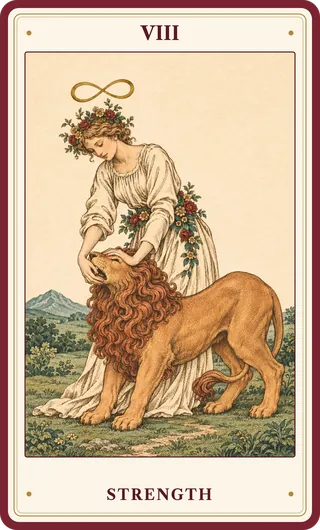
The woman in white
Her white robe stands for a clear, composed spirit. Reversed, she is the part of you that is tired or doubting, not gone.
The lion
The lion is instinct, appetite, anger and fear. Reversed, it may be loose and in charge, or held down so hard that it growls underneath.
The infinity symbol
The lemniscate above her head shows a steady, unlimited source of inner power. Reversed, it reminds you the reserve is still there even when you cannot feel it.
The gentle hands on the jaws
She calms the lion by touch, not by force. Reversed, you may be gripping too hard, or not touching the problem at all.
The garland of flowers
The flowers around her and the lion show that nature and discipline can be joined by gentleness. Reversed, that link is strained, and control starts to feel like a fight.
The mountains
The far peaks suggest a long climb that can be survived by steady effort. Reversed, the distance feels bigger than your energy.
The yellow sky
The warm sky reflects clarity and the Sun-like confidence of the card. Reversed, it suggests the light is dimmed by worry, not removed.
Is Strength reversed a yes or no?
Reversed, Strength leans towards “not yet” or “yes, but you need to steady yourself first”. The outcome is not blocked. The issue is that doubt, fatigue or emotion may distort your choices right now. If you are acting from panic or anger, the answer to most big questions is to wait.
Apply it to the question. “Should I send this angry message?” is a clear no for now. “Can I handle this challenge?” is a qualified yes, because the card says the strength exists but you need to rebuild trust in it. For the full picture, including the upright answer, see Strength as a yes or no.
How to respond when Strength reversed appears
You do not fix this card by pushing harder. These steps usually work better, in roughly this order:
- Rest or pause before you decide anything important.
- Name what you feel in plain words, ideally out loud or on paper.
- Look for evidence of past strength: times you coped, learned or recovered.
- Ask one trusted person for support, or ask for one practical thing.
- Take one small, calm action and notice how it feels.
The point is to rebuild trust in yourself gradually. Big dramatic moves belong to the upright card, when you feel steady. Reversed Strength is about repair.
If force or control is your pattern, add one more step: ask what you are afraid will happen if you loosen your grip. That answer is usually the real lion.
Try this: Take five minutes tonight and list ten moments when you handled something hard. Include small ones. Read the list aloud, then pick one thing you can do tomorrow with the same quiet steadiness.
Strength reversed versus upright
Upright Strength is gentle mastery: courage, compassion and patience working together. You feel the fear and act anyway, with warmth toward yourself and others. Reversed, that balance wobbles. You may doubt, lash out, shut down or drain yourself holding everything together.
The card is the same, and so is the lesson. The difference is where you are in it. Upright shows the skill in action. Reversed shows the skill under repair, which is a normal stage for anyone, not a failure. If you often pull this card upside down, you are probably in a season of rebuilding, not a permanent state.
A useful comparison is the reversed Chariot, which is about losing direction and drive. Strength reversed is quieter and more internal: the problem is less where you are going and more how you feel about yourself on the way.
Strength reversed in different spread positions
Position changes the emphasis. Here is how it tends to read:
- Past: A time when you doubted yourself or burned out, and it still shapes your reactions now.
- Present: You are depleted or emotionally stretched, and the issue is current.
- Future: A warning to protect your energy and composure before a challenge arrives.
- Obstacle: Your own self-doubt, fear or temper is the main block.
- Outcome: Things resolve once you rebuild confidence, or a result is shaky until you do.
- Advice: Rest, soften your approach and trust yourself again.
In a simple 3 card tarot reading, Strength reversed in the middle often shows the heart of the matter: the emotion or doubt at the centre. Cards on either side show how it began and where it can lead.
Strength reversed with other cards
Combinations sharpen the meaning. A few useful pairings:
- With the Nine of Wands: you are close to your limit but still guarding yourself, so rest matters. See the Nine of Wands.
- With the Five of Cups: loss and grief are weighing on confidence.
- With the Emperor: control is the theme, either too much or too little.
- With the Star: healing is available once you accept support.
- With the Devil: fear or an unhealthy pattern is holding you in place.
When the nearby cards are positive, Strength reversed is often a brief dip. When the spread is heavy overall, it points to a longer recovery. Either way, the lion in the card is not an enemy, and your task is to build a calmer relationship with it.
Reading Strength reversed if you do not use reversals
Many readers never turn cards upside down. If you are one of them, you can still draw on this meaning by reading upright Strength with a question: where are you not showing it? When the card appears and you feel tired, doubtful or on edge, treat it as a prompt to restore your inner balance.
For readers who do use reversals, it helps to see them as a shift in emphasis, not a flip to the opposite. Our guide to reading reversed tarot cards covers the different methods, from blocked energy to shadow side. Strength works well with the “blocked” approach: the quality is there, but something is in the way.
Try this: Pull Strength out of your deck and place it upright on your desk for a week. Each morning, ask one question: where do I need gentleness today, with myself or someone else?
Questions to ask yourself when you draw it
A reversed card works best when it prompts honest questions. Try these:
- Where do I feel less capable than I really am?
- What emotion am I trying to hide, and why?
- Where am I using pressure when patience would work?
- When did I last rest properly?
- Who helps me feel steady, and have I asked for support lately?
You do not need perfect answers. A single honest sentence is enough to shift the reading from vague unease into something you can act on. If you want more ideas for framing your own readings, see our list of questions for a tarot reading later on the site.
Questions readers ask
What does Strength reversed mean in tarot?
Strength reversed points to self-doubt, low energy and emotions that feel bigger than your ability to handle them. It can also mean force or control used where patience would work better. The courage is still in you, but it needs rest and care to come back.
Is Strength reversed a bad card?
No. It is a check-in, not a verdict. It shows where your confidence or composure has slipped so you can respond before it costs you more.
What does Strength reversed mean in love?
It usually shows insecurity, jealousy, emotional reactivity or a power imbalance, such as one partner managing the other. It can also describe someone who is hiding their true feelings out of fear. The fix is honesty and self-compassion, not more control.
What does Strength reversed mean for how someone feels about me?
They likely have real feelings but feel unsure, overwhelmed or afraid of being vulnerable. That can show up as hesitation, mixed signals or a sharp reaction when they feel exposed. It describes their inner state more than a lack of interest.
Is Strength reversed a yes or no?
It leans towards a cautious not yet. The situation can work out, but you or someone involved is not steady enough right now. Wait until you feel calmer, then ask again.
What is the difference between Strength reversed and Strength upright?
Upright Strength is gentle mastery: calm, courage and compassion working together. Reversed, that balance breaks, either into doubt and depletion or into force and suppressed emotion. The lesson is the same, but the work becomes rebuilding trust in yourself.