
The Chariot Reversed (Meaning in Love, Work & Life)

- Arcana
- Major Arcana, card 7
- Element
- Water, Cancer
- Yes or no
- Yes
determinationvictorydirectionwillpower
lack of directionaggressionobstacles
The Chariot reversed means that your forward momentum has broken down. The drive is still there, but it has lost direction, scattered across too many goals, or turned into force and aggression. In a reading it asks one question: who is actually steering?
It is rarely a card of defeat. The upright Chariot is about victory through self-command, so the reversal shows where that command has slipped, and that is information you can act on. Below you will find what the card means in love, work, money, health and as a person or set of feelings, plus how to tell which kind of reversal you are looking at and what to do about it.
The Chariot reversed at a glance
The core idea is misdirected or blocked will. Where the upright card moves ahead with focus, the reversed card spins its wheels, pulls in two directions, or pushes so hard that it damages what it is trying to reach.
Common keywords include loss of control, lack of direction, aggression, scattered energy, stalled progress, obstacles, indecision and self-sabotage. Some readers also add burnout and overcontrol, which is the over-driven side of the card.
The Chariot is card VII of the Major Arcana, tied to the element of water and the zodiac sign Cancer. That water link matters when it is reversed, because it hints that emotion is often what is really steering, even when the situation looks like a purely practical one.
What the upright Chariot is about, and what breaks
To read the reversal well, remember what is working in the upright card. A charioteer holds two opposing sphinxes together and drives them forward through will alone. There are no reins in the Rider-Waite-Smith image. He steers by concentration and intention, and that is the point of the card.
Victory in this card does not come from being unopposed. It comes from managing opposing forces: ambition and fear, head and heart, what you want and what is sensible. The upright Chariot says you have done that internal work and can now move.
When the card is reversed, something in that arrangement has failed. Either the opposing forces have gained the upper hand, or the driver is forcing them instead of leading them, or the driver has stepped out of the seat. Knowing which one of those three applies is the key to a useful reading.
What changes in the image when the card flips
Turn the card upside down and the picture itself tells the story. The sphinxes, now facing different ways, seem to pull the chariot apart. The charioteer, with his wand and his armor, looks less like a commander and more like a passenger hanging on. The city behind him, once a place he was leaving with purpose, becomes the thing he cannot escape or the thing he fled without a plan.
Remember that this is a card without reins. Upright, that shows control by will. Reversed, it can show how fragile that will becomes when it is not backed by a clear aim. Nothing physical holds the sphinxes in place except the driver’s attention, so when attention drifts, the whole vehicle goes with it.
It also helps to see that the starry canopy overhead is about trust in a direction larger than the ego. A reversed Chariot often belongs to someone who has either lost that sense of direction or never checked whether the goal is actually theirs.
Read The Chariot for your question
Upright: You pursue love with clear intention, commit to a direction together and move the relationship forward with confidence.
Reversed: The relationship stalls, one of you pushes too hard or pulls away, and two different ideas of the future are tugging in opposite directions.
Upright: They feel driven, certain and ready to act on what they want.
Reversed: They feel conflicted, overwhelmed or unsure, and may be sending mixed signals because they cannot decide.
Upright: You advance through focus and discipline, and a promotion, launch or clear win is within reach.
Reversed: Effort is scattered or stuck, with burnout, power struggles or a plan that needs rethinking before you push on.
Upright: You take charge of your finances with a firm plan and steady progress toward a target.
Reversed: Spending is impulsive or avoided, and money decisions are being delayed or forced without a clear budget.
Upright: Hold your focus, pick a destination and drive toward it.
Reversed: Stop, choose one direction and reset your approach before you add more speed.
Upright: Discipline and routine give you strong momentum with your body and habits.
Reversed: Overtraining, restlessness or a stalled routine signals that willpower alone is not carrying you, so rest and simplify.
Three ways the Chariot reverses
Not every reversed Chariot means the same thing, and mixing them up is the most common mistake. Look at the surrounding cards and your question to decide which pattern fits.
- Lost control: you have let go of the wheel. Life, other people or habits are steering. This is the most common reading, and it carries a sense of drifting or being a passenger.
- Forced control: you are gripping too hard. Discipline has become rigidity, ambition has become aggression, and you are bulldozing people or timing that will not bend.
- Stalled movement: the sphinxes are pulling opposite ways, so you sit still. This is indecision, with fear and desire cancelling each other out.
Each pattern calls for a different response. Lost control needs you to retake the seat, forced control needs you to ease off, and a stall needs a decision. If you are unsure which one you have, ask whether you feel too powerless or too pushy. The answer is usually obvious.
Try this: Write down the goal you are stuck on. Underneath, finish this sentence three times: “The part of me that wants this is ___, and the part of me that doesn’t is ___.” Seeing both sphinxes in words often shows you which way the chariot is really leaning.
The Chariot reversed in love
In love, the reversed Chariot most often describes a relationship that has stopped moving. You may be stuck at the same stage for months, with no real conversation about where things are heading. Or you may want different futures, and the unspoken gap between those two plans has made progress impossible.
The card can also describe a power struggle. One partner pushes the pace, makes the decisions and tries to win arguments, while the other digs in or withdraws. Love cannot be conquered the way a contest can, and the reversed Chariot warns that forcing a connection or controlling the pace of a relationship usually pushes the other person away.
If you are single, the card can show someone who is either charging after relationships with more force than feeling, or avoiding them out of fear of choosing wrong. It is a signal to slow down, find out what you actually want, and stop treating love like a project to be completed. If you are in a relationship that feels pulled in two directions, the Lovers reversed is a useful card to look for beside it, since it speaks to values and choices.
The Chariot reversed as feelings
When you ask what someone feels about you, the reversed Chariot points to confusion. They may be pulled between wanting you and being afraid of what that means, or between staying and leaving. That inner tug-of-war can show up as mixed signals: warm one week, distant the next.
This is not the same as rejection. A person who feels nothing rarely produces a conflicted Chariot. More often it means they are overwhelmed, unsure of their own direction in life, or struggling to commit to a decision they have not yet made. It can also show someone who is holding their feelings back because they feel out of control.
If the card describes your own feelings, take it as a sign that you may be reacting rather than choosing. You can find the upright version of this reading in the Chariot in love and as feelings, which is helpful for comparing the confident and conflicted versions of the same person.
The Chariot reversed in career
At work, the reversed Chariot shows ambition that is not getting traction. You may be putting in effort and seeing little return, working in a role with no real room to grow, or running a business that goes in circles. The phrase “spinning your wheels” fits well.
It can also mean the opposite problem: too much force. Micromanagement, power struggles with colleagues, pushing a project through before it is ready, or driving yourself into burnout are all Chariot reversed territory. In that case the lesson is to reduce pressure and trust the plan, not to push harder.
Because the card is about direction, it is worth asking whether the goal itself still fits. A reversed Chariot sometimes appears when you are chasing a promotion or a title that you no longer actually want. Before you add more effort, check that the road leads somewhere you want to go.
The Chariot reversed with money
With finances, the card shows weak steering. That might mean impulsive spending, where emotion rather than a plan is making the decisions. It might mean the opposite, putting off money decisions, ignoring a budget or leaning on someone else because taking charge feels uncomfortable.
It can also point to financial disagreements with a partner, where each person is pulling toward a different goal. Treat it as a prompt to review where your money is actually going and whether your spending matches what you say you want.
The card does not predict ruin, despite what some sources claim. It says that your current handling of money lacks a clear aim. A simple plan with one target, whether that is a debt, a savings figure or a purchase, is the usual fix.
Health and wellbeing
In health readings, the reversed Chariot often describes willpower used the wrong way. You may be over-training, forcing a strict diet, or pushing through exhaustion because stopping feels like losing. The body eventually pushes back.
It can equally show the other direction: a routine that has fallen apart, a loss of motivation, or restlessness that will not settle. In both cases the card suggests that sheer effort is not the right tool right now. Rest, a simpler plan and support from others tend to do more than another burst of discipline.
If your reading touches on anxiety, stress or feeling out of control, treat the card as emotional context only. For any physical or mental health concern, a doctor or qualified professional is the right place to start, not a tarot spread.
The Chariot card symbols
Choose a symbol to read what it means on the card.
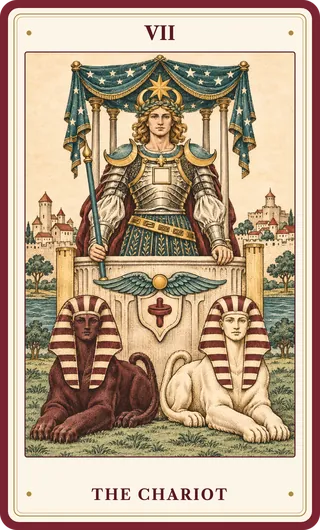
The armored charioteer
He represents will and self-command. Reversed, the armor can turn into rigidity or aggression, or it can crack and leave him unsure who is in charge.
Black and white sphinxes
They stand for opposing forces such as desire and doubt, or head and heart, that the charioteer must hold together. Reversed, they pull apart and the chariot goes nowhere or lurches in two directions.
The starry canopy
The stars overhead point to guidance from something larger than ego. Reversed, you may be ignoring that guidance or driving by willpower alone.
The walled city behind him
The city is the settled life he has left behind or defended. Reversed, it can mean you are unable to leave it, or that you charge off without a plan for what comes next.
The river
Water at his back reflects emotion and the unconscious, which he has mastered upright. Reversed, feelings are either flooding the driver or being ignored.
The winged emblem on the front
The winged disc speaks of purpose lifted above instinct. Reversed, the lift is missing and the effort stays earthbound and scattered.
Crescent moons on the shoulders
They tie him to the changing tides of emotion and intuition. Reversed, mood can steer you more than intention does.
Spirituality and personal growth
On a personal level, the reversed Chariot raises the question of purpose. You may be going through the motions without knowing why, or following a path set by family, culture or habit rather than choice. The sense of being lost is strong, and it can feel like driving through fog: you are moving, but you cannot see the road.
This is a good card for inner work. The sphinxes can be read as two parts of yourself that disagree. Giving each of them a voice, in journaling or meditation, tends to do more than trying to silence either one.
It also shows how ego and guidance can conflict. If the starry canopy over the chariot stands for something larger than your own plans, a reversal may be telling you to listen before you charge ahead.
Try this: Sit for five minutes and picture the two sphinxes, one black and one white. Give each a name and a sentence it would say to you. Then ask the driver what single next step all three of you can agree on.
The Chariot reversed as a person
As a person, the reversed Chariot can describe someone controlling, restless or prone to bulldozing others in order to get their way. They may be competitive, impatient and hard to argue with, and the intensity can turn aggressive when they feel blocked.
It can just as easily describe someone who has lost their drive: a person who is unfocused, avoids decisions and lets others steer. The thing they have in common is the lack of healthy command. Neither the bully nor the drifter is truly in the driver’s seat.
If the card represents you, it is not a character judgment. It describes a current pattern. The upright qualities of focus and self-command are still available to you, and the card is a reminder to use them.
Is the Chariot reversed a yes or no?
For a yes or no question, the reversed Chariot leans toward no, or more helpfully “not yet.” The goal may still be possible, but the plan, timing or state of mind behind it is not ready. Pushing ahead now would likely waste effort or cause damage.
How you read it depends on the question. If you ask “Should I launch this week?” the answer is probably to wait and tighten the plan. If you ask “Will this relationship move forward?” it suggests a stall that needs a conversation first, not a final ending.
For a clearer upright comparison, see the Chariot as a yes or no answer, which shows how the same question reads when the card is the right way up.
The Chariot reversed in past, present, future and outcome positions
In the past position, the card shows a time when you lost control or direction, or when a push for a goal went too far. In the present, it describes where you are stuck or scattered now. As a future card, it is a caution: if you continue this way, momentum will stall.
As an outcome, the reversed Chariot should be read as a warning about the path, not a closed door. It suggests the result you want needs a change in approach, whether that means slowing down, deciding or letting go of control. The cards around it will show which.
If it falls in a blockage or challenge position, the message is more specific: your own scattered will or overcontrol is the obstacle. The reversed card asks you to look at your own hands on the wheel before you blame circumstances. For more on how position and reversal interact, see how to read reversed tarot cards.
Cards that pair with the Chariot reversed
Some combinations sharpen the meaning. Eight of Wands reversed alongside it points to delays and stalled speed, so the road is blocked as well as unclear. Strength reversed suggests that self-doubt or a lack of inner calm is underneath the loss of control.
Two of Swords reversed shows that indecision is the real brake. You are pulled between options and cannot choose, which is exactly the two-sphinx problem. With the Hermit, the message becomes to step back and think before moving again.
Paired with strong upright cards such as the Sun or the Star, the reversal softens. It becomes a short wobble inside a larger story that goes well, a pause rather than a collapse.
What to do when the Chariot appears reversed
Start by naming which of the three patterns fits: lost control, forced control or a stall. That one step usually shows you the next move. Then reduce your goal to a single, clear destination. The Chariot depends on one aim, and scattered aims are what break it.
Next, check what is pulling in the opposite direction. Fear, old habits, another person’s expectations and your own mixed feelings all count. You do not have to defeat them. You only need to understand them well enough to hold them together.
Finally, choose a small action you can take this week and do it. The reversed Chariot is fixed by regaining the seat, not by a grand plan. Even a modest, decisive move changes how steady the whole vehicle feels.
Try this: Pull the card again for each of the three patterns (lost control, forced control, stall) using a random tarot card generator, or simply ask yourself which one you recognize. Then write one action for the one that fits, and do it within 24 hours.
Common mistakes when reading the Chariot reversed
The most common error is treating it as a prediction of failure. The card describes the state of your drive, not a fixed outcome. Another error is assuming reversal always means weakness, when overcontrol and aggression are just as likely.
It is also easy to forget the question. The same card reads very differently in a love spread and a career spread, so keep it tied to what you actually asked. And if you feel it is describing someone else, check whether the pattern belongs to you too before you decide it is all their fault.
Finally, do not skip the upright card. Knowing what the Chariot looks like when it works, with focus, command and clear direction, tells you what the reversed version is missing and gives you something concrete to aim for.
Questions readers ask
What does the Chariot reversed mean?
The Chariot reversed means your forward momentum has broken down. It points to lost direction, scattered willpower, or force and aggression used in place of focus. It is a prompt to regain control, not a fixed verdict.
Is the Chariot reversed a bad card?
Not really. It describes a block or a misuse of drive, and both can be corrected. It is most useful as an early warning that your current approach is not working.
What does the Chariot reversed mean in love?
It usually shows a relationship that has stalled, a power struggle, or two people who want different things. It can also describe a single person who feels torn between wanting love and fearing it. Honest conversation and one clear decision are the way forward.
Is the Chariot reversed a yes or no?
It leans toward no, or more precisely not yet. The goal may still be reachable, but the current plan, timing or state of mind is not ready for it.
What does the Chariot reversed mean as someone's feelings?
It suggests the person is conflicted, overwhelmed or hesitant, and may be moving forward and back without a decision. It is more often confusion than rejection.
What is the difference between the Chariot reversed and the Eight of Wands reversed?
The Chariot reversed is about personal control and direction, the question of who is driving. The Eight of Wands reversed is about speed and delays, the question of why things are slow. They often appear together when a stalled plan needs both clarity and patience.