
The Chariot as a Yes or No Answer

- Arcana
- Major Arcana, card 7
- Element
- Water, Cancer
- Yes or no
- Yes
determinationvictorydirectionwillpower
lack of directionaggressionobstacles
The Chariot is a yes. Upright, it is one of the more confident answers in the Major Arcana, and it tells you that you can reach the goal if you take control, stay focused and keep moving. Reversed, it is a no or a not yet, because the effort behind the question is scattered or the timing is off.
It is also a conditional yes. The Chariot never says the outcome will arrive without your effort. It says you have what you need, and the result depends on how well you steer. This page covers how to read that answer for love, career, money, health and timing, and what to do when the card lands reversed or beside another card. For the full card, see the Chariot tarot card meaning.
The short answer: yes, if you drive
In a yes or no reading, upright Chariot means yes. If you ask whether you will succeed at something that depends on your own drive, such as a goal, a project or a decision to act, the card backs you. It is a card of victory through discipline, and it shows up when someone is ready to stop hesitating.
Reversed Chariot means no or not yet. The card has not turned into a flat refusal. It is closer to a signal that the engine is running but nobody is steering. If you draw it reversed, the question is usually not about whether you can, but about whether you are ready to commit to a single direction.
Think of the Chariot as a green light with an instruction attached. It does not predict a smooth ride. It predicts that if you hold the line, you arrive.
Why the Chariot leans yes
The Chariot is card seven of the Major Arcana, and its image is one of motion and control. A charioteer in armor stands in a stone cart, with a starry canopy overhead and a city behind him. He has already left the walls. Nothing in the picture suggests waiting.
The two sphinxes, one black and one white, are the key to the answer. They represent opposing pulls: what you want versus what you fear, or what you should do versus what you feel like doing. The charioteer does not defeat either one. He holds them together and goes forward, which is why the card supports a yes for anyone willing to do the same.
Because the card is about willpower rather than luck, it is also a card of ownership. The yes belongs to you. That is a more useful answer than a bare “yes” would be, because it tells you what to do next.
What kind of yes it is
The Chariot’s yes comes with conditions, and it helps to be clear about them. When you pull the card, the answer usually means yes if you:
- commit to one direction instead of keeping several options half open
- stay disciplined through the boring or difficult middle stretch
- manage the competing pressures in your life rather than letting them manage you
If the thing you are asking about needs none of those, the card is less relevant. A question that depends entirely on another person’s choice, or on pure luck, is a poor fit for a card about your own steering.
Try this: Write your question, then draw the Chariot (or imagine it). Under the question, list the two “sphinxes” in your situation, the two pulls you feel. Then write one sentence on how you will keep both moving in the same direction.
Read The Chariot for your question
Upright: A yes to taking the next step, as long as you act on it and stay honest about what you each want.
Reversed: A no for now: mixed signals, a power struggle or two people pulling in different directions.
Upright: They are driven and invested, and they want to move things forward with intent.
Reversed: They feel pulled in two directions, defensive or unsure, and their feelings are not steering anything yet.
Upright: A strong yes to the promotion, the pitch, the application or the push toward a goal.
Reversed: Not yet: your plan lacks direction, or you are rushing into something without a clear route.
Upright: Yes to a focused, planned move, such as a disciplined savings push or a confident business step.
Reversed: No to impulsive spending or investing, and no to any plan you cannot steer.
Upright: Pick a direction, hold your focus and commit to the effort the answer will take.
Reversed: Stop and regroup before you act, because force and speed will not fix a scattered plan.
Upright: Yes to building a routine, recovering with discipline and sticking to a plan.
Reversed: No to pushing through or overdoing it, as burnout and erratic habits are the risk.
The Chariot reversed as yes or no
Reversed, the Chariot is a no, or more often a “not yet.” The usual causes are lost focus, poor timing, aggression without a plan, or an internal conflict you have not settled. The sphinxes are pulling apart, and the cart is going nowhere useful.
It helps to separate two readings. One is “no, this will not work.” The other is “no, not the way you are going about it.” The reversed Chariot is nearly always the second. It shows you are trying to force an outcome or racing ahead without a route, and it asks you to pause and set a direction. For a fuller look at how it reads in different areas of life, see the Chariot reversed.
If you do not read reversals, the Chariot is simply a yes, and you can lean on the surrounding cards for nuance. If you do, the guide to reading reversed tarot cards will help you decide how strictly to treat the flip as a no.
The Chariot yes or no in love
For love questions, the Chariot is a yes when the question is about action. Should you ask them out, commit, move in, or push through a rough patch together? The card says yes, as long as both of you are pulling toward the same place. It is a card of two forces made to work as one, which suits a relationship at a turning point.
It is more of a maybe when the question is passive, such as “Will I meet someone?” or “Will they come to me?” The Chariot rewards people who go out and steer. It is less about love arriving and more about you showing up for it. If you are single, read it as a yes to putting yourself in motion, not a promise of a particular person.
For what the card says about someone’s feelings in a relationship, see the Chariot in love and as feelings. The short version: they are driven, invested and want to move forward, though they may be controlling or stubborn about it.
Getting back together and “will they return?”
For reconciliation, the upright Chariot is a cautious yes. It suggests movement is possible, but only if both people are willing to align their goals and work at it. Old patterns will not fix themselves, and the card often shows two people who both want to lead.
Reversed, it leans no. The two of you are pulling in opposite directions, and one or both of you is either too proud or too unsure to commit. That does not close the door forever. It says the reunion does not work as things stand.
If you are asking about a specific person’s response, keep the question about what you can do. “Should I reach out and propose we try again?” gives the Chariot something to answer. “Will they text me?” leaves it with nothing to steer.
Career and job questions
Work is where the Chariot is at its most confident. Should you apply for the promotion, launch the project, take the interview, or push for the raise? The card says yes, especially when the path is clear and the goal is something you are willing to work toward. It often shows up when a person has been ready for a while and needs permission to go.
It is a weaker answer if your question is “Should I stay or leave?” with no plan attached. The Chariot supports whichever route you will drive with purpose, so if both options leave you idle, the card has little to add. Pair it with a second draw to see which route it favours.
The card also fits questions about studying, exams and competitions. It carries the energy of a person who prepares, shows up and wins. A reversed Chariot in these questions points to poor preparation, nerves or an attempt to rush the work.
Money and business
For money, the Chariot is a yes to disciplined, planned moves. Starting a business, committing to a savings target, or paying down debt on a strict schedule all fit its energy. The card favours the steady driver over the gambler.
It is not a yes to impulsive spending, even if the feeling of momentum is strong. Speed without direction is exactly what the reversed card warns about. If you are asking about an investment or a purchase, ask whether you have a plan you can steer, since the Chariot answers that better than it answers whether the market will rise.
Remember that tarot is not financial advice. Use the card to test your own readiness and commitment, then check the real numbers.
The Chariot card symbols
Choose a symbol to read what it means on the card.
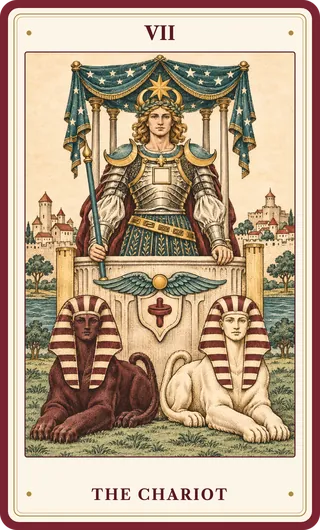
The charioteer in armor
He is a figure of discipline and self-command, dressed for a fight he intends to win. His power comes from his own will, not from luck.
The black and white sphinxes
They pull the chariot in opposite directions, standing for competing forces within you or your situation. The yes depends on you holding them together.
No reins
The charioteer steers by willpower and focus rather than by force. It shows that real control is mental before it is physical.
The starry canopy
Stars over his head link his ambition to something larger than a personal wish. The goal has meaning, which is part of why the card supports a yes.
The city and river behind him
He has left the safe, settled place and is heading out into open ground. The yes means moving, not staying put.
The crescent moons on his shoulders
These pauldrons carry intuition and instinct on his body as he advances. They show that drive works best when it is paired with inner guidance.
The winged emblem on the chariot
A winged disc on the front of the cart points to purpose and higher direction. It suggests the movement has an aim, not just speed.
Health and personal goals
For health goals such as building a training routine, sticking to a recovery plan, or quitting a habit, the Chariot is a yes. It is the card of self-mastery, and it describes someone who has decided to stay on course. The yes is strongest when the goal is behavioral and depends on consistency.
Reversed, it warns against forcing results or overdoing it. A person who pushes too hard, too fast, may burn out or get hurt. Treat that as a nudge to build a steadier plan.
The card cannot diagnose or predict a medical outcome, so do not use it to decide about treatment. Use it as a reflection on your own determination and pacing.
Timing: how fast is the yes?
The Chariot is a card of speed and forward motion, so the answer tends to come through activity rather than long waiting. It is not “wait and see.” It is “go and do.” You often see results as soon as you commit and begin, rather than months down the line.
That said, it does not promise a date. The yes arrives as fast as you move. If you hesitate, the timing slips. Some readers link the card with Cancer, but this is not a reliable way to fix dates, so avoid reading the card as a calendar. For more on pinning down when, the guide to tarot timing covers the methods readers use and their limits.
Try this: Draw the Chariot for a goal and set a 7 day test. Write down one concrete action you will take each day for a week. At the end, ask whether you are steering the situation or just riding along.
When the Chariot is the wrong answer
Sometimes the Chariot upright does not feel like a yes, or does not fit. This usually happens when the question calls for the opposite of what the card offers. If you ask “Should I wait this out?” or “Should I rest?” the Chariot’s call to act pushes against the question itself.
It also fits poorly with questions about outcomes you cannot influence. Lottery results, another person’s secret thoughts or events decided by others do not respond to willpower, so the card’s yes has nothing to attach to. In those cases, redraw using a better-framed question.
Finally, the Chariot can carry a harsher side. Waite’s own list of meanings includes triumph, but also presumption and trouble. If you are asking about a plan where you would win by overpowering someone else, the card can warn about arrogance rather than bless the push.
The Chariot with other cards in a yes or no spread
In a multi-card draw, the Chariot sets a tone of forward motion, and the cards around it decide how smooth the road is. A three-card spread works well here: situation, obstacle, outcome. A Chariot in the outcome position is a clear yes. In the obstacle position, it says the thing blocking you is a fight for control, often with yourself.
A few combinations come up often:
- Chariot with Eight of Wands: a strong yes, and fast. See Eight of Wands as a yes or no answer for the card on its own.
- Chariot with Eight of Swords: the yes softens into a maybe, because fear or self-doubt is holding the reins. The Eight of Swords yes or no explains why.
- Chariot with The Hermit: the answer is yes, but slow down. Reflection comes first, then action.
When two yes cards land together, the answer is strong. When the Chariot meets a card of delay or doubt, read it as “yes, if you deal with that first.”
How to ask a question the Chariot can answer
The Chariot responds best to questions about your own action. Vague questions get vague answers, and passive questions give the card nothing to steer. A little care with wording makes the answer more useful.
- Make the question about something you can do or influence.
- Keep it specific, with one decision and one time frame.
- Avoid “will” questions about other people’s choices.
- Decide beforehand whether you are reading reversals.
- Treat a yes as a prompt to act, and a no as a prompt to adjust.
If you want a quick draw to test a question, the yes or no tarot reading tool will give you an answer to work with. Treat any result as a reflection, not a guarantee.
Reading the card’s image for your answer
Looking at the picture can sharpen the answer. The charioteer has no reins, which tells you the steering is internal. If your question depends on a gadget, a plan or another person to do the work, the image reminds you that the Chariot’s yes depends on your own focus.
The city behind him is a useful detail for any “should I leave?” question. He has already left it, and he is not looking back. A yes here often means a decision is already made inside you, and the card is confirming it. The river and the stone cart under his feet add that the movement is real, built on solid ground.
Finally, notice that the sphinxes are resting, not straining, as long as he holds his focus. When your own conflicting needs are balanced, the pull becomes power. That balance is what the Chariot’s yes is made of.
Quick reference: Chariot yes or no answers
Use this as a summary of how the card tends to answer different questions.
- General question: yes, with effort
- Love (taking action): yes
- Love (waiting for it to arrive): maybe
- Reconciliation: cautious yes
- Career and goals: strong yes
- Money: yes to a plan, no to impulse
- Reversed, any topic: no or not yet
Whatever the answer, the card’s message stays the same: pick a direction, hold your focus and keep steering. If you want to understand where the Chariot sits among the other cards, the full tarot card meanings list is a good next step.
Questions readers ask
Is the Chariot a yes or no card?
The upright Chariot is a yes, but a conditional one. It says you can get there if you stay focused, disciplined and willing to steer. Reversed, it leans to no or not yet.
Is the Chariot a yes for love?
Usually yes when your question is about taking action, such as asking someone out or committing to the next step. If you are asking whether love will simply arrive, treat it as a maybe, since the Chariot rewards effort and direction.
What does the Chariot reversed mean as a yes or no?
It is a no or not yet. Something is scattered: your focus, your timing or two sides of the same situation. Regroup and choose a direction, then ask again.
Does the Chariot mean yes quickly or after a delay?
It points to momentum, so the answer tends to come through active steps rather than long waiting. It is not a promise of an instant result, since the yes depends on the effort you put in.
Is the Chariot a yes for getting back together with an ex?
It is a cautious yes. It shows movement is possible if both people are willing to align their goals and work at it. Reversed, it suggests the two of you are still pulling in different directions.
Can the Chariot be a no when it is upright?
Yes, in a few cases. If your question is about waiting, resting or letting something happen on its own, the Chariot's call to act pushes against it. It also softens to a maybe when it sits next to cards of fear or delay.