
The Chariot in Love & as Feelings

- Arcana
- Major Arcana, card 7
- Element
- Water, Cancer
- Yes or no
- Yes
determinationvictorydirectionwillpower
lack of directionaggressionobstacles
The Chariot as feelings means someone is feeling determined, focused and ready to act. In a love reading, it describes a person who has made up their mind about you (or about what they want from the relationship) and is moving toward it with effort. It is less a card of soft emotion than of decision, drive and follow-through.
That distinction matters, because many readers expect a feelings card to say how tender, nervous or in love someone is. The Chariot says something different: they are not drifting, and they are not waiting for the situation to resolve itself. Read it as “they are coming,” and then check what kind of arrival the rest of the spread suggests. For the full card across every topic, see The Chariot tarot card meaning.
What The Chariot means as feelings
The Chariot is card seven of the Major Arcana, and its message is victory through discipline. A charioteer stands inside a moving vehicle, pulled by two sphinxes that want to go different ways, and he directs them with willpower alone. When this image lands in the feelings position, it describes an emotional state built on resolve: strong interest, held steady and pointed at a goal.
In practice, someone drawn by The Chariot does not feel confused about you. They feel motivated. They may feel energised by the idea of being with you, competitive about winning your attention, or protective of the relationship you already have. What they feel is real, but it expresses itself as “I am going to make this happen” more than “I am overcome by emotion.”
The card also carries a quiet link to Cancer and the Moon, which is why the charioteer wears crescent faces on his shoulders. Underneath the armour there is feeling. It is just kept under control and channelled into movement.
Actions speak louder than words
The most useful thing to know about The Chariot in a feelings reading is how it shows itself. This is not a person who sends long confessions. They show up. They plan, they travel, they sort out the obstacles, and they make time. The feelings live in the effort.
That makes the card easy to test against real life. If someone’s behaviour matches the card, you will probably see some of these:
- They make concrete plans and keep them, even when it is inconvenient.
- They deal with obstacles (distance, schedules, awkward conversations) instead of using them as excuses.
- They push things forward at a steady pace and want to know where you both stand.
- They take the lead, sometimes more than you asked them to.
If none of that is happening, the card may be describing a wish or an intention that has not yet turned into action. The Chariot is about momentum, so evidence of movement is what confirms it.
The Chariot upright as feelings for you
Upright, The Chariot says they feel clearly and strongly drawn toward you, and they are prepared to work for it. There is little hesitation in this card. Whatever internal struggle they had (fear of rejection, bad timing, old hurt), they have largely won it, and now they are moving.
This often reads as confidence, and sometimes as intensity. They may feel excited by the challenge of building something with you, and they are unlikely to be discouraged by a small setback. If you have been wondering whether they are really interested, The Chariot is a reassuring answer: interest is not the problem. Direction is the question, and they have chosen one.
Be aware that The Chariot feels most alive while there is something to overcome. The drive is strong when there is distance, family disapproval or a rough patch to push through. Once the path is clear, it needs to settle into steady commitment or it can start looking for the next challenge. That does not make the feeling fake. It means the card is describing energy, and energy needs somewhere to go.
Try this: Write down three things this person has actually done in the last month that show effort toward you. Compare the list with what the card suggests. If the list is short, treat The Chariot as potential, not proof.
Read The Chariot for your question
Upright: Love moves forward with purpose: someone has decided what they want and is steering the relationship toward it.
Reversed: Love loses direction through power struggles, mixed signals or two people pulling different ways.
Upright: Their feelings are strong, focused and shown through effort, not soft words.
Reversed: Their feelings are scattered, impatient or held in so tightly that nothing reaches you.
Upright: Ambition pays off: you have the drive, the plan and the momentum to win.
Reversed: Effort stalls, goals pull in different directions or someone bulldozes the team.
Upright: Disciplined, goal-led choices move your finances forward and help you reach a target.
Reversed: Impulsive spending or a rushed plan leaves your money going nowhere in particular.
Upright: Pick a direction, hold your reins steady and act on it.
Reversed: Slow down, work out what you actually want and stop forcing the outcome.
Upright: Strong willpower and energy help you stick to a routine and recover your stamina.
Reversed: Burnout, scattered habits or pushing too hard are wearing you down.
Is The Chariot love, or just the chase?
This is the question most readers want answered, and an honest reading admits the card does not settle it. The Chariot describes strong, directed feeling. It does not specify warmth, tenderness or emotional depth, and it is not a love card in the way The Lovers or the Two of Cups is.
For some people, The Chariot really is love in action: devoted, determined, willing to fight for the relationship. For others, it can be the thrill of pursuit, the wish to win, or pride in not backing down. The difference tends to show up over time. Love keeps showing up after the chase is over, while conquest loses interest once the goal is reached.
To tell which you are dealing with, look at the surrounding cards and at how they treat you when things are easy. Cups cards beside The Chariot suggest the drive is emotional. Swords or Wands around it suggest the feeling is more about ego, ambition or intensity. The Lovers in love and as feelings shows what it looks like when the heart and the choice line up, which is a useful contrast.
The Chariot reversed as feelings
Reversed, the feeling is still there, but the steering has gone. The Chariot reversed usually points to someone whose drive has stalled, scattered or turned into something harder to live with. The sphinxes are no longer pulling the same way, and the charioteer is struggling to hold them together.
Depending on the spread, that can look like several things:
- They care but feel torn, so they move toward you one week and pull back the next.
- Their enthusiasm has cooled because they feel you are not matching their pace.
- They try to control the situation, the pace or you, which can feel pushy or competitive.
- They feel strongly but keep everything so tightly managed that you never see it.
The common thread is poor direction. It is not necessarily a lack of feeling. If you want the full breakdown of this position, including work and life, see The Chariot reversed.
The Chariot as your own feelings
When you pull The Chariot for your own feelings, it says you feel driven, resolved and ready to act. You may be tired of waiting and want to take the lead, whether that means asking someone out, having a difficult conversation or finally ending something that has dragged on. The card gives you permission to stop hovering and choose.
It can also describe a quieter kind of strength. For some people, The Chariot means you have regained your confidence after a hard stretch and you no longer feel you need a relationship to feel whole. You feel capable and self-directed, and that is a form of readiness.
The warning in this position is about haste. Strong drive can feel like certainty even when it is partly adrenaline, ego or fear of losing. Before you push forward, ask whether you are moving toward something you truly want, or just moving because stillness feels uncomfortable.
Try this: Finish this sentence three times in a notebook: “The direction I actually want to steer in is…” If the three answers differ, your sphinxes are pulling apart. Work out which one you trust before you act.
The Chariot as feelings from an ex
When The Chariot describes an ex, it suggests they are thinking in terms of action. They may feel a strong urge to resolve what is unfinished, to prove something, or to win you back. This is not the passive nostalgia of the Six of Cups. It is more likely to show up as contact with a purpose behind it.
The risk is that determination can be about pride as much as love. An ex who feels The Chariot may want to correct how things ended, or to avoid feeling they lost. That can still lead to a real reconciliation, but it is worth checking whether they are responding to you as you are now or to the story they have about the relationship.
Reversed, an ex’s Chariot energy often means they feel conflicted, stuck or stubborn. They may want to reach out but cannot decide how, or they may be pushing for control of the situation. In either case, watch behaviour over several weeks rather than a single gesture.
The Chariot in a new romance or situationship
In early dating, The Chariot is one of the better signs for people who are tired of ambiguity. Upright, it says the other person is interested enough to take initiative. They are likely to make plans, to be clear about their intentions and to move at a pace that shows they are serious.
If you are stuck in a situationship, The Chariot reads as a nudge toward clarity. Either the person is ready to step forward and define things, or you are being asked to take the reins yourself and name what you want. It rarely supports staying in limbo.
Be a little cautious if the pace feels too fast. The Chariot likes momentum, and some people mistake intensity for compatibility. A strong start is a good sign, provided the pace feels comfortable to you and not like being swept along.
The Chariot in an established relationship
For couples, The Chariot is about direction and teamwork. It suggests both partners feel committed to a shared goal, such as moving in together, building a business, getting through a tough period or simply getting the relationship back on track. The feeling is less romance than resolve: “we can handle this.”
It can also point to one partner taking charge of the relationship’s course. That is healthy when it comes from clarity and the other person agrees. It becomes a problem when one person steers and the other is left holding on, which is when the reversed meaning starts to show.
Because the charioteer is not holding reins in the usual way, the card also reminds partners that control works best when it comes from within, not from controlling the other person. A relationship under The Chariot does best when each person manages their own opposing urges, then moves together.
The Chariot card symbols
Choose a symbol to read what it means on the card.
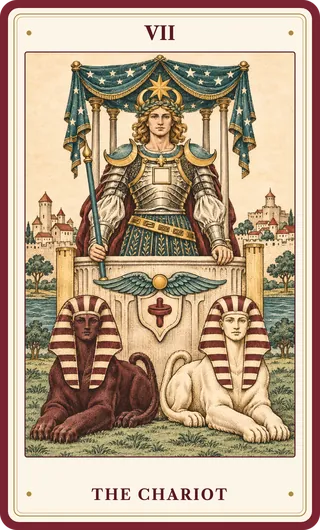
The charioteer
A armoured figure stands upright and moves forward without visible reins. He steers by willpower and focus, which is why the card feels more like decision than emotion.
Black and white sphinxes
Two sphinxes face opposite ways, one dark and one light, yet they pull the same chariot. They stand for opposing urges (desire and doubt, hope and fear) brought under one direction.
The star-covered canopy
Eight-pointed stars sit above the charioteer's head. They suggest his drive has a higher purpose than ego alone, and that his goal feels meaningful to him.
Crescent moons on the shoulders
Two crescent faces rest on his armour. They link the card to Cancer and the Moon, a reminder that strong emotion sits underneath all that control.
The city walls behind
The charioteer has just left the walled city, the safe and familiar place. In love, it points to someone leaving old habits, fears or a comfort zone to pursue what they want.
The winged emblem on the chariot
A winged disc sits on the front of the vehicle. It represents inspiration lifting the drive upward, so the effort is aimed at something, not just frantic.
The river and the green fields
Water flows behind him and the land is fresh. Emotions are present and moving, but they stay behind the charioteer, not in front of him.
The Chariot for singles
For singles, The Chariot describes a readiness to get out there and pursue connection on your own terms. You feel capable, motivated and willing to take action, whether that is dating more intentionally, ending an unsatisfying situation or going after someone specific.
It can also describe the feelings of the person you will meet. Someone who comes in under this card is likely to be decisive and direct, and may be driven in other parts of life too. They are probably not someone who wants to wait for months to find out whether you are interested.
If you are using the card to ask about a crush, note the shape of the answer: it points to action and effort, not to quiet admiration. Someone who feels The Chariot toward you is likely to let you know in a way that is hard to miss.
The symbols and what they say about emotion
The Chariot’s imagery explains why its feelings come out the way they do. The black and white sphinxes are the key. They stand for the opposing parts of any emotional life: desire and caution, hope and fear, wanting someone and worrying what it will cost. The charioteer does not destroy either one. He gets them to work in the same direction.
The city walls behind him add something. He has left the familiar and the protected, which in love often means someone stepping out of their comfort zone to pursue a connection. The star canopy above suggests the effort is meant to serve something larger than ego, and the winged emblem on the front of the chariot repeats that point.
Notice also what is missing. There are no visible reins, and the figure does not look at the animals. His control is internal. For feelings, that tells you the person is managing their emotions through discipline rather than expression, which is why the feelings can look calm even when they are strong.
The Chariot versus similar cards as feelings
Several cards can look similar in a feelings reading, and the differences are worth knowing. The Emperor as feelings is about building something stable and expecting commitment in return: “I have made a place for you.” The Chariot is more mobile: “I am coming to you.” One is structure, the other is momentum.
Strength as feelings is patient and gentle, a quiet courage that can wait. The Chariot does not wait. Where Strength tames through compassion, The Chariot directs through will, which is why it feels more urgent and more visible.
The Knight of Wands is the closest cousin: also fast, also passionate. The difference is staying power. The Knight can burn bright and vanish, while The Chariot has a goal and a plan, so it is more likely to follow through.
Card combinations to look for
The cards beside The Chariot tell you what the drive is made of. Here are some pairings people ask about often:
- The Chariot with the Two of Cups: determined effort toward a mutual, emotionally real connection.
- The Chariot with The Lovers: a choice for love, backed by action.
- The Chariot with the Eight of Cups: the drive is toward leaving, not toward you.
- The Chariot with the Five of Wands: competition or conflict, possibly a rival or a power struggle.
- The Chariot with The Tower: a sudden obstacle that tests the resolve.
When in doubt, read the card after The Chariot as the destination. If it is warm and settled, the effort is heading somewhere good. If it is cold or chaotic, the energy may be better than the outcome.
When will the feelings turn into action?
The Chariot is a fast-moving card, and in timing questions it usually points to a short window, often days to a few weeks, once the decision has been made. Because it signals that things are already in motion, you are likely to see signs of movement soon rather than after a long wait. Treat that as a pattern, not a date.
If you are waiting for a particular person to act, do not read The Chariot as permission to sit and wait. The card rewards activity. The more effort that goes in on both sides, the faster things move. If a few weeks pass with no change, either the drive belongs to someone else, or it is reversed and has stalled.
For timing questions across the deck, the tarot timing guide can help you compare cards.
What to do when The Chariot appears
A useful reading ends in a choice. If The Chariot is upright and the feelings are on your side, you can respond with the same clarity: say what you want and let their actions show you whether they match. If you are the one drawing it for yourself, decide your direction first, then act.
Here is a simple way to use it:
- Name what the person has done, not what you hope they feel.
- Decide what pace feels right for you, and say so.
- Ask for clarity if the signals are mixed.
- Notice whether their effort continues after the obstacles are gone.
If you want more detail than a single card can give, lay out a relationship tarot spread and put The Chariot in context with the cards for what each of you wants and needs.
Try this: Draw one more card to sit beside The Chariot and ask, “Where is this energy heading?” Read the second card as the destination, then wait a week and compare it with what actually happens.
Quick summary
Upright, The Chariot as feelings means focused, determined emotion shown through action. Reversed, it means the same energy has lost its direction, turned into control or stalled. In both cases, it is a card of effort, so the evidence for it is in what people do.
Take it as a strong sign of intention rather than a guarantee of love. Use your own judgement about how the feeling is being expressed, and let the cards around it tell you whether the drive is warm, practical or competitive.
Questions readers ask
What does The Chariot mean as someone's feelings for you?
It means they are focused, determined and ready to act on what they feel. Their interest is strong enough that they will make effort, solve problems and move things forward, usually through actions more than words.
Does The Chariot mean they love me?
Not necessarily. The Chariot shows drive and commitment to a goal, and you may be that goal, but it does not describe tenderness or deep attachment on its own. Look at the cards around it, especially cups, to see whether the feeling is love or the thrill of pursuit.
What does The Chariot reversed mean as feelings?
Reversed, the drive has stalled, scattered or turned into control. They may care but feel torn, or they may push too hard and overwhelm you. It can also mean strong feelings are being held back so tightly they never reach you.
Is The Chariot a good card for love?
Yes when you want momentum, commitment and effort from someone, and less so when you want gentle emotional openness. It is strongest in situations where something needs to be overcome, such as distance or a stalled relationship.
What does The Chariot mean for an ex?
It suggests your ex is thinking in terms of action and has a strong urge to resolve things or win you back. Whether that is wise depends on whether the pull is real care or pride, so check the surrounding cards and their actual behaviour.
Is The Chariot a yes or a no?
It leans yes, because it shows forward movement and determination. The catch is that the yes depends on you keeping a steady direction, so it does not promise an easy road.