
The Emperor Tarot Card Meaning: Upright, Reversed, Love and Career

- Arcana
- Major Arcana, card 4
- Element
- Fire, Aries
- Yes or no
- Yes
structureauthoritystabilityleadership
rigiditycontrolstubbornness
The Emperor tarot card means authority, structure, stability and responsible leadership. He is card IV of the Major Arcana, the figure who takes the raw creative energy of the earlier cards and gives it rules, boundaries and a solid base. Upright, he says it is time to plan, take charge and build something that lasts. Reversed, he warns of rigidity, domination or a lack of discipline.
He is a practical card, and he rarely arrives to flatter you. When The Emperor shows up, the question underneath is usually: where do you need order, and who is in charge? This guide covers his meaning upright and reversed, in love, career, money and health, plus the symbolism in the Rider-Waite-Smith image, astrology, yes or no answers and how he behaves next to other cards.
What The Emperor Means at a Glance
The Emperor is the archetype of the ruler and the father. Where The Empress nurtures and creates, The Emperor organises and protects. He represents the part of you that can make a decision, hold a line and take responsibility for the outcome.
Here are the core keywords:
- Upright: authority, structure, discipline, protection, leadership, stability, planning
- Reversed: control, tyranny, rigidity, stubbornness, lack of discipline, abuse of power
- Number: 4 (the Major Arcana card IV)
- Element and sign: fire, Aries
- Role: the father figure, the boss, the builder
Keep in mind that his power is conditional. The Emperor is not simply “a man in charge”. He is what authority looks like when it is steady, fair and aimed at keeping things safe. When it is none of those things, the card turns into its reversed shadow.
The Emperor Upright Meaning
Upright, The Emperor asks you to take charge. He is the call to stop drifting, write the plan and commit to it. If your life or project has been growing without direction, he provides the frame it needs.
There is a calm, grounded quality to this card. He does not rush or panic. He decides, sets a standard and keeps to it, and others tend to feel safer around that. In a reading, upright Emperor often points to a period where clear rules, routines and firm boundaries will serve you better than inspiration alone.
It also carries an invitation to see yourself as an authority. That does not mean being loud. It means accepting that your choices matter, that people may depend on you, and that structure is a form of care. If you have been waiting for permission, this card is it.
Try this: Pick one area of life that feels messy. Write three rules for it (for example, “bills reviewed every Sunday”) and follow them for one week. Notice how it feels to be your own authority.
The Emperor Reversed Meaning
Reversed, authority has become distorted. The Emperor can fail in two opposite ways. One is the tyrant: someone whose need for control has hardened into domination, micromanaging, ultimatums and an unwillingness to listen. The other is the abdicator: someone who avoids responsibility, breaks their own rules and leaves a vacuum where leadership should be.
Which version applies depends on the question and the cards around him. In a reading about a difficult boss or partner, the tyrant is likely. In a reading about your own habits or goals, the reversed Emperor often shows a lack of discipline, or fear of taking charge. It can also point to rules that no longer fit, or a person in power who has lost your trust.
The shadow side can be subtle. Control often hides fear, and rigidity can be a way of avoiding vulnerability. For a fuller breakdown of how this card plays out in love, work and daily life, see The Emperor Reversed. If you are new to flipped cards in general, how to read reversed tarot cards explains the method.
Read The Emperor for your question
Upright: A steady, committed and protective partner, or a relationship being built on clear promises and real commitment.
Reversed: A controlling partner, a power struggle, or a relationship that has gone cold and rule-bound.
Upright: They feel serious about you, respect your strength and want to provide stability.
Reversed: They may feel threatened, want to dominate, or hide behind emotional distance and pride.
Upright: Leadership, promotion, clear systems and the confidence to take charge of a project or team.
Reversed: A tyrannical boss, red tape, poor planning, or your own struggle to take responsibility.
Upright: A budget that is followed, savings built with discipline and long-range financial planning.
Reversed: Tight-fisted control over money, or the opposite: no plan, no records and no limits.
Upright: Make a plan, set boundaries and lead with calm authority.
Reversed: Loosen your grip, or stop avoiding the decisions only you can make.
Upright: Strong foundations, a steady routine and the discipline to keep healthy habits going.
Reversed: Stress from overwork or rigidity, or a routine that has fallen apart.
The Emperor Card Description and Symbols
In the Rider-Waite-Smith deck, a bearded ruler sits on a massive stone throne against a stark, orange sky. He wears a red robe over armor, holds an ankh scepter in his right hand and a golden orb in his left. Four ram heads are carved into the throne, and bare mountains rise behind him with a thin river running below.
Every part of the picture says the same thing: power that is built to endure. The stone throne and mountains speak of permanence. The armor and red robe show a ruler who is ready to defend what he has made. The ankh adds an important twist, since it is a symbol of life, which suggests that his rule exists to protect rather than to crush.
Look at the landscape too. It is harsh and almost empty, with only the river offering softness. Many readers take this to mean that a strong structure can feel stark, and that the best rulers still stay connected to feeling. The Emperor in a spread can ask whether your own structure leaves room for that flow.
The Emperor in Love and Relationships
Upright in love, The Emperor describes a stable, committed and protective partner, or a relationship phase where structure is being created. Think moving in together, getting engaged, merging finances or finally agreeing on shared goals. This is love shown through reliability: someone who keeps promises, shows up on time and plans for the long term, even if tender words do not come easily.
If you are single, he can mean you are ready for a serious relationship and are drawn to security over excitement. It may also describe a potential partner who is older, established or in a position of authority. In an existing relationship, he is a nudge to bring more intention to the partnership rather than letting things drift.
Reversed, the same energy becomes control. That can look like one partner making all the decisions, treating disagreement as disloyalty, or keeping emotional walls up. It can also mean a relationship that has turned into a list of rules with no warmth. Sometimes the reversed Emperor points inward, to your own fear of vulnerability posing as strength. For a closer look at how someone’s heart may be reading, see The Emperor as feelings.
What The Emperor Means as Someone’s Feelings
When you ask what another person feels about you, upright Emperor suggests serious, protective intent. They see you as capable, dependable and worth building something with. They may not be openly romantic, but they are likely to show care through actions: practical help, commitment and consistency.
Reversed, it can mean they see the relationship as something to control, or that they feel threatened and respond with distance, pride or rigid expectations. It can also mean they struggle to express feelings at all and hide behind a “strong” front.
Context matters. If the card shows up beside something warm, such as the Two of Cups or Ten of Cups, the steadiness is likely genuine love. Beside cold or sharp cards, the same steadiness may be closer to emotional shutdown.
The Emperor in Career and Work
Work is where The Emperor is at his strongest. He is one of the clearest leadership cards in the deck, pointing to promotion, a management role, a successful launch or the confidence to run your own business. He values clarity, consistency and plans that can be carried out.
He also covers the less glamorous side of success. Upright, he can mean setting the schedule, defining who does what, making the unpopular decision and sticking to it. He suits careers in management, law, government, the military, engineering, finance and any field with clear hierarchy. If you are job hunting, he suggests aiming for roles with real structure and authority.
Reversed, watch for authoritarian bosses, toxic workplaces, endless bureaucracy or a promotion that comes with impossible demands. It may also show a lack of planning in your own approach, or a business without solid foundations. If you are the boss, ask whether your style has become more control than leadership. For a related card that blends authority with practical skill, see the King of Pentacles.
Try this: Before your next work week, list the three decisions you have been avoiding. Pick the smallest and make it before lunch on Monday. The Emperor is built on decisions, not intentions.
The Emperor in Money and Finances
Order is The Emperor’s gift to money. Upright, he describes budgets that are followed, records that are kept, bills paid on time and a long-range plan for savings, property or retirement. He favours slow, structured wealth-building over gambling or impulse.
In a money reading, he often says the answer is a system rather than a windfall. Set up the automatic transfer, write the debt payoff plan and review your accounts on a schedule. Financial security is possible, and it is built through discipline.
Reversed, there are two faces. One is the tight grip: someone who holds the purse strings and uses money as power in a family or partnership. The other is disorder: no budget, ignored statements and a refusal to plan because rules feel confining. Either way, the fix is the same: make financial structure that is fair, visible and sustainable.
The Emperor and Health
In health readings, The Emperor suggests strong foundations and the power of routine. Upright, he points to regular sleep, steady habits, a plan you can stick to and the discipline to keep it going. He supports recovery that is structured, such as a clear treatment plan or training schedule.
Reversed, he can show stress caused by rigidity or overwork, tension held in the body, or a routine that has collapsed. It may also reflect resistance to medical advice or authority. Tarot is not a diagnosis, so use the card as a prompt for reflection and see a qualified professional for any real health concern.
The Emperor as a Spiritual Lesson and Shadow Work
On a deeper level, The Emperor is about inner authority. He asks whether you are the one steering your own life or handing the wheel to habit, other people or fear. Spiritually, he represents learning to hold power without cruelty and to set limits without shutting people out.
Many people meet this card in connection with their father or other authority figures. Your relationship with those figures shapes how you treat rules, power and discipline today. The Emperor can show up to ask whether you are repeating a pattern: either imitating an overly strict parent, or rebelling against structure so completely that you cannot build any.
Shadow work with this card means looking at both extremes. Where do you control too tightly? Where do you avoid responsibility? The healthy Emperor sits between them, firm but fair, protective without being possessive.
The Emperor card symbols
Choose a symbol to read what it means on the card.
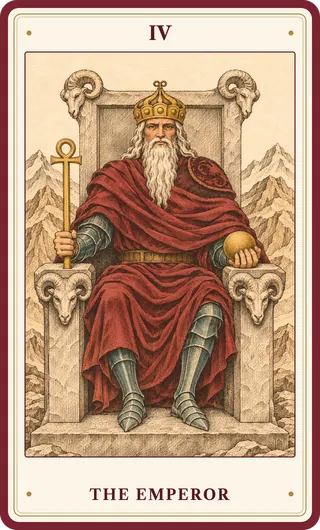
The stone throne
The Emperor sits on a solid block of stone, which stands for permanence and rule built to last. Nothing about his seat is soft or temporary.
The four ram heads
Rams are carved into the throne's back and arms. They link the card to Aries, the sign of initiative, and to the Mars-like drive to lead.
The ankh scepter
In his right hand he holds an ankh, the ancient sign of life. It shows that his power is meant to sustain and protect, not only to command.
The golden orb
The orb in his left hand represents the world he governs. He holds it firmly, which suggests responsibility for what is under his care.
The red robe and armor
Red is the colour of will, action and the physical world. Armor shows beneath his robe, a reminder that authority is also defence, and that he is guarded.
The barren mountains
Rugged, bare peaks rise behind him. They point to a hard, demanding environment where structure matters, and to the discipline needed to hold your ground.
The narrow river
A thin stream runs below the mountains, the only sign of softness in the scene. It suggests that even rigid order depends on a flow of feeling and life.
Is The Emperor a Yes or No Card?
The Emperor is generally a yes, especially for questions about leadership, planning, career advancement and building something stable. The answer usually comes with conditions: yes, if you do the work, stay organised and take responsibility.
Reversed, he leans toward no, or “not yet”. Things may stall until you sort out a power struggle, make a clearer plan or deal with a person who is blocking progress. For questions about romance and spontaneity, the answer is less certain, because The Emperor prefers commitment and order to impulse. For the full breakdown, see The Emperor as a yes or no answer.
Astrology, Numerology and Element
The Emperor is traditionally linked to Aries, the first sign of the zodiac, ruled by Mars. This fits the rams on his throne and the fire in his red robe. Aries brings initiative, courage and a willingness to lead, and the card shows that energy matured into disciplined rule. Some readers also associate the card with Capricorn because of its focus on structure and ambition. To see how other cards map to signs, see tarot and astrology correspondences.
In numerology, 4 is the number of foundations: four walls, four corners, four seasons. It stands for stability, order and practical effort. The Emperor is the Major Arcana’s expression of that number, the point where the creative rush of cards 1 to 3 is given a shape. Fire is his element, which shows that his authority comes from will and action rather than from emotion or intellect alone.
The Emperor Compared With Similar Cards
The Emperor is often confused with other authority cards, so it helps to see the differences:
- The Empress: nurturing, creative and sensual, where The Emperor is structured and protective. Together they show balance between care and order.
- The Hierophant: authority through tradition and shared belief, where The Emperor’s power comes from personal will and practical rule. See The Hierophant for the contrast.
- Justice: fairness and consequence through law and truth, where The Emperor is about creating and enforcing the structure itself.
- King of Wands: a fiery, visionary leader, where The Emperor is a steady, rule-setting one.
Seen together, The Emperor is the most direct expression of earthly power. He is less about spiritual teaching or moral judgment than about building and running things in the real world.
The Emperor in Card Combinations
Cards next to The Emperor show which kind of authority is at work. Here are some common pairings:
- Emperor and Empress: a partnership that blends stability with warmth, or a need to balance the two in your own life
- Emperor and Lovers: a serious commitment or a choice about long-term values
- Emperor and Tower: a rigid system or authority that is about to be shaken
- Emperor and Devil: control, possessiveness or an unhealthy power dynamic
- Emperor and Death: a major restructuring or the end of an old regime
These are starting points, not fixed rules. Read the surrounding cards for tone, and let your own question decide which reading fits. A three card tarot spread is a good place to see how The Emperor interacts with the cards on either side.
When The Emperor Represents a Person
In a reading, The Emperor often stands for a real person. This could be a father, a boss, a mentor, a landlord, a partner or anyone who holds structure and authority in your life. Traditionally the card is associated with a mature man, but gender does not matter: the Emperor describes a role and an energy.
Upright, this person is reliable, protective and decisive. Reversed, they may be controlling, inflexible or absent when you need leadership. If you are unsure, check the cards around him for emotional tone, and consider whether he describes someone in your life or the part of you that is taking charge.
He can also describe you. If you are the one in charge of a household, team or project, the card may simply be recognising the weight you carry. Ask whether you are using your authority well.
How to Work With The Emperor
The Emperor responds well to action. After you draw him, translate the card into a small, concrete change instead of just thinking about it. Ask what one structure would make the rest of your life easier, and put it in place.
Journal prompts can help you go further:
- Where do I need clearer boundaries, and where have mine become walls?
- What would I build if I trusted myself to see it through?
- How did the authority figures in my life use their power, and how do I use mine?
- What am I controlling out of fear?
Try this: Draw The Emperor from your own deck, or use the random tarot card generator to pull a card. Set a 10-minute timer and write down every rule you currently live by. Circle the ones that protect you and cross out the ones that only restrict you.
Over time, you will notice that The Emperor is less about being tough and more about being dependable. The goal is to be someone whose word can be trusted, starting with yourself.
Frequently Asked Questions About The Emperor
Most questions about this card come down to whether he is good or bad, and the answer is that he is neither. He is a tool, and it matters how he is used. Upright, he brings reliability and progress. Reversed, he exposes where control has gone too far or where discipline has gone missing.
If you are looking for more, the tarot card meanings list lists every card in the deck, and how to read tarot shows how to combine them into a full reading.
Questions readers ask
What does The Emperor mean in tarot?
The Emperor is card IV of the Major Arcana and stands for authority, structure, stability and responsible leadership. He is the father figure of the deck, showing how order is built and kept.
Is The Emperor a good card?
Mostly, yes. Upright he is steady, protective and productive, especially for work, planning and commitment. He can feel uncomfortable if you were hoping for flexibility or romance, because he asks for discipline.
What does The Emperor mean in love?
He describes a reliable, protective, committed partner, or a relationship moving toward real structure such as living together or marriage. Reversed, he warns of control, emotional coldness or a power imbalance.
What does The Emperor mean reversed?
Reversed, authority goes wrong in one of two ways: too much control and rigidity, or too little discipline and avoided responsibility. Often it points to a domineering person, or to your own struggle with boundaries and leadership.
What zodiac sign is The Emperor?
The Emperor is linked to Aries, a fire sign ruled by Mars. Some readers also connect his structured, ambitious energy to Capricorn, though Aries is the traditional correspondence.
Does The Emperor represent a person?
It can. He often shows a father figure, a boss, a mentor or someone in authority, usually older or more established. He can also describe you when you are the one in charge.