
Judgement Tarot Card Meaning (Upright & Reversed)

- Arcana
- Major Arcana, card 20
- Element
- Fire, Pluto
- Yes or no
- Yes
reflectionawakeningreckoninga calling
self-doubtharsh self-judgmentignoring a call
The Judgement tarot card means awakening, reckoning and rebirth. It is the 20th card of the Major Arcana, and it appears when you are being asked to look honestly at your past, release the guilt or confusion attached to it, and answer a calling that has become too loud to ignore. Despite the name, it is not about being condemned. It is about being called forward.
In a reading, Judgement usually marks a turning point that you recognise from the inside: a moment of “I know what I need to do now”. Upright, it brings clarity and renewal. Reversed, it shows the same call being avoided or drowned out by self-doubt. Below you will find the imagery, the meaning in love, feelings, work, money and health, the yes or no answer, and how to tell Judgement apart from similar cards.
Judgement at a glance
Judgement is card number XX, placed near the end of the Major Arcana, just before The World. It follows a long run of lessons about choice, loss, hope and illusion, and it asks you to gather all of that into one honest review. The card is linked to fire and spirit in older systems and to Pluto in many modern ones, which fits its themes of death and rebirth, and of clearing what no longer serves.
Here are the core ideas to keep in mind:
- Upright keywords: awakening, reckoning, rebirth, absolution, a calling, a decision made with full awareness
- Reversed keywords: self-doubt, avoidance, harsh self-judgement, ignoring the call, regret that never turns into action
- Element and planet: Fire and Spirit (Golden Dawn), Pluto (modern astrology)
- Question it answers: “What am I being called to now that I understand my past?”
The imagery of the Judgement card
In the Rider-Waite-Smith deck, an angel appears in the clouds blowing a long trumpet. Below, pale figures rise from open coffins that float on a sea, with their arms stretched upward. Snowy mountains stand behind them. The scene comes from the Last Judgement of Christian tradition, when the dead are said to be called back by the sound of a trumpet, and older decks such as the Marseille tarot show the same moment.
Pamela Colman Smith drew the figures as an ordinary group: a man, a woman and a child. This matters. Nobody here is being sorted into saved and damned. Everyone is rising, and everyone is looking up. The red cross on the trumpet’s flag, with arms of equal length, points to balance rather than punishment.
The grey colour of the people is easy to miss. They are not yet glowing or triumphant. They are in the moment between waking and standing, which is exactly where Judgement tends to catch us in real life: knowing something has changed but not yet knowing what to do about it.
Judgement upright meaning
Upright, Judgement is the sound of an inner alarm that you finally hear. You have lived through something, learned from it, and now you can see it for what it was. The card asks you to take that understanding seriously and act on it, rather than let it fade into another “I should have known”.
This is a card of absolution. It invites you to review your past honestly and then put the weight down. You may be forgiving yourself for a mistake, forgiving someone else, or accepting that a stage of your life has truly finished. The honesty is the hard part, but the reward is a clean sense of direction.
Judgement also points to decisions that call for more than logic. Where Justice weighs facts and consequences, Judgement asks you to combine your intuition with what you have learned. When it appears, the right choice usually feels like a quiet yes in the body, not a clever argument in the head.
Try this: Write down one chapter of your life that you feel is ending. Under it, list three things it taught you and one thing you are ready to stop carrying. Then write one action you can take this week that fits the person you now are.
Read Judgement for your question
Upright: You see your love life clearly, forgive the past, and either recommit with honesty or move on with a clean conscience.
Reversed: Old guilt, harsh self-criticism or a refusal to face the truth keeps you repeating the same relationship pattern.
Upright: They feel a real shift and want to speak honestly, often with a sense of having finally understood what they want.
Reversed: They are confused, defensive or avoiding their own feelings, and may be judging you (or themselves) too harshly.
Upright: A review, a calling or a clear decision arrives, and you step into work that fits who you have become.
Reversed: You ignore the signs that you need a change, doubt your own worth, or stay put out of fear of being judged.
Upright: An honest audit of your finances leads to a fresh start, a settled debt or a decision you can stand behind.
Reversed: You avoid looking at the numbers, repeat old spending habits or make choices from shame rather than clarity.
Upright: Answer the call, review the past without self-punishment, and act on what you now know.
Reversed: Stop hiding from the question you already know the answer to, and put down the habit of self-blame.
Upright: Recovery, a wake-up call about habits, or a decision to finally take care of yourself.
Reversed: Ignoring symptoms or warning signs, or staying stuck in guilt about past habits that you could now change.
Judgement reversed meaning
Reversed, the trumpet is still sounding, but you are covering your ears. Judgement reversed often shows self-doubt that grows out of old mistakes, a habit of going over the same regrets without learning anything new, or a refusal to look at something you already suspect is true. It can feel like being stuck in a loop where guilt replaces action.
It can also turn outward. Reversed Judgement may show that you are judging someone else too quickly, or that others are judging you without knowing the full story. In both cases the card asks you to slow down, gather the facts and hold back the verdict. For a detailed look at each area of life, see our full guide to Judgement reversed.
Less often, the reversal points to a missed opportunity or a calling you have delayed for so long that it now feels risky to answer. The card is not saying the chance is gone. It is saying that avoidance costs something, and that every day of waiting adds to the weight you are trying to avoid.
Judgement in love and relationships
In a love reading, Judgement means seeing your relationship life clearly and acting on what you see. For couples, it often marks a moment of truth: an honest conversation, a decision to recommit after a rough period, or a recognition that something has run its course. The card favours forgiveness that is earned through understanding, not forgiveness that simply avoids conflict.
If you are single, Judgement suggests that you are shedding old patterns before you meet someone new. You may be reviewing past relationships, noticing what you repeated, and choosing differently. It can also bring someone from the past back into view, but the question is whether both of you have actually changed. Without that, the card is more about closure than reunion.
Some readers also link Judgement to distance, such as a partner living across a sea or in another country, because of the water in the image. Treat that as a possibility, not a rule, and let the rest of the spread confirm it. For how the card looks when you ask about a specific person, read our page on Judgement as feelings.
Reversed in love, it can show a relationship held in place by guilt or blame, a refusal to forgive, or fear of being judged that stops you from being honest. The remedy is the same as upright: say the true thing, kindly and clearly.
Judgement as feelings
When Judgement describes what someone feels about you, it usually means they have gone through a shift in perspective. They have been thinking about you or the relationship in depth, and they have reached a point where they cannot go on pretending. That might mean they want to reconnect, apologise, commit or finally say goodbye.
The key quality is honesty. This person is reviewing their own behaviour as much as yours, and may be feeling a mix of regret, relief and determination. If you are the one asking, the card suggests that real communication is possible now, and that waiting for them to act on their own may be less useful than inviting a straight conversation.
Reversed, the same person may be unwilling to face their feelings. They may be defensive, stuck in self-criticism, or quick to blame you so they do not have to look inward. In that case, the card is a reminder that you cannot hear the call for someone else.
Judgement in career
At work, Judgement points to a review, an evaluation or a moment where your skills and choices are seen clearly. It can show up as a performance review, a promotion decision, or a quiet realisation that you have outgrown your role. Because the card is tied to calling, it often asks the bigger question: is this work what you are actually meant to be doing?
It is a strong card for career changes made with full awareness. You are not jumping because you are bored. You are moving because you have looked at where you have been and you know what fits. If you are job hunting, Judgement can mean a response arrives or an offer becomes clear after a stretch of waiting.
Judgement also has a legal and administrative side in many readings: hearings, contracts, decisions from authorities, or a long-running matter being settled. Take this as a theme to check against the cards around it, not as a guarantee.
Reversed, you may be putting off a necessary change, doubting that you deserve more, or worrying about what colleagues will think. The card asks you to stop letting other people’s opinions be the judge.
Judgement in money and finances
In a money reading, Judgement is the card of the honest audit. It encourages you to open the statements, face the debts or the spending habits, and make a plan that is based on what is really there. The relief comes quickly once you stop avoiding it.
It can also signal a financial fresh start: a debt cleared, a settlement reached, or a decision to change how you earn or save. If you are comparing options, Judgement favours the choice you can stand behind in a year, not the one that only feels comfortable today.
Reversed, it often shows money shame. You may be avoiding your accounts, repeating a pattern you promised yourself you would stop, or making purchases to escape a feeling of failure. Start small: one account, one number, one honest look. If you want a structured way to do this, the money tarot spread works well with Judgement’s themes.
Judgement in health
For health questions, Judgement often points to recovery and renewal. After a long illness, a stressful season or a period of poor habits, it can show that your body and mind are ready for a new phase. It is also a wake-up call card, so it can appear when it is time to take your wellbeing seriously.
The emotional side matters here too. Judgement can show guilt about past choices, and the card encourages you to replace self-blame with practical steps. Look at what you now know and what you can do with it, rather than punishing yourself for what you did not know before.
Reversed, it may suggest ignoring symptoms, putting off a check-up, or staying stuck in shame. Tarot is not medical advice, so if a health worry is real, speak to a qualified professional and use the card as a prompt to act.
Judgement as advice and as an outcome
As advice, Judgement says: answer the call. You already know what has changed, and the next step is to act on it. Review the past once, without drama, take the lesson, and then make the decision. The card does not ask for perfection. It asks for honesty and movement.
As an outcome, it suggests that the situation resolves through clarity. A decision is made, a truth is spoken, or a long cycle closes. The result is not always dramatic from the outside, but it feels decisive from the inside. In a Celtic Cross, Judgement in the outcome position often means you will see the whole situation differently by the end.
In a spiritual reading, Judgement is the card of vocation and awakening. It can show a new spiritual path, a return to a practice you set aside, or a sense that your life has a purpose you are only now recognising. It works in the same way whether you read tarot religiously, psychologically or simply as a tool for reflection.
Try this: Pull Judgement out of your deck and place it where you will see it for a day. At the end of the day, write down any moment when you felt a quiet “I should deal with that”. Choose one and do it within 48 hours.
Judgement card symbols
Choose a symbol to read what it means on the card.
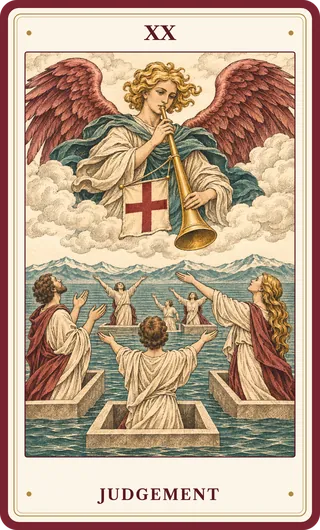
The angel and trumpet
The angel (traditionally read as Gabriel) blows a trumpet from the clouds, which stands for a call you cannot ignore. It signals that a moment of truth has arrived and something is asking for your response.
The rising figures
Men, women and a child rise from their coffins with arms open and faces lifted. They show that old identities are laid to rest and a renewed self emerges, whatever your age or history.
The coffins on the water
The graves float on a sea, linking the past with the unconscious and with emotional release. What was buried is now brought to the surface to be seen and let go.
The banner with the red cross
The trumpet carries a flag with an equal-armed red cross on white. It stands for balance, sacrifice transformed into spirit, and a higher order that treats every part of you as worthy of integration.
The snow-capped mountains
Tall, cold peaks rise behind the scene. They suggest a lasting perspective, a view from above, and the sense that this change is bigger than one passing mood.
The grey skin tones
The figures are pale and ash-coloured, as if still between states. They remind you that renewal begins before it feels finished, and that you are allowed to rise as you are.
The child with the family group
A man, a woman and a child stand together with their backs to us. They suggest a whole-person response, with every stage of life taking part in the awakening.
Judgement as a yes or no answer
Judgement leans toward yes when your question is about renewal, healing, a decision or a change you have already earned the right to make. Because the card is about awareness and response, it supports questions like “Should I finally have this conversation?” or “Is it time to leave this role?” It is more cautious when the question depends on someone else’s choice, since the card points back to your own part.
Reversed, the answer shifts toward not yet, or not until you face something. It is rarely a flat no. It says that the real obstacle is avoidance. For more detail on how it works in quick questions, see Judgement as a yes or no answer.
Judgement compared with Justice, Death and The World
Readers often mix up Judgement with similar-looking cards. Justice is about fairness, cause and effect, and decisions based on facts. Judgement is about conscience, calling and transformation. Justice asks what is fair. Judgement asks what is true for you now.
Death shows an ending that clears space. Judgement shows the moment after: the recognition and the decision to rise. Death is the necessary loss. Judgement is the waking up that gives that loss meaning, which is why they often appear together at big life changes.
The World comes straight after Judgement and shows completion. Judgement is the last honest review before that finish: you cannot complete a cycle until you have understood it. If you want the full arc of the Major Arcana, start at The Fool and read forward, noticing how each card prepares you for the awakening of Judgement.
Judgement card combinations
Judgement changes shade depending on its neighbours. Some pairings come up often enough to be worth knowing:
- Judgement and Death: a major ending followed by rebirth, usually a life-changing transition.
- Judgement and The Tower: a sudden truth that forces you to rebuild on honest ground.
- Judgement and The Sun: a joyful renewal, forgiveness that brings real relief.
- Judgement and the Eight of Cups: a calling to walk away from what no longer fits.
- Judgement and the Six of Cups: old memories and past relationships coming back for review.
Pay attention to the suit as well. With Cups, the awakening is emotional. With Swords, it is mental and often tied to a conversation or decision. With Wands, it points to purpose and action. With Pentacles, it affects work, money and the body.
If you want to explore pairs more systematically, try the tarot card combination calculator to see how two cards read together.
Judgement in past, present and future positions
In the past position, Judgement tells you that you have already been through a major reckoning. You may have made a life-changing decision or recovered from something, and its effects are still shaping the present. It suggests that the work of reflection is done, even if you have not fully noticed it.
In the present position, Judgement says you are standing at the moment of truth right now. Something is asking for your answer and you are being invited to respond. This is not a time for half-measures or waiting for more proof.
In the future position, it points to an awakening or turning point ahead. You may be about to receive news, face a decision or realise something that changes your direction. The card does not give a date, but it does say that clarity is coming, and that how you respond will shape what follows.
Astrology, numerology and history
Judgement is linked to Pluto in modern tarot astrology, the planet of transformation, power and rebirth. The Golden Dawn tradition connected it to fire and to the Hebrew letter Shin, often tied to spirit and the primal fire of renewal. Both fit the card’s themes of change that cannot be undone.
In numerology, 20 reduces to 2, which brings in themes of balance, partnership and listening. That is a good match for a card about hearing an inner voice and weighing what it says. It also sits close to the end of the Major Arcana, where all lessons begin to be gathered.
Historically, the card began as “The Angel” or “The Last Judgement” in early European decks, showing the resurrection of the dead. In the Rider-Waite-Smith deck of 1909, Pamela Colman Smith kept the trumpet and the rising figures but gave them an almost quiet, communal feeling. The idea that the card means personal renewal, rather than a verdict from above, is a modern emphasis that grew with psychological readings of tarot.
How to work with Judgement in a reading
When Judgement appears, begin with a simple question: what am I being called to see? Then ask what you already know but have been avoiding. These two questions are often enough to turn a general reading into a useful one.
Use these prompts to go further:
- What chapter of my life is closing, and what did it teach me?
- What am I still blaming myself for that I could now forgive?
- What decision have I been delaying because I fear being judged?
- What would I do if I trusted what I now know?
If Judgement turns up often, treat it as a nudge to stop circling. Shorter rituals work too: a letter you do not send, a walk without your phone, or a single honest conversation. The card is rarely asking for a grand gesture. It wants an honest response that you can actually carry out.
Try this: Draw one card with the random tarot card generator after you write your answer to “What am I avoiding?” Compare the card’s message to what you wrote, and note any overlap with Judgement’s call to honest review.
Frequently misunderstood points about Judgement
Judgement is not a warning that you will be punished, and it is not a prediction of a court verdict, although legal matters can sometimes appear. It is also not a spiritual test that you can fail. The core message is that you are allowed to change, and that you are being invited to do so.
It is also not the same as regret. Regret looks back and stays there. Judgement looks back once, learns, and turns toward the future. If your reading feels heavy with shame, check whether you are reading the card through the lens of guilt rather than through its real offer of absolution.
Finally, Judgement does not always arrive as a big event. Many of its most important moments are quiet: a conversation you finally have, a decision you finally make, a habit you finally stop. If the card appears and nothing dramatic is happening, look for the small, honest step it is pointing to.
Questions readers ask
What does the Judgement tarot card mean?
Judgement means awakening, honest self-assessment and rebirth. It appears when a chapter is closing and you are called to look at your past clearly, forgive what needs forgiving and answer a new calling.
Is the Judgement card a good card?
Generally yes. It is a card of renewal and absolution, not punishment. It can feel uncomfortable because it asks for honesty, but the outcome it points to is freedom and a fresh start.
Does Judgement mean a breakup or getting back with an ex?
Neither is guaranteed. Judgement points to clarity, so it can bring a reconciliation, a final honest conversation or a clean ending, depending on the cards around it and what both people are willing to face.
What does Judgement reversed mean?
Reversed, Judgement points to self-doubt, avoidance and ignoring a call you already hear. It can also mean harsh self-criticism or judging others too quickly. The lesson is the same as upright, but you are resisting it.
Is Judgement a yes or no card?
It leans yes when your question is about change, healing or a decision you have already thought through. It is less clear when the question depends on outside events, because the card is about your response rather than a fixed result.
What is the difference between Judgement and Justice?
Justice weighs facts and consequences in a fair, rational way. Judgement is a spiritual reckoning that calls for intuition, forgiveness and a change of direction.