
Judgement in Love & as Feelings

- Arcana
- Major Arcana, card 20
- Element
- Fire, Pluto
- Yes or no
- Yes
reflectionawakeningreckoninga calling
self-doubtharsh self-judgmentignoring a call
When Judgement shows up as feelings, it means the person has had a deep realization about you or about the relationship and is taking it seriously. They are not casual or confused in the usual sense. They are reflecting on the past, weighing what they truly want and feeling called to act. Reversed, the same awareness is there, but it is blocked by fear, guilt or denial.
This card does not tell you what they will do. It tells you where they are: at a moment of reckoning. Below you will find how that reads for a crush, a partner, an ex and your own heart, how to tell Judgement apart from similar cards, and what to do once you have drawn it. For the card on its own, see the full Judgement tarot card meaning.
Judgement as feelings at a glance
Here is the short version before the detail:
- Upright: a clear realization, serious feelings, readiness for honesty
- Upright with an ex: honest review of the past, possible pull to reconnect or make peace
- Upright with a partner: the relationship is at a turning point and they want a renewal
- Reversed: avoidance, self-doubt, harsh criticism or guilt that blocks the feeling
- Always: the person is reflecting, not acting on impulse
Judgement is one of the more emotionally weighty answers you can get to “how do they feel about me?” Many cards describe a mood. This one describes a moment, the point where a feeling stops being a vague background hum and becomes something the person has to deal with.
What the Judgement card shows about the heart
The Rider-Waite-Smith image helps here. An angel blows a trumpet over a flooded landscape, and grey figures rise from open coffins with their arms stretched wide. Nobody is being punished. They are being woken up. The call comes from outside them, but the response comes from within.
Read as feelings, that picture describes someone who has been carrying something quietly and can no longer carry it quietly. A feeling that was buried, an attraction they talked themselves out of, or a hurt they pretended was over has come back to the surface. The open arms matter too. These figures face the call without hiding, which is why Judgement is so often linked to honesty.
It is also a card of review. Judgement is the twentieth Major Arcana card, and it comes after the heavy lessons of the Tower, Star, Moon and Sun. By this point the person has seen enough to evaluate what has happened. That is why people drawn to this card as feelings so often say they have been “thinking about everything”.
Judgement upright as feelings
Upright, Judgement says the person has reached clarity. They may have realized they are in love with you, or that they have been holding back from someone they care about. They may also have realized something less comfortable, such as how they have behaved or what they actually need. Either way, the feeling is serious and it has weight.
They are likely thinking about the connection with real attention. They are assessing the history, the patterns and what the future could look like. Many people feel their relationship with you has changed them, taught them something, or marked a turning point in their life.
The emotional tone is usually sincere, not playful. This is rarely a “keeping it casual” card. If you have been wondering whether their feelings are real, Judgement is a strong sign that they are, and that they are being treated as something that matters.
Read Judgement for your question
Upright: A relationship reaches a moment of truth, with honest conversation, forgiveness and a real chance to begin again on better terms.
Reversed: Old hurts and harsh verdicts keep both people stuck, and nobody is willing to say what needs saying.
Upright: They have had a clear realization about you and are taking their feelings seriously.
Reversed: They feel something real but are avoiding it, doubting it or afraid of being judged for it.
Upright: A calling becomes clear, and you are ready to change direction or step into a role that fits who you now are.
Reversed: You ignore the pull to change, doubt yourself, or dodge an honest review of your own performance.
Upright: A frank look at your finances leads to a clean reset and a better plan.
Reversed: Avoiding the numbers or punishing yourself for past mistakes keeps you from making a fresh start.
Upright: Listen to the inner call, forgive what you can, and act on what you now know.
Reversed: Stop condemning yourself and others, and face the truth you have been putting off.
Upright: A wake-up call leads to a real change in habits, and recovery or renewed energy follows.
Reversed: Ignoring warning signs or sinking into guilt delays healing.
Judgement reversed as feelings
Reversed, Judgement describes feelings that are blocked. The person may feel the call but refuse to answer it. Common forms are denial (“it’s not that serious”), avoidance (going quiet when things get close) and fear of exposing themselves. They may care about you and still be afraid of what admitting it would mean.
Reversed Judgement can also show harsh judgement in action. They may be criticizing you, criticizing themselves or both. Someone stuck in guilt over a past mistake can pull back from a relationship because they feel they do not deserve it. Someone stuck in resentment can refuse to forgive and keep score instead.
The reversal does not mean the feelings are gone. It means the reckoning is delayed. For more on how to handle upside-down cards in general, see how to read reversed tarot cards, and for this card specifically, Judgement reversed goes further into the blocks.
Judgement as a crush or new connection
If you are asking about someone you have only just started seeing, or someone you have a quiet crush on, Judgement suggests they see you as significant. Something about meeting you has changed how they think. They may feel their life has shifted since you appeared, even if they have not said so.
For a friendship that might become something more, the card can show a re-evaluation. They may be looking at you in a new light and asking themselves whether the friendship is really just a friendship. That quiet internal review is the typical Judgement moment.
Be careful with early connections, though. Judgement can mean someone is sure of their feelings, but it can also mean they are deep in thought and have not made up their mind yet. If you want to know which one it is, look at how they treat you now. Consistent effort tells you far more than a single card.
Judgement as a partner’s feelings
In an established relationship, Judgement as feelings means the partnership is at a turning point. Your partner is likely reviewing what has happened between you, noticing problems that used to be ignored, and thinking about how to make things better for both of you. Many readers see this as a wish to renew love and commitment.
It can be a good sign. Couples often draw this card just before a frank conversation that clears the air, or after a rough patch when both people are ready to forgive. It can mark the point where a relationship goes from drifting to chosen.
It can also be a challenge. The card brings the truth to the surface, and sometimes the truth is that something has to change. Your partner may feel a real need for honesty about what is working and what is not. Treat it as an invitation to talk, not as an alarm. If you are curious about the other side of a committed pairing, the Two of Cups shows mutual attraction and balance in its simplest form.
Try this: Before you next talk with your partner, write down one thing you have been avoiding saying and one thing you are ready to forgive. Start the conversation with the forgiveness.
Judgement as an ex’s feelings
When an ex appears with Judgement, they are almost certainly thinking about the relationship. They are reviewing what went wrong, including their own role, and the memory of you may have changed how they see love and relationships in general. For some people this review leads to wanting a second chance. For others it leads to peace and closure.
Judgement is one of the stronger “revival” cards, so reconciliation is a real possibility, but it is not the only one. The card is about resurrection of feelings, and the feelings can be warmth, regret, gratitude or an apology that has never been said. Do not assume a particular outcome because of one card.
What helps is looking at the conditions. A reconciliation under Judgement tends to involve honesty about the past and a change in behaviour, not a return to the old pattern. If the reasons you broke up have not been faced, the card may be showing the feeling without the change. Use your own judgement (the ordinary kind) about whether they are ready to do something different.
Judgement as your own feelings
Draw Judgement in the position that represents your own heart and the message is different: you are being called. You may feel pressure to decide something about a relationship, or an inner voice that has been getting louder. The card says that voice deserves your full attention.
Often the call is to be truthful with yourself. You may know that you want to leave, that you want to commit, or that you have been settling. Judgement does not push you toward any particular choice. It asks you to stop pretending you do not know.
It also asks for forgiveness. If you are holding on to a past mistake, yours or someone else’s, Judgement says you can set that down. Self-judgement is a common theme here. You cannot hear the trumpet properly while you are busy cross-examining yourself.
Try this: Write a short letter to yourself in the voice of the angel, naming one thing you already know about your relationship and one thing you forgive yourself for. Read it aloud once, then decide on one small action.
Judgement card symbols
Choose a symbol to read what it means on the card.
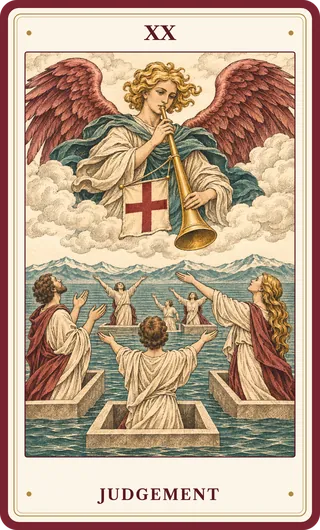
Archangel Gabriel
The angel fills the sky and calls the figures below to wake. In love, it stands for a message that cannot be ignored, a feeling or truth that finally demands attention.
The trumpet
Its sound is a summons, not a punishment. It marks the moment someone stops pretending and answers the call of what they actually feel.
The banner with a cross
A red flag with a white cross hangs from the trumpet. It points to reconciliation and balance, the joining of past and future, and to love that has been tested and holds.
Rising figures with open arms
A man, a woman and a child lift their arms toward the angel. They show people meeting the truth openly, with nothing left to hide from each other.
Open coffins
The coffins mean what was buried is rising again. That can be an old love, an old hurt or a feeling someone has kept quiet for a long time.
Grey skin
The figures are grey, drained of the colour of their old lives. They have been through an ending and are about to be renewed, which is why this card feels like a reset.
Sea and mountains
The water and snowy peaks sit behind the scene, steady and vast. They suggest deep emotion and a larger perspective that makes a personal reckoning feel part of something bigger.
When they feel judged
There is another reading that most guides skip. The word “judgement” can also point to a person who feels judged, either by you, by their family or by themselves. Their feelings for you may be tangled up with a fear of being seen critically.
You can often spot this when the reading’s other cards are guarded or tense. A person who fears judgement may hold back affection, avoid vulnerable topics or become defensive when you ask direct questions. The feeling is real, but it is wrapped in self-protection.
If this sounds familiar, the helpful move is to lower the stakes. Make it safe for them to be honest. People rarely rise from the coffin when they expect to be criticized the moment they do.
Judgement vs Justice and Death as feelings
Judgement is often confused with Justice because the names sound alike. Justice is about fairness and cause and effect: the person is being careful, logical and weighing facts. Judgement is about awakening: the person is moved by something deeper than a calculation. Compare it with Justice as feelings if you got both cards in one reading.
Death also involves endings, but it is about letting something go so that the new can begin. Judgement is about answering a call that revives something. In a love reading, Death says a chapter is closing. Judgement says someone has woken up to what that chapter meant.
A useful rule of thumb: Justice calculates, Death releases, Judgement awakens. If a person feels “I need to do the right thing”, think Justice. If they feel “I cannot ignore this anymore”, think Judgement.
Judgement with other cards
Combinations change the emotional colour of the card. A few that come up often in feelings readings:
- Judgement with the Ace of Cups: they see the chance of a very deep emotional connection and feel hopeful about it.
- Judgement with the Lovers: they are facing a real choice or conflict between values and desires, which is a sign of depth, not disinterest. See The Lovers in love and as feelings.
- Judgement with the King of Cups: they feel a need for change in love, handled with emotional maturity.
- Judgement with the Eight of Cups: they may be reviewing whether to walk away from something that no longer satisfies them.
- Judgement with the Three of Swords: an old heartbreak is being honestly faced.
Court cards can describe the person. Judgement beside a Knight often shows action following realization. Beside a Page it shows a message or beginning of honest feeling. Treat the neighbouring cards as the “how”, with Judgement supplying the “why now”.
How to respond when you draw Judgement
Because the card describes an inner reckoning, the best response is steady and unhurried. You cannot force someone to finish their review, and pressure tends to push people back into denial. Give them room, and make your own position clear in a calm way.
Some practical steps:
- Keep communication open and honest, without demanding an answer.
- Pay attention to actions over the next few weeks, not just words.
- Say what you need, plainly and once.
- Do your own review: what do you want, and what are you willing to forgive?
If the card is about you, the same steps apply in reverse. Be honest with yourself first. Then tell the other person what has become clear, even if it is difficult. Judgement rewards those who answer the call.
Timing and why Judgement is not a simple yes
Judgement does not give a speedy timeline. It is a turning point, and turning points arrive when the person is ready, not on a schedule. In a reading it often suggests that a decision or conversation is close, but “close” depends on how long they need to finish thinking.
For yes or no questions, the card leans positive because it suggests renewal and clarity. Still, it is a card about readiness, not about guarantees, so read the surrounding cards before you commit to an answer. The Judgement yes or no page covers how that works in more detail.
The most reliable timing clue is behaviour. When the realization has landed, you tend to see it in directness, consistency and a willingness to talk about hard things. If weeks pass and none of that appears, the card may have been showing a moment of insight that did not turn into action.
Using Judgement in a feelings spread
Judgement is easy to read when the question is specific. “How does this person feel about me?” gives a clearer answer than “what is going on with us?” Name the person and the situation, then draw. A relationship tarot spread gives you positions for each person’s feelings, the connection itself and likely direction, which lets Judgement sit in context.
Position matters. In the “their feelings” spot, the card describes their reckoning. In the “your feelings” spot, it describes yours. In an “outcome” spot, it shows the relationship reaching a moment of truth. In a “challenge” spot, it can warn of harsh judgement or avoidance.
Try this: Draw one card for what they feel, one for what you feel and one for what needs to be said. If Judgement lands in the third position, have the conversation you have been putting off.
Common mistakes when reading Judgement as feelings
The biggest one is assuming it always means “they want you back” or “they love you”. The card shows a realization, and realizations can go several ways. Keep it open until you see how they act.
Another is reading it as punishment. Judgement is not external criticism or a verdict handed down. It is an inner call to rise and align with the truth. If you or they feel dread when it appears, that is usually guilt, not the card’s message.
The last is ignoring your own part. Judgement is a personal reckoning, so it invites you to look at what you contributed and what you want, not only at what the other person feels. The best readings leave you with a clearer idea of your own next step.
Questions readers ask
What does Judgement mean as feelings?
It means the person has had a deep realization about you or the relationship and is taking their feelings seriously. They are reflecting, weighing the past and feeling called to act, which usually means honesty or a decision is close.
Is Judgement a good card for someone's feelings?
Usually yes, because it points to clarity, forgiveness and a wish to renew things. It is not a promise of romance, though. It tells you they are facing their feelings, not what they will choose to do about them.
What does Judgement mean for an ex's feelings?
Your ex is thinking about the relationship honestly and reviewing what went wrong, including their own part. They may feel a pull to reconnect or to make peace. Closure is as likely an outcome as reconciliation.
What does reversed Judgement mean as feelings?
They have feelings but are avoiding, denying or fearing them. It can also show harsh criticism of you or of themselves, or guilt that stops them from reaching out. The feeling is there, but it is blocked.
Does Judgement mean they will confess or commit?
It shows readiness for an honest reckoning, so a confession or a serious conversation is possible. The card does not guarantee a result. Their actions over the following weeks show what the realization led to.
How is Judgement different from Justice as feelings?
Justice is about fairness, logic and weighing facts, so the person is being careful and rational. Judgement is about an inner awakening and a calling, so the person is being moved by something deeper than a calculation.