
Judgement as a Yes or No Answer

- Arcana
- Major Arcana, card 20
- Element
- Fire, Pluto
- Yes or no
- Yes
reflectionawakeningreckoninga calling
self-doubtharsh self-judgmentignoring a call
Judgement is a yes in a yes or no reading, but it is a yes with a condition attached. Upright, the card says that what you are asking about is possible and that the time to answer the call is now. Reversed, it becomes a not yet, or a soft no, because something unresolved is in the way.
That condition is what makes Judgement different from an easy green light like the Sun. Judgement does not hand you a result. It asks you to look honestly at what has happened, then respond. This page covers how to read it upright and reversed, how the answer shifts by topic, and how to word your question so the card has something clear to say.
Why Judgement leans yes
Judgement is card XX in the Major Arcana. It follows the Sun and comes just before the World, so it sits near the end of the sequence, at the point where everything lived so far is weighed and understood. The pictured angel is not delivering a punishment. The call is an invitation to rise, and the people in the image respond with open arms.
That is why the card reads as a yes. Its core themes are awakening, renewal, forgiveness and answering a call, and all of them move you forward. When you ask whether you should take a step, and Judgement appears, the answer tends to be that the step is right and you already half know it.
For a fuller look at the card beyond binary questions, see the Judgement tarot card meaning.
Judgement upright: a yes with a condition
Think of upright Judgement as saying, “Yes, and you will need to meet it halfway.” The yes is real. The situation you are asking about is open to change, a decision is ripe, and the past has taught you enough to choose well.
The condition is honesty. Judgement works best when you have already done the review: you know what went wrong, what you learned and what you want next. If you have, the card confirms it. If you have been avoiding that review, the card is a nudge to do it, and the yes holds once you have.
A useful way to hold this: the card answers yes to the direction, not to the comfort. It will often confirm that the right move is also a demanding one.
Judgement reversed: not yet, or no
Reversed, the call is still sounding but you are not listening. The typical blocks are self-doubt, a harsh inner critic, fear of being judged by others, or a refusal to learn from something that clearly repeats. In a yes or no reading this makes the answer not yet, and sometimes a plain no.
How firm that no is depends on your question. If you ask “should I quit?” while avoiding the real reason you want to leave, a reversed Judgement says the decision is not ready. If you ask “will this work out?” about a situation where nobody has changed, it leans no. The card is not saying you are doomed. It is saying that the outcome is held up by something inside the situation, and naming it moves the answer.
Reversed cards in general are easier to handle with a method, so it is worth reading how to read reversed tarot cards if you are unsure which readings to take as blocked energy and which as a flat opposite. For the full picture of this card, see Judgement reversed.
Try this: Draw Judgement reversed? Write one sentence that finishes “The thing I keep avoiding looking at is…”. Then ask your yes or no question again and see if the card changes.
Read Judgement for your question
Upright: A yes to honest repair, forgiveness and a fresh start, as long as both people face what happened.
Reversed: A not yet, because old guilt, blame or avoided conversations are still in the way.
Upright: They are looking at the past clearly and feel pulled to respond to it with honesty.
Reversed: They are stuck in doubt, regret or self-criticism and cannot say what they feel.
Upright: A yes to a calling-led change, a review of your path or a decisive move you already know is right.
Reversed: A no for now, because fear of failure or harsh self-judgement is stalling the decision.
Upright: A yes after an honest review of your habits, with a clear and sensible change of direction.
Reversed: A no until you stop repeating old patterns and look at the real numbers.
Upright: Answer the call: look back honestly, forgive what needs forgiving and act.
Reversed: Stop punishing yourself, then make the choice you keep postponing.
Upright: A yes to a turning point, a wake-up call taken seriously and a fresh commitment to your wellbeing.
Reversed: A not yet, because denial or avoiding a check-up is holding recovery back.
Judgement yes or no in love
In love, Judgement upright is a yes to honesty, forgiveness and a real second chance. It suits questions like “Can we repair this?” or “Is it time to have the conversation?” It favours relationships where both people have grown and are willing to look at what happened without hiding.
It is a weaker yes for “Will I meet someone soon?” The card is about reckoning and renewal, not about a new person arriving. For singles it often points to the end of an old pattern, which makes room for a different kind of love, so the yes is to change, not to a specific meeting.
Reversed in love, the answer is a cautious no or a not yet. Old guilt, blame or an avoided conversation is still doing the damage. If you want to know what a person is thinking, Judgement as feelings goes into that in more detail.
Judgement yes or no in career and money
Career is where Judgement is at its clearest. Upright, it says yes to a calling-led change, a performance review, a return to a field you left, or a decision you have been circling for months. It is a good card for “Is it time to leave?” when the real reason is that the work no longer fits who you have become.
Money is a steadier yes with a catch. Judgement supports a sensible review of your spending, debts or plans, followed by a clear change of direction. It does not promise a windfall. If you ask “Will I get rich from this?” the card tends to answer a different question: whether you have looked honestly at what you are doing.
Reversed, both areas turn into a no for now. Fear of failure stalls the career move, and repeating the same money habits blocks improvement. The fix is the same: face the pattern, then decide.
Judgement yes or no for health and personal growth
Judgement is a decent yes for questions about change in health, such as “Should I take this seriously?” or “Is a new routine right for me?” It often marks a wake-up call and the moment you decide to act on it. It is not a medical prediction, and it should never replace advice from a doctor.
For personal growth, it is one of the strongest yes cards in the deck. Questions like “Am I ready to let go of this?” or “Should I forgive them?” fit its themes of release and rebirth. The yes is to the act of letting go, not to every outcome that follows it.
Reversed, it is a not yet. Denial, harsh self-criticism or putting off a check-up or a conversation is the likely block, and the card suggests gentleness with yourself as the first step.
When Judgement’s yes is uncomfortable
Some questions get a yes from Judgement that is not what the asker hoped for. The card is about accountability, so it can confirm that something is coming to light, that a decision has consequences, or that you are about to be held to account.
“Will the truth come out?” gets a yes. “Will I get away with it?” does not get a comfortable answer. “Should I stay in this situation?” may get a yes to leaving, because the awakening it describes is about seeing clearly, and clear sight often ends things that no longer work. Read the yes as an answer to the question the card is actually responding to.
If the answer feels sharp, check whether you asked the question you really care about. Often the card is answering the underlying one, and that is where the useful information is.
How to word your question for Judgement
Judgement works best with questions about a decision you are ready to make, a calling, a change, a review or a reconciliation. Open, vague questions give a vague answer, and questions that depend on another person’s secret feelings usually produce a muddy one.
Better wordings include “Is it right for me to apply for this role?”, “Should I have this conversation?” and “Is it time to move on from this project?” Weaker ones are “Will he text me?” or “Will I win?”, because the card talks about your response, not about events you do not control. If you need ideas for phrasing, questions for tarot reading has a good list.
Try this: Write your question in the form “Should I do X?” with one specific action in place of X. Then draw. A card about a call to action is far easier to read against a concrete action.
Judgement card symbols
Choose a symbol to read what it means on the card.
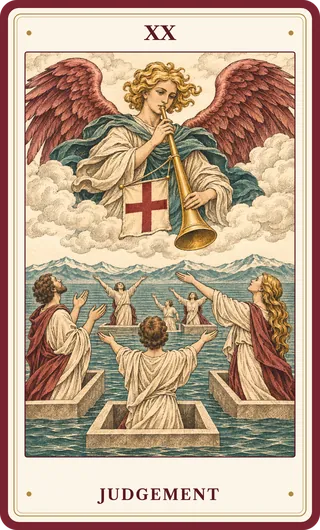
Archangel Gabriel
The angel in the clouds blows the call that wakes everyone below. It shows that this answer comes from outside the usual noise, and it is hard to ignore.
The trumpet and banner
The trumpet carries a white flag with a red cross, a sign of balance and a clear message. In a yes or no reading it says the answer is plain once you stop talking yourself out of it.
The rising figures
A man, a woman and a child rise with open arms and face the sound. They show that the yes is a response, not a guarantee, and that you have to stand up to receive it.
The coffins
The coffins float on the water and have been opened. They stand for the past, which is released but not erased, so the yes depends on what you leave behind.
The sea
The water carries everything and brings it into view. It points to emotions and memories that must be faced before the answer can settle.
The snow-capped mountains
The mountains are far off and steady. They suggest a big goal that is still a long way away, so the yes may take time to arrive.
Judgement and timing
Judgement does not point to a fixed date. The recognition tends to be immediate: you see what needs to change as soon as the card lands. The result takes longer, because the card is about integrating a new understanding into how you live.
In practice, read it as “start now, expect the outcome over weeks or months.” If the card is reversed, the clock does not start until you deal with the block. A reader who wants to put a number on it can find ways to do so in tarot timing, but with this card the better question is usually “what do I need to do first?” than “when?”
What the cards around Judgement change
A single card gives a lean, and the neighbours give the detail. Judgement almost always keeps its yes, but the cards beside it tell you the price, the delay or the form it takes.
- With the Tower or Ten of Swords: a yes that arrives after a hard ending.
- With the Eight of Swords or the Moon: fear or confusion needs clearing first.
- With the Sun or the World: a strong, complete yes.
- With Justice or the Hanged Man: a yes that needs a fair decision or a pause before you act.
If Judgement lands in a three-card line, the middle position matters most. A card in the position of “what is blocking you” changes the meaning of the yes far more than the same card in the outcome slot.
Judgement vs Justice and Death in a yes or no reading
Judgement is often mixed up with Justice, because both involve weighing things up. Justice is about fair outcomes, cause and effect, and decisions made with a clear head, and its answer depends on the facts. Judgement is about awakening and a personal response, and its answer leans yes. If you want to compare, here is Justice as a yes or no answer.
Death and Judgement are both about endings that lead to something new. Death is the ending itself, where something is cut away, while Judgement is the rising after it. In a spread with both, the sequence usually matters: one is what is closing, and the other is what you answer next.
A simple way to read a yes or no draw with Judgement
A single draw gives a lean, not a verdict, and Judgement shows why. The yes comes with a task, so it helps to have a routine for turning the card into something you can act on.
- State your question as a concrete choice.
- Note whether Judgement is upright or reversed.
- Ask what you would need to look at honestly for the yes to hold.
- Pull one clarifying card for the answer to step 3.
- Decide what you will do in the next seven days.
If you want a fast, no-frills draw before applying this, the yes or no tarot reading tool gives you a card to start from.
Common mistakes when Judgement shows up
The biggest mistake is reading the card as a literal judging, as if someone is passing a verdict on you. In most readings the judge is you, and the card is about how you assess your own past. That is why it helps to separate “I am being judged” from “I am ready to look at this clearly.”
Other mistakes are easy to spot once you know them:
- Treating the yes as a guarantee and skipping the work it asks for.
- Pulling the card again and again until it is a different answer.
- Using a reversed Judgement as a reason to feel worse about yourself.
Try this: If you get a yes from Judgement, write down one thing you will do within a week that proves you heard the call. A yes with no action behind it is just a nice feeling.
When to read beyond yes or no
Judgement is a card that wants more than a single word. If your question is emotional, or if it is a decision with real stakes, a binary answer can flatten what the card is telling you. A 3 card tarot spread covering what is behind you, what the call is and what to do next works far better.
Remember that tarot is a mirror, and a yes or no draw is the quickest, roughest version of it. Judgement is among the cards that reward a longer look: the yes is real, the condition is real, and the useful part of the reading is what you decide to do once you have heard both.
Questions readers ask
Is Judgement a yes or no card in tarot?
Judgement leans yes when it is upright. It answers yes to questions about renewal, a calling, forgiveness and a decisive change. The yes usually comes with a condition: you have to act on what you now see.
What does Judgement reversed mean as a yes or no answer?
Reversed, Judgement reads as not yet, or a soft no. The door is not shut, but fear, guilt or self-criticism is blocking the decision. Deal with that first and the answer can change.
Does Judgement mean yes in a love reading?
Yes, when the question is about repair, forgiveness or a real second chance. It is less clear if you hope to repeat the old pattern unchanged. Judgement favours a fresh start over a rerun.
Is Judgement a yes for getting back with an ex?
It can be, because it is a card of second chances and things returning. The yes holds only if both people have changed and the reunion is a new start. If nothing has been faced, treat it as a not yet.
How soon will a Judgement yes happen?
The recognition is often immediate, but the results unfold as you act on it. Think of it as a turning point that starts now and plays out over weeks or months, not as a single fixed date.
What if Judgement appears with a negative card in a yes or no spread?
The surrounding cards tell you what the yes will cost or what stands in the way. Judgement with the Tower or Ten of Swords suggests a yes that arrives after a hard ending. Judgement with the Eight of Swords or the Moon says fear or confusion needs clearing first.