
Justice as a Yes or No Answer

- Arcana
- Major Arcana, card 11
- Element
- Air, Libra
- Yes or no
- Maybe
fairnesstruthcause and effectlaw
unfairnessdishonestyavoiding accountability
Justice is a conditional yes when it appears upright. It says yes if your question is fair, your facts are straight and you are willing to accept the result, even if it is not the one you wanted. Reversed, Justice leans to a no, or to a firm “not yet”, because something is unbalanced, hidden or being avoided.
That conditional quality is why people disagree about this card. Some readers treat it as a plain yes, some as a maybe, a few as a no. This page explains how to read it so you can give a clear answer without ignoring what the card is actually about: truth, balance and consequences.
The short answer: upright yes, reversed no
If you only need a quick verdict, use this. Upright Justice: yes, if it is fair. Reversed Justice: no, or not yet. That is the lean, and it holds in most readings of a straightforward question.
The “if” matters. Most yes or no cards say yes to what you want and no to what you do not. Justice does not care what you want. It reflects what is true and what has been earned, so a yes from this card means your position can stand up to scrutiny.
For the full picture of what the card says beyond yes or no, see the Justice tarot card meaning page. If you want a fresh answer to a question right now, the yes or no tarot reading tool will draw one for you.
Why Justice gives conditional answers
Justice is a Major Arcana card numbered VIII in some decks and XI in others. The Rider-Waite-Smith deck uses XI, with Strength as VIII. Either way, it sits near the center of the Major Arcana, at the point where the story shifts from outward events to inner accounting.
The card shows a seated figure with a sword raised in one hand and scales in the other. The sword is decision and truth. The scales are cause and effect. Together they say that a result is reached by weighing evidence, not by hoping.
This is why a yes from Justice always comes with a check. It is closer to a judge saying “the case holds” than a friend saying “go for it.” The answer is only as good as the honesty of the question you put to it.
Justice upright: yes or no?
Upright Justice leans yes when three things are true: the facts are known, your actions have been fair, and the outcome you are asking about is a proportionate one. If you have done the work, kept your word and told the truth, the card backs you.
It also says yes to resolution. Questions like “Will this dispute be settled?”, “Will I get a clear decision?” or “Will the agreement be signed?” often get a yes, because Justice is the card of things being made official and balanced.
It says no, or at least wait, when the situation depends on information you do not have yet. A famous piece of Justice advice is to hold your decision until the facts are in. If you are asking whether to act on a rumor, a guess or half a story, upright Justice is quietly telling you the question is premature.
Read Justice for your question
Upright: A yes to a relationship that is honest, equal and based on shared responsibility.
Reversed: A no to the current terms, because one person is carrying more, hiding something or avoiding accountability.
Upright: They see you clearly and want things to be fair and open between you.
Reversed: Their feelings are tangled up with blame, bias or a version of events that has not been checked.
Upright: Yes to a fair result on merit, such as a contract, a decision or a pay discussion.
Reversed: No or not yet, because a process is biased, paperwork is incomplete or someone is dodging responsibility.
Upright: Yes to fair payment, settled debts and agreements that are clear and in writing.
Reversed: No to deals with vague terms, hidden costs or an unresolved dispute.
Upright: Check the facts, own your part and then decide with a clear head.
Reversed: Stop deciding on a one-sided story and look at what you have been avoiding.
Upright: Yes to balanced, evidence based choices that treat body, mind and routine as a whole.
Reversed: No to extremes or shortcuts, and not yet on a decision made without proper information.
Justice reversed: yes or no?
Reversed Justice leans no. The scales are tipped, the process is unfair, or someone is refusing to take responsibility, and the situation cannot give you a clean yes while that remains true.
The “no” is often narrower than it sounds. It is usually a no to the current terms, not to the whole goal. A contract with a hidden clause, a negotiation where one side is bluffing, or an apology that blames you: reversed Justice rejects the version on the table and asks for a fairer one.
Occasionally the card is reversed because you are the one being unfair, to yourself or someone else. If you are asking “Am I in the right?” and Justice comes up reversed, take the question seriously. For the long form, read Justice reversed, and for general guidance on interpreting upside-down cards, see how to read reversed tarot cards.
The three tests behind Justice’s answer
When Justice comes up, run the question through three checks. They turn a vague card into a usable answer.
- Facts: Do you actually have the information, in writing or confirmed, or are you relying on assumptions?
- Fairness: Would the result still feel right if the roles were swapped?
- Accountability: Has each person involved, including you, owned their part?
Three yes answers means the card’s yes is solid. Two means a cautious yes with a condition to fix first. One or none means treat Justice as a no for now, because the thing it asks for is missing.
Try this: Write your yes or no question, then answer the three tests in one sentence each before you look at the card’s lean. If you cannot answer one, that is your real next step.
Justice yes or no in love
In love, upright Justice says yes to a relationship that is honest, equal and clear about what each person wants. It is a good sign for commitment, for having a necessary conversation, or for a new relationship that starts on straight terms.
It does not say yes to a lopsided connection. If one person is doing all the emotional work, if there is a lie underneath the romance, or if someone wants the benefits without the responsibility, Justice will not bless it. In that case the answer is not a cruel no, it is “fix the balance first.”
For questions about a specific person’s feelings rather than the outcome, read the card through Justice as feelings. There it describes someone who wants fairness and honesty, who thinks before they act, and who may be slow to commit until they are sure. Reversed in love, it points to blame, scorekeeping or a partner who will not own what they did.
Getting back together and other commitment questions
For “Will we get back together?” Justice upright leans yes only if the original problem has been named and dealt with. It rewards an honest accounting, not nostalgia. If both people have taken responsibility and changed what caused the break, the yes is real.
If the breakup came from dishonesty, a pattern one person denies, or a debt of trust that nobody has repaid, the answer softens to not yet. Reversed, it usually says the reconciliation would repeat the old imbalance.
Questions about marriage, moving in or signing something together tend to get the same treatment. Justice has a strong link to formal agreements, so it often appears for engagements, prenups, divorces and shared leases. A yes is likely if the terms are clear and both sides feel they are fair.
Justice yes or no for career and money
At work, Justice upright is one of the more reliable yes cards, with the condition that you have earned it. Will you get the job you interviewed for? Will your promotion be approved? Will a fair offer come through? If you prepared properly and you are qualified, it leans yes, because it favors results based on merit.
It is also a strong card for contracts, HR matters and negotiations. Yes to signing when the terms are in writing and both sides understand them. No, or not yet, when something is verbal only or a conflict of interest is hidden.
For money, upright Justice backs fair payment, settling a debt, getting a refund or resolving a billing dispute. Reversed, it warns against deals with vague terms or any arrangement where one party carries the risk and the other the reward. A reversed Justice next to a “too good to be true” offer is a clear no.
Justice yes or no in legal matters
Justice is the card most associated with law, which makes it the card people most want a yes from. The honest reading is that it supports a fair process, not a particular winner. If your case is honest and your records are in order, that is encouraging. If you are hoping to win on a technicality or because the other side deserves it, Justice does not promise that.
For “Will I win?” questions, upright Justice leans yes when you are in the right and can show it. Reversed, it points to delays, procedural problems, bias, or an outcome that will not feel fair to you.
Tarot is not legal advice. Use Justice to clarify how you feel about your position and what to prepare, and rely on a qualified professional for the legal decision itself.
Justice card symbols
Choose a symbol to read what it means on the card.
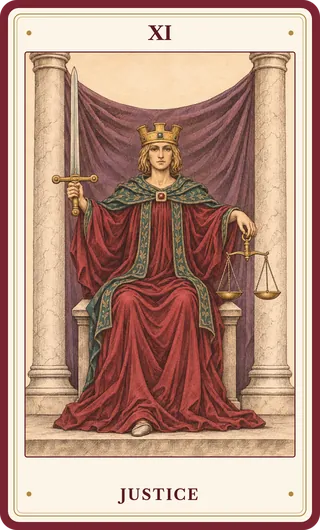
The upright sword
The double-edged sword stands for truth and the power to decide. It cuts both ways, so every verdict applies to you as well.
The scales
The scales in her left hand weigh cause and effect. They ask what is owed and what has been earned, not what is wanted.
The square crown
The crown with a small square gem marks reason and fixed principle. Judgment here comes from the mind, not from mood.
The red robe
Red shows that justice is active, not abstract. Real consequences follow the decision.
The purple veil
The curtain behind her hides what is beyond the fair verdict. Some facts are still outside your view.
The two pillars
The grey pillars frame the figure as a gate, a fixed boundary between order and chaos. You are expected to stay inside the lines of what is fair.
Health, pregnancy and other personal questions
For health, Justice leans yes to balanced and informed choices. It favors a sensible routine, a second opinion, honest tracking of symptoms and treating the body, mind and daily habits as one system. Reversed, it says no to extremes and shortcuts, and not yet to decisions made on poor information.
On pregnancy or other major life choices, upright Justice leans yes when the decision is considered and you are ready to accept the responsibilities that come with it. It is about accountability more than prediction, so it will not tell you what will happen. It will tell you whether you are choosing with open eyes.
Do not use any tarot card to answer a medical question. Let the card suggest what to ask your doctor, then act on their advice.
How to word a question for Justice
Because Justice answers according to fairness and truth, it works best with questions that are specific and concrete. “Will I get a fair settlement from this negotiation?” will get a more useful answer than “Will things work out?” Include the action, the timeframe and the people involved.
Avoid questions that already assume someone is guilty or that ask the card to prove you right. Justice responds badly to loaded questions, and the result is often a reversed card or a vague one. Try the form “Is it fair and wise for me to do X?” instead of “Will X punish them?”
For more ideas on phrasing, see this list of questions for a tarot reading.
Try this: Rewrite your question so it contains no names you want to blame and no outcome you are desperate for. Draw again only after you have rewritten it.
When will it happen? Justice and timing
Justice is rarely a fast card. It stands for processes that need to be completed in order: a review, a decision, a hearing, a signature. Expect the answer to arrive when the facts are complete, not when you are impatient.
In practical terms that often means weeks or months rather than days, especially with legal or official matters. It can also map to Libra season, since the card is traditionally linked with that sign. For more on how to approach this, see tarot timing.
If Justice appears reversed on a timing question, assume delay. The delay is usually because of missing paperwork, a dispute over terms, or someone postponing a decision they do not want to make.
Justice with other cards in a yes or no spread
When you pull more than one card, Justice sets the standard for the others. A positive card next to upright Justice is a yes with strong support. A difficult card next to it tells you where the unfairness or the missing fact sits.
A few pairings come up often:
- Justice and the Seven of Swords: a hidden agenda is spoiling what should be a fair result, so soften the yes to a maybe. See Seven of Swords for why.
- Justice and the Four of Swords: yes, but only after both sides have had time to reflect.
- Justice and the Ace of Pentacles: a fair offer or payment is on the way.
- Justice and the Five of Swords: the question is being won by pressure, not fairness, so be careful.
Treat these as prompts, not rules. The question you asked decides which meaning applies.
When the card points at you
Sometimes the unfairness Justice shows is your own. You might want a yes so much that you are skipping a fact, or you want someone else to take the blame. In those cases even an upright Justice carries a quiet warning: the verdict goes both ways.
The card’s sword is double-edged. If you are asking whether you can act, ask also whether you would accept the same decision applied to you. That one check keeps a yes from becoming a rationalization.
A reversed Justice with an upright question is often the sharpest version of this. It says that the problem is not the situation but the way you are seeing it.
A simple way to read Justice in a yes or no draw
Keep the process short so the card has room to speak. Ask one clear question, draw one card and note whether it is upright or reversed. Then give the lean: upright is yes, reversed is no or not yet.
Next, apply the three tests of facts, fairness and accountability. If they all pass, treat the yes as firm. If one fails, name the missing piece and treat the answer as a conditional yes until it is resolved.
Last, decide on the smallest responsible next step. That might be requesting something in writing, having an honest conversation, or waiting a set time before you decide. If the answer still feels unclear, a three card draw, as in a 3 card tarot spread, can show what is helping and what is in the way.
Try this: After your draw, write one sentence beginning “The fair thing to do is…” and finish it without using the word “should.” Act on that sentence today.
When Justice is the wrong card to rely on
Some questions do not suit Justice, and a yes or no draw will not fix them. If you are asking about luck, passion or a sudden change, a card of fairness will feel out of place. Justice answers questions about decisions, agreements and consequences much better than questions about fate.
It is also a poor choice when you are in the middle of strong emotion and want comfort. The card is honest, not gentle, and it will not tell you what you want to hear. If you are not ready for that, wait until you are calmer to ask.
When the answer you get is mixed, that is normal. A conditional yes is still useful: it tells you exactly which condition to meet before moving ahead.
Questions readers ask
Is Justice a yes or no card in tarot?
Upright Justice is a conditional yes. It says yes when your case is honest and fair, and it says no or not yet when facts are missing or someone is not being straight. Reversed, it leans no.
What does Justice reversed mean as a yes or no answer?
Reversed Justice usually means no to the situation as it stands, or not yet. Something is unbalanced: a biased process, a hidden fact or someone avoiding responsibility.
Does Justice mean yes in love?
It means yes when the relationship is equal, honest and both people take responsibility. If one person gives far more than the other, or something is being hidden, Justice will not give a comfortable yes.
Does Justice mean I will win my court case?
Not automatically. Justice favors a fair outcome, so it is a good sign if your case is honest and well documented. It is not a promise to win, and it is not legal advice.
Is Justice a yes for pregnancy or health questions?
It leans yes when the choice is considered, balanced and made with good information. For medical questions, use the card to prompt better questions for a professional, not as a diagnosis or a forecast.
What if I draw Justice and I do not like the answer?
Treat that reaction as information. Justice often shows up when part of the story is being skipped, so ask what fact or responsibility you would rather not look at.