
Justice Reversed (Meaning in Love, Work & Life)

- Arcana
- Major Arcana, card 11
- Element
- Air, Libra
- Yes or no
- Maybe
fairnesstruthcause and effectlaw
unfairnessdishonestyavoiding accountability
Justice reversed means the scales have tipped. Fairness, honesty or accountability is missing from the situation: someone is dodging responsibility, a decision was made with half the facts, or a system is treating you unfairly. The card asks you to find where the distortion is, and it is often both outside you and inside you.
It is not a prediction that injustice will win. The reversal is a warning and an invitation: the imbalance is visible now, so you can do something about it. Below you will find what the card means in love, feelings, work, money and health, how to read it as a person, advice or outcome, and how it differs from similar cards.
The Justice card at a glance
Justice is the eleventh card of the Major Arcana in the Rider-Waite-Smith deck, and it is linked to Libra and the element of air. In the image, a crowned figure sits between two pillars with a sword raised in the right hand and scales held in the left. It is a card of truth, cause and effect, law, contracts and moral responsibility. If you want the full upright picture first, the Justice card meaning page covers it.
Upright, the scales are level and the sword is clear. Everyone gets a fair hearing, and what you sow is what you reap. Reversed, that clean logic breaks down. The sword may be hidden, the scales loaded, or the person holding them unwilling to look at the evidence.
What Justice reversed means
At its core, Justice reversed is about a failure of fairness or honesty. That can show up as dishonesty, bias, avoided consequences, unfair treatment, legal delays or decisions made without full information. The upright card says the truth will be weighed. The reversed card says the weighing is being skipped, rigged or resisted.
The second layer is accountability. Reversed Justice often appears when someone knows, deep down, that they have done something that does not sit right and is hoping no one notices. You can hide it, or you can own it and repair it. Either way you live with the result, so the card nudges you toward the option your conscience can stand behind.
The third layer is self-judgement. For some people the reversal does not mean dodged blame but too much of it: taking responsibility for things that were never yours, or punishing yourself far beyond what the situation deserves. Honest reckoning works in both directions.
Which way is the distortion running?
The most useful question to ask of this card is simple: where is the tilt coming from? There are three common answers, and a good reading usually finds that more than one applies.
- Outside you: an employer, institution, family member or process is treating you unfairly, and you are right to feel wronged.
- Inside you: you are avoiding a truth, justifying a choice, or blaming others for something that is partly yours.
- Between you: both sides are keeping score, and neither is telling the whole story.
Look at the surrounding cards and the question you asked. If you asked “Why am I being treated this way?” the card may confirm a real injustice. If you asked “Why does this keep happening to me?” it may be pointing to a pattern you have not yet examined. Being honest about which one it is is the whole lesson of the card.
Try this: Write down the situation in two columns. In the first, list what was done to you. In the second, list what you did, said or avoided. Read both columns back as if they described a stranger, and notice which one you filled in faster.
Read Justice for your question
Upright: Honesty and fairness hold the relationship steady, and both people take responsibility for their share.
Reversed: Something is unbalanced or unspoken, whether that is a lie, a double standard or one person carrying all the effort.
Upright: They see you clearly and want to treat you fairly, and their feelings are considered rather than impulsive.
Reversed: Their feelings are muddled or guarded, and they may be avoiding an honest conversation about where they stand.
Upright: Fair pay, clear contracts and decisions made on merit.
Reversed: Unfair treatment, office politics, a skewed review or a contract with fine print you have not read.
Upright: Debts are settled, accounts balance and you receive what you earned.
Reversed: Disputes over money, hidden costs, unfair terms or avoiding a financial reality you already suspect.
Upright: Tell the truth, weigh the facts and accept the consequences of your choices.
Reversed: Stop dodging the honest reckoning, and check whether your own bias is tilting the scales.
Upright: Balance between rest, work and habits, with cause and effect easy to see.
Reversed: Habits have drifted out of balance, or you are ignoring symptoms or advice because the truth is inconvenient.
Justice reversed keywords
Keywords help you orient quickly, especially in a spread with many cards. For Justice reversed, these are the ones that come up most often:
- Unfairness and bias
- Dishonesty and hidden information
- Avoiding accountability or blame-shifting
- Legal delays, errors or unfair outcomes
- Imbalance, one-sidedness and double standards
- Guilt, denial and self-judgement
- Karma delayed or ignored
Use these as prompts, not as a checklist. The best interpretation is the one that fits your question and your position in the spread, not the longest list of words.
Justice reversed in love
In a love reading, reversed Justice signals an imbalance that is not being addressed honestly. It could be one person giving far more than the other, an agreement that is no longer being honoured, or a lie, small or large, that is sitting between you. The card says this cannot continue without consequences, because unspoken problems tend to grow.
It also asks you to check your own scorekeeping. Reversed Justice can describe a relationship where both partners tally who did what, who apologised last and who is “right”. If that sounds familiar, the issue is less about who is fair and more about whether either of you feels safe enough to be honest. A conversation that begins with “here is my part” usually goes better than one that begins with “here is yours”.
If you are single, the card can suggest you are standing in your own way. Perhaps you are judging potential partners by an impossible standard, or replaying an old unfairness and expecting it to repeat. Looking squarely at the last relationship, including your role, clears space for the next one.
Justice reversed as someone’s feelings
When Justice reversed describes how another person feels about you, expect mixed or guarded emotions. They may not be fully honest with themselves about what they want, or they may be avoiding a conversation that would force clarity. There can also be a sense that they feel judged, or that they are judging you harshly.
This is not a card of cold indifference. It tends to show someone caught between what they feel and what they think is fair, and not yet willing to resolve it. For a broader read on how the upright card shows up in affection, see Justice in love and as feelings.
Treat it as a cue to ask directly rather than guess. A card cannot read another person’s mind, and the reversal is practically asking for plain speech.
Justice reversed in career
At work, Justice reversed often points to unfair treatment: a skewed performance review, credit going to the wrong person, unequal pay, favouritism or office politics that do not reward merit. If you feel wronged, the card agrees that your sense of fairness deserves attention. Document what is happening, check your contract and policies, and raise concerns calmly and in writing where you can.
It can also warn about your own conduct. Cutting corners, bending the truth on a report, blaming a colleague for your error or avoiding a hard conversation will catch up with you. The same energy appears in the Seven of Swords reversed, where a secret is on the verge of coming out and the sensible move is to get ahead of it.
For job seekers, read contracts carefully before signing. Reversed Justice is the card of the clause you did not notice and the verbal promise that never made it into writing.
Justice reversed with money and legal matters
In money readings, reversed Justice can mean disputes, unfair terms, hidden fees, errors in paperwork or a payout that does not match what you were promised. It can also mean avoiding a financial reality, such as unopened statements, an unpaid tax bill or a debt you are pretending is smaller than it is. The card favours the awkward audit over the comfortable guess.
With legal matters, it suggests delays, bias, mistakes or a result that feels wrong. That does not mean you will lose. It means this is no time for shortcuts: keep every record, read every document, and take qualified legal advice. Tarot can describe the mood of a situation but it cannot stand in for a lawyer or predict a verdict.
If you are the one in the wrong, the best financial move is usually to settle, correct or disclose before the problem is forced into the open.
Justice reversed and health
Health readings are best kept gentle and general: tarot is not medical advice. Reversed Justice usually speaks about balance. Your habits, rest, work and recovery may have drifted out of proportion, and you may be bargaining with the facts, such as telling yourself that the symptoms are nothing because the appointment would be inconvenient.
It can also point to fairness in care. You may feel unheard by a practitioner, or you may be asking for a second opinion. That is reasonable. Bring notes, ask clear questions and keep copies of results so that the full picture is in front of whoever is helping you.
Emotionally, the card can reflect guilt that is draining you. Making amends where you can, and forgiving yourself where you cannot, is its own kind of rebalancing.
Justice reversed as a person
Drawn as a person, Justice reversed describes someone who struggles with accountability. They may deflect blame, play by different rules from everyone else, or use the language of fairness to win an argument rather than to find the truth. In a position of power, they may abuse it. They can also be a person with a rigid, harsh moral code who judges others far more strictly than themselves.
The person may also be you. Sometimes the card shows up when you have been the one making excuses, keeping score or holding someone to a standard you would not apply to yourself. For a court-card cousin of this energy, look at the King of Swords reversed, who can turn clear logic into cold, one-sided judgement.
Justice card symbols
Choose a symbol to read what it means on the card.
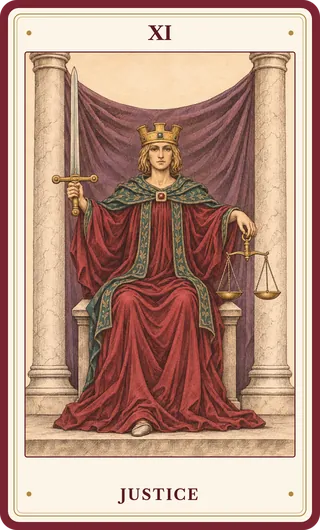
The scales
The scales in the left hand stand for weighing evidence and balancing cause and effect. Reversed, they suggest a tilt: bias, missing facts or a decision made before everything was weighed.
The upright sword
The double-edged sword in the right hand stands for clear, decisive truth that cuts both ways. Reversed, it points to a truth that is being blunted, hidden or used as a weapon.
The crown
The square crown with a small ornament marks authority grounded in reason rather than emotion. Reversed, it asks whether authority is being used fairly or abused.
Red robe and green cloak
The red robe shows the energy of action and consequence, while the green cloak shows growth and the natural order. Reversed, the two can feel out of step, with action disconnected from honest values.
Purple curtain and grey pillars
The curtain stretched between two pillars frames Justice like a courtroom, a place of formal judgement. Reversed, the frame suggests a process that is stalled, rigged or hiding something behind the cloth.
The small white shoe
A pale shoe peeks out from under the robe, a quiet hint that Justice is grounded and human, not distant. Reversed, it reminds you that the verdict ultimately lands in your own life and your own conscience.
Justice reversed as advice, outcome and in a spread
As advice, Justice reversed says: face it honestly, and the sooner the better. Gather the real facts, own what is yours, and avoid acting while you are still bending the story. If you have been wronged, speak up precisely and with grace rather than letting resentment do the talking.
As an outcome, it suggests resolution will not be as fair or as quick as hoped. Plan for delays, extra paperwork or a partial result, and focus on what is within your control. In a past position, it points to an old unfairness or an unresolved decision still shaping the present. In a future position, it shows a possible imbalance you can still avert.
Try this: Pull Justice reversed as a daily card and ask one question: “What am I avoiding being honest about today?” Write the first answer that comes, then do one small thing about it before bed, such as sending the message, reading the document or making the apology.
Is Justice reversed a yes or no?
Justice reversed leans towards no, or at least not yet. The card says the honest reckoning has not happened, so a confident yes would be built on shaky ground. If you are asking whether a deal, a legal matter or a relationship decision will go your way, the reversed card suggests checking the facts and your motives before committing.
It is not a flat refusal. If the question is “Should I come clean?” or “Should I speak up about this unfair situation?”, the reversal can actually support a yes, because honesty is what the card is demanding. The wording of your question matters. For a quick reference and a way to frame yes-or-no questions, see Justice as a yes or no answer.
Justice reversed vs upright Justice, Judgement and Wheel of Fortune
Upright Justice is balanced, fair and clear. Reversed Justice is the same energy blocked: the truth is being avoided, the scales are tilted or the outcome feels undeserved. The cards are mirror images, so they respond to the same questions with opposite answers.
People often mix Justice up with other cards about consequences. Judgement reversed is about self-doubt, ignoring a calling and refusing to learn from the past, while Justice reversed is about fairness, honesty and responsibility for specific actions. Wheel of Fortune reversed points to bad luck or resistance to change, where Justice reversed points to choices and their effects. If both appear, ask how much of what is happening is fate and how much is decision.
How to read Justice reversed with other cards
Context changes the flavour of the card. With swords, expect conversations, documents and mental games. With cups, the unfairness is emotional, such as resentment, guilt or a lopsided heart. With wands, it concerns ambition and the ways people jostle for position. With pentacles, it is about money, contracts and fair exchange.
A few pairings are worth noting:
- Justice reversed with a Seven of Swords: deceit, or someone getting away with something for now.
- Justice reversed with the Devil: feeling trapped by an unfair arrangement or by guilt.
- Justice reversed with the Hanged Man: a stalled process, with the right choice being to pause and reassess.
- Justice reversed with a Court card: a person involved in the imbalance, either you or someone close.
If the whole spread seems to be saying the same thing, take it seriously. If you want to learn how reversals fit into a full reading, the guide to reading reversed tarot cards explains the main approaches.
What to do when Justice shows up reversed
Start with honesty. Ask which facts you do not have, which ones you are avoiding and which ones you would rather not say aloud. Then act on the smallest honest step: confess a mistake, ask for the missing information or set a boundary about unfair treatment.
If you have been wronged, gather evidence and choose your channel: a manager, a mediator, a regulator, a lawyer or a trusted friend. The card does not ask you to be quiet. It asks you to be precise, and to check your own bias before you present your case.
If you are carrying guilt, resist the urge to either hide or self-punish. Make amends where you can, change the pattern, and let the matter rest. That is what balance looks like after the fact.
Common misconceptions about Justice reversed
The first is that reversed Justice means you will be treated unfairly. Sometimes it does, but often it points to an internal distortion rather than an external verdict. The second is that it means you are guilty. It can, but it can also mean you are punishing yourself too hard or that someone else is dodging their share.
The third is that it predicts a legal loss. It does not: it flags that care, honesty and documentation matter. The fourth is that reversed cards are simply bad versions of upright ones. A reversal is better understood as the same energy blocked, internal or in need of attention, and in this case it hands you a clear task.
Questions to ask yourself with Justice reversed
Use these as journalling prompts, a gentle check on the tilt in your own scales:
- What am I avoiding being honest about, and with whom?
- Where do I hold someone to a standard I would not meet myself?
- What facts am I missing, and who could supply them?
- What would a fair outcome actually look like, and is it realistic?
- What is my part in this, however small?
If the answers lead to an apology, a firm email or a hard conversation, that is the card doing its work. Come back to your reading afterwards and see whether the imbalance feels lighter. You can also draw a fresh card using the random tarot card generator to see what comes next.
Questions readers ask
What does Justice reversed mean in tarot?
Justice reversed means fairness has slipped: someone is avoiding accountability, being dishonest, or a process is producing an unfair result. It often points inward as much as outward, asking where you are bending the truth or avoiding a consequence.
Is Justice reversed a bad card?
It is uncomfortable rather than doomed. The card names an imbalance clearly, which gives you the chance to correct it, speak up or make amends before things get worse.
What does Justice reversed mean in love?
It points to an imbalance that is not being addressed honestly, such as one-sided effort, unspoken resentment or a lie. It can also mean you are judging a partner or yourself too harshly.
Does Justice reversed mean I will lose a court case?
Not necessarily. It suggests delays, errors, bias or a result that feels unfair, so get proper legal advice, keep records and avoid cutting corners. Tarot cannot predict a verdict.
Is Justice reversed a yes or no?
Usually it leans towards no, or not yet. The honest reckoning needs to happen before a sound decision can be made, so check the facts and your own motives first.
What does Justice reversed mean as someone's feelings?
Their feelings are likely mixed, guarded or not fully honest. They may be avoiding clarity about where they stand, or struggling to be fair to you and to themselves.