
Seven of Swords Reversed (Meaning in Love, Work & Life)

- Arcana
- Minor Arcana, Suit of Swords
- Element
- Air
- Yes or no
- No
strategydeceptiongetting away with something
confusionrecoveryrelease of mental strain
The Seven of Swords reversed means a secret is coming to light, a clever plan is falling apart, or someone is choosing to come clean. Upright, the card shows stealth. Reversed, the stealth ends, either because the person is caught, because their conscience catches up, or because they decide the hiding is no longer worth it.
That makes this a card of exposure and, often, relief. It rarely says what the secret is. It says the arrangement that depended on silence is no longer holding, and that honest action is now cheaper than continued concealment. Below you will find how that plays out in love, work, money and your own inner life, including the less comfortable reading where the deception simply gets worse.
What the Seven of Swords Reversed Means
At its core, the reversed card describes the moment the trick stops working. The upright Seven of Swords is a person quietly slipping away with something that is not entirely theirs. Turn it over and the quiet breaks. Somebody notices, a loose end is found, or the person carrying the load simply cannot carry it any more.
Most readers boil the reversal down to three outcomes: confession, exposure and a change of tactics. Confession is chosen. Exposure is forced. A change of tactics sits between them, where someone sees that the old approach has stopped paying off and tries a more direct one. Which of the three applies depends on your question and the cards around it.
The card also carries a quieter meaning about self-deception. Sometimes the secret being exposed is not a fact about someone else but a story you have been telling yourself: that you are fine, that the shortcut did not matter, that nobody would mind. The reversed Seven is the point where that story no longer holds up.
Reading the Image Upside Down
In the Rider-Waite-Smith image, a figure tiptoes away from a military camp holding five swords, with two more left standing in the ground behind him. He glances back as he goes. The picture is built on a gamble: he has taken as much as he can manage and hopes the rest will not be missed.
Reversed, every part of that gamble can fail. The two swords he left behind become the evidence. The backward glance becomes a witness who looks back. The soldiers in the tents, who were peacefully unaware, are about to find out. The yellow sky, a morning light, is the reminder that daylight does not favour secrets.
You do not need to flip the picture literally to read it this way. Many readers ask one simple question of the reversed card: who in this story is about to see what has been taken, hidden or left out? The answer is often the quickest route to what the card means for your situation. For more on how reversals work in general, see our guide to reading reversed tarot cards.
Confession and Coming Clean
The most common reading is a confession. Reversed, the figure turns around with the swords still in his arms and considers bringing them back. Conscience is the engine here: the person has run out of energy for pretending.
In practice this looks like someone finally telling a partner about something they have kept quiet, an employee flagging their own error, or a friend admitting they told a story that was not true. It can also be you. If the card appears for you and something sits uneasily in your chest, the reading may be a plain nudge to say it before anyone else does.
Confession is not the same as repair. Telling the truth opens the door to trust being rebuilt, but it does not rebuild it on its own. Responsible action after the admission matters just as much as the admission, and the reversed Seven asks for both.
Read Seven of Swords for your question
Upright: A secret comes out or someone finally speaks honestly, which clears the air and lets you decide whether trust can be rebuilt.
Reversed: Suspicion is fed by half-truths, or someone doubles down on a lie instead of admitting it, so the relationship stays stuck in guessing.
Upright: Guilt and relief arrive together as the urge to stop hiding grows stronger than the fear of being found out.
Reversed: Anxiety, defensiveness or a constant sense of being watched, with feelings kept buried rather than named.
Upright: A shortcut, a hidden mistake or office politics is exposed, or you choose to own an error before someone else finds it.
Reversed: Quiet manoeuvring continues past the point where it works, and blame is deflected rather than owned.
Upright: Hidden spending, debts or dodgy dealings surface, and honest accounting becomes possible.
Reversed: Financial secrets or loose habits are protected for too long, and the cost compounds in the background.
Upright: Stop managing impressions, tell the truth early and plainly, and take responsibility for what follows.
Reversed: Do not take cleverness further than it can hold: every extra cover story makes the eventual exposure larger.
Upright: Admitting a symptom, habit or worry you have been hiding from yourself or your doctor brings real relief.
Reversed: Avoidance and minimising keep a problem going, and stress from keeping up appearances starts to show in the body.
Getting Caught
The second reading is involuntary. Nobody confesses: the plan simply fails. Someone checks the numbers, a message is seen, a story does not add up. The scheme meets reality and loses.
This is the version people find uncomfortable, because the card does not take sides. It may be you who is exposed, or it may be someone else, and the card works as well for discovering another person’s dishonesty as for facing your own. Look at the question you asked. If you wondered whether someone is being straight with you, the card leans toward finding out. If you asked about your own situation, look honestly at what you have been avoiding.
A good sign that exposure is the theme is a sense of tension building with no clear cause: odd silences, changed routines, details that slip. The reversed Seven rarely arrives in a calm, resolved situation.
When It Means Doubling Down
Not every reversal is redemptive. Sometimes the person who is caught responds by lying harder. They deny, deflect, rewrite the story or blame whoever noticed. The same card, reversed, can show a deception that grows rather than ends.
You can tell this reading apart by the energy in the rest of the spread. Cards of defensiveness, conflict or pride nearby (for example the Five of Swords reversed, with its lingering resentment and unfinished fights) point to escalation. Cards of relief, release and fresh starts nearby point to a genuine confession.
If you are the one doubling down, the card is not a verdict, only a warning. Every extra layer of cover story raises the cost of the truth when it arrives, and it will arrive.
Try this: Write down one thing you have been quietly managing, a half-truth, an unsent message or an avoided conversation. Then write the plain one-sentence version you would say if you stopped managing it. Notice how your body reacts.
Seven of Swords Reversed in Love
In love, the reversed Seven of Swords is about truth between two people. A hidden issue comes into the open, through confession, discovery or an honest conversation that finally happens. Depending on the situation, that can be a painful revelation or a long-awaited release.
If you are in a relationship, the card can mean a secret is about to surface, or that one of you is ready to stop performing and speak plainly. It can cover infidelity, but it just as easily covers smaller concealments: money, a past relationship, a plan to leave, a feeling of unhappiness nobody has named. Notice also the opposite possibility, that your suspicion has been louder than the facts and the card brings reassurance rather than a bombshell.
If you are single, the card can speak about how you present yourself on dates, or about meeting someone who has not been fully honest. It is a reasonable prompt to slow down, ask direct questions and watch whether actions match words. If you are exploring more cards about hidden dynamics in love, the Three of Swords shows what the pain of a revealed truth often feels like.
Seven of Swords Reversed as Feelings
When this card describes what someone feels about you, it often points to guilt or inner conflict. They are uneasy about something, and the unease is shaping how they act. They may be quiet, evasive or oddly over-attentive, and they may be close to coming clean.
It can also describe someone who is trying to protect themselves rather than someone who intends harm. A person afraid of your reaction can look secretive even when they are not scheming. The card tells you there is a gap between what is said and what is felt, not what fills that gap.
Pulled for your own feelings, the reversed Seven often means you are tired of holding something back. You may feel relief at the idea of being honest, or dread at the idea of being found out. Both are the same card.
Seven of Swords Reversed in Career
At work, the reversed Seven of Swords points to workplace deception being exposed. A colleague who took credit, cut a corner or went around you may be called out, or a hidden mistake may surface. If the shortcut is yours, the card advises owning it before someone else produces the proof.
It also describes a shift in how you work. Where the upright card suggests confidential planning and quiet strategy, the reversed card says that secrecy is costing more than it earns. Sharing information, asking for help and letting people see your process can build more standing than any manoeuvre.
A subtler reading is imposter syndrome: the fear that your real ability does not match the persona you present. The reversed Seven asks you to stop managing impressions and let your actual competence speak. For the opposite energy of steady, visible effort, compare the Eight of Pentacles.
Seven of Swords Reversed in Money
Financially, the card shows hidden things coming into view. That might be a debt you have not looked at, spending you have kept from a partner, or an arrangement that was never quite above board. Reversed, there is an opportunity to put the facts on the table and deal with them.
It can also warn about other people. A deal with unclear terms, an offer that does not hold up under questions, or an advisor who avoids straight answers may be exposed. Read contracts, ask for specifics and be wary of pressure to decide fast.
If you want a structured way to look at your finances in a reading, try a money tarot spread alongside the card.
Seven of Swords card symbols
Choose a symbol to read what it means on the card.
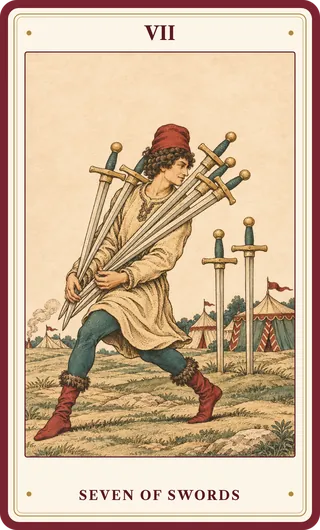
The sneaking figure
A man tiptoes away from a camp with his arms full, moving quietly so no one will notice. Reversed, the plan is breaking down: he is seen, he stops, or he turns back.
Five swords carried
He carries five swords in his arms, the part of the plan that has worked so far. Reversed, they are the stolen goods or half-truths that are now being returned or discovered.
Two swords left behind
Two blades stand upright in the ground behind him, a loose end he could not manage. Reversed, they are the evidence that gives the game away.
The backward glance
He looks over his shoulder, checking whether anyone has noticed. Reversed, that glance becomes guilt, a conscience catching up, or the moment he is spotted.
The military camp
Tents and a gathering of soldiers sit in the background, the community he is taking from. Reversed, the group is the audience that will learn the truth.
The yellow dawn sky
A pale yellow sky suggests early morning light, the hour when secrets are hard to keep. Reversed, daylight is exactly what the card promises: things become visible.
Tiptoe stride
He walks on the balls of his feet to avoid making noise. Reversed, the silence breaks, and the careful movement gives way to being heard or choosing to stop.
Spiritual Meaning and Self-Honesty
Spiritually, the reversed Seven is a card of clearing the conscience. Carrying a secret takes energy, and many people feel noticeably lighter after telling the truth, even when the truth is difficult. Confession here can be to another person, to a journal or simply to yourself.
It also invites you to look at the parts of yourself you have tried to push away. Some versions of this reversal describe a person learning to accept something they once denied: a desire, a mistake, a way of being. The Seven, upright, is a card of avoiding things. Reversed, it is a card of facing them.
Try this: Pull the Seven of Swords reversed as a journal prompt. Write for five minutes beginning with the words “What I have been avoiding saying is…” Do not edit, and do not share it unless you choose to.
Health and Wellbeing
For health questions, the reversed Seven often shows avoidance. Ignoring a symptom, minimising a habit or telling a doctor less than the full story keeps a problem going. The card suggests being honest, with yourself first, about what is really happening.
It can also point to the strain of keeping up appearances. Chronic stress from hiding something, whether a worry, a difficult situation or an unhappy routine, tends to show up as tension, poor sleep or racing thoughts. Telling the truth to someone you trust is often the first real relief.
This is a symbolic reading, not medical advice. If something physical concerns you, speak to a professional.
Is Seven of Swords Reversed a Yes or No?
The Seven of Swords is generally a no card, and reversed it leans toward a cautious maybe. The reversed card says the truth is coming out, so the right answer often becomes yes only after the facts are on the table. If you are being asked to commit to something while key details are missing, the card says wait.
Context matters. If your question is “will the truth come out?”, the reversed Seven is a fairly clear yes. If your question is “should I go ahead with this plan?”, it is a no until the hidden parts are visible. For a quick card-specific take, see the Seven of Swords yes or no page.
Upright vs Reversed: What Changes
Upright, the Seven of Swords is stealth in motion: acting alone, avoiding confrontation, taking a smart shortcut or a dishonest one. The reversed card describes what happens when the stealth ends. Either the plan fails, the person confesses, or the person changes approach.
Here is the shift at a glance:
- Upright: secrecy, strategy, acting alone, getting away with something
- Reversed: exposure, confession, guilt, returning what was taken, honest strategy
- Upright question: what is being kept quiet?
- Reversed question: what is about to be seen?
Both sides of the card share the same theme, the gap between what is said and what is true. Upright, the gap is being used. Reversed, it closes.
Seven of Swords Reversed in Combination
Cards nearby decide whether the reversal is redemptive or damaging. A few combinations are worth knowing.
- With the Ace of Swords: a clear truth cuts through, and the honest conversation becomes possible.
- With the Ten of Swords: the exposure hurts, and a painful chapter closes.
- With Justice: consequences arrive, fair or not, and accountability becomes unavoidable.
- With the Five of Cups: grief or regret over what has been lost through the deception.
The same logic applies to the full spread. If the cards around it feel open and warm, read the card as confession and relief. If they feel tense and defensive, read it as exposure or doubling down. When the card sits in a three-card line, check whether it falls in the past, present or future position. The 3 card tarot guide shows how those positions shift meaning.
When the Card Is Not About Deception
Not every Seven of Swords reversed is about lies. In some readings it simply describes poor planning: a strategy that was too clever for its own good, or a plan that needs to be rethought. The card can mean retreating from a solo approach and asking for help.
It can also describe the opposite problem: being too honest for the situation. Telling everything to everyone, including people who do not need or deserve it, is not the same as integrity. Discretion is different from deceit, and the card can ask you to tell the difference.
What to Do When You Draw It
Start by deciding whether the card is about you or someone else. Ask what you or they have been hiding, avoiding or managing. If the answer is you, consider telling the truth early, plainly and in person where possible, without a performance of guilt. If the answer is someone else, gather facts before accusing, and focus on what you can verify.
Next, think about what comes after. Honesty is the start of repair, not the finish. Be ready to offer or ask for concrete changes: returned money, a corrected record, a clear apology, a new agreement. Consistent action over weeks is what rebuilds trust.
Finally, remember the card is not a verdict on anyone’s character. The Seven of Swords is part of the wider suit of Swords, the suit of thought, truth and communication. Its reversed form says that thinking has reached its limit, and honest speech is the next move.
Questions readers ask
What does the Seven of Swords reversed mean?
It usually means a secret is coming out, someone is confessing, or a sneaky strategy has stopped working. It can also mean you are dropping cunning tactics in favour of honesty.
Is the Seven of Swords reversed a yes or no?
Leaning no, but softer than upright. Reversed, it often reads as a cautious yes only after the full truth is out in the open, so do not proceed on partial information.
Does the Seven of Swords reversed mean cheating?
Not by itself. It points to deception being exposed or confessed, which can include infidelity but also covers smaller secrets, and it can even show that a suspicion was unfounded. Surrounding cards will tell you which.
What does the Seven of Swords reversed mean as feelings?
The person is carrying guilt, anxiety or a sense of being found out. They may want to be honest with you, or they may be defensive and still hiding something.
Is the Seven of Swords reversed a good card?
It is more hopeful than the upright card. Truth, relief and a fresh start are possible, but the road there can be uncomfortable, and sometimes the card shows someone doubling down instead.
What does the Seven of Swords reversed mean in a career reading?
Workplace shortcuts, credit-taking or hidden mistakes are exposed, or you decide to own an error before it is found. It also encourages working more openly with colleagues.