
8 of Pentacles Tarot Card Meaning: Upright, Reversed, Love and Career

- Arcana
- Minor Arcana, Suit of Pentacles
- Element
- Earth
- Yes or no
- Yes
skilldiligencecraft
setbackspoor planningfinancial worry
The 8 of Pentacles is the tarot card of diligence, skill-building and patient craftsmanship. It shows a worker carving coin after coin, and it tells you that steady, focused effort will turn you from a learner into someone who is truly good at what they do. In a reading it usually points to training, practice, a demanding project or a stretch of work that is slow but worthwhile.
It is one of the most encouraging cards in the Minor Arcana, but it is not a card of luck. The reward is real and it is earned, so the message is to keep going, keep improving and care about quality. Below you will find what the card means upright and reversed, how it reads in love, career, money and health, how it differs from the cards around it in the suit, and how to work with it when it lands in your spread.
8 of Pentacles at a glance
Here is the short version, so you can check the essentials before reading further.
- Upright keywords: diligence, apprenticeship, mastery, practice, quality, dedication, steady progress
- Reversed keywords: perfectionism, boredom, burnout, sloppy work, lack of focus, effort in the wrong place
- Element and sign: Earth, with the traditional association of Sun in Virgo
- Suit and number: Pentacles, number eight
- Yes or no: yes when upright, not yet when reversed
If you want the wider picture of how this card sits among the others in its suit, the Pentacles suit overview covers all 14 cards and the practical themes that run through them.
What the card shows
The Rider-Waite-Smith image is deceptively simple. A craftsman stands at a wooden bench, hammer in one hand and chisel in the other, carving a pentacle symbol into a coin. Finished coins are displayed beside him, and one more sits on the bench waiting to be done. His head is bowed and his eyes never leave the work.
Behind him, in the distance, is a small town. He is not in it. He has chosen to work apart from it, which is part of the card’s message: focus has a cost in time and attention, and for a while the work asks you to step away from the crowd. The town is still there, and the coins are made for it, so this is not isolation for its own sake.
Notice that the coins are all roughly the same. He is not making eight different things, he is making one thing eight times and getting a little better each time. That repetition is the heart of the card. It is the opposite of the glamorous start of the Ace or the final reward of the Ten, and it covers the unglamorous middle where skill actually forms.
Upright 8 of Pentacles meaning
Upright, the card describes someone who is applying themselves fully to learning or producing something. It can mean an apprenticeship, a course, a certification, a long project, or simply a season of showing up and doing the work well. The tone is calm and productive. There is satisfaction in it, because the person is absorbed and improving.
It is also a card of quality over speed. The craftsman cares how each coin looks, and that care is what makes the finished piece valuable. When it appears, you are being encouraged to pay attention to detail, to learn the fundamentals properly and to resist shortcuts. You are building something that will last.
The 8 of Pentacles often confirms that you are on the right track even when the progress feels invisible. Skill grows quietly. You may not notice improvement from one day to the next, but the stack of finished coins is growing. If you are doubting whether the effort is worthwhile, this card says it is.
Try this: Pick one skill you want to improve and give it twenty focused minutes a day for seven days, at the same time and place. Write one line each evening about what you did better than the day before.
Read Eight of Pentacles for your question
Upright: You show love through steady, practical effort, and a relationship improves because both people keep working at it.
Reversed: Work, self-improvement or routine has crowded out real attention, so the relationship runs on autopilot.
Upright: Their feelings are expressed through consistent actions and reliability rather than big words.
Reversed: They are distracted, half engaged or hiding behind busyness, and their effort does not match what they say.
Upright: You are building real expertise through training, practice and quality work, and it will be recognised.
Reversed: You are bored, burnt out, cutting corners or polishing a task forever instead of finishing it.
Upright: Income grows slowly and reliably through skill, extra training or careful saving.
Reversed: Money is leaking through careless spending, unfinished courses or hours that are not paying off.
Upright: Commit to the craft, practise daily and let progress come from repetition rather than inspiration.
Reversed: Check your motivation and method: stop perfecting, stop coasting, and aim your effort at something that matters.
Upright: Steady routines, training and consistent habits build strength and wellbeing over time.
Reversed: Overwork, rigid routines or abandoned habits are wearing you down, so rest and adjust your approach.
Reversed 8 of Pentacles meaning
Reversed, the same bench shows a different problem. There are several ways the energy goes wrong, and your job is to work out which one fits. The first is perfectionism: you keep polishing a coin that was finished long ago, afraid to call it done. The second is boredom and coasting, where the work feels pointless, so you rush it, cut corners or avoid it altogether.
A third version is burnout. The craftsman has been working so long and so hard that the effort has become joyless, and quality drops because he is exhausted. The fourth is misdirected effort: you are working very hard, but on the wrong project, in the wrong job, or for someone who does not value it. In that case the answer is not to work harder but to change what you are working on.
Sometimes the reversal also describes poor workmanship from someone else, such as a contractor, colleague or system that has left you fixing their mistakes. For a deeper look at each version, including how it reads in love and at work, see the dedicated guide to the 8 of Pentacles reversed. If reversals are new to you, how to read reversed cards explains the different approaches.
8 of Pentacles in love
In a love reading, the 8 of Pentacles means a relationship is being built through steady effort and attention. It is not the card of sudden passion. It is the card of two people learning each other, showing up reliably and getting better at being together. It can describe working on a marriage, committing to counselling, or the early stage of a relationship where trust is being laid down one small act at a time.
For singles, it often suggests working on yourself before or alongside looking for a partner. That might mean therapy, building a life you enjoy, or learning to communicate more clearly. It can also point to a slow-burn connection, perhaps with a colleague or someone you meet through a class or shared project, where affection grows out of shared work.
Reversed in love, it warns of a relationship that has become mechanical, or one where work and self-improvement have taken over from real presence. It can also mean putting in effort that is not returned. The full breakdown is in 8 of Pentacles in love, including how it reads when you are single, dating or committed.
8 of Pentacles as someone’s feelings
When this card describes what another person feels, think steady, practical and sincere, but not especially expressive. They may show interest through consistency: replying, turning up, remembering details, putting in effort to learn about you. Their feelings are being built, not blurted out.
This person is probably careful and a little slow to commit, but when they do commit, they take it seriously. They are more likely to fix your bike or help with your CV than to write a poem. If you are looking for fireworks you may miss the signal, because the language here is effort.
Reversed, it can mean the person is distracted, uninterested or giving a half-hearted effort, or that their work life leaves little room for you. Treat the card as a prompt to watch their actions over time rather than as proof of what they feel.
8 of Pentacles in career
Work is where this card feels most at home. Upright, it is one of the clearest signs of professional growth through competence. You may be training for a promotion, learning a new tool, studying for a qualification, or simply becoming known as someone who does excellent work. Recognition tends to follow quality, so keep your standards high.
It also describes a good fit between person and job. The craftsman is not suffering at his bench, he is absorbed. If you draw this card and you love what you do, it affirms that. If you do not, it can ask whether you are working hard in a direction that suits you.
Reversed, it can mean burnout, boredom, a job that no longer teaches you anything, or a tendency to hide in details instead of finishing. It can also point to sloppy work that needs correcting. The remedy is usually one of three things: rest, a change of method, or a change of direction. Ask which applies before you decide.
Try this: Write down the one task at work you keep polishing or avoiding. Set a time limit of one hour, finish it to a “good enough” standard, and send it.
8 of Pentacles in money
The 8 of Pentacles links income to skill. It rarely predicts a windfall. It suggests that your earnings will rise as your ability does, through a qualification, a better role, freelance work, a trade or a second income stream built on something you are good at. The progress is gradual and dependable.
It also supports practical money habits: budgeting carefully, saving consistently and paying attention to the small numbers. If you are asking whether to invest in training or tools, the card is generally a green light, particularly where the investment improves your earning power. For more on how Pentacles cards describe stability and resources, the Ace of Pentacles shows where this kind of effort often begins.
Reversed, it can describe money spent on courses you never finish, hours that are not paid fairly, careless spending, or financial stress caused by overwork. It may also say that your income is stuck because your skills are no longer matched to what the market needs, and that a small investment in learning would help.
8 of Pentacles in health
In health readings, the card favours routine and gradual improvement. It supports habits such as regular exercise, physiotherapy, learning a new movement practice, or sticking to a treatment plan. Results come from consistency, not intensity, and the card encourages patient, sustainable progress.
It also reflects the body of a person who works with their hands or sits at a desk for long hours. Posture, repetitive strain and eye fatigue are the sorts of things this card can nudge you to look after, since the craftsman is bent over his bench from morning to night.
Reversed, it can warn of overtraining, burnout and working through exhaustion, or of habits abandoned because they felt dull. Tarot cannot diagnose anything, so treat these as gentle prompts and speak to a qualified professional about real health concerns.
Learning, study and creative practice
This is one of the strongest study cards in the deck. It fits students, language learners, musicians, writers, artists, coders and anyone who is learning through repetition. It says the thing you are doing now, which may feel repetitive, is building the foundation for fluency.
It also works as a manifestation card, though in a practical way. The 8 of Pentacles does not promise results because you wished for them. It says the result comes when you commit to the process and keep returning to it. If you want something, the card asks what the daily practice looks like.
Spiritually, the same idea holds. Devotion is built through regular practice, whether that is meditation, journaling or learning tarot itself. If you are new to reading the cards, the 8 of Pentacles is a good reminder that learning tarot is a craft that improves with repetition, not a talent you either have or lack.
Eight of Pentacles card symbols
Choose a symbol to read what it means on the card.
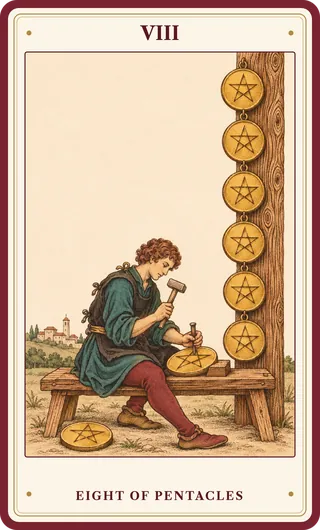
Hammer and chisel
These are the tools of patient, repeated work. They show that skill is made by small deliberate strikes, not sudden inspiration.
The coin being carved
The pentacle on the bench is unfinished, which means the work is still in progress. It reminds you that mastery is built one piece at a time.
Finished pentacles on display
The completed coins show the results of earlier effort. They suggest that quality work stacks up and becomes a visible body of work.
The workbench
The bench is a fixed place where he returns to practise. It stands for routine, discipline and a dedicated space for your craft.
The distant town
The town sits behind him while he works alone. It shows that focus sometimes means stepping back from the crowd, with the community still waiting for the finished product.
The apron and working clothes
His plain, practical clothing marks him as a tradesperson, not a spectator. It points to humility and a willingness to learn by doing.
Bowed head and steady posture
He looks only at his work and never at the viewer. This is absorption, the state in which effort stops feeling like a chore.
8 of Pentacles yes or no
As a yes or no answer, the upright 8 of Pentacles is a yes, with a condition attached: yes, if you are prepared to put in the work. It supports questions about study, training, building a skill, saving money or improving a relationship through effort. It is less suited to questions about sudden luck or quick outcomes, because this card does not do quick.
Reversed, it leans to a no or a not yet. Usually that means the plan lacks focus, the effort is not being sustained, or you are working in the wrong direction. It is a prompt to adjust, not a permanent refusal.
For a fuller answer with examples of how to phrase questions, see 8 of Pentacles as a yes or no answer.
Astrology, element and numerology
The 8 of Pentacles belongs to the suit of Pentacles, which is linked to the element Earth: the body, work, money, resources and everything physical and practical. In the Golden Dawn system, which many modern decks follow, the card is associated with the Sun in Virgo. Virgo is the sign of craft, precision, service and improvement, which fits the image perfectly. Some older titles call the card the Lord of Prudence.
In numerology, eight is the number of power, momentum and the result of sustained effort. It sits after the testing midpoint of the suit and before the near-completion of the Nine and the full harvest of the Ten. For the wider system, tarot numerology explains how each number shapes the cards.
In the Pentacles story, the 8 is the point where you have decided to commit. The earlier cards are about starting out, trading and holding on. This one is about choosing a path and putting in the hours.
8 of Pentacles compared with nearby cards
Readers often confuse the 8 with its neighbours. The 3 of Pentacles shows a craftsman working with others who review his plans, so it is about teamwork and being seen. The 8 is solitary and repetitive: no audience, no feedback, only the work. Think of the 3 as the first project and the 8 as the long practice that makes you good.
The 7 of Pentacles is about waiting and reassessing what you have grown, while the 8 is about actively producing. The 7 asks whether the effort is worth it, and the 8 answers by getting on with it. After the 8 comes the 9 of Pentacles, where the skill and discipline built here become independence and comfort.
You can also compare it with the other eights. The Eight of Wands is about speed and momentum, and the Eight of Cups is about walking away. The 8 of Pentacles is the only one in which effort is the point, which is why it feels so grounded.
8 of Pentacles in past, present and future positions
In the past position, it suggests that you have recently put in a lot of work, or that your current skills come from a period of training and repetition. It can also point to a time when you learned a hard lesson through practice.
In the present position, it says you are in the middle of a learning or building phase. It asks you to stay with it. If it appears in a spread about a current problem, the answer is often to improve the fundamentals before changing anything else.
In the future position, it indicates a coming period of focused work, study or training. It is a forecast of effort, not a sudden outcome, and the prediction is that effort will lead somewhere good. As an outcome card, it says the result will be skill and recognition earned by consistent work. If you want to practise reading positions, the 3 card tarot spread is a simple way to see how the card behaves in each place.
Questions to ask when it appears
When the 8 of Pentacles lands in your spread, a few specific questions help you move from the symbol to something you can act on.
- What skill or project am I practising, and am I practising it often enough to improve?
- Is my effort aimed at something I actually care about?
- Where am I over-polishing instead of finishing?
- Where am I coasting or cutting corners?
- Do I need rest, a better method or a different direction?
These questions cover both sides of the card. If your answers show strong commitment and good aim, the card is simply confirming you. If you find gaps, the reversal is likely at work even when the card is upright.
Try this: Answer those five questions in a notebook, then choose one change you can make this week. Keep it small, such as scheduling an hour or finishing one thing.
Combinations with other cards
Card combinations add detail. The 8 of Pentacles next to the Ace of Pentacles points to a new opportunity that needs your sustained effort to grow. Next to the Magician it describes a person with the tools and talent who is now sharpening them. With the Hermit, it suggests focused, solitary study or craft.
- With the Four of Pentacles: careful, perhaps over-controlling, attention to your resources and skill
- With the Six of Pentacles: your expertise is being rewarded, or you are sharing it by teaching
- With the Five of Cups: you may be dwelling on setbacks when you should return to your practice
- With the Ten of Pentacles: long-term effort building a lasting legacy
When combining cards, read the story of the whole spread rather than adding up keywords. The Celtic Cross is a good layout for seeing how this card interacts with others across past, present and outcome.
Working with the 8 of Pentacles
The most useful way to work with this card is to treat it as a practice prompt. If it turns up in a daily draw, ask what you can do today that your future self will thank you for. Start with one specific task and make it small enough to finish.
If you want more of this energy in your life, build a routine around a defined time, place and goal. The craftsman does not wait for motivation. He sits at the bench, picks up the chisel and starts. That is as true for learning tarot as it is for learning a trade.
You can also use the card as a check on balance. A good week involves effort and rest, and the craftsman eventually puts the tools down and walks back to town. If you notice that you are obsessing or exhausted, let that be your cue to step back and reconnect with people. To get a card of your own to reflect on, use the random tarot card generator.
Questions readers ask
What does the 8 of Pentacles mean in tarot?
The 8 of Pentacles means diligence, apprenticeship and the steady building of skill. It shows a craftsperson carving coins one by one, and it promises that consistent effort will lead to mastery and reward.
Is the 8 of Pentacles a yes or no card?
Upright, it is a yes, but a conditional one: yes if you keep working at it. Reversed, it leans towards no or not yet, usually because of poor focus, burnout or effort in the wrong direction.
What does the 8 of Pentacles mean in love?
It means love is being built through consistent effort, attention and practical care rather than drama. Reversed, it points to neglect, routine without warmth, or someone who is too busy with work or self-improvement to show up.
What does the 8 of Pentacles reversed mean?
Reversed, it points to perfectionism, boredom, cutting corners or burnout. The effort is either missing, misdirected or so obsessive that nothing gets finished.
Is the 8 of Pentacles about money?
Partly. It is about earning money through skill, such as training, a better job or a trade, rather than windfalls. The reward is steady and earned, and it grows as your ability grows.
What is the difference between the 8 of Pentacles and the 3 of Pentacles?
The 3 of Pentacles is about collaboration and having your skill checked by others. The 8 of Pentacles is solitary, repetitive practice, the long stretch of work that makes you good enough to be noticed.