
8 of Pentacles Reversed: Meaning in Love, Work & Life

- Arcana
- Minor Arcana, Suit of Pentacles
- Element
- Earth
- Yes or no
- Yes
skilldiligencecraft
setbackspoor planningfinancial worry
The Eight of Pentacles reversed means that your effort has lost its quality, focus or direction. It can show up as perfectionism that stops you finishing, laziness and shortcuts, or exhausting overwork that leads nowhere. In every version, the card is asking you to look at how you are working, and why.
Upright, this is the card of apprenticeship and mastery. Reversed, the same energy is blocked, distorted or pushed too far. This guide covers what the 8 of Pentacles reversed means in love, feelings, work, money and health, how to tell which version applies to you, and what to do once it appears.
Eight of Pentacles reversed at a glance
The reversal rarely means one single thing. It describes a problem with the working process, and that problem tends to fall into one of a few groups. Common keywords include:
- Perfectionism and over-polishing
- Lack of focus, motivation or ambition
- Cutting corners, poor quality, careless mistakes
- Burnout, overwork, workaholic habits
- Repetitive, dead-end work or the wrong career path
- Get-rich-quick thinking and money mismanagement
Many readers treat all of this as a warning of laziness, and sometimes it is. But the card is just as likely to describe someone who works far too hard and gets nothing back. Part of your job as a reader is to decide which kind of misdirected effort is in front of you.
For the base meaning of the card in its natural position, see the Eight of Pentacles upright meaning. If you are unsure how reversals work in general, the guide to reading reversed tarot cards explains the main approaches.
What the card shows and why reversal changes it
In the Rider-Waite-Smith image, a craftsman stands at a bench and carves a star into a coin. Finished pentacles are displayed behind and beside him, and a small town sits in the distance. He is alone, calm and absorbed. Nothing in the picture is rushed, and nothing is in doubt: he knows what he is making and he is getting better with every strike.
The card belongs to the suit of earth, which governs work, money, health and the physical world. Its number, eight, carries ideas of mastery, power and a cycle moving toward completion. Traditional systems also link it to the Sun in Virgo, a sign known for precision, service and attention to detail. All of that points to refinement through patient repetition.
Reversal disturbs that calm. The craftsman might put the tools down, hammer too hard, polish one coin forever or realise that he never wanted to make coins at all. Reading the card reversed means asking which of those things has happened in your own situation.
The four faces of the reversed Eight of Pentacles
Perfectionism
The craftsman carves the same pentacle over and over because it is never quite right. Work is never released, projects stay unfinished and every flaw feels fatal. The effort is real, but the standard is so high that it blocks progress. This is the version that fits people who say they are still “not ready” after years of preparation.
Disengagement and cutting corners
Here the craftsman stops caring. Deadlines are met barely, details are skipped and quality drops. The card can describe a lack of ambition, a loss of interest or a quiet decision to coast. It often appears when someone has stopped believing the work is worth doing well.
Overwork and burnout
This is the opposite extreme and the most overlooked. You are putting in long hours, grinding and repeating the same tasks, yet the results are poor and you feel hollow. Working harder is not helping, and the card is asking you to rest and rethink.
The wrong craft
Sometimes the effort is fine and the trade is wrong. You may be perfecting a skill you picked up for someone else’s reasons, or staying in a job because you have already invested so much in it. If your work feels meaningless despite being competent, this is the face to consider.
Read Eight of Pentacles for your question
Upright: You put steady, patient effort into the relationship and it grows stronger for it.
Reversed: Effort has dried up or gone to the wrong place, so the relationship drifts, or one person's perfectionism leaves no room for real closeness.
Upright: They feel committed, focused and invested in getting this right with you.
Reversed: They feel frustrated, distracted or half-hearted, and may be giving their attention to work, a project or their own fears instead.
Upright: You are building real skill, and focused effort is leading to mastery and recognition.
Reversed: You are bored, cutting corners, overworking without results, or stuck in a role that no longer suits your craft.
Upright: Skilled, reliable work brings steady income and the means to save.
Reversed: Careless spending, shortcuts, get-rich-quick hopes or money tied up in training that is not paying off.
Upright: Keep practising and trust that patient repetition will make you good at this.
Reversed: Stop and check your method: are you avoiding effort, over-polishing, or working hard at the wrong thing?
Upright: A steady routine of sleep, movement and good habits is paying off.
Reversed: Habits have slipped, or you are overworking and running yourself down, so balance and rest need attention.
Eight of Pentacles reversed in love
In a relationship reading, the card usually means effort has dropped off. Maybe one or both of you are coasting, assuming the relationship will take care of itself. Maybe work, study or a personal project is absorbing the energy that used to go into your partner. Love, like a craft, needs regular and unglamorous attention, and the reversed card shows that attention is missing.
It can also point to perfectionism inside the relationship: expecting a partner to meet an ideal, criticising small flaws or holding back because things are not yet perfect. Another reading is that the relationship has become routine, with the same arguments, the same evenings and no new learning. Neither person is exactly failing, but nothing is growing either.
For singles, the card often shows low motivation or low confidence about meeting people. It can also mean wanting a relationship without doing anything to find one. The message is practical: love will need some action from you. For more on the card’s romantic side, see the Eight of Pentacles in love.
Try this: Write down three small things your partner (or your future partner) would notice if you did them every week for a month. Pick one and start this week. Then check how it feels after seven days.
Eight of Pentacles reversed as feelings
When the card describes what someone feels about you, it points to frustration, boredom or distraction rather than strong emotion. They may feel that the relationship demands more than they can give right now, or that they are not getting enough back. They might also be pouring their energy into work or a goal, leaving little for you.
The card does not tell you they have stopped caring. It shows that their effort and focus are low or misplaced at the moment. A person who is overwhelmed and exhausted can draw this card just as easily as one who has lost interest. Look at how they behave over a few weeks, and at the other cards around it, before concluding anything.
If the card describes your own feelings, it may mean you are dissatisfied with how much you are investing, or that you are doubting yourself in the relationship. It is worth asking whether you are tired, resentful or simply unsure what you want.
Reconciliation and second chances
If you ask whether an ex will return and draw this card reversed, the answer usually leans toward not yet. Not enough work has been done by one or both sides. Apologies may be half-hearted, old problems may be unaddressed or the other person may not be willing to put in sustained effort.
That said, the card is not a permanent no. Reconciliation, like skill, grows through steady repeated action, and a reversed Eight asks whether anyone is actually doing that. If both people are still doing the same things and expecting different results, the reading is unlikely to change.
Eight of Pentacles reversed in career
At work, this card is a signal that something about your effort or your role has gone off course. You may be bored, doing repetitive tasks with no growth, or stuck in a dead-end position. You may be making careless mistakes, missing details or watching your standards slip. In a workplace that rewards speed over quality, it can also describe an environment where careful work is simply not valued.
Alternatively, it can show you doing too much. The overworked employee who stays late, takes on every task and receives little recognition fits this card well. If that sounds familiar, the Ten of Wands reversed is another card that often appears when burdens become too heavy to carry.
If you are job hunting, the card warns against sending out generic applications or assuming your experience will speak for itself. Employers will want to see evidence of skill, so it helps to prepare properly. And if you are studying or training, ask whether you are learning anything or just attending.
Eight of Pentacles reversed in money
Financially, the card can point to careless spending, shortcuts or a hope of quick riches without proper work. It may warn against schemes that promise high returns for little effort, or against investing before you understand what you are buying. Money may also be tied up in training or equipment that has not yet paid off.
Another reading is that your income does not reflect your skills. You may be underpaid, undercharging or working in a field where good work earns little. In that case, the reversal invites you to improve your pay or your position, not simply to try harder.
On the positive side, the card gives an early warning. Pentacles deal with material reality, and a reversed Eight tells you to tighten your habits before problems grow. Reviewing a budget, comparing prices or learning a skill that increases your earnings are all practical responses. The Suit of Pentacles overview shows how the cards around this one tend to describe your financial picture.
Health and daily habits
Because the Eight is about routine, a reversed one often reflects broken or unhelpful habits in health. Exercise, sleep, meals and medical check-ups may have slipped. Or you may have the reverse problem: an overly rigid regime, obsessive tracking or training so hard that your body suffers.
If you draw the card for health, ask what balance you need. Burnout, tension and exhaustion are common themes, and the card suggests that consistency matters more than intensity. A small routine you keep beats a punishing one you abandon. Tarot cannot diagnose anything, so take persistent physical or mental health concerns to a qualified professional.
Eight of Pentacles card symbols
Choose a symbol to read what it means on the card.
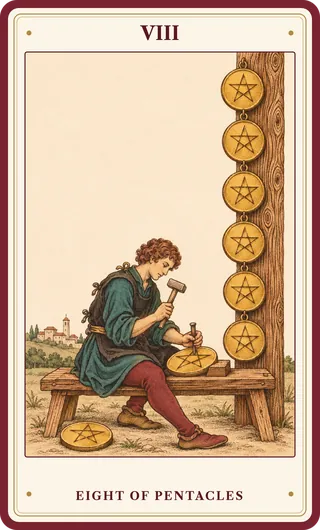
The craftsman
A young worker bends over his task with total focus, showing patience and the willingness to learn. Reversed, his attention drifts, hardens into perfectionism or burns out.
The pentacle being carved
He is stamping a single coin with a star, one careful strike at a time. It represents skill built by repetition, and reversed it asks whether the repetition is still getting you anywhere.
The finished pentacles
Several completed coins are displayed beside and above him, proof that steady work produces results. Reversed, they can point to the output you are not producing or the finished work you refuse to release.
Hammer and chisel
These are the simple tools of an honest trade, used with control and precision. When the card is reversed, they warn of rushed, careless or forced effort.
The workbench
He stays in one place and sticks to his task, which stands for discipline and routine. Reversed, this can read as being stuck at the bench, chained to a job or a method that no longer fits.
The distant town
A small town sits far behind him while he works alone. It suggests that real mastery takes some solitude, and reversed it shows isolation or a loss of connection to why the work matters.
Spiritual and personal growth
When the card turns up in a reading about inner development, it can mean you are ignoring your own practice. You may have stopped meditating, journalling or studying, or you may be collecting techniques without applying any. It can also mean spiritual perfectionism, where you wait to feel completely ready before trusting your intuition.
Some readers note a more positive version: a person deeply committed to self-improvement, with rules and habits designed to make them better. That is fine up to a point. The reversal asks whether those routines still serve you, or whether they have become another way of never feeling good enough.
Eight of Pentacles reversed as a person
As a person, the reversed Eight is either the perfectionist who cannot finish or the worker who stopped caring. The first is anxious, exacting and slow to share anything unless it is flawless. The second is disengaged, doing the minimum and perhaps resentful about it.
It can also describe someone who works constantly and has little left for other people, or someone who is overqualified and under-challenged in their job. In a relationship context, this might be a partner who lives at the office or a colleague who cuts corners and leaves the details to others. Notice whether the quality of their effort, and not only the amount, matches what they say they care about.
Is the Eight of Pentacles reversed a yes or no?
Most of the time it leans toward no, or at least not yet. The upright card is a yes because skill and persistence pay off. Reversed, the plan needs more care, better timing or a different approach before it can succeed. If you ask whether a project will work and the answer is reversed Eight, it is common to find that the preparation is not enough.
Context matters. A reversed Eight in answer to “Should I keep working at this?” may mean yes, but change the method. In answer to “Will I get the promotion?” it often means you need to show more. You can compare this with the dedicated Eight of Pentacles yes or no guide for more detail.
How to tell which meaning applies to you
Because the card has opposite faces, the question is which one you are living. Start with how you feel when you think about the task. If the feeling is dread about not being good enough, it is probably perfectionism. If it is boredom or resentment, disengagement. If it is exhaustion, burnout. If it is a sense of emptiness despite doing well, you may have the wrong craft.
Then look at the surrounding cards. Cups nearby point to emotional causes, Swords to anxiety or overthinking, Wands to drive that has run too hot or too cold, and other Pentacles to practical matters like money or job structure.
Try this: Ask yourself: “If I stopped doing this tomorrow, would I feel relief or loss?” Relief points toward burnout or the wrong craft. Loss points toward perfectionism or a temporary dip. Write your answer down before you read further.
Eight of Pentacles reversed with other cards
Card combinations shift the emphasis. A few that readers often meet:
- With the Four of Pentacles: you may be hoarding effort, time or money out of fear. See the Four of Pentacles reversed for what happens when that grip loosens.
- With the Three of Pentacles: collaboration and feedback are missing, so you work alone when you should be learning from others.
- With Cups cards such as the Five of Cups: disappointment over past effort is weighing on your motivation.
- With the Magician: you have the skill and tools, but you are not using them with intent.
- With Swords cards: stress and overthinking are interfering with your work.
When the card is reversed beside a strong upright card, the upright one often shows the resource or support you can draw on to fix the problem.
Similar cards and how they differ
The Eight reversed is easy to confuse with other work-and-effort cards. The Seven of Pentacles reversed is more about impatience with results, giving up too soon, or doubt about whether the investment will pay off. The Eight is about the quality of the daily work itself, not the wait for the harvest.
The Four of Pentacles is about holding on tightly, while the Eight is about how you are spending effort. The Ten of Wands is about carrying too much, whereas the reversed Eight is about carrying it poorly, or for a reason that no longer fits.
If you remember that this card is about the craft and not the reward, you can separate it from most of its neighbours.
What to do when you draw it
The card is more useful when you turn it into a few steps. Try this order:
- Name the problem: perfectionism, avoidance, burnout or wrong direction.
- Reduce the task to something you can finish in one sitting.
- Set a “good enough” standard and a deadline, and stick to both.
- Ask for feedback from someone who knows the work.
- Review in two weeks: is the effort now matched by progress?
If the card shows burnout, steps two and three become rest and boundaries. If it shows disengagement, step four becomes the main one, because a new challenge or a conversation may restore interest. If the craft itself is wrong, the question for the next few weeks is what you would train for if no one else’s opinion counted.
Try this: Choose one unfinished task and give it exactly 25 minutes. Finish it at “good enough”, with no polishing. Notice whether the world ends.
Used this way, the reversed Eight of Pentacles is a practical card. It points to fixable habits, and it assumes you can do the work: you only need to decide how, and for what.
Questions readers ask
What does the Eight of Pentacles reversed mean?
It points to effort that has gone wrong in some way. That might be perfectionism, scattered focus, laziness, burnout or hard work aimed at the wrong goal. The card asks you to look honestly at how and why you are working.
Is the Eight of Pentacles reversed a yes or no?
Usually it leans toward no, or at least not yet. The plan may need more skill, more care or a better method before it can succeed. Read it alongside the surrounding cards and the exact question you asked.
What does the Eight of Pentacles reversed mean in love?
It often means a relationship is not getting the attention or effort it needs, or that one person's perfectionism or work habits are crowding out intimacy. For singles it can mean low motivation to meet people. It is a prompt to put in the work, not a fixed verdict.
What does the Eight of Pentacles reversed mean as someone's feelings?
It suggests they feel frustrated, bored or distracted, and may not be giving the connection much energy at the moment. It does not mean they feel nothing. It describes a lack of effort or focus right now.
Can the Eight of Pentacles reversed mean burnout?
Yes. When the card is reversed, hard work can tip over into exhaustion, workaholism or effort that no longer feels meaningful. If you have been grinding for a long time with little reward, this card often signals that you need rest and a change of method.
How is the Eight of Pentacles reversed different from the Seven of Pentacles reversed?
The Eight reversed is about the quality and direction of your daily effort. The Seven of Pentacles reversed is more about impatience, poor returns and doubts about whether the long wait is worth it.