
Wheel of Fortune Tarot Card Meaning: Cycles, Luck and Turning Points

- Arcana
- Major Arcana, card 10
- Element
- Fire, Jupiter
- Yes or no
- Yes
cycleschangeluckturning points
bad luckresisting changesetbacks
The Wheel of Fortune is card ten of the Major Arcana, and its meaning is cycles, luck, fate and turning points. When it appears upright, your situation is changing, usually for the better, and much of that change is arriving from outside your control. The message is to move with it instead of gripping the old way of doing things.
It is also one of the most misunderstood cards in the deck. Many readers treat it as a simple “good luck” card, but the image shows a wheel that rises and falls, with figures on both sides. This guide covers the upright and reversed meanings, every major symbol, how the card reads in love, career, money and health, and how to use it when it turns up in a spread.
Wheel of Fortune at a glance
Before the detail, here are the basic facts that most readers want on one screen.
- Number: X (10), the tenth card of the Major Arcana
- Upright keywords: cycles, luck, fate, destiny, turning point, change, opportunity, karma
- Reversed keywords: bad timing, resistance to change, setbacks, repeating patterns, breaking a cycle
- Planet: Jupiter, the planet of expansion and good fortune
- Element: Fire in many modern guides, though the Rider-Waite-Smith image shows clouds and sky
- Hebrew letter: Kaph, the palm of the hand
- Yes or no: leans yes upright, leans no for now when reversed
Jupiter is the clue to the card’s mood. It is the planet of growth, generosity and lucky breaks, so the upright Wheel carries an expanding, hopeful energy. If you are curious how planets and signs attach to the other cards, the page on tarot and astrology correspondences lays out the full system.
What the Wheel of Fortune means upright
Upright, the Wheel of Fortune says that a cycle is turning and a new phase is starting. It often shows up when something has been stuck for a while: a job search with no replies, a relationship in a holding pattern, a plan waiting for the right moment. The card says the moment is arriving, and often it arrives through a phone call, an offer or a coincidence you did not arrange.
The card is about timing as much as luck. Things that were not possible last month become possible now, and the reverse is also true: a chance that is open today may close later. That is why the usual advice with this card is to act when the wheel favours you. A lucky break only helps if you step through it.
The Wheel is also the card of karma in the plain sense: what goes around comes around. Seeds planted earlier, whether kind or careless, tend to show up when the wheel turns. So the upright card can read as a reward for steady effort, as well as plain good fortune.
The image, symbol by symbol
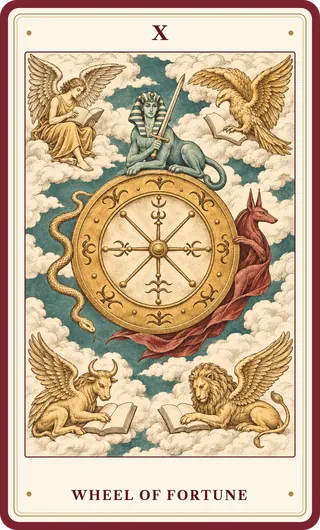
The Rider-Waite-Smith card shows a large wheel hanging in a blue sky among the clouds. Nobody is turning it and nobody sits in the middle. That detail matters, because it tells you the wheel turns by itself, and your job is to decide where you stand while it does.
At the top sits a sphinx holding a sword. It does not move with the wheel, which makes it the calm point inside the change. On the right, the jackal-headed Anubis rises, and on the left a serpent (usually named Typhon) sinks. Together they show that the same turn lifts one part of life while lowering another.
In the four corners, an angel, an eagle, a lion and a bull each hold a book. These are the four fixed signs of the zodiac (Aquarius, Scorpio, Leo and Taurus), and they appear again on The World. They represent steady wisdom that watches the cycle without being moved by it.
The rim of the wheel is the most puzzling part. The letters T, A, R, O sit between the Hebrew letters Yod, Heh, Vav, Heh, the unpronounceable name of God. Depending on how you read them, they spell ROTA (Latin for wheel), TORA (law) and TARO. Inside, small alchemical symbols for mercury, sulphur, water and salt hint that the wheel is a process of change, not a roll of dice.
Try this: Look at a picture of the card for one minute and decide where you are on it: rising with Anubis, falling with the serpent, or sitting with the sphinx. Write one sentence about why. That answer is often a better reading than any keyword list.
Read Wheel of Fortune for your question
Upright: A relationship hits a turning point, or a meaningful meeting arrives with perfect timing, and things start moving again.
Reversed: You repeat the same relationship pattern, or resist a change that both of you can already feel coming.
Upright: They feel that something fated or well timed is happening between you, and they are open to where it leads.
Reversed: They feel stuck, unsettled or unlucky about the connection, and may be fighting a shift they did not choose.
Upright: A lucky break, a new role or a change in direction opens up, and acting on it quickly pays off.
Reversed: Delays, restructures or a stalled project test your patience, and clinging to the old plan makes it worse.
Upright: Finances improve through good timing, a windfall or a favourable change in income, though cycles still apply.
Reversed: A dip, an unexpected cost or a repeated money habit drains you until you change the pattern.
Upright: Move with the change, say yes to the opening and remember that this phase will also pass.
Reversed: Stop forcing the old way to work, look at the pattern you keep repeating, and choose where to put your effort.
Upright: Energy and wellbeing are turning for the better, and a new routine or treatment can finally take hold.
Reversed: Symptoms or habits cycle round again, so slow down, track the pattern and break the loop gently.
Where the Wheel of Fortune comes from
The image is far older than the tarot. The Roman goddess Fortuna was shown turning a wheel that lifts people up and drops them down, and the philosopher Boethius used the same picture in The Consolation of Philosophy around the year 524. His point was that the wheel turns without malice, and that complaining about its motion is pointless because a wheel that stopped turning would no longer be fortune’s wheel.
Medieval artists drew the wheel with human figures riding it, often with a king on top and a beggar below. Early tarot decks, including the Tarot de Marseille, kept that design. The riders became animal-like figures, one climbing, one crowned at the top and one falling, and the wheel was often turned by a handle.
Pamela Colman Smith’s version for the 1909 Rider-Waite deck changed the picture. She took out the human riders and filled the card with symbols from Egyptian, Jewish, alchemical and astrological sources. This is why most modern readers see the card as a reflection on fate and order as well as luck.
Wheel of Fortune reversed
Reversed, the Wheel of Fortune points to bad timing, a downturn or a feeling that luck has run out. Plans stall, offers fall through and things that used to come easily now take effort. It can be frustrating, because the cause often seems to lie outside you.
The reversed card also has an inner side. It often appears when you are resisting a change that is already underway: refusing to accept that a job, a friendship or a way of living has ended. In that case the bad luck is partly the friction of holding on, and loosening your grip helps more than pushing harder.
There is a positive reading too. Reversed, the Wheel can show you finally breaking a cycle, such as a pattern in relationships or a money habit you have repeated for years. For the full breakdown of each life area, see Wheel of Fortune reversed. If reversals are new to you, the guide to reading reversed tarot cards explains the different ways to approach them.
Wheel of Fortune in love
In a love reading, the upright Wheel says the relationship is at a turning point. For couples, that might mean a move, a commitment, a reconciliation or a shift in how you live together. The old routine is no longer enough, and the card asks both of you to find a new rhythm, not to defend the previous one.
If you are single
For singles, the Wheel often signals a meeting that feels well timed or even fated. It can be an old connection returning or a new person arriving through a chance event. The card suggests that you do not need to chase, but that you do need to show up, because luck cannot help someone who stays home.
Reversed in love
Reversed, the card warns about repeating patterns: the same kind of partner, the same argument, the same ending. It can also describe a stretch of bad timing, where one person is ready and the other is not. The question to ask is which parts of the cycle belong to you and which belong to circumstance.
Wheel of Fortune as someone’s feelings
When you pull the Wheel for how someone feels about you, it often means they see the connection as significant, even fated. They may feel that meeting you changed something in their life. At the same time they can feel unsure, because the Wheel describes a person who senses things moving faster than they can control.
Reversed, it can mean they feel stuck, unlucky or reluctant to face a change in the relationship. Their feelings may be real but tangled up with fear of what happens next. For more on this reading, see the page on the Wheel of Fortune as feelings.
Wheel of Fortune in career and work
At work, the upright Wheel brings a lucky break, a promotion, a new role or an industry shift that works in your favour. It is common to see it when someone has been waiting for months and a sudden change opens things up. The key advice is speed: say yes while the door is open.
It can also describe a bigger change that is not entirely welcome, such as a restructure or a new manager, with an outcome that depends on how you respond. People who treat the change as an opening tend to land well. People who treat it as an attack tend to burn energy fighting the tide.
Reversed, the Wheel shows delays, stalled projects or setbacks that feel unfair. Check whether you are clinging to a role, a method or a plan that has already run its course. Sometimes the best move is to wait for the cycle to turn and prepare quietly in the meantime.
Wheel of Fortune and money
Money readings with the Wheel lean toward fluctuation. Upright, it can bring a windfall, a good investment, a raise or an income that rises because of good timing. It is one of the more hopeful money cards in the deck.
The honest advice with any Wheel reading is to expect cycles. A strong period does not last forever, so this is a good time to build a buffer, pay down debt and save, not to spend as if the high is permanent. The card rewards people who use the upswing to prepare for the downswing.
Reversed, it points to an unexpected cost, a dip in income or a repeated money habit such as overspending after a good month. The pattern, not the bad luck, is usually the thing to fix. If you want a structured way to look at your finances, try the money tarot spread.
Wheel of Fortune and health
In health readings, the Wheel describes a body and mind that move in cycles: energy that rises and falls, symptoms that come and go, moods with seasons. Upright, it can show a turn for the better, such as improving energy or a routine that finally works.
Reversed, it can describe a condition that keeps coming back or habits that loop, such as poor sleep followed by a crash. It is a prompt to track patterns over time. Tarot is not a medical tool, so use the card as a reflection and see a professional for any real concern.
Wheel of Fortune card symbols
Choose a symbol to read what it means on the card.
The Sphinx
Seated on top of the wheel and holding a sword, the sphinx stays still while everything else turns. It stands for steady awareness and the mind that can see the pattern without being swept along by it.
Anubis
The jackal-headed figure rises on the right side of the wheel. He represents the upward swing of fortune, and in his Hermanubis form he guides the soul between worlds.
Typhon the serpent
The snake sinks down the left side of the wheel. It shows the falling half of the cycle, and the shedding and loss that come before renewal.
The four winged creatures
The angel, eagle, lion and bull sit in the corners reading books among the clouds. They are the four fixed zodiac signs (Aquarius, Scorpio, Leo, Taurus) and stand for wisdom that holds steady while life changes.
TARO and YHVH letters
The Roman letters T, A, R, O alternate with the Hebrew letters Yod, Heh, Vav, Heh. Read around the rim they give ROTA (wheel), TORA (law) and TARO, hinting that the turning follows a deeper order.
The alchemical symbols
The inner ring carries the old alchemical signs for mercury, sulphur, water and salt. They suggest that the wheel is a process of transformation, not just luck.
The clouds and blue sky
The wheel floats in the air, not on the ground. Fortune is something you can see from above if you step back from the ride.
The Wheel of Fortune as advice
As advice, the Wheel says to stop trying to control what cannot be controlled and focus on what you can. You cannot stop a recession, a breakup or a change in the season, but you can choose how you respond. This is why the sphinx is so central: it stays aware and steady while the rim turns.
In practice that often means three things: accept that the change is real, take the opportunity that comes with it, and keep your own centre. The card does not tell you to be passive. It tells you to stop spending energy on the one thing you cannot influence.
Try this: Think of one situation where you are pushing against a change. Write down what is in your control and what is not. Pick one small action from the first list and do it today.
Is the Wheel of Fortune a yes or no card?
Upright, the Wheel of Fortune leans yes. The situation is turning in your favour, and the timing supports whatever you are asking about. That makes it one of the clearer positive answers among the Major Arcana, especially for questions about new opportunities or a change you hope for.
Reversed, it leans no, or at least not yet. The turn you are waiting for has not arrived, and forcing it will not help. Treat it as a “wait and see” and ask again later. The Wheel of Fortune yes or no page goes deeper into how to ask the question and weigh the answer.
Timing with the Wheel of Fortune
The Wheel is a card of timing, so readers often ask when something will happen. The honest answer is that it points to a change that is close, not a date. It often appears when things are about to move, but it does not say how many days or weeks.
If you need a time frame, use the surrounding cards and your spread positions. Many readers link the card to long cycles because of Jupiter, which takes about twelve years to circle the zodiac, but treat that as symbolic, not literal. For methods that work better, read about tarot timing.
Wheel of Fortune with other cards
The Wheel reads differently depending on its neighbours, and its place in the Major Arcana sequence helps. It follows The Hermit, who spends time alone looking for answers, and the Wheel can be the reward: after the quiet search, things start to move. It comes before Justice, which asks you to take responsibility for where the turn leads.
A few combinations come up often:
- Wheel and The Tower: a sudden shake-up inside a larger change, usually followed by relief
- Wheel and Death: an ending that is part of a natural cycle, not a punishment
- Wheel and The Sun: good fortune with real warmth behind it
- Wheel and The Fool: a lucky leap, so go with open eyes
Also note that the number ten reduces to one (1+0), which brings the sequence back to The Magician. The Wheel marks the end of one cycle and the start of the next.
The Wheel of Fortune as a person or outcome
When the Wheel describes a person, it points to someone who rolls with change, takes chances and seems to attract good timing. They are adaptable and optimistic, and sometimes unreliable because they trust luck more than planning. It can also describe someone who is going through a big transition right now.
As an outcome, the upright card suggests things will turn out well, though you may not control how. Reversed, it suggests the outcome is delayed or that you will need to adjust your approach. In a past, present, future layout, the Wheel in the past position shows a turn that already shaped things, and in the future position a shift is coming. You can practise this in a simple 3 card tarot spread.
Common mistakes when reading the Wheel of Fortune
The most common mistake is reading the card as pure luck. Luck is one part, but the image also shows a descending side and a still centre, and ignoring them gives you a shallow reading. The better question is not “will I be lucky?” but “where am I on the wheel?”
A second mistake is treating the reversed card as a curse. It is usually temporary, and it often points to a pattern you can change. Reversed does not mean doom, it means friction.
The third mistake is using the Wheel to avoid responsibility. “It was fate” is a comfortable answer, but the card’s message is that you choose how to respond to the turn. Fortune changes the situation, and your choices decide what you do with it.
Try this: Pull the Wheel of Fortune from your deck and place it where you will see it this week. Each evening, write down one thing that changed that day and how you responded to it.
Why this card matters
The Wheel of Fortune reminds you that nothing stays fixed. Good times pass, hard times pass, and both are easier to live through if you stop expecting permanence. Few cards say this so plainly or so kindly.
The next time it appears, ask three questions: what is turning, which side of the wheel am I on, and what is the one thing I can still choose? If you want to see how it fits among the others, browse the full list of tarot card meanings.
Questions readers ask
What does the Wheel of Fortune mean in tarot?
The Wheel of Fortune is Major Arcana card X and stands for cycles, luck, fate and turning points. It tells you that circumstances are shifting, partly outside your control, and that the best response is to move with the change.
Is the Wheel of Fortune a good card?
Upright, it is usually good news, because it brings a lucky break, better timing or a change that frees you from a stuck situation. It is better described as neutral, though, because the wheel also carries the falling side of the cycle.
What does the Wheel of Fortune mean in love?
In love it points to fated timing, a turning point or a relationship moving into a new phase. For singles it can mean a meaningful meeting arrives suddenly, and for couples it says the dynamic is changing and needs a new rhythm.
What does the Wheel of Fortune mean reversed?
Reversed, the Wheel points to bad timing, resistance to change or a pattern that keeps repeating. It is usually a temporary dip, and it often invites you to break a loop you have been stuck in.
What is the Wheel of Fortune card number and element?
It is card ten (X) of the Major Arcana. In the Golden Dawn system it belongs to Jupiter, and some modern guides give it the element Fire, though the Rider-Waite-Smith image itself sits among the clouds of Air.
Is the Wheel of Fortune a yes or no card?
Upright, it leans yes, because the situation is turning in your favour and the timing is right. Reversed, it leans no for now, since the turn you want has not arrived yet.