
The Devil Tarot Card Meaning (Upright & Reversed)

- Arcana
- Major Arcana, card 15
- Element
- Earth, Capricorn
- Yes or no
- No
attachmenttemptationhabitsmaterialism
releasebreaking freereclaiming power
The Devil is card XV of the Major Arcana, and it means being bound to something that has more power over you than it deserves. That might be a person, a habit, a fear, a craving or a belief about yourself. Upright, it points to temptation, addiction, materialism and the shadow self. Reversed, it points to breaking free, reclaiming your power and ending a pattern.
Despite the name, this card is not about evil, and it rarely predicts anything supernatural. It shows an ordinary human situation: you are stuck, and part of you is choosing to stay. The best readings of the Devil are honest and a little uncomfortable, and they usually end with a clearer sense of what to do next.
The Devil at a glance
Before going into detail, here is the card in short form. Use it as a quick reference once you know the story behind it.
- Upright keywords: bondage, addiction, temptation, materialism, obsession, shadow self, unhealthy attachment, lust
- Reversed keywords: release, detachment, reclaiming power, breaking patterns, recovery, self-awareness
- Element and planet: Earth, Capricorn, Saturn
- Number: 15, reduced to 6
- Yes or no: usually no upright, usually yes reversed
The card describes a situation where your freedom is limited, and the limit is mostly one you have agreed to. That idea of agreement is what separates the Devil from other hard cards such as the Tower or the Ten of Swords, where trouble arrives from outside.
What the Devil card shows
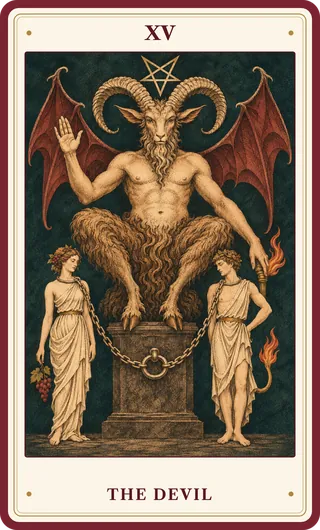
The Rider-Waite-Smith image places a large horned figure on a black pedestal, with a naked man and woman chained to it below. The figure has bat wings, goat legs and an inverted pentagram over his head. His right hand is raised in a gesture that mirrors the Hierophant, and his left holds a downward-pointing torch.
The two humans are the key to the card. They carry small horns and tails, a sign that they have taken on the nature of what holds them. Their chains are loose around their necks, and neither is struggling. This is why many readers say the Devil is a card of voluntary bondage: you could lift the chain off, but you do not, usually because of fear, pleasure or habit.
The man and woman are the same pair as in The Lovers, drawn after the fall. Where the Lovers card shows choice and union under an angel’s blessing, the Devil shows the same two people giving their agency away. The comparison is useful in a reading: a Devil dynamic often began as something that felt like a Lovers moment.
Try this: Look at the card for two minutes and trace the chain from each person’s neck to the pedestal. Then ask what in your life has a chain you could lift, and write down the first thing that comes to mind without editing it.
The Devil upright meaning
Upright, the Devil is about being held. Something has a grip on you, and the grip may feel like pleasure, security, duty or comfort. It could be a relationship dynamic, a compulsive habit, a job you stay in out of fear, or a story you tell about what you deserve.
The card is also about temptation and the shadow self. The shadow is the part of you that holds the desires, resentments and impulses you prefer not to look at. The Devil does not say these parts are wrong. It says that what you refuse to look at tends to run your decisions from behind the scenes.
Materialism is the other thread. The Devil can point to a strong focus on money, status, appearance or physical pleasure to the exclusion of everything else. This is not a moral ruling on wealth or desire. It is a check on whether you own your possessions and appetites, or they own you.
Upright, the card carries a warning and an invitation in equal parts. The warning is to notice that you are not as free as you think. The invitation is to see that the chains are loose, and that seeing them clearly is already a form of power.
Read The Devil for your question
Upright: A strong pull of attraction, jealousy or habit keeps you in a bond that may feel exciting but not free.
Reversed: You see the dynamic clearly and start to loosen it, whether that means setting boundaries or walking away.
Upright: Someone feels intensely drawn, possessive or obsessed, and the feeling may be more craving than care.
Reversed: Someone is pulling back from an unhealthy hold, or finally admitting what they actually feel.
Upright: You feel stuck in a job, contract or ambition you resent but cannot bring yourself to leave.
Reversed: You are ready to leave a draining role, refuse the golden handcuffs or stop overworking.
Upright: Spending, debt or the chase for status has a grip on you, and short-term pleasure is costing you later.
Reversed: You regain control of your finances by cutting a habit, clearing debt or facing the real numbers.
Upright: Name what has a hold on you and notice that the chains are looser than they look.
Reversed: Keep going, but expect old habits to tug at you and build support before they do.
Upright: Compulsive habits, addiction, cravings or stress-driven patterns are affecting your wellbeing.
Reversed: Recovery, detox or a healthier relationship with a habit is under way, though relapse risk is real.
The Devil reversed meaning
Reversed, the Devil usually means the chains are coming off. You have recognised a pattern for what it is, and you are starting to act on that. It can look like ending a relationship, setting a boundary, quitting a habit, leaving a draining job or finally telling someone the truth.
The reversed card is not always a clean victory. It can show the early, wobbly phase of recovery, where you understand the trap but still feel the pull. A good reading of the reversed Devil includes a note of caution: build support, remove temptations and expect old habits to knock again. For a fuller treatment, see our page on the Devil reversed.
There is a second, less common reading. Reversed, the Devil can show someone who is in denial, or who is swinging into the opposite extreme, such as strict control after indulgence. It can also mean you are punishing yourself far more than the situation deserves. If the surrounding cards are heavy and the question is about guilt, consider this reading. The wider guide to reading reversed tarot cards explains how to tell which meaning fits.
The Devil in love
In a love reading the Devil points to intense, magnetic attraction, often physical, and sometimes a relationship that is hard to leave for reasons that are not entirely healthy. It can describe jealousy, possessiveness, control, codependency, or a bond that survives on habit and fear rather than affection. It can also simply mean a passionate, sensual connection, so context and the cards around it matter.
The test is freedom. Ask whether each person can say no, disagree, spend time apart and leave without punishment. If the answer is no, the Devil is flagging a real problem. If both people are choosing the intensity with open eyes, the card is describing chemistry and nothing more sinister.
For single people, the Devil often shows up when you are drawn to someone who is clearly wrong for you, or when you are repeating a familiar pattern with a new face. Reversed, it often shows the moment you stop chasing that pattern. If you want to see how the card reads when it stands for someone’s inner state, read the Devil as feelings.
The Devil as a person
When the Devil represents a person, it describes someone magnetic, driven and hard to resist. They may be charming, sexual and persuasive, and they may also be controlling, manipulative or addicted to something. The common thread is that they have power over you, or you believe they do.
It can also describe you. The Devil as a self-portrait is someone caught in compulsion, working too hard, spending too much or hiding a side of themselves. It may be you who is doing the gripping, as in an obsessive crush or a controlling streak.
Reversed, the person is usually someone who is working to address their own destructive patterns, or someone who has just stepped out of a controlling situation. Treat that as a hopeful sign, but watch behaviour over words, since the reversed Devil can also describe someone who promises change without doing it.
The Devil in career and money
At work, the Devil shows a job or ambition that holds you tight. It might be a well-paid role you dislike, a toxic boss you cannot leave, a company that exploits your loyalty, or your own workaholism. The common feeling is being trapped while telling yourself you have no choice.
With money, it points to spending that is driven by craving, debt that has taken on a life of its own, or a chase for status that never feels like enough. It can also describe contracts, loans and arrangements with hidden strings. Check the small print before agreeing to anything when this card appears next to a financial question.
Reversed, the Devil is a good sign for career and money. It shows you walking away from a draining job, breaking an unhealthy financial habit, or finally reading your bank statements. Pair it with a card like the Four of Pentacles if you want to see whether the issue is grasping and hoarding, or with the Ace of Pentacles for a fresh and healthier start.
Try this: Write down your three biggest regular expenses or time commitments. Next to each, note whether you chose it freely, or whether you keep it because you are afraid of what happens if you stop.
The Devil and health
For health, the Devil usually points to compulsive or addictive patterns: alcohol, drugs, food, nicotine, screens, gambling or overwork. It can also show stress-driven habits, or a cycle where you feel bad, indulge to cope, then feel worse.
Tarot cannot diagnose anything, and no card should replace medical or mental health care. If the Devil appears in a health reading and you recognise yourself in it, treat it as a nudge to talk to a doctor, a counsellor or a support group. Asking for help is a practical way of loosening the chain.
Reversed, the Devil often marks recovery, detox, or a healthier relationship with a habit. It can also be a reminder that recovery is not linear. Building routines, removing triggers and leaning on other people matter as much as willpower.
The Devil card symbols
Choose a symbol to read what it means on the card.
Horned figure on the pedestal
The goat-horned, bat-winged figure is modelled on Baphomet, a symbol of the material world and the instincts rather than a literal devil. He sits above the pair as a picture of whatever you have handed power to.
Inverted pentagram
The upside-down star above his head puts matter and appetite above spirit. It tells you the card is about the body, desire and the physical world running the show.
Chained man and woman
The pair echo Adam and Eve from The Lovers, now with horns and tails. They show a couple, or a person split in two, who have given up their freedom for pleasure or security.
Loose chains
The chains around their necks hang loosely and could be lifted off. This is the key to the card: the bondage is real but it is chosen, and escape is possible.
Tails of flame and grapes
The man's tail burns like a torch and the woman's tail carries grapes. Together they point to lust and indulgence, and to appetites that burn or intoxicate.
Raised hand and downturned torch
The devil's raised hand echoes the Hierophant's blessing, twisted into a false authority. The downward torch can set the man's tail alight, a hint that desire left unchecked burns the person holding it.
Black background
The empty black space has no horizon, no light and no exit drawn in. It stands for the closed-in feeling of being trapped inside a pattern you cannot see past.
The Devil and spirituality
Spiritually, the Devil is the shadow work card. Carl Jung described the shadow as the parts of ourselves we reject or hide, and the Devil is the tarot’s picture of what happens when those parts are ignored. The card asks you to look at your hunger, anger, envy and desire directly, without shame.
This matters because suppressing a drive rarely removes it. The things we deny tend to turn up in disguise, as compulsions, projections or sudden outbursts. Meeting them on purpose, with curiosity, takes away much of their charge.
Reversed, the card can show that shadow work is paying off. You feel lighter, less defensive and more honest. It can also mark a release from religious guilt or inherited rules that no longer fit you.
Is the Devil a yes or no card?
Upright, the Devil is generally a no, or at least a warning to check your motives. If you ask whether a relationship will be healthy and the Devil appears, the card is asking you to look hard at the dynamic. If you ask about a tempting offer, it suggests there are strings attached.
Reversed, the Devil leans towards yes, particularly when the question is about getting free. Will you leave the job? Will you break the habit? The reversed card supports yes, though the effort still has to come from you. If you want a quick answer for a specific question, try our page on the Devil as a yes or no answer.
Treat any yes or no reading as a starting point. The Devil is better at showing you what is really going on than at giving a simple verdict.
The Devil in astrology and numerology
The Devil is traditionally linked to Capricorn, the sign of ambition, structure and material success, and to its ruler Saturn, the planet of limits and discipline. Both fit the card well. Capricorn builds and Saturn restricts, and the Devil shows what happens when building and restriction become a cage. You can explore more of these links in our guide to tarot and astrology.
The number 15 reduces to 6 (1 + 5), which is the number of The Lovers. That is no accident. Both cards feature a man and a woman, and both deal with desire, attachment and choice. The Lovers asks what you choose with your whole heart, while the Devil asks what you chose out of fear or craving.
In the Marseille tradition the card looks different. The figure is a hybrid, often with a face on the belly, and the two humans are smaller imps on leashes. The Rider-Waite-Smith version softens the bondage so that the chains can be removed, which is the version most modern readers work from.
The Devil in combination with other cards
The Devil changes meaning depending on what sits beside it. These pairings come up often.
- Devil and Lovers: a relationship that started in real attraction and now has a possessive edge, or a choice between freedom and habit.
- Devil and Tower: a sudden collapse that breaks a trap, often painful but freeing. See The Tower for the full picture.
- Devil and Death: an ending that finally closes a harmful pattern. The Death card is rarely literal and fits well here.
- Devil and Eight of Swords: feeling trapped by your own thoughts, with the bindings mostly mental.
- Devil and Star: healing after a period of dependency, with hope on the horizon.
Read the card in the context of the spread as well as its neighbours. A Devil in the position of past tends to mean you have lived through the pattern already, while a Devil in the future position is a warning to watch for it.
Common misreadings of the Devil
The first mistake is reading the card as evil, or as a sign that something supernatural is going on. The image comes from a symbolic tradition, and the figure is a picture of attachment to the material world. It is not a prediction of possession or a curse.
The second mistake is reading all desire in the card as bad. Lust, ambition and pleasure are not problems in themselves. The card becomes a problem when the desire controls you, rather than the other way round. A consensual, joyful sexual relationship can be a perfectly healthy Devil.
The third mistake is assuming the card means someone else is to blame. Sometimes another person really is controlling you, and that deserves serious attention. But the loose chains in the image suggest the card is mostly asking about your own part in the pattern, which is the part you have the power to change.
How to work with the Devil when it appears
If you pull the Devil, treat it as a prompt to get specific rather than a sentence to dread. These steps give you a practical way to work with it.
- Name the grip. Write one sentence saying what has power over you.
- Ask what it gives you. Every pattern pays something, such as comfort, excitement or safety. Be honest about the payoff.
- Ask what it costs. List time, money, health and self-respect.
- Find the loose chain. Decide the smallest real step that would loosen it, such as telling one person or deleting one app.
- Plan for the pull. Decide in advance what you will do when the old habit calls.
Many readers also use the Devil as a daily card when they are building a new habit or leaving a situation. If you are new to this kind of practice, the tarot for beginners guide will help you build a routine around single-card pulls.
Try this: Draw the Devil’s mirror: pull one extra card and ask “What would freedom from this look like?” Place it beside the Devil and write three sentences about what you see.
Questions to ask yourself with the Devil
Because the card works so well as a mirror, good questions matter. Try these when it shows up in a reading, a journal entry or a spread:
- What am I afraid would happen if I let this go?
- What part of myself am I hiding, and from whom?
- Where am I acting out of habit rather than choice?
- Who benefits from me staying exactly as I am?
- What would I do tomorrow if the chain were already off?
If a question lands with a small flinch of recognition, that is usually where the card is pointing. Stay with it for a few minutes and write down what comes up. The Devil is at its most helpful when it makes you honest, and honesty is the first loosening of any chain.
Questions readers ask
What does the Devil card mean in tarot?
The Devil represents attachment: to a person, a habit, a belief or a desire that has more power over you than it should. It is less about evil and more about feeling stuck and giving your power away. The loose chains in the image remind you that you can usually step free.
Is the Devil card bad?
It is a difficult card, but it is not a curse or a prediction of doom. It points to something you can name and work on, which is often the first step to changing it. Many readers find it one of the most useful cards for honest self-examination.
What does the Devil reversed mean?
The Devil reversed usually means breaking free, setting a boundary or ending a pattern that held you. It can also mean you are only beginning to see the trap, or that you are being too harsh on yourself. Watch for old habits creeping back.
Is the Devil a yes or no card?
Upright, the Devil leans towards no, or towards a warning to check your motives before you proceed. Reversed, it leans towards yes, especially where the question is about freeing yourself from something. Always read it against the question you asked.
What does the Devil mean in a love reading?
In love the Devil points to intense attraction, jealousy, control or a bond held together by habit and fear. It can also describe passion that is simply playful and physical. The question to ask is whether both people are free to leave.
What zodiac sign is the Devil tarot card?
The Devil is linked to Capricorn, an earth sign ruled by Saturn, which fits the themes of structure, ambition and limits. Saturn is the planet of boundaries, so the card often points to the walls we build or accept around ourselves.