
The Devil Reversed: Meaning in Love, Work & Life

- Arcana
- Major Arcana, card 15
- Element
- Earth, Capricorn
- Yes or no
- No
attachmenttemptationhabitsmaterialism
releasebreaking freereclaiming power
The Devil reversed means the chains are coming loose. You are recognising an attachment, habit, belief or relationship that has controlled you, and you are starting to release it. It is one of the more hopeful reversals in the deck, but it describes a process rather than a finished escape. The card can also show the opposite side of that process: a person who sees the trap and still has not moved.
If you searched for the devil card reverse, this is the same card seen upside down in a spread. Below you will find what it means in love, feelings, work, money and health, how to tell the hopeful reading from the stuck one, and what to do next. For the full picture of the card in its normal position, read The Devil tarot card meaning.
The Devil reversed meaning in short
Upright, the Devil is about bondage: appetite, fear, obsession, and the quiet belief that you cannot leave. Reversed, the same energy shifts from holding you to losing its hold. The keywords are release, detachment, awareness, independence and reclaimed power.
The central idea is recognition. People rarely break a pattern before they can name it, and this card often appears at the point where the name finally arrives. You may have said “I can’t stop” for years. The reversed Devil is the moment you start to suspect that “I won’t yet” was closer to the truth, and that a different answer is available.
It helps to treat the card as a mood of the whole situation, not a single event. Some readers see a breakthrough. Others see a slow loosening that takes weeks or months. Both are valid, and your question and the neighbouring cards decide which one fits.
Why the reversed Devil is not always a happy card
Most descriptions say the reversed Devil is purely about freedom. In practice, it has a second face. Reversed cards often describe energy that is blocked, internal or hidden, and the Devil is a card about things we hide from ourselves. So it can show a person who has not yet faced the pattern at all.
In that reading, the chains are loose but the person keeps them on. They tell themselves the job is fine, the drinking is social, the relationship is just intense. The card then points to denial, quiet resignation or a cycle that has been renamed rather than ended. A relapse after a period of progress also fits here.
A third version is the near miss. You were close to a harmful person or situation and stepped back in time, sometimes without fully knowing why. When the Devil reversed lands in a reading, ask which of these three is true: freeing yourself, avoiding the problem, or having narrowly avoided one. The rest of the spread will usually tell you. If you are new to reading upside-down cards generally, reversed tarot cards explains the main approaches.
What the upside-down image shows
In the Rider-Waite-Smith deck, the Devil sits on a black pedestal while a naked man and woman stand chained to it. Look closely and the chains are loose around their necks. Nothing locks them in, and the pedestal has no walls. This is the heart of the card: the trap is held in place by belief, not force.
Turn the card over and the Devil himself is upside down. His authority is inverted, his raised hand points to the ground and the inverted pentagram above him points up instead. The chains hang in a way that makes them look ready to slip off. The image gives a simple instruction: the figures only need to notice that they can lift the loops over their heads.
The two figures also echo the couple in The Lovers, with horns and a tail now added to them. Many readers see the Devil as The Lovers gone wrong, desire without trust. If that connection interests you, The Lovers tarot card meaning shows the version where the same two people stand free.
Try this: Look at the upside-down Devil for one minute and write one sentence beginning “The chain I could lift off today is…” Keep it small and specific, such as one habit, one message you keep re-reading, or one commitment you no longer want.
Read The Devil for your question
Upright: You are leaving an unhealthy bond or finally seeing a controlling pattern for what it is, and choosing love built on respect instead of compulsion.
Reversed: You are still circling a toxic dynamic, denying how much it costs you, or swapping one obsession for another.
Upright: Someone is loosening an obsessive or idealised view of you, or you are feeling lighter and less controlled by desire or fear.
Reversed: Attachment or jealousy is still running quietly in the background, and the feeling has not been admitted or examined yet.
Upright: You are ready to leave a draining job, set firmer boundaries, or stop tying your worth to title and salary.
Reversed: Golden handcuffs, fear of change or workaholic habits keep you in place even though you know the job is costing too much.
Upright: You are paying down debt, simplifying spending and breaking a cycle of impulse buying or financial dependence.
Reversed: Spending, debt or money anxiety is still driving your choices, and the plan to change keeps being postponed.
Upright: Name what has held you, take one concrete step away from it, and trust that the hold was looser than it felt.
Reversed: Stop explaining the pattern away and look at it plainly, ideally with another person who can see it from outside.
Upright: Recovery, quitting a habit or a real break in a compulsive cycle, with better mental and physical energy following.
Reversed: A habit or addiction is being minimised or hidden, so support is needed before the cycle can truly change.
The Devil reversed in love
In love, the reversed Devil often marks the end of an unhealthy hold. That might be a relationship built on control, jealousy or guilt, or a pull toward someone who is exciting but not good for you. It can also describe a pattern, such as repeatedly choosing the same type of partner, finally being seen and interrupted.
In a relationship
If you are partnered, the card can show you and your partner loosening a rigid dynamic: one person checking up on the other, one person carrying all the emotional weight, or an intense bond that left no space for either of you. It suggests honest conversation and rebuilding with more independence. In a relationship that is truly harmful, it supports leaving, and it asks you to take your own sense of unease seriously.
It can also mean the relationship had a close call. Something nearly broke it, and the clarity that followed is the real gift of the card.
If you are single
For singles, the Devil reversed often says you are done with chasing people who keep you off balance. You may be ready to be attracted to calmer, more respectful people, even if it feels unfamiliar at first. The card can also mark a stage of healing after a bad relationship, when the nostalgia is finally fading and you can see the whole picture.
After a breakup or reconciliation
After a breakup, the reversed Devil can mean the ex’s emotional hold is lessening, and that cutting contact is working. In reconciliation questions, treat it with care. It is positive only if the freedom is real: both people have changed the pattern, not just agreed to try again with the same dynamic.
The Devil reversed as feelings
When you ask what someone feels about you, the Devil reversed points to a loosening of intensity. Their infatuation, fixation or possessiveness is fading, or they are beginning to see you as a real person rather than a fantasy. That can feel like cooling off, but it can also be the first step toward a more honest connection.
It can also show someone who is wrestling with their own shadow side. They may have noticed how controlling or avoidant they are being and want to change. Or they may feel torn between a strong pull and their better judgement. Check the surrounding cards for warmth: a Cups card suggests the feeling is turning toward tenderness, while a Swords card suggests the head is overruling the heart.
For a fuller look at how this card reads when you are asking about a person’s heart, see The Devil in love and as feelings.
The Devil reversed in career
At work, the Devil upright shows feeling trapped by money, status or fear. Reversed, it shows you stepping out of that. You may be considering leaving a job that drains you, or you may have already started: updating a CV, saving a buffer, speaking to a mentor. The pull of security is still there, but the desire for freedom and meaning begins to outweigh it.
It can also mean breaking an unhealthy relationship with work itself. Perhaps you stop answering messages at midnight, turn down a promotion that would cost your health, or stop defining your worth by your title. The card supports setting boundaries with a boss who exploits you, and it sometimes flags a situation you spotted as a trap before it closed.
The shadow side is golden handcuffs. If you keep saying you will leave next year, the reversed Devil may simply confirm that you know the answer and have not acted on it. For that kind of pattern, the self-imposed bindings in the Eight of Swords make a useful comparison.
The Devil reversed in money
Financially, the card points to loosening the grip of debt, overspending or money anxiety. You may be paying down what you owe, cancelling subscriptions you resent, or simplifying a lifestyle that costs more than it gives. Financial freedom here is as much about your habits as about your balance.
It can also mark the end of a financial dependence, such as relying on a partner, a parent or a lender in a way that left you without a voice. Taking back control of the accounts, the budget or the decisions is exactly the kind of move this card encourages.
If the card falls next to a negative Pentacles card, or sits in the “what is blocking me” position, the reading can flip. Then it warns of impulsive spending or secrecy about money that has not yet been faced. Be honest about which side of the card you are on.
The Devil reversed in health and addiction
The reversed Devil is strongly linked with recovery. It can describe quitting a habit, reducing a compulsion, or starting treatment for something you used to avoid. Because the card concerns the mind as much as the body, it also appears when anxiety, obsessive thoughts or self-sabotage start to ease.
Remember that tarot does not diagnose and is no substitute for medical or mental health support. If this card shows up on a question about addiction, treat it as encouragement to ask for help, not as proof that you can manage alone. The chains are loose, but nobody is expected to lift them without support.
Reversed, the card can also warn that a habit is being hidden or minimised. Hiding is a sign the pattern still has power. Telling one trusted person is often the most practical way to begin.
Try this: Choose one habit the Devil reversed brings to mind. For seven days, note down only when you do it and what happened just before. Do not try to change anything yet. The pattern is usually clearer after a week of simple observation.
The Devil reversed in spirituality and shadow work
Spiritually, the Devil is the shadow card: the parts of ourselves we hide, deny or project onto other people. Reversed, it often signals active shadow work. You stop blaming the people or circumstances around you and start asking what role your own fear, appetite or avoidance plays.
This is not about punishing yourself. The Devil card is not evil, and the reversed version is more about curiosity than guilt. It asks you to look at the dark parts of yourself with honesty, so they stop running things from behind the scenes.
It can also mean stepping away from a belief system, group or teacher that kept you dependent. If a spiritual community has been telling you that you need them to be safe, the card suggests you can walk out of that door.
The Devil card symbols
Choose a symbol to read what it means on the card.
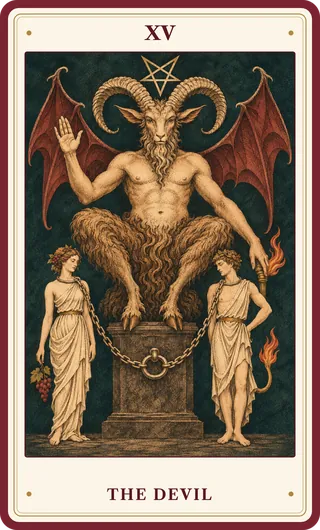
Loose chains
The chains around the necks of the two figures are slack enough to lift off. In the reversed card they fall away, showing that the bondage was never fully locked.
Upside-down Devil
The horned figure is turned over, so his authority is literally inverted. His grip on the people below him is weakening.
Naked man and woman
They echo Adam and Eve from The Lovers, now shackled to a pedestal. Reversed, they are the ones who can step away.
Inverted pentagram
Above the Devil's head, the pentagram points down, a sign of matter and appetite ruling spirit. Reversed, the order begins to right itself.
Bat wings
The wings suggest a creature of darkness and fear. When upside down, the fear is exposed and loses some of its shadow.
Raised hand and torch
The Devil's raised hand mocks a blessing, and the torch burns the tail of the man. Reversed, the flame points at what you have been letting burn you.
Black background
The empty dark space shows a trap with no walls. Reversed, you can see that nothing physically holds the figures in place.
The Devil reversed as a person
As a person, the upright Devil is charismatic, magnetic and sometimes controlling. Reversed, it can describe someone who is actively addressing their own destructive patterns: a person in recovery, someone leaving a toxic environment, or a former controller learning to let go.
It can also describe someone who has already left the influence of a bad relationship and carries the lessons from it. They tend to be wary of manipulation and clear about their limits.
Use care, because the reversal sometimes describes the opposite: a person who hides their controlling side better. If the rest of your spread shows secrecy or deceit, such as the Seven of Swords or the Moon, do not assume the improvement is real until you see consistent behaviour over time.
Is the Devil reversed a yes or no?
For a yes or no question, the Devil reversed leans yes when you are asking about freedom: leaving a job, ending a habit, setting a boundary, or walking away from something unhealthy. It leans no when you are asking about gaining something that already has a hold on you, such as more of a compulsion, a deeper tie to someone controlling, or a purchase made from impulse.
The card is not a clean yes or no on its own. It works best as a pointer: it says the right answer is the one that loosens the chain. For a wider approach to single-card answers, see The Devil as a yes or no answer.
Devil upright versus reversed
The two positions show different stages of the same story. A quick comparison:
- Upright: you feel stuck, tempted or controlled, and you may not see how much choice you have.
- Reversed: you see the pattern, begin to release it, or sit in denial about it.
- Upright in love: obsession, jealousy, toxic attachment. Reversed in love: independence, ending codependency, healthier attraction.
- Upright at work: feeling trapped by money or status. Reversed at work: boundaries, a change of direction, or a refusal to be exploited.
Neither position is a prediction of a fixed outcome. Upright can still describe a rich, consensual, intense bond if the cards around it are supportive, and reversed can still describe avoidance. Use position as a clue to the stage of the story, not a verdict.
How to tell which reversed meaning applies
Because the card has a hopeful and a stuck reading, a few questions will help you place it:
- Is the card in a position about the past, present or what is blocking you? In “past” it usually means release already happened. In “blocking” it often means denial.
- Do the neighbouring cards show movement (Eight of Cups, Six of Swords, Death) or stillness (Four of Swords, Two of Swords, Four of Pentacles)?
- Does the question already contain relief, such as “I have finally decided,” or does it contain excuses?
- How do you feel when you see it: lighter, or defensive? Defensiveness is data.
Your honest answers will usually settle it. If you still cannot tell, pull one clarifying card and ask, “What is the next step in this loosening?”
Cards that change the Devil reversed
Some pairings sharpen the message. With Death or Eight of Cups, the release is real and the departure is underway. With the Tower, the chains come off suddenly, often through a shock rather than a plan. With the Hermit, freedom comes through solitude and reflection.
Pairings with Swords often mean the pattern is mental: rumination, guilt, or a story you repeat about yourself. The Star after the Devil reversed is gentle recovery, hope after the breaking away. With the Moon or the Seven of Swords, be alert to self-deception or hidden behaviour.
Court cards can describe who or what is involved. A King or Queen beside the Devil reversed may show the person who held power over you, or the part of you that is now taking authority back.
What to do when the Devil appears reversed
You do not need a dramatic exit. The card responds best to small, honest, repeatable steps. A simple approach:
- Name the chain in one plain sentence, without softening it.
- Write down what it gives you (comfort, excitement, safety, identity). Every pattern pays something.
- Decide on one action in the next 48 hours that reduces its hold, such as a boundary, a call, or removing a trigger.
- Tell one trustworthy person what you are doing.
- Expect a wobble, and plan for it before it arrives.
Relapse is common and does not erase your progress. The Devil reversed is not asking for perfection. It is asking you to keep choosing the loosened chain over the familiar weight.
Try this: Draw the Devil reversed as a daily card for three days, or pull one with the 3 card tarot spread: what holds me, what I gain from it, and what loosens it. Compare the three cards and write what you notice.
Reading the Devil reversed in your own spread
Put the card in context. A Celtic Cross, a relationship spread or a simple three-card line will each show the Devil reversed in a different light. In a “challenge” position, it can show the pattern is the main obstacle. In an “outcome” position, it usually promises greater freedom, provided the earlier cards show you are willing to act.
Write your first impression before looking up any meaning. Often the image alone will tell you which chain applies, and the interpretation you reach by yourself is the one you will remember and use. Return to the card’s own symbols if you get stuck: the loose chains, the inverted pentagram, the black background with no walls. They all say the same thing, which is that the way out is nearer than it looks.
Questions readers ask
What does the Devil reversed mean in tarot?
The Devil reversed means the chains are loosening. You are seeing an unhealthy attachment, habit or belief clearly and beginning to release it. It can also mean the process has barely started, or that you are still denying how much the pattern controls you.
Is the Devil reversed a good card?
Usually yes, because it points to freedom, awareness and reclaimed power. It is not automatically positive, though. If the surrounding cards show denial or relapse, it can describe someone who is stuck and has stopped looking.
What does the Devil reversed mean in love?
It often means leaving a controlling or obsessive relationship, breaking a pattern of choosing the same harmful partner, or ending codependency. In a healthy relationship it can mean releasing jealousy and unspoken power games.
Is the Devil reversed a yes or no?
It leans yes when your question is about freeing yourself, leaving something or ending a habit. It leans no when your question is about gaining more of something that is already controlling you.
What does the Devil reversed mean as feelings?
As someone's feelings, it suggests their attachment, infatuation or possessiveness is loosening, or that they are trying to see you more honestly. It can also show someone who is wrestling with their own shadow side.
How is the Devil reversed different from the Devil upright?
Upright, the Devil shows the trap: temptation, compulsion and a belief that you have no choice. Reversed, it shows the moment of recognition and release, though the work of staying free still follows.