
Swords 8: Eight of Swords Tarot Card Meaning

- Arcana
- Minor Arcana, Suit of Swords
- Element
- Air
- Yes or no
- No
restrictionfeeling trappedself-limiting beliefs
confusionrecoveryrelease of mental strain
Swords 8, the Eight of Swords, is the tarot card of feeling trapped by your own thinking. A woman stands blindfolded and loosely bound inside a ring of swords, and the card asks how much of that cage is real. Upright, it points to fear, self-doubt and a sense of having no options. Reversed, it shows the blindfold slipping and a way out coming into view.
This page covers the image and its symbols, the upright and reversed meanings, then love, feelings, career, money and health. It also covers yes or no answers, astrology, card combinations, and what to do when this card turns up in your own reading.
What the Eight of Swords looks like
In the Rider-Waite-Smith deck, a woman stands in the middle of the card with a cloth over her eyes and a wrap of pale fabric binding her arms and body. She is surrounded by eight upright swords stuck into wet ground. Behind her, a castle sits on a rocky hill under a grey sky.
The details are the point. The bindings are loose, her feet are free, and the ring of swords has gaps in it. Nobody stands guard over her. Pamela Colman Smith drew a prison that holds only as long as the prisoner believes in it.
Waite’s own notes for the card speak of hindrance, indecision and difficulty. That fits the picture: she is not defeated, she is stuck in doubt about which way to step.
Eight of Swords upright meaning
Upright, the Eight of Swords describes a moment when your thoughts are working against you. You feel restricted, helpless or out of options, and the feeling is strong enough that you stop testing it. The swords are thoughts, and eight of them means a belief has hardened into a wall.
Common keywords for the upright card:
- Feeling trapped or powerless
- Fear and self-doubt
- Overthinking and mental fog
- A victim story (“this always happens to me”)
- Narrow vision, with options you cannot yet see
The card does not say your problems are imaginary. It says your view of them has shrunk. Pressure, disappointment or a long run of bad luck can leave the mind convinced that nothing will work, and the Eight of Swords shows that conviction in picture form.
Try this: Write down the sentence your mind keeps repeating about your situation (“I can’t leave,” “I have no choice”). Underneath it, write three facts that are true and three that are only fears. Notice which list is longer.
Eight of Swords reversed meaning
Reversed, the blindfold comes off. The Eight of Swords reversed is one of the more hopeful turns in the suit, because it marks the point where you start to see your situation as it is. Limiting beliefs lose their grip, a new perspective arrives, and you take back some control.
It can also mean the release is partial or still forming. You may know what you want to change and not yet have acted. In that case the reversal is an invitation: the exit is visible, so use it. For a fuller reading of the flipped card, see Eight of Swords reversed.
There is a darker reading to keep in mind. Occasionally the reversed card shows someone who refuses to take the blindfold off, clinging to the victim story because it feels safer than choice. Context from the surrounding cards and your own honesty will tell you which version applies. If you are new to flipped cards, how to read reversed tarot cards explains the different approaches.
Read Eight of Swords for your question
Upright: You feel stuck in a relationship or in a belief that love is not safe for you, even though you have more choice than it seems.
Reversed: Old fears about love loosen, and you start speaking honestly, setting boundaries or leaving what no longer fits.
Upright: Someone feels anxious, frozen and unsure how to move, and may be hiding behind silence or indecision.
Reversed: Someone is finding their nerve, seeing the situation more clearly and ready to act on what they feel.
Upright: You feel boxed in by a role, a boss or your own lack of confidence, and you have stopped looking for exits.
Reversed: You see options again, speak up, apply, retrain or negotiate, and your confidence starts to return.
Upright: Financial fear or a scarcity story keeps you from making a plan, even though a few clear steps are available.
Reversed: You face the numbers, drop the story that nothing can change and begin making small, practical moves.
Upright: Question the story you are telling yourself, and list the real options before you decide there are none.
Reversed: Trust the clarity you have gained and take the first small step out, without waiting to feel completely ready.
Upright: Anxiety, overthinking and sleepless worry are tightening their hold, and the mind needs rest and support.
Reversed: Stress eases as you get help, build routines and stop feeding the worry loop.
Eight of Swords in love
In a love reading, the upright Eight of Swords often shows someone who feels stuck: in a relationship that has gone quiet, in a situationship with no clear direction, or in a fixed idea about what they deserve. The fear might be of being alone, of being hurt again, or of saying the one honest thing that changes everything. What the card notices is that you have not tested those fears.
For singles, it often points to self-protective beliefs such as “nobody will want me” or “I always pick the wrong person.” These act like the blindfold: you cannot see the people who are actually available, or you dismiss them before they get close.
Reversed in love, the card signals relief. You may speak up, set a boundary, end something that has been draining you, or let a new connection in. It also suggests you are no longer waiting for permission. The card does not ask you to rush; it asks you to stop pretending you have no say.
Eight of Swords as feelings
When this card describes what someone feels, it usually shows anxiety and hesitation rather than a lack of interest. The person may be frozen, afraid of making the wrong move, or telling themselves a story about why it cannot work. They might go quiet, give mixed signals or avoid the topic entirely.
That makes it a tricky card to read as “they don’t care.” More often it says they feel stuck, and that fear is louder than desire right now. The kindest and most useful response is clear, calm communication, since pressure tightens the bindings.
If the card describes your own feelings, treat it as a mirror. Ask what you are afraid will happen if you say what you want. For other cards that show emotions in a similar way, the Eight of Cups shows someone who chooses to walk away, which is the opposite of being frozen.
Eight of Swords in career
At work, the Eight of Swords shows feeling boxed in. You may be stuck in a role that no longer fits, under a manager who stifles you, or unable to speak up in meetings. Often there is a quiet story underneath: “I’m not qualified for anything else,” “I can’t afford to quit,” “they’d never listen to me.”
Some of those statements may be partly true. The card’s message is that you have stopped checking. Updating your CV, speaking to a recruiter, asking a trusted colleague for honest feedback, or booking a conversation with your manager are all small moves that test the walls.
Reversed, the card shows a career breakthrough in confidence: you see the ways you have been playing small, you start applying, negotiating or setting limits, and the sense of being stuck eases. Upright or reversed, it is also a common card for fear of failure, so look at whether you are avoiding a risk because you are afraid of being seen to fail.
Eight of Swords in money
Financially, the card describes a mind clamped shut around money worries. You might avoid opening statements, feel certain you will never get ahead, or convince yourself that no plan could work. Fear makes the picture seem smaller and bleaker than the numbers often are.
The practical answer is almost always to look. Write out income, debts and fixed costs, even if it is uncomfortable. A clear picture takes the blindfold off, and a clear picture is where any plan starts. If you want a layout for this kind of question, the money tarot spread can help structure it.
Reversed, the Eight of Swords shows you finally facing your finances. You may find options you could not see before, such as renegotiating a bill, taking a side income or asking for advice. Real limits can still exist, but you stop treating them as the whole story.
Eight of Swords for health and wellbeing
The Eight of Swords is closely tied to the mind, so in health readings it often points to anxiety, intrusive thoughts, insomnia and the tight feeling of being trapped in a worry loop. It can also describe feeling powerless in the face of a diagnosis or a long recovery, when the future looks closed off.
Tarot cannot diagnose anything, and a card like this is a prompt to look after yourself, not a verdict. If worry is affecting your sleep, appetite or daily life, speaking to a doctor or therapist is a strong, sensible step, and the card would endorse it: it is about finding the exits.
Reversed, it suggests the mental grip is easing. Support, routine and fresh air all count here. Grounding practices, writing worries down and talking them through are the type of simple, repeatable moves that loosen the bindings over time.
The spiritual meaning of the Eight of Swords
Spiritually, this card is about the stories we carry. Fear, family patterns, old failures and other people’s opinions can settle into beliefs that feel like facts. The Eight of Swords asks you to look at which of those beliefs you inherited and which you have chosen.
Its lesson is agency. Nothing outside her is holding the woman in place, so freedom begins with awareness, then with one small move. That does not mean the world is always fair or that pain is a mindset problem. It means that in the space where you do have a choice, you can use it.
Because Swords belong to Air and the intellect, the work is mental and verbal. Naming the belief aloud, writing it, or talking it over with someone you trust shifts it from a blindfold to something you can look at.
Try this: Stand up and take three slow steps in any direction, eyes open. Then say aloud: “One thing I could do this week is…” and finish the sentence with a small, real action.
Is the Eight of Swords a yes or no?
Upright, the Eight of Swords answers no, or more gently “not yet.” Fear, confusion or a limiting belief is in the way, so a decision made now would probably be driven by anxiety. It is a card that says to pause, gather facts and find out what is actually possible.
Reversed, it leans toward yes. The blindfold is off, the options are visible, and action is realistic. Even then, the answer is a conditional yes: it depends on you taking the first step. For a dedicated answer page, see Eight of Swords as a yes or no.
If you are asking a yes or no question and drawing this card, treat the answer as information about your state of mind, as well as the situation. A “no” caused by fear is not the same as a “no” caused by facts, and part of your job is to work out which one you have.
Eight of Swords card symbols
Choose a symbol to read what it means on the card.
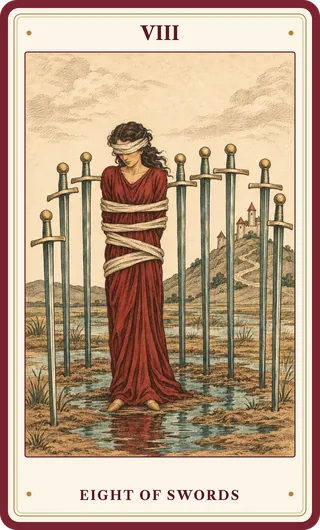
The blindfold
It shows she cannot see her situation clearly. Fear and assumption have replaced facts, and the card asks you to take the cloth off.
The loose bindings
The cloth wraps her body but is not tied tight, and her legs are free. The restriction is real as a feeling and weak as a fact.
The eight swords
Swords stand for thought, and eight of them show thinking that has become a fixed pattern. They are planted in the ground, so they limit her without touching her.
The open gaps in the ring
The circle of swords is not closed. There is a way through, and she can only find it by moving with care.
The shallow water
Water points to emotion and unprocessed feeling underfoot. She is wet and uncomfortable, but not sinking.
The distant castle
It sits on a rocky hill behind her, a sign that safety, structure and other people exist nearby. Help is within reach once she looks up.
The grey sky
The flat, heavy light matches a low, muted mood. It suggests a passing mental weather, not a permanent condition.
When the trap is real
Most readings treat the Eight of Swords as self-imposed, and that is the usual lesson. But it is worth being careful. Some situations really do restrict you: financial dependence, a controlling partner, caring responsibilities, visa or legal limits, illness. A card cannot tell you that these are all in your head, and a good reader never should.
In those cases, the card shows the pressure and the way it narrows thinking. It can also show that fear is real because the circumstances are. The kind reading is to focus on what small piece of choice remains and on getting practical support from people and services who can help.
If you are in a situation where you feel unsafe, contact local emergency services or a specialist support organisation. Tarot can help you reflect, but it is not a substitute for safety, medical or legal help.
Eight of Swords astrology, element and numerology
The Eight of Swords belongs to Air, the element of thought, speech and ideas. In the Golden Dawn system it corresponds to Jupiter in the first decan of Gemini, which runs roughly from May 21 to 31. Jupiter wants breadth and meaning, while Gemini collects small details and keeps the mind moving, so the pairing can feel like big hope squeezed into too many narrow thoughts.
Some traditions call the card “Interference” or “Shortened Force,” which captures the sense of energy being held in check. Gemini, Libra and Aquarius, the three Air signs, are often linked to it in modern practice because of the element.
Numerologically, eight is about power, cycles and mastery, and in Swords it often shows thought pressure at its peak. The next two cards in the suit, the Nine of Swords and Ten of Swords, show worry deepening into despair and then a final ending, so the Eight is the point where you can still intervene. More on number meanings is in the guide to tarot numerology.
Eight of Swords card combinations
The surrounding cards tell you whether the trap is fear, circumstance or a choice. A few pairings come up often:
- With the Eight of Cups: you may be stuck in doubt about whether to leave, and the Cups card suggests the heart already knows.
- With the Two of Swords: indecision and avoidance, with a refusal to look at what is happening.
- With the Hanged Man: a pause that feels like imprisonment but could also be a useful change of view.
- With the Star: hope is available, and the card asks you to trust it.
- With Strength: quiet courage is the way out, rather than force.
- With the Six of Swords: a gradual move to calmer waters, after the mental trap loosens.
You can build your own read of these using the tarot card combination calculator, or by noting which cards show the fear and which show the exit.
How to work with the Eight of Swords
When this card shows up, the aim is to loosen the story and take one real step. A simple sequence works well:
- Name the feeling: “I feel trapped by…”
- Separate facts from fears. What is verifiable, and what is assumption?
- List every option, including ones that seem unrealistic. Do not judge yet.
- Ask one person you trust for a different view of the situation.
- Choose the smallest action you can take within a few days, and do it.
Notice how small the steps are. The woman on the card does not need a rescue or a perfect plan; she needs enough movement to find the gap in the swords. Waiting until you feel brave tends to keep you in place, and courage often shows up after the first action, not before.
If the card keeps appearing, ask what you are getting out of staying stuck. Sometimes the answer is safety, or avoiding a hard conversation, or not wanting to be blamed. Seeing that clearly often does more than any plan.
The Eight of Swords compared with similar cards
Several cards can look alike, but each has a different centre. The Eight of Swords is stuck because of what it believes. The Eight of Cups is the opposite: someone who sees clearly and walks away from something that no longer feeds them. The Two of Swords is a blindfolded woman too, but she holds her swords and chooses not to decide, while the woman in the Eight has had her choices narrowed by fear.
The Nine of Swords is anxiety at its peak, awake in the night with despair. The Eight is quieter and more rigid, a dull sense that nothing can be done. The Five of Cups, by contrast, is grief over what was lost, while the Eight is fear about what could still happen.
Reading the card inside its suit also helps. Swords are the suit of mind, communication and truth, and you can see the whole sequence in the suit of Swords guide. Just before the Eight, the Seven of Swords shows scheming and evasion, and that background can hint at how you ended up here.
Eight of Swords in a spread
Position changes the emphasis. In the past, it describes a time you felt trapped that still shapes your thinking. In the present, it is the story you are living inside. In the future, it is a warning that you may box yourself in unless you question your assumptions.
As advice, it tells you to look again at what you consider impossible. As an obstacle, in a Celtic Cross for example, it shows a mental block that is the real source of the problem. As an outcome, it asks you to work on confidence and perspective, as a fixed ending is unlikely.
A three card tarot pull is a simple way to use it: one card for the belief that traps you, one for what is actually true, and one for the next step. Pulling a single card as a daily prompt also works well. If you want something random to try, draw one from the random tarot card generator and ask where you are telling yourself you cannot move.
Try this: Pull two more cards and set them beside the Eight of Swords. Label the first “what I fear” and the second “what is possible.” Read them as an answer to the trap, not as a prediction.
Quick summary of the Eight of Swords
The Eight of Swords means being trapped by fear, doubt and limiting thoughts, with a way out that is closer than it looks. Upright it asks you to question your story, gather facts and avoid deciding from panic. Reversed it shows freedom returning as you see clearly and take action.
It is a card of self-awareness more than punishment. The swords stand around her, not on her, and the blindfold is only cloth. Each time it appears, it points to the same quiet task: take the blindfold off, look at the gaps, and walk through one of them at a time.
Questions readers ask
What does the Eight of Swords mean in tarot?
It means feeling trapped, powerless or stuck, usually because of fear, self-doubt and limiting beliefs rather than outside walls. The card shows a blindfolded woman who is only loosely bound, which hints that escape is possible.
Is the Eight of Swords a yes or no card?
Upright, it leans to no, or at least not yet, because fear is steering the decision. Reversed, it leans toward yes, since the blindfold is coming off and options are visible.
Is the Eight of Swords a bad card?
It is an uncomfortable card, but not a doom card. It describes a mental trap and points straight at the fix, which is to see clearly and take one small action.
What does the Eight of Swords mean in love?
It can show feeling stuck in a relationship, or being held back from love by fear of rejection, past hurt or low self-worth. Reversed, it shows breaking free of those beliefs and speaking or acting more honestly.
What zodiac sign is the Eight of Swords?
In the Golden Dawn system it is Jupiter in Gemini, covering the first decan of Gemini, roughly May 21 to 31. Its element is Air, the element of the whole suit of Swords.
What does the Eight of Swords mean as feelings?
Someone is anxious, indecisive or frozen by fear and may not know how to express what they feel. It points to hesitation more than to a lack of interest.