
Eight of Swords as a Yes or No Answer

- Arcana
- Minor Arcana, Suit of Swords
- Element
- Air
- Yes or no
- No
restrictionfeeling trappedself-limiting beliefs
confusionrecoveryrelease of mental strain
In a yes or no tarot reading, the Eight of Swords upright is a no, usually meaning “no, not yet” or “not as things stand.” Reversed, it leans toward yes, because the blindfold is coming off and the way forward is becoming visible. This is one of the clearest negatives in the Swords suit, but it is a no with an explanation attached.
The card shows a woman blindfolded and loosely bound, standing among eight upright swords. The answer it gives is less “this will never happen” and more “you are not seeing clearly enough to decide.” Below you will find how to read it for love, career, money and health, when the answer shifts toward yes, and how to word your question so the card is useful. For the full card, see the Eight of Swords meaning.
Why the Eight of Swords says no
The Eight of Swords is about restriction. It sits in the suit of Air, the suit of thoughts, beliefs and words, so the restriction it describes is mental. In a yes or no spread, a card that stands for being stuck, fearful and unable to see options does not support forward movement. That is why it reads as no.
It also matters that this card falls near the painful end of the Swords sequence. It comes after the conflict and defeat of the Five of Swords and the retreat and secrecy that follow, and leads toward the anguish of the Nine of Swords. The anxious thinking has gathered momentum by the eighth card, and a plan made inside that mindset is rarely a good one.
Think of the no as a pause button. The card is not forbidding your plan. It is saying the situation, as you currently see it, is not ready for a yes.
What the no is actually about
The most useful thing to understand is what the card says no to. It does not usually say no to the outcome you want. It says no to the version of the situation you are looking at while frightened. The woman in the image is not in a cage with a locked door. The cloth around her is loose, the swords are spaced apart, and there is a clear gap in front of her.
So when you pull this card for “Will I get the job?”, the answer is more like “Not while you are convinced you will not.” When you ask “Is this relationship going to work?”, it points at the blocked communication, the assumptions and the fear that are in the way, rather than a final verdict on the other person.
That is why this card suits readers who want a straight answer but also want a reason. The no is real. Still, it carries a reason you can act on, which most no cards do not.
Eight of Swords reversed as a yes or no answer
Reversed, the Eight of Swords moves toward yes. The blindfold slips, the bindings loosen, and the person begins to see what was there all along. The upright card is the stuck mind, and the reversed card is the mind starting to work again.
The reversed yes is a cautious one. It is often “yes, once you act” instead of “yes, and it will happen on its own.” The release is under way, but it is rarely complete, and you may still feel some fear or hesitation. For a deeper look at that stage, read the Eight of Swords reversed page.
There is one reading in which the reversed card can still be a mild no. If the reversal reads as sinking further into denial, with the person refusing to take off the blindfold even when others point out the exit, then the answer stays closer to “not yet.” The context of the question and the surrounding cards usually settle which version you are in. For more on how reversals work, see how to read reversed tarot cards.
Here is a quick summary of the answers by position:
- Upright: no, or no for now
- Reversed: leaning yes, or yes once you act
- Reversed with fear still strong: not yet
Read Eight of Swords for your question
Upright: No for now: fear, old patterns or a feeling of being stuck is blocking the connection or your honesty within it.
Reversed: Leaning yes: you are removing the blindfold, speaking up, and the relationship or your freedom within it can move forward.
Upright: They or you feel trapped, anxious and unsure there is any way out, even though the way out is not as closed as it seems.
Reversed: The fear is easing, and feelings are becoming clearer, calmer and more honest.
Upright: No to the move as it stands: self-doubt or a stuck situation is limiting you, and you may be overlooking real options.
Reversed: Leaning yes: you are seeing your options again and ready to apply, negotiate or leave.
Upright: No for now: money worry is clouding your judgment and you feel you have no choices, so hold off on big commitments.
Reversed: Leaning yes: a clearer view of your finances shows workable steps, and a sensible plan is within reach.
Upright: Question the story you are telling yourself before you act, because the barrier is mostly mental.
Reversed: Act on what you now see: take the first small step out of the situation.
Upright: Anxiety, tension or feeling powerless over a health issue is weighing on you, so ask for support and information.
Reversed: Recovery and relief are starting, helped by clearer information and a calmer mind.
What the image tells you about the answer
Looking at the Rider-Waite-Smith image helps you judge how firm the no is. The woman stands in shallow water, not deep. The castle on the distant rock shows that safety and structure exist within reach. The sky is grey, but grey skies change.
Count the swords as well. They surround her, but they do not seal her in, and there are open gaps between the blades. A reader who sees only the fence will read a hard no. A reader who sees the gaps will read “no, until you notice the exit.” The second reading is closer to what the card intends.
Try this: Put the card in front of you and spend one minute looking only for gaps: spaces between swords, loose cloth, open ground. Then write down one gap in your own situation that you have been ignoring.
Eight of Swords yes or no in love
In love questions, the upright Eight of Swords is usually a no for now. The question might be “Will they commit?”, “Should I reach out?” or “Is this relationship working?” The card points to a block: someone is afraid, silent, defensive or stuck in an old pattern. Often that someone is you.
If the question is about another person’s feelings, the card suggests they feel trapped, confused or unable to say what they want, and a clear yes is not available yet. It does not necessarily mean they have no feelings. For more on how this card reads in that context, see the Eight of Cups yes or no page for a card that shows deliberate walking away, which is quite a different message.
Reversed in love, the answer leans yes. Conversations open up, a person finds the courage to say what they have been holding back, or you stop letting fear decide for you. A yes here depends on an honest conversation, not on waiting.
Eight of Swords yes or no for career
For career questions such as “Should I accept this offer?”, “Will I get the promotion?” or “Should I apply?”, the upright Eight of Swords says no for now. Often the real obstacle is a belief like “I am not qualified” or “I have no other options.” You may be undervaluing yourself, or staying in a job because leaving feels impossible.
A common good use of this card is when you are asking whether you can change jobs and the reading shows the Eight of Swords. The card does not forbid the change. It says your sense of having no choices is the first thing to challenge. Update your CV, speak to someone in the field, and check the facts before deciding.
Reversed, the answer leans yes. You can see what you can offer, you can name your options, and you are ready to move. If your question is about leaving a bad workplace, the reversed card can be a clear green light.
Eight of Swords yes or no for money
With money questions, the upright card says no to large decisions made under worry. This might be “Should I take on this loan?”, “Can I afford to quit?” or “Will my finances improve?” Fear of scarcity narrows your thinking, and the card advises you not to commit while you feel cornered.
That does not mean your finances are hopeless. It means you may not be looking at the full picture. Write down your income, spending and options on paper before making a call. The Money Tarot Spread is a good follow-up if you want a structured look at where you stand.
Reversed, the Eight of Swords leans yes for money. Clearer information shows workable steps, such as a budget, a debt plan or a new income source. The answer improves as you act on it.
Eight of Swords yes or no for health
In health questions, handle the card with care. It is a mental and emotional card, not a diagnosis. Upright, it tends to describe anxiety, helplessness or feeling stuck with a health concern, and the answer to “Will this improve soon?” leans no for now, mostly because stress and fear are making it worse.
The practical message is to get clear information and support. Talk to a professional, ask direct questions and avoid spiraling on worst case scenarios. Tarot is not a substitute for medical advice, and no card should replace it.
Reversed, the card leans yes. Relief, better information and a calmer mind can open the way to recovery. It often shows the point where worry begins to ease.
Eight of Swords card symbols
Choose a symbol to read what it means on the card.
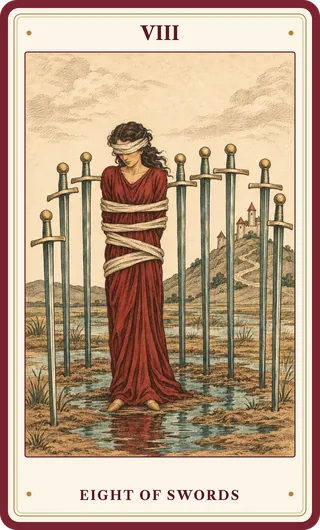
Blindfold
The cloth over her eyes shows she cannot see her options. It is a sign of fear, denial or a limited point of view, not of a real lack of choices.
Bound arms and body
Loose cloth wraps her body, but it is not tied tightly. It suggests the restraint is partly self-imposed and could be worked free.
Eight swords
The blades stand in the ground around her like a fence. They are thoughts and beliefs, and there are gaps between them.
Gaps between the swords
There is open space in front of her and behind her. The card quietly shows that an exit exists.
Water at her feet
She stands in shallow puddles, not deep water. The emotions around her are real but not overwhelming, and she can wade through them.
Castle on the cliff
A castle sits in the distance on a rock. It stands for safety, structure and the place she may reach when she moves.
Grey sky
The heavy sky reflects a clouded mind and a low mood. It also suggests the weather can change.
When the Eight of Swords can mean yes
Most sources give a flat no, but the answer depends on what you asked. If your question is about whether to break free, the Eight of Swords can support it, because the card is about the exact thing you are trying to escape. For example, “Should I leave this controlling situation?” or “Should I stop letting fear decide?” can be met with a yes, because the card names the trap and shows it is escapable.
The test is the direction of the question. Questions that ask for more of something, like a new commitment, a bigger risk or a fast purchase, tend to get a no. Questions that ask for release from something, like quitting, ending, speaking up or letting go, can get a yes.
Try this: Rewrite your question in two forms: “Should I do X?” and “Should I stop being held back from X?” Draw for each and compare. The Eight of Swords often answers the second differently from the first.
How to word the question so the card helps
This card responds well to specific, honest questions. “Will everything be okay?” is too vague and invites a vague answer. “Should I send this message to my ex today?” is specific and can be answered. The more concrete the question, the more the no or yes has something to attach to. For ideas, browse the questions for tarot reading list.
Avoid questions that ask the card to take responsibility for a decision you have already made or are afraid to make. If you ask while panicking, the Eight of Swords often shows up as a mirror of that panic. That is useful in itself, but it is not a prediction.
A simple routine helps:
- Take a few slow breaths so your question comes from a calm place.
- Write the question in one clear sentence.
- Draw one card.
- Read the answer as yes, no or not yet, and note the reason the card gives.
If you want a ready tool, the yes or no tarot reading page lets you draw an answer quickly.
Reading the Eight of Swords with other cards
When you pull more than one card, the neighbours change how hard the no is. A supportive card next to the Eight of Swords softens the verdict, while another heavy card hardens it.
- With the Six of Swords: the no softens, because movement toward calmer waters is already under way.
- With the Ten of Swords or Nine of Swords: the no is firm and the distress is high, so rest and support come first.
- With the Ace of Swords: a flash of clarity cuts through the confusion, and the answer moves toward yes.
- With Cups cards such as the Five of Cups: grief or regret is part of what is clouding your view.
In a three-card spread, the Eight of Swords in the first position often shows the current mindset, while a card in the third can show whether you break free. A simple 3 card tarot layout works well for this.
How long the no lasts
The Eight of Swords is a temporary state. Its no lasts as long as the fear or limiting belief does, and that can shift quickly once you see the situation differently. Some readers treat it as a no that could turn within days or a few weeks, since Swords are fast and mental. Do not treat that as a fixed prediction.
The thing that actually shortens the wait is action: gathering information, having a conversation, asking someone you trust for an outside view. The card does not ask you to wait passively. If you want to explore timing further, tarot timing covers how readers approach it.
If you draw the card again for the same question in the same week, the answer has probably not changed. Reframe the question instead, or ask a different one, such as “What would help me see this clearly?”
What to do after an Eight of Swords no
A no from this card is a prompt to examine the story, not to give up. Start by naming the fear. Write down what you believe is stopping you, then separate facts from assumptions. You will often find the facts are shorter than the fears.
Next, choose one small, concrete action. This could be a message, a phone call, a budget, or an appointment. The woman in the image only needs a few steps to leave the circle of swords. The point is to move before the whole plan feels safe.
Try this: Write “I cannot because…” and finish the sentence three times. Then challenge each ending with “Is that definitely true?” Circle any answer that turns out to be a belief, not a fact.
Final thoughts on the Eight of Swords as a yes or no answer
Treat the Eight of Swords as an honest no with an exit sign. Upright, it tells you not to proceed while fear is steering. Reversed, it gives a yes that depends on you using the clarity you have gained. Either way, the card keeps pointing at the same thing: the barrier is mostly in the mind, and minds can change.
If you want to keep exploring the suit, the Suit of Swords page covers all fourteen cards, and the Ten of Swords yes or no page shows how the story ends when the pain is at its peak. Then take your next question back to the cards with a clearer head.
Questions readers ask
Is the Eight of Swords a yes or no card?
It is a no card when upright. The answer is usually no for now, because fear, doubt or a stuck mindset is in the way. Reversed, it leans toward yes.
What does the Eight of Swords reversed mean as a yes or no answer?
Reversed, it leans yes, or at least not yet. The blindfold is slipping and you can see your options again. Expect progress once you act on what you now see.
Does the Eight of Swords mean I am really trapped?
Usually not. The card shows feeling trapped, and the figure in the image is only loosely bound with open space around her. It is pointing at a mental limit more than a physical one.
Can the Eight of Swords be a yes if I ask about leaving a situation?
Sometimes, yes. If your question is whether to break free, quit or end something that confines you, the card can support that choice. Check that the decision comes from clear thinking and not from panic.
Should I pull another card if I get the Eight of Swords as a no?
It is better not to redraw the same question. Instead, reframe the question or draw a clarifying card asking what would change the answer. Repeated pulls tend to muddy the message.
How long does the no from the Eight of Swords last?
It lasts as long as the fear or limiting belief does. It is a temporary no that can lift as soon as you see your options, which could be days or a few weeks.