
The Hierophant Tarot Meaning (Upright & Reversed)

- Arcana
- Major Arcana, card 5
- Element
- Earth, Taurus
- Yes or no
- Maybe
traditionguidanceinstitutionsshared values
rebellionunconventional pathsquestioning rules
The Hierophant tarot meaning centres on tradition, teaching and shared belief. Upright, it is the card of the mentor, the institution and the time-tested path, and it advises you to learn from those who came before you and commit to a framework that gives your efforts shape. Reversed, it asks you to question inherited rules, break away from expectations that no longer fit, or find your own way to what you believe.
The Hierophant is card V of the Major Arcana, and he follows The Emperor, who builds the law and order that the Hierophant then teaches. Below you will find what the card means in love, as someone’s feelings, in work, money, health and spirituality, along with its symbols, its astrology, how to read it as a yes or no, and how it behaves beside other cards.
What the Hierophant means in a reading
The simplest way to hold the card is this: a body of knowledge exists, and you can receive it from someone who carries it. That might be a school, a faith, a profession, a family, a club or a trusted teacher. The Hierophant is less about the knowledge itself and more about the system that keeps it alive and the relationship between the person who teaches and the person who learns.
Upright, the card is supportive. It tells you that you do not have to reinvent everything, and that following a proven method is a strength, not a weakness. It often shows up when you are about to join something, sign up for training, make a vow, or ask someone more experienced for help.
Core keywords for the upright card:
- Tradition, custom and ritual
- Teaching, mentorship and education
- Shared values and belonging
- Institutions, rules and conventional paths
- Spiritual or religious guidance
The Hierophant card description and symbols
In the Rider-Waite-Smith deck, a robed figure sits on a stone throne between two grey pillars. He wears a tall triple crown, holds a staff topped with three crossbars, and raises his right hand in blessing. Two followers kneel before him, and two crossed keys lie on the floor at his feet.
The setting echoes The High Priestess, who also sits between two pillars. She guards the inner, intuitive mysteries, while he presides over the outer, communal ones: ceremony, doctrine and the teaching that anyone can sit down and receive. The grey pillars are plainer than hers, which is part of the message. This is a structure meant for many people, not a secret for a few.
One detail rewards a second look. The keys lie at his feet, not in his hands. Access to wisdom is available, but it asks something of you: attention, humility, and willingness to be a student for a while.
Try this: Look at the card for two minutes and decide which figure you are in your current situation: the teacher, one of the kneeling students, or the person standing outside the frame. Write one sentence about what that position asks of you.
The Hierophant upright meaning
Upright, the Hierophant says that structure will help you now. You may be asked to follow a recognised process, respect a custom, or accept guidance from someone with more experience. The tone is calm and steady, not dramatic. Nothing in this card rushes you, and the progress it promises is built from repetition, practice and trust.
It also points to belonging. People often draw the card when they are looking for a community, a faith, a profession or a family tradition that gives their life a shape. The Hierophant says that shared values are a real form of support, not a trap, as long as you have chosen them.
A good test for an upright Hierophant is whether the tradition in your situation still serves a purpose. A rule that exists because it protects people, teaches skill or keeps a community together deserves your respect. The card sits in its strength when you can say why you follow the rule, not only that you were told to.
Read The Hierophant for your question
Upright: A committed relationship built on shared values, often moving toward a formal step such as engagement, marriage or meeting the families.
Reversed: Different beliefs or outside pressure strain the bond, or you want a relationship that does not follow the usual script.
Upright: They respect you, take you seriously and want something stable and recognised, not a casual arrangement.
Reversed: They feel boxed in by expectations, or they are unsure your values match theirs.
Upright: Training, credentials, mentors and established institutions are the right route, and you do well inside a structure.
Reversed: A rigid workplace or outdated rulebook is holding you back, and you may be ready to work on your own terms.
Upright: Steady, proven choices such as savings, pensions and advice from a qualified professional serve you best.
Reversed: Do not follow the crowd or a financial rule you do not understand, and check whether conventional advice truly fits your situation.
Upright: Learn from someone who has done it before, respect the process and commit to a path you believe in.
Reversed: Question what you were taught, keep what holds up, and decide your own beliefs instead of inheriting them unexamined.
Upright: Proven treatments, regular routines and trusted practitioners support you, and belonging to a group helps.
Reversed: A rigid regime or one-size-fits-all advice is not working, so seek a second opinion or a more personal approach.
The Hierophant reversed meaning
Reversed, the Hierophant questions the system. Where the upright card says to trust the established path, the reversed card asks whether that path is really yours. It often appears when you have outgrown a belief, a role or a set of expectations, and you feel the pull to do things differently.
This is not automatically a rebellion card. It can mean healthy independence, such as forming your own spiritual practice or choosing an unconventional career. It can also warn of the opposite problem: dogma that has gone stiff, a leader who demands obedience without explanation, or tradition used as a reason to avoid thinking. In a few readings it points to ignoring good advice simply because it comes from an authority, so ask which direction fits your situation. The full breakdown is on the page for the reversed Hierophant, and the general method is covered in how to read reversed cards.
Try this: Name one belief or rule you follow because you were taught it. Ask three questions: Do I still agree with it? What does it protect? What would change if I dropped it? Keep what survives.
The Hierophant in love and relationships
In love, the upright Hierophant points to commitment, shared values and a relationship that others can see and support. It often appears when a couple talks about marriage, engagement, moving in together, meeting each other’s families, or building a life around the same beliefs. There is a sense of doing things properly, at a pace that lets trust grow.
If you are single, the card can suggest meeting someone through an established setting: a community, a place of worship, a class, a family introduction or a friend group with long roots. It favours the person who is looking for a serious partner with compatible values, not a quick thrill. For a card that leans more toward chemistry and choice, compare it with The Lovers.
Reversed in love, the card shows values that do not line up, pressure from relatives or culture, or a relationship that does not fit the standard pattern and may not need to. It can also describe someone who resists labels and formal steps. The question to ask is whether the differences are a real conflict or simply an unconventional arrangement that works for both of you.
The Hierophant as someone’s feelings
When the Hierophant describes how another person feels about you, it usually means they take the connection seriously. They respect you, they are thinking about the long term, and they would like the relationship to have a clear place in their life: introduced to friends, acknowledged by family, treated as real. Casual flirting is not the card’s style.
Reversed, it can mean they feel hemmed in by expectations or doubt that your beliefs are compatible with theirs. It can also mean they are pulling back from a formal step they feel pushed toward. If you want more detail on this reading, see the Hierophant in love and as feelings.
The Hierophant in career
The Hierophant is a strong career card for anyone who thrives inside an organisation. Think training programmes, professional qualifications, apprenticeships, mentoring and fields with established standards, such as teaching, law, medicine, counselling, academia, the church and public service. Upright, it says the best next step is to follow the recognised route and learn from someone who has already done it.
It also describes the people who help you advance: a mentor, a manager who teaches, a company with a clear structure. If you are job hunting, an employer with solid values and a defined path may suit you better than a chaotic start-up.
Reversed, the card describes friction with rigid rules, an office culture that has stopped making sense, or a qualification route that wastes your time. It may also suggest working for yourself or choosing a less traditional career. Before you quit, find out what you can learn from the system first, and leave on purpose, not in reaction.
The Hierophant in money and finances
Financially, the Hierophant favours steady, proven methods: regular saving, pensions, insurance, a budget you stick to and advice from a qualified professional. It is not a card of get-rich-quick plans. Its wealth is built slowly and held securely, which fits its link to Taurus.
It can also point to financial support from institutions such as a bank, a scholarship, a grant or a family trust, and to money linked with education, religion or community. The card may encourage you to learn the basics properly before you invest.
Reversed, it asks you to stop following financial rules just because everyone else does. Perhaps conventional advice does not fit your circumstances, or you are being pushed by a salesperson or relative toward a product you do not understand. Equally, it can warn against ignoring professional guidance out of pride.
The Hierophant in health and wellbeing
For health, the Hierophant supports routine, structure and trusted care. It favours consulting a qualified practitioner, following a treatment plan and joining a group such as a class, a support circle or a team. Regular habits, practised faithfully, are more useful than dramatic fixes.
Reversed, it may suggest that a rigid regime or one-size-fits-all advice is not helping. You might need a second opinion, a gentler approach or a method that respects your own pace. Tarot cannot diagnose or replace medical care, so treat this as a prompt to ask better questions of the professionals you trust.
The Hierophant card symbols
Choose a symbol to read what it means on the card.
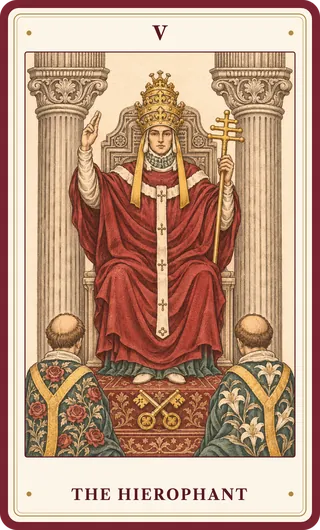
Two grey pillars
The Hierophant sits between two pillars, as the High Priestess does. Here they are plain grey, which points to established, outward-facing structures instead of hidden mystery.
Triple crown
The tall, layered crown marks spiritual authority over three levels, often read as body, mind and spirit. It shows a role that was granted by a tradition, not invented by one person.
Raised right hand
Two fingers rise in blessing while two stay folded, a gesture that passes on teaching and approval. It echoes the raised hand of the Magician, but now the power is shared through an institution.
Triple cross staff
The staff with three crossbars is a symbol of papal authority. It stands for a lineage of belief handed down, and for the weight that comes with speaking for a group.
Two acolytes
Two figures in the robes of followers kneel before the teacher, ready to be taught. They show the student side of the card: humility, apprenticeship and the choice to belong.
Crossed keys
Gold and silver keys lie at his feet, usually read as conscious and unconscious knowledge, or heaven and earth. They show that access to wisdom exists, but someone decides who is let in.
Roses and lilies
The acolytes' robes carry red roses and white lilies, the same pairing of desire and purity found elsewhere in the deck. They suggest that devotion takes in both passion and discipline.
The Hierophant and spirituality
The Hierophant is the card most closely tied to organised religion and formal spiritual practice. It can represent a faith community, a teacher, a ritual, a sacred text or the sense of being held inside something older than you. For people who find meaning in shared worship or a lineage of teaching, the card is warm and affirming.
For others, it can bring up complicated feelings. If you were hurt by a religious institution, a Hierophant draw does not require you to return to it. It can point to the part of the tradition that was worth keeping, the longing for belonging, or the work of building your own practice with the help of a mentor you freely choose.
The name itself comes from the ancient Greek word for one who shows sacred things, a priest who revealed the rites of the mysteries to initiates. That origin explains the card’s emphasis on guidance and initiation: the Hierophant does not create the mystery, he introduces you to it.
The Hierophant as a person
When the card stands for a person, it often describes a teacher, mentor, priest, minister, counsellor, professor, or anyone who guides others through established knowledge. It can also describe a traditional, conventional or cautious person: someone who values family customs, good manners and doing things the right way.
This person can be generous and reliable, or rigid and judgmental, depending on the cards around it and the way the question is worded. Look at whether they explain their rules or merely enforce them. A true Hierophant figure can say why a tradition matters and welcomes your questions.
Is the Hierophant a yes or no card?
The Hierophant leans yes when the question concerns a conventional route, a formal commitment, a course of study or any matter where proven methods and trusted advice apply. Marriage, training, joining an organisation and seeking counsel all get a favourable nod.
Reversed, it leans no to the conventional route. The answer is often “not in the usual way” or “not until you have decided what you believe.” If your question is about breaking from tradition, such as leaving an institution or starting something new, the upright card can feel like a no, while the reversed card may support the change. For a fuller breakdown, see the Hierophant as a yes or no answer.
The Hierophant in astrology and numerology
The Hierophant belongs to Taurus, the earth sign ruled by Venus, and that pairing explains much of its character: patience, loyalty, comfort in routine and a deep wish for something that lasts. Taurus season runs from roughly 20 April to 20 May. If you work with correspondences, the tarot and astrology guide shows how the card fits the wider system. Some traditions, including the Golden Dawn, also link the card to the Hebrew letter Vav, which means a nail or hook, a connecting piece.
In numerology the card is a five, the number of change, learning and the testing of structure. The Emperor at four builds the law, and the Hierophant at five hands it on to a community and asks what it means. His number also hints at the five senses: tradition lives in ritual that you can touch, hear and taste.
In older decks, such as the Tarot de Marseille, the card is called the Pope (Le Pape), and some modern decks call it the High Priest. The meaning stays the same: a trusted guide between the sacred and the everyday.
The Hierophant with other cards
Cards nearby will tell you whether the Hierophant is acting as support or as restriction. Some pairings come up often:
- Hierophant and The Lovers: a serious commitment or a choice about values, with marriage as a possible outcome.
- Hierophant and The Emperor: rules, authority and structure at their strongest, helpful or stifling depending on the question.
- Hierophant and The High Priestess: outer teaching against inner knowing, and the need to balance them.
- Hierophant and The Tower: a belief, institution or tradition is shaken or collapses.
- Hierophant and the Eight of Cups: walking away from a community or belief system that no longer feels right.
In a spread like the Celtic Cross, the position of the Hierophant matters too. In the past position it may describe a formative teacher or upbringing, while in the outcome position it may point toward commitment or a settled structure.
How to work with the Hierophant
Treat the card as an invitation to think about what you have been taught and what you choose to carry forward. Journal on questions such as: Who taught me what I know? Which traditions give my life meaning? Which rules do I follow without thinking? Whom could I ask for guidance right now?
A quick way to tell healthy tradition from hollow conformity:
- Can someone explain the reason behind the rule?
- Are questions welcome, or are they punished?
- Does belonging make you more yourself, or less?
- Would you choose this again if you were free to leave?
Try this: Draw one card as a follow-up to the Hierophant and ask it, “What would make this tradition work for me?” Read the answer as practical advice for the next week.
Common mistakes when reading the Hierophant
The biggest mistake is reading the card as purely religious. Many draws have nothing to do with church. A Hierophant may simply mean a professional qualification, a family custom, or a mentor at work.
Another mistake is assuming upright means good and reversed means bad. An upright Hierophant can describe suffocating conformity if the surrounding cards are heavy, and a reversed one can describe a healthy break from a damaging system. Read the card within the question, the position and the neighbouring cards.
If you are new to reading the Major Arcana, the tarot card meanings list and the guide to how to read tarot show how each of these cards fits into a spread.
Questions readers ask
What does the Hierophant mean in tarot?
The Hierophant stands for tradition, teaching, shared beliefs and belonging to an established group or institution. It asks you to learn from experience that has been passed down, and to commit to a path with a clear structure.
Is the Hierophant a good or bad card?
It is generally a positive, stabilising card, especially upright. It turns uncomfortable only when it points to blind conformity, outdated rules or pressure to be someone you are not.
What does the Hierophant mean in love?
Upright, it points to commitment, shared values and a relationship that others recognise, often with marriage or a formal step in view. Reversed, it suggests mismatched beliefs, family pressure or a wish for a relationship on your own terms.
What does the Hierophant mean as a person?
It can describe a teacher, mentor, religious leader, counsellor or an older, traditional figure who gives guidance. It can also describe anyone who strongly values rules, family customs and doing things properly.
Is the Hierophant a yes or no card?
It leans yes when your question concerns a proven route, a commitment or a formal process. Reversed, it leans no to the conventional route and points you toward choosing your own way.
What zodiac sign is the Hierophant?
The Hierophant is linked to Taurus, an earth sign ruled by Venus. The link fits the card's love of stability, loyalty, routine and values that hold up over time.