
The Hierophant Reversed (Meaning in Love, Work & Life)

- Arcana
- Major Arcana, card 5
- Element
- Earth, Taurus
- Yes or no
- Maybe
traditionguidanceinstitutionsshared values
rebellionunconventional pathsquestioning rules
The Hierophant reversed means questioning tradition, rules and authority, and choosing your own path instead of an inherited one. It often shows up when a belief, institution or expectation no longer fits who you have become. It can signal healthy rebellion, a spiritual awakening outside organised religion, or a plain refusal to do something “because that is how it is done.”
It can also carry a caution. Rejecting every rule on principle is its own kind of rigidity, and not all advice deserves to be thrown out. The task this card sets is to sort what is truly yours from what you were handed, and to keep what works. The sections below cover love, feelings, work, money, spirituality, health, yes or no questions and how to read it in a spread.
What the Hierophant stands for upright
To read the reversal well, start with the card the right way up. The Hierophant is card five in the Major Arcana, linked to Taurus, and it shows a robed religious figure seated between two pillars. He represents institutions, shared belief, formal teaching, mentorship and the comfort of a path that others have walked before you. If you want the full upright reading, see the Hierophant tarot card meaning.
Upright, the card says: learn the rules before you break them, and respect what has been tested over time. It points to weddings, graduations, ceremonies, degrees, apprenticeships and the feeling of belonging to something larger than yourself.
Reversed, that same energy is turned over. The institution, belief or teacher is no longer taken at face value. You stop asking “what am I supposed to do?” and start asking “what do I actually believe?”
The core meaning of the Hierophant reversed
The central idea is a shift of authority from outside to inside. Where the upright card hands you a ready-made structure, the reversed card asks you to check whether the structure is yours. You may be outgrowing a religion, a family script, a workplace culture or a social circle whose rules feel empty.
This is why the card so often appears at points of transition. A person leaving a tradition, changing careers against advice, or ending a long-held belief will often draw it. The feeling that goes with it is usually restlessness, a sense that “this used to fit and now it doesn’t.”
Some older sources also link the reversed card with conformity, over-kindness or weakness before an established order. That reading is still useful. Sometimes the reversal describes someone who goes along with everything to avoid conflict, and the card is nudging them to speak up.
Healthy rebellion or reckless rejection?
The Hierophant reversed has two faces, and a good reading names which one is in play. The healthy version is thoughtful. You have examined a rule, found it lacking and decided to do something different, ideally with your eyes open to the consequences.
The unhealthy version is reflexive. You reject advice from a qualified person because accepting it feels like obedience, or you walk away from a commitment because any commitment feels like a cage. The card then warns that independence has turned into avoidance.
A few quick signs help you tell the two apart:
- Healthy: you can explain what you are leaving and what you are moving towards.
- Healthy: you are still willing to listen to people who know more than you.
- Unhealthy: you are mainly reacting against someone, such as a parent or a boss.
- Unhealthy: you feel pushed to reject every rule, including ones that protect you.
Try this: Write down one rule, belief or tradition you are questioning right now. Then list what it gave you and what it costs you. Keep the parts that still help and let go of the rest.
Read The Hierophant for your question
Upright: Commitment, shared values and a relationship that follows a clear, traditional path.
Reversed: An unconventional bond, clashing beliefs, or a relationship that feels stale because it runs on rules rather than real connection.
Upright: They take you seriously and want to do things properly.
Reversed: They feel boxed in by expectations, confused about what they want, or restless against the 'normal' path.
Upright: Structure, mentors, qualifications and steady progress inside an institution.
Reversed: Rigid rules and office politics are wearing you down, and self-employment or a less conventional route is calling.
Upright: Conventional advice, proper accounts and long-term planning that pays off.
Reversed: Outdated financial habits or advice that no longer fits, and a need to build your own system.
Upright: Learn from someone qualified and respect the process.
Reversed: Question the rule, test the tradition, and keep only what genuinely works for you.
Upright: Established treatment, routine and professional guidance support you.
Reversed: A one-size-fits-all plan is not working, so ask questions, get a second opinion and personalise your approach.
The Hierophant reversed in love and relationships
In love, this card often describes a relationship that does not follow the standard script. It might be an open arrangement, a couple who do not want marriage or children, a partnership across cultures or faiths, or simply two people who are making up their own rules. Nothing is wrong with that. The card only asks that both people have actually agreed to the rules.
It can also describe the opposite problem: a relationship that has become stale because it runs on habit and obligation rather than connection. If the two of you do things a certain way because you always have, the reversed Hierophant asks whether either of you still wants to.
Clashing values are another common theme. Different views on religion, family expectations, money or how a relationship should progress can create tension, and the card suggests those differences need honest discussion rather than silent compromise. For singles, it can mean you are done with traditional dating routines and want something that feels more genuine, or that you are measuring partners against an outdated checklist.
The Hierophant reversed as feelings
When this card describes what someone feels about you, it usually points to pressure and resistance. They may care but feel hemmed in by what the relationship is “supposed” to become, such as commitment, labels or meeting the family. Their reaction is often to pull back, get vague or push against the usual milestones.
It can also reveal confusion. The person may not know what they believe about relationships, or they may be rebelling against a background that taught them one narrow way to love. This does not mean the feelings are false. It means the framework for expressing them is shaky.
If you pulled the card for your own feelings, it suggests you feel stifled by convention or routine and want more room to be yourself. The upright version is covered in the Hierophant as feelings, which makes a helpful contrast.
The Hierophant reversed in career
At work, the Hierophant reversed points to frustration with rigid systems. You may be tired of rules that no one can justify, a management style built on “we have always done it this way,” or a career path that demands conformity you cannot give. The card often appears when people consider self-employment, freelancing, switching fields or building something outside a large institution.
It can also describe a boss, organisation or industry that resists change, and in that case the advice is to find a workaround or a more flexible setting. Sometimes the best move is to work within the rules while quietly building your own alternative.
There is a warning here too. If you are a newer employee, a student or an apprentice, the reversed Hierophant may be telling you that you are dismissing mentorship you could use. Ask yourself whether the person in front of you has real experience worth borrowing. When your frustration is with a specific power-hungry leader, see also the Emperor reversed.
The Hierophant reversed in money
Financially, the card questions inherited advice. That might be a family attitude about money, a standard retirement plan that does not suit your situation, or a bank product you took on because everyone does. It asks you to look at your own numbers and decide what actually serves you.
It can support unconventional income, such as running a small business, investing in a way that differs from the norm or building several income streams. It can also warn against ignoring professional help out of stubbornness. A good accountant or adviser is not a dogma, and the reversed card does not tell you to refuse expertise.
Practical use: if you feel uneasy about a standard financial rule, research the reasoning behind it first. Then adjust it to your life rather than copying it or tossing it out.
Spirituality and belief
This is the area where the reversed card feels most at home. It often marks a break from organised religion or a rigid belief system, and the start of a more personal spiritual practice. Many people draw it while deconstructing the faith they grew up in, or while mixing elements from several traditions.
The card does not say that tradition is false. It says that your own direct experience carries authority. You can still borrow rituals, texts and teachers, but you do so by choice rather than obligation.
It also asks for humility. A personal path can slide into spiritual vanity if you take only what feels flattering and avoid anything that challenges you. A good teacher, even one outside the mainstream, can still help. The card is not telling you to learn alone, only to choose your guides yourself.
Try this: Spend ten minutes writing “What I believe and where I got it.” For each line, mark whether you tested it yourself or inherited it. Pick one inherited belief to investigate this week.
The Hierophant reversed in health and wellbeing
For health, the card suggests that a standard approach may not be working for you. This could be a treatment plan, a diet, an exercise routine or a therapy style that was designed for the average person. The invitation is to ask questions, find a second opinion and tailor the approach to your body and needs.
That said, the card is not an endorsement of dropping medical advice. If you are choosing between a qualified professional and a trend, the reversed Hierophant’s warning about reckless rejection applies. Work with the professionals who help you, but speak up when something does not fit.
It can also describe stress from rigid expectations, such as perfectionism, strict routines or pressure to meet a social standard. Loosening those can be good for your wellbeing. For physical or mental health concerns, tarot is no replacement for real care.
The Hierophant card symbols
Choose a symbol to read what it means on the card.
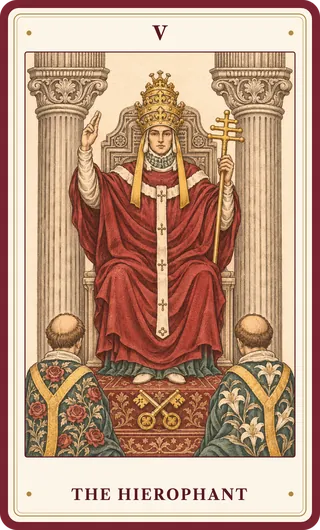
The Hierophant's throne
He sits between two grey pillars, a seat of institutional authority. Reversed, it asks whether that authority has earned your trust.
Triple crown and triple staff
The three tiers and the three-barred cross stand for authority over body, mind and spirit. Reversed, they point to power that has grown too rigid or too self-important.
Raised two-finger blessing
His hand passes a formal blessing down from the institution to the student. Reversed, you stop waiting for permission and give it to yourself.
Crossed keys
One gold key and one silver key unlock conscious and subconscious knowledge. Reversed, you hold your own keys rather than borrowing his.
Two kneeling acolytes
They wear robes patterned with roses and lilies and receive teaching without question. Reversed, you are the student who finally asks why.
The two pillars
They frame the scene and mark the boundary of what the institution allows. Reversed, you look at what lies outside those walls.
Tonsured heads
The shaved crowns mark the acolytes' vow of obedience to the order. Reversed, you may be ready to take back your own mind.
The Hierophant reversed as a person
As a person, this card describes someone who defines themselves against the establishment. They might be a rebel, a free thinker, a former believer, a nonconformist or an innovator who ignores “the proper way.” They can be refreshing and inspiring, and they can also be hard to pin down or reluctant to take advice.
It can also describe a teacher or authority figure who has lost credibility, such as a mentor who gives poor counsel, a religious leader who abuses trust, or an institution that no longer deserves its status. In that case the card validates your doubts.
Occasionally it describes the quietly conformist person who does not dare to disagree. Look at the context of the question to decide which version fits.
Position matters: past, present, future, advice and outcome
Position changes the emphasis of the reversed Hierophant. In the past, it often shows a time when you rebelled or broke from a tradition, or a restrictive upbringing you are still sorting through. In the present, it says that you are questioning something right now. In the future, it predicts a coming break from convention or the arrival of a new way of doing things.
As advice, it says that the structure you are following is no longer the right fit. Take what helps and rewrite the rest. As an outcome, it suggests that the resolution lies outside the usual channels, and that a creative or unconventional approach will work better than the standard one. If you want to practise reading a card in these positions, a 3 card tarot spread is a clear place to start.
Be careful with the word “outcome.” The reversed Hierophant does not promise success for rebellion. It shows direction, not a guarantee, and the other cards will tell you whether the new path holds up.
Upright versus reversed: the key differences
Putting the two orientations side by side makes the meaning sharper:
- Upright: follow established paths. Reversed: choose your own.
- Upright: trust teachers and institutions. Reversed: trust your own experience, while testing your teachers.
- Upright: conformity and belonging. Reversed: individuality and, sometimes, isolation.
- Upright: tradition as a source of wisdom. Reversed: tradition as something to question, update or leave.
Neither version is better. The upright card suits situations where you need structure and guidance, and the reversed card suits situations where structure has become a limit. If you are unsure how to treat reversals in general, how to read reversed tarot cards explains the main approaches.
Is the Hierophant reversed a yes or no?
It depends on what you are asking. If the question is “Should I follow the standard route?” the answer leans towards no. If the question is “Should I try my own way?” the answer leans towards yes. That makes it a conditional card rather than a blunt one.
It tends to be a “no” for anything that depends on formal approval, traditional commitment or an institution’s blessing, such as a proposal or application that must pass through a rigid process. It is a “yes” for freelance ideas, spiritual exploration, creative departures and any plan that values independence over convention. For a cleaner comparison, see the Hierophant as a yes or no answer.
Combinations that shift the meaning
Neighbouring cards show how the rebellion plays out. With the Devil reversed, the two together often describe breaking free from a restrictive pattern or belief, so the sense of liberation grows. With the Emperor upright, you may be dealing with a strict authority figure whom you are trying to resist.
Swords cards tend to make the questioning sharper and more intellectual, with debates, arguments and critical thinking. Cups cards soften it into an emotional or spiritual shift, and Pentacles cards ground it in practical matters such as jobs, contracts and money. Wands cards add energy and action, so the break from convention tends to happen quickly.
Court cards often tell you who is doing the questioning, and Major Arcana cards signal that the theme is large and life-shaping rather than a passing mood.
When you do not read reversals
If your practice skips reversals, you can still use the Hierophant’s lesson. Draw the upright card and ask in which area you are following a rule without thinking, and where you could adapt it. The same questions come up whichever way the card lands.
Some readers also treat reversals as a softened or internal version of the upright meaning. By that approach, the reversed Hierophant is a quieter form of tradition: you honour your teachers privately, or you hold your beliefs without announcing them. Both readings are valid, and the best one is the one that fits the question and the spread around it.
Questions to ask yourself when you draw it
A good reversed Hierophant reading ends with action, not just insight. Use these questions to bring the card down to your own life:
- Which rule am I following that I have never examined?
- Whose approval am I waiting for, and do I still need it?
- What would I do differently if no one were watching?
- Is my rebellion moving me towards something, or only away from something?
- Who could teach me something useful right now, even if I disagree with parts of their approach?
Try this: Pull the Hierophant and the Magician reversed side by side, or read the Magician reversed beforehand. Ask whether you are confident enough in your own skills to leave the structure, or whether you still need a teacher first.
The Hierophant reversed is not a card of destruction. It is a card of discernment, and it rewards people who respect the past enough to question it honestly and brave enough to build something of their own.
Questions readers ask
What does the Hierophant reversed mean in tarot?
It means questioning tradition, rules and authority, and choosing a personal path over an inherited one. It can be healthy rebellion or a warning against rejecting all guidance out of habit. The surrounding cards show which.
Is the Hierophant reversed a bad card?
No. It is more a card of freedom than of misfortune, and many readers see it as a sign of growth. It turns negative only when you rebel for the sake of it or ignore good advice that would help you.
What does the Hierophant reversed mean in love?
It points to an unconventional relationship, clashing values, or a partnership that has become routine and lifeless. It can also mean you do not want to follow the usual timeline of dating, marriage and children.
What does the Hierophant reversed mean as someone's feelings?
The person may feel pressured by expectations, unsure about commitment, or resistant to doing things the traditional way. Their feelings can be real while their willingness to follow a set path is not.
Is the Hierophant reversed a yes or no?
It leans towards a conditional no if the question is about following the standard route, and a yes if the question is about going your own way. Read it as a yes to independence and a no to blind conformity.
How is the Hierophant reversed different from the upright card?
Upright, the Hierophant honours tradition, teachers and shared belief systems. Reversed, it questions them, whether by breaking away, adapting them or building something new.