
The Hierophant as a Yes or No Answer

- Arcana
- Major Arcana, card 5
- Element
- Earth, Taurus
- Yes or no
- Maybe
traditionguidanceinstitutionsshared values
rebellionunconventional pathsquestioning rules
The Hierophant is a yes in a yes or no tarot reading, with conditions. Upright, it says yes when you follow the proper process, ask for guidance and honour your commitments. Reversed, it leans no, because it is the card of rules and tradition turned upside down: the answer is no to the standard route, and sometimes yes to doing things your own way.
That condition matters more than most yes or no pages admit. The Hierophant does not hand out easy approval. It approves of the slow, respected, well-advised way of getting something, so the same card can be a confident yes to a wedding and a hesitant maybe to a plan that depends on cutting corners. The rest of this page shows how to tell the difference.
Is the Hierophant a yes or no card?
Upright, the Hierophant is a conditional yes. It is the fifth card of the Major Arcana (numbered V), the card of teachers, institutions, shared belief and tested methods. Those are stabilising forces, so when a question lands on this card, the reading tends to affirm. The thing you are asking about has a recognised path, and the card is telling you to take it.
Reversed, the Hierophant leans no, but the no is narrower than it sounds. It is not a prediction of failure. It rejects the rigid, inherited or merely expected version of what you are asking about. If your question is “Should I stay in a job that follows every outdated rule?”, the reversed Hierophant answers no. If your question is “Should I leave a structure that stopped serving me?”, the same card is a yes.
Most card-by-card guides call the Hierophant a straightforward yes, and a few call it a maybe. In practice both are right for different questions. If your question fits an established path, treat it as yes. If your question avoids or bends that path, treat it as maybe. For the full picture of the card beyond yes and no, see the Hierophant tarot card meaning.
Why the Hierophant says yes
Think about what the card does in the Major Arcana. The Fool (0) starts out with pure instinct, the Magician has the skill, the High Priestess holds inner knowing, the Empress creates and the Emperor builds structure. The Hierophant comes next and takes the structure into a community. His job is to pass knowledge on, so he is on the side of learning, belonging and continuity.
Because the card represents things that last, it affirms questions about lasting things: a degree, a vocation, a marriage, a religious or spiritual commitment, a contract, a mentorship. These are the areas where the traditional way is also usually the reliable way, and the Hierophant has no reason to resist.
The card also rewards humility. In the Rider-Waite-Smith image, the figures kneeling in front of him are students. A yes from the Hierophant often carries the quiet message that you will get what you want by being willing to learn how it is done, not by trying to reinvent it.
The conditions attached to the yes
The yes comes with strings, and the strings are the useful part of the answer. When the Hierophant appears, check your question against these conditions:
- Is there a proper process, and are you willing to follow it?
- Have you asked someone experienced for advice?
- Are you honouring an existing commitment, not dodging one?
- Do your values match those of the people or institution involved?
If you can answer yes to most of these, the card’s yes is strong. If you are looking at a plan that depends on skipping the queue, ignoring advice or acting against your own principles, the card holds back. It does not say no outright, but it makes clear that the thing will cost you more than you expect.
This is why many readers describe the answer as “yes, by the established route”. The result you want is available, and the card names the road.
Try this: Write your question, then underline the action inside it (apply, propose, sign, start). Next to it, write the official or proven way to do that thing. If you already plan to do it that way, the Hierophant’s yes is solid. If your plan avoids the proven way, note what you are trading for the shortcut.
Read The Hierophant for your question
Upright: A yes to commitment, shared values and a relationship that is ready to be made official, as long as both people want the same kind of future.
Reversed: A no to the standard script: the relationship may work, but only if you drop expectations that were never really yours.
Upright: They feel loyal, respectful and serious about you, and they prefer steady commitment to games.
Reversed: They feel boxed in by rules or expectations, or they are unsure the relationship fits what they were taught to want.
Upright: A yes to training, mentorship, formal qualifications and working inside a respected organisation.
Reversed: A no to the rigid system as it stands: bureaucracy, outdated methods or a boss who will not listen are the problem.
Upright: A yes to conventional, proven choices such as steady saving, regulated products and professional advice.
Reversed: A no to following the crowd or an advisor's script without checking that it suits your own situation.
Upright: Follow the proper process, ask someone with experience and keep your commitments.
Reversed: Stop doing it because it is expected, and work out what you actually believe before you decide.
Upright: A yes to established treatment, a qualified practitioner and a steady routine you can stick to.
Reversed: A no to blind obedience: get a second opinion or ask why a method is being recommended.
Hierophant reversed: yes or no?
Reversed, the Hierophant is usually a no to the conventional answer. The card’s energy turns from guidance to restriction, from tradition to dogma, from mentorship to pressure. Where upright says “learn how it is done”, reversed says “stop doing it that way just because it was always done that way”.
The practical reading depends on what you asked. If your question was about joining, following or conforming (a strict programme, a group with rigid rules, a relationship built on obligation), the reversed card leans no. If your question was about leaving, questioning or going your own way, it leans yes. A few sources treat reversed as a yes across the board, but that reading skips the fact that the card is still about a structure, only one that has stopped working.
Reversed can also warn about the opposite problem: ignoring good advice from someone who knows better, or rebelling for its own sake. If your question is about a decision where you have been dismissing qualified guidance, the reversed Hierophant may be asking whether you are rejecting the rules or the wisdom behind them. The Hierophant reversed page covers this in more detail, and our guide to reading reversed cards explains how to decide when to use reversals in the first place.
The Hierophant yes or no in love
In love, the Hierophant is a yes for anything that points toward commitment: exclusivity, moving in together, engagement, marriage, meeting family, making the relationship official. It values loyalty and shared principles over excitement, so it is at its best when two people want the same slow, serious thing.
For questions like “Does he like me?” or “Will we be together?”, the answer is a softer yes with a caution. The card suggests the connection has real potential, but it asks whether your values, beliefs and life expectations line up. The card is less certain for casual or unconventional arrangements. If you asked about a fling, an open relationship or something that deliberately avoids labels, the Hierophant is a maybe leaning no, simply because it is not the card of improvisation.
For how a person feels about you, rather than whether something will happen, read the card as respect, seriousness and a wish to do things properly. That is covered in the Hierophant in love and as feelings.
Marriage, commitment and getting back together
If you want a yes or no on marriage, this is one of the best cards you can draw. The Hierophant is traditionally linked to vows, ceremonies and recognised unions. Asked “Will we get married?” or “Is this person ready to commit?”, it leans clearly yes, particularly when the wedding or promise is something both people want, not something one person is pushing.
Asked about reconciliation with an ex, it is a cautious yes. The card likes the idea of formally repairing something and agreeing new terms. What it does not like is a quiet drift back into old patterns. If you are asking whether you can get back together, the answer is yes if there is honest conversation, a clear commitment and some agreed change. If you are hoping to return without discussing what went wrong, expect the card to hold back.
Reversed in love, the card suggests a relationship held together by habit, family pressure or “what we should do”. The no here is to the obligation, not necessarily to the person. It is worth asking whether you would choose this relationship if nobody expected it of you.
The Hierophant for career and money
Career questions are where the Hierophant gives some of its clearest yeses. Asked about a course, a certification, an apprenticeship, a promotion through an established ladder, teaching, counselling, law, medicine, government or any role inside a respected institution, upright is a strong yes. It also favours finding a mentor, joining a professional body and doing the unglamorous training properly.
It is a weaker yes for freelancing without any grounding, starting something that has no precedent, or taking a job that depends on avoiding the rules. In those cases the card is not forbidding the choice, but it is pointing out that you are choosing a path with no map. If you want a card that backs bold solo ventures, the Magician as a yes or no answer is a better fit.
For money, think conventional and proven: a pension, a regulated savings account, paying down debt on schedule, getting a qualified advisor. Those are yes. Speculative bets, get-rich plans and anything you cannot explain to a cautious relative are a maybe or a no. Reversed, the card warns against following financial advice blindly or against sticking with a method that has clearly stopped working.
Health and spiritual questions
For health, the Hierophant favours established medicine, qualified practitioners and routines you can keep. A question such as “Should I see a specialist?” or “Should I follow this treatment plan?” gets a yes. The card is a poor supporter of ignoring professional advice. Reversed, it suggests a second opinion, or asking why a particular approach is being recommended, before you commit.
For spiritual questions, the card is a yes to joining a community, finding a teacher, studying a tradition properly and keeping a regular practice. It is a good draw if you ask “Should I join this group?” or “Should I study this path formally?”, provided the group is one you have actually looked into. The card is about legitimate guidance, which means it is also a reminder to check that a teacher or organisation deserves your trust.
Reversed in spiritual matters, it often means you have outgrown a belief system or want to build your own practice. That is not a bad result, and it can be a yes to leaving. If that applies to you, the High Priestess as a yes or no answer covers the card most closely tied to inner knowing.
When your question goes against convention
The most common reason people get a confusing answer from the Hierophant is that their question already sits outside the usual path. Asking “Should I drop out and start my own business?” or “Should I leave my religion?” puts the card in an awkward position, because it represents the thing you are questioning.
In these cases, read the card as a pointer, not a verdict. Upright, it is asking whether you have really learned what the traditional route offers before leaving it. Reversed, it is likely backing your decision to move on. Either way, the card does not say you cannot take the unconventional road. It asks you to do so knowingly, with the skills and advice that make it workable.
Try this: Ask the question twice. First as “Should I do this the usual way?”, then as “Should I do this my own way?”. Draw once for each. If the Hierophant appears in the first and not the second, the proven route has the card’s backing.
The Hierophant card symbols
Choose a symbol to read what it means on the card.
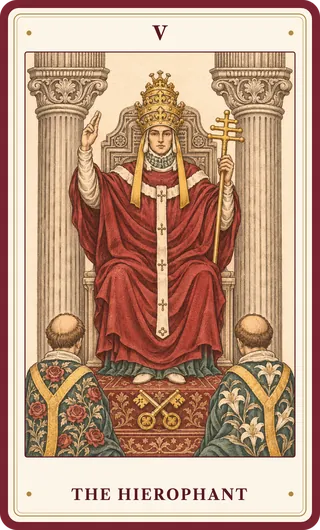
Triple crown
The Hierophant wears a tall crown with three tiers. It points to authority that reaches across the physical, mental and spiritual levels of life.
Raised right hand
Two fingers lift in blessing while two curl down. It is the gesture of a teacher passing on formal, recognised wisdom.
Triple cross staff
His staff has three crossbars, a sign of institutional authority and of the same three levels as the crown. It marks him as a keeper of a tradition rather than an individual voice.
Two crossed keys
The keys lie at his feet, one gold and one silver. They stand for access to conscious and subconscious knowledge, and for the idea that wisdom has to be earned and unlocked.
Two pillars
He sits between grey pillars, a quieter echo of the High Priestess's black and white columns. They mark a sanctuary with rules, where the sacred is handled in an ordered way.
Two kneeling acolytes
Two figures in robes decorated with roses and lilies kneel before him. They show students who have chosen to learn, accept guidance and join a lineage.
Red and white robes
His robes carry the colours of passion and purity, often read as wisdom shaped by discipline. The blue under-layer suggests the calm, structured mind a teacher needs.
How to word your question
Because the Hierophant responds to structure, it works best with clear, closed questions about a defined action. “Should I accept this offer?” works better than “What will happen with work?” because the first has a path and a decision. Avoid vague questions, and avoid stacking two decisions in one. Our guide to questions for a tarot reading has more ideas for phrasing.
Some wording that suits the card:
- Should I apply for this course or qualification?
- Is this relationship ready for a formal commitment?
- Should I ask this person to mentor me?
- Is joining this group a good choice for me?
Some that give it little to work with: questions about secret feelings, luck, or sudden events. For those, other cards such as the Wheel of Fortune or the Moon are more natural voices. If you want a quick single-card answer on any question, the yes or no tarot reading tool will draw one for you.
Neighbouring cards that change the answer
A yes or no reading with one card is a starting point. When the Hierophant sits next to another card in a longer spread, that neighbour can shift the answer:
- Hierophant with the Lovers: a strong yes to a committed, values-based relationship.
- Hierophant with the Four of Wands: yes to a ceremony or formal milestone, probably with timing still ahead.
- Hierophant with the Devil: a warning that rules or obligation have become a trap.
- Hierophant with the Tower: an institution or belief is about to be shaken.
- Hierophant with the Eight of Pentacles: a strong yes to training and skill-building.
If you are reading a spread rather than a single card, check the cards around it before settling on a final answer. The same logic applies to position: in a past position the Hierophant can mean an old belief that no longer works, while in the future position it points to guidance and formal steps ahead.
Timing: how fast is the Hierophant’s yes?
The Hierophant is linked to Taurus and the element of earth, which makes it slow and steady. A yes from this card is rarely sudden. Think weeks to months, and expect the pace to be set by formal steps: applications, notice periods, waiting lists, courses, ceremonies, signed agreements.
If your question is “How soon?”, the card suggests that rushing will not help, and that the delay may be part of doing things properly. If you need a quick resolution, this is not the card that gives one. Reversed, timing can feel stalled by bureaucracy or by a rule that no longer makes sense.
The image behind the answer
The yes or no meaning is grounded in the card’s picture. A seated figure with a triple crown and a triple cross staff blesses two kneeling students, with crossed keys at his feet and grey pillars behind him. Every detail is about transmission: wisdom handed from someone who has studied it to someone willing to learn it.
That picture explains the condition on the yes. Nobody in the image is acting alone. The teacher has authority because of the lineage behind him, and the students kneel because they have chosen to be taught. When you read the card for yes or no, ask which of those roles you are in. If you are the student and the path is sound, the answer is yes. If you are trying to be the teacher before the learning has happened, it is a maybe.
Hierophant or Emperor: which gives the firmer yes?
People often confuse these two. The Emperor is about personal authority and control: rules you make and enforce. The Hierophant is about shared tradition: rules handed down and held by a community. In yes or no terms, the Emperor supports decisions where you take charge, while the Hierophant supports decisions where you work within something established. You can compare the two directly on the page for the Emperor as a yes or no answer.
If you drew the Hierophant and wanted the Emperor’s answer, the difference is useful. The Hierophant asks “who can guide you?” and the Emperor asks “what will you take charge of?” A question about getting advice, joining something or following a recognised path belongs with the Hierophant.
Common mistakes when reading it as yes or no
The first mistake is treating the yes as unconditional. The card approves of the proper route, and a reader who ignores that will miss the warning built into the answer. The second is reading a reversed card as a flat no without checking whether the question is about leaving a structure or entering one.
The third is bringing a bias about religion or authority to the card. The Hierophant is not an instruction to obey a church or a boss. It stands for guidance and shared knowledge, and an unhealthy institution is exactly what its reversed form describes. The fourth is forcing a yes or no when the card is better read as a condition. If the answer feels like “yes, if…”, then the “if” is the reading.
Quick reference
Use this as a short summary once you have your answer:
- Upright, general question: yes, by the proper route.
- Upright, love and marriage: yes, especially for commitment.
- Upright, career and study: strong yes.
- Reversed, general question: leans no to the conventional way.
- Reversed, leaving or questioning a system: yes.
- Timing: slow, often weeks to months.
Try this: Draw one card a day for a week with a plain yes or no question each time. Note every time the Hierophant appears and whether your question involved a rule, a mentor or a commitment. Most readers find the pattern within a few draws.
To see where this card sits among all 78, browse the full list of tarot card meanings.
Questions readers ask
Is the Hierophant a yes or no card?
Upright, the Hierophant is a yes, but a conditional one. It says yes when you go through proper channels, seek good advice and keep your commitments. If you are trying to skip steps or break the rules, the answer softens to a maybe.
Is the Hierophant reversed a yes or no?
Reversed, the Hierophant leans no. It says no to the conventional route, outdated rules or doing something just because it is expected. It can still be a yes if your question is about breaking away from a rigid tradition.
Is the Hierophant a yes for love?
Usually yes, if you are asking about commitment, engagement, marriage or a serious relationship built on shared values. It is less certain for casual dating or relationships that do not follow a traditional pattern.
Does the Hierophant mean yes to getting back with an ex?
It is a cautious yes. The card favours reconciliation that happens openly, with honest conversation and a real commitment to do things properly, rather than drifting back together without addressing what went wrong.
Is the Hierophant a yes for career and money questions?
Yes, particularly for training, qualifications, mentorship, stable employment and conventional financial choices. It is a weaker yes for risky ventures, shortcuts or plans that depend on avoiding established systems.
How long does the Hierophant say it will take?
The Hierophant is an earth card linked to Taurus, so it points to slow, steady timing, often weeks to months rather than days. Formal steps such as applications, courses, ceremonies and agreements set the pace.