
The High Priestess as a Yes or No Answer

- Arcana
- Major Arcana, card 2
- Element
- Water, Moon
- Yes or no
- Maybe
intuitioninner knowledgemysterypatience
secretsignored instinctswithdrawal
The High Priestess is a maybe in a yes or no reading. Upright, she means “not yet”: the answer exists but is still hidden, and she leans toward yes when your gut feels calm and the facts start to agree. Reversed, she leans toward no, or at least not now, because secrets, confusion or ignored instincts make a confident yes unreliable.
Readers disagree on this card. Some call her a flat yes, others a flat no, and plenty say maybe. The disagreement makes sense once you look at what she actually represents, which is knowledge that is not available yet. Below you will find how to read her in each kind of question, how to tell when her maybe is turning into a yes, and what to do next.
Why the High Priestess is a “not yet” card
Most yes or no cards carry some sense of movement. The Sun, the Ace of Wands and the Chariot push forward, while the Tower and the Ten of Swords close a door. The High Priestess does neither. She sits still, holds a scroll she only half shows you, and sits in front of a veil. Her message is that there is more to know than you currently know.
That is why a hard yes or no would be dishonest. If you ask “Should I take this job?” and she appears, the cards are not telling you to accept or refuse. They are telling you that a piece of information is missing, or that you already have an answer inside you that you have not admitted yet.
The most useful way to hold this is: she is a legitimate maybe, not a dodge. A maybe from the High Priestess comes with an instruction, which is to wait, watch and listen. For the full picture beyond yes and no, see the High Priestess card meaning.
The High Priestess upright: yes or no?
Upright, read her as maybe, leaning yes. The lean depends on one thing: how does the question feel in your body when you hold it quietly? If you feel calm, settled and a little curious, the High Priestess is a gentle yes. If you feel a tight knot you keep trying to talk yourself out of, she is a pause.
She suits questions about learning, studying, researching, reflecting and keeping something private for now. “Should I keep quiet about this plan until it’s ready?” gets a yes. “Should I keep studying this subject?” gets a yes. “Should I make a big public announcement today?” gets a not yet.
She is a poor fit for questions that demand speed or a firm commitment, such as “Should I sign this today?” Her energy is the opposite of urgency. If the question is a clock-driven one and she appears, the card is quietly telling you the clock may be false.
The High Priestess reversed: yes or no?
Reversed, she leans no, or not now. The reasons tend to fall into three groups: something is being hidden from you, you are being unclear with yourself, or you are ignoring a feeling that you already know is true. All three make a clean yes unreliable.
This is not a dramatic no like the Tower. It is a no that says the foundations are not solid. If the reversed High Priestess lands on “Is this person being honest with me?” the honest answer is that the picture is incomplete, and you should believe your doubts enough to check. For a fuller read on how she behaves when flipped, see the High Priestess reversed page, and the guide to reading reversed cards if you are unsure how your own deck practice works.
Some readers do not use reversals at all. If that is you, treat every High Priestess as upright, and let the surrounding cards decide whether the maybe tips one way or the other.
Read The High Priestess for your question
Upright: Feelings are real but private, so the answer is a maybe: watch, listen and let the other person show their hand before you decide.
Reversed: Secrets, mixed signals or a gut feeling you keep overriding make this a soft no until things are said out loud.
Upright: Someone feels deeply but keeps it guarded, and you may be sensing more than you can prove.
Reversed: Feelings are hidden, withheld or not fully understood, even by the person having them.
Upright: Not yet: research, stay quiet about your plans and gather the facts before you accept or announce anything.
Reversed: A no for now, especially where details are missing, office politics are hidden or you are ignoring a bad feeling.
Upright: Wait and learn more before committing, because the full numbers are not on the table yet.
Reversed: Do not sign or invest while terms are unclear, rushed or being kept from you.
Upright: Pause, trust your quiet inner read and ask better questions before you choose.
Reversed: Stop talking yourself out of what you already know, and stop acting on guesses.
Upright: Listen to your body and keep notes on patterns, then use that to get clear answers from a professional.
Reversed: Symptoms or worries are being ignored or kept secret, so seek proper information instead of waiting.
How to ask a question she can answer
The High Priestess gives her best answers to questions about what is hidden, what you sense and what you should do while you wait. She gives her worst answers to questions that assume the facts are already known. A small change in wording can change everything.
Compare these two:
- “Will he commit to me?” asks for a fixed outcome, and she will give you a shrug.
- “What do I need to understand about where this is going?” invites her to show what is veiled.
Good yes or no questions for her are narrow and about a decision in your control: “Should I wait a week before replying?” “Should I get more information before I accept?” For more wording ideas, the list of questions for a tarot reading will help you shape them.
Try this: Write your question, then rewrite it so it starts with “Should I” and ends with something you control. Draw one card for each version and compare how the High Priestess reads in each.
The High Priestess yes or no in love
In love, upright, she is a tentative yes with strings attached. Feelings may be present on one side or both, but they are quiet, private or not ready to be spoken. She is the card of the slow burn and the knowing look, not the card of the big declaration.
For a new connection, she suggests watching and listening before you push for labels. For a long relationship, she calls for honest, private conversation rather than public arguments or assumptions. She can also mean that one of you is holding something back, and that it matters more than either of you is saying. The High Priestess in love page goes deeper into what she means for a partner’s feelings.
Reversed in love, she is a soft no until things are said plainly. Mixed signals, secrets, an intuition you keep overriding, or someone who only reveals half of the story all fit. It does not mean the relationship is over, only that the current set-up is not honest enough to deserve a yes.
Getting back together and ex questions
When people ask whether an ex will return, the High Priestess is rarely a confident yes. Upright, she points to unspoken feelings, a situation not yet settled and a connection that is still quietly alive on some level. That is not the same as a promise of reconciliation.
Her advice is to stop chasing and stop interrogating. Silence is part of the picture. Let space do its work and notice what the other person does without being prompted, because the real answer will show in actions, not in explanations.
Reversed, she can warn that the other person is hiding their true position, or that you are clinging to a story built on guesses. In that case the card is not predicting a no so much as asking you to stop reading tea leaves and ask for a direct conversation.
The High Priestess yes or no at work
At work she is a not yet, with an emphasis on research. Upright she favours confidential planning, careful preparation, learning more before accepting an offer and watching how a workplace really operates before you commit. If you ask “Should I resign?” she suggests quietly lining up your options first.
She also favours roles built on discretion, analysis, counselling, writing, research and anything involving quiet expertise. For a “Should I apply for this?” question she is a yes if your instinct is already pulling you toward it, and a pause if it is not.
Reversed, she warns of office politics, hidden agendas, withheld details and decisions you are making against your better judgment. If the terms of a contract keep shifting or nobody will answer plain questions, take that as a no until they do.
The High Priestess yes or no with money
With money she advises caution rather than refusal. Upright, she means the full numbers are not yet visible. Ask for documents, read the small print and take extra time before you commit. If you already know the details and feel steady about them, she can support a quiet, well-researched yes.
Reversed, she is a clearer no. If the terms are murky, the explanation keeps changing or someone uses urgency to stop you checking, then the reversed High Priestess says to walk away or at least slow down.
She is not a card of gambles or windfalls. Ask the Ace of Pentacles or the King of Pentacles about growth and she will make little sense. She is about due diligence.
Health and personal decisions
For health questions, use her carefully, and never as a substitute for medical advice. She is the card of body awareness: the subtle symptom you have noticed, the pattern that keeps repeating, the thing you have not mentioned to anyone. Upright, she suggests keeping a simple log and bringing it to a professional.
Reversed, she can point to a worry you are hiding or symptoms you are brushing off. The answer to “Should I get this checked?” is almost always yes, and the card simply underlines that you already suspected it.
In personal choices such as moving, studying, spiritual practice or taking time alone, she is often a yes. These are decisions that benefit from inner stillness and take little outside approval.
The High Priestess card symbols
Choose a symbol to read what it means on the card.
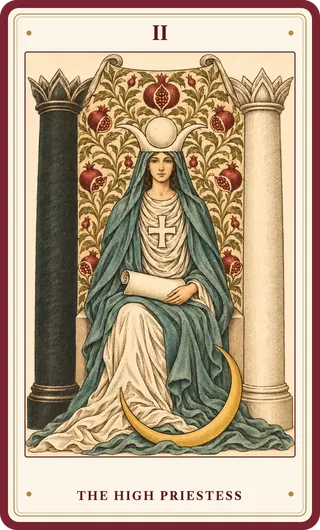
Black and white pillars
The two pillars marked B and J echo the pillars of Solomon's Temple and stand for opposites: dark and light, yes and no. She sits between them because the answer lives in the balance, not at either extreme.
The veil of pomegranates
The veil behind her hides what lies beyond, and the pomegranates point to fertile, hidden knowledge. It is the reason she so often means 'not yet': something is still covered.
Crescent moon at her feet
The moon rules her and links her to cycles, tides and slow timing. Answers from her arrive in phases, not on demand.
Lunar crown
Her horned crown holding a full moon shows all moon phases held together. It says she sees the whole cycle, including the part you cannot see yet.
Partly hidden scroll
She holds a scroll marked TORA, partly tucked into her robe. Knowledge is within reach but only partly revealed.
Blue flowing robe
Her robes fall like water, tying her to emotion, dreams and the subconscious. The answer comes as a feeling before it comes as a fact.
Equal-armed cross
The cross on her chest stands for balance and for the union of spirit and matter. It reminds you to weigh intuition and evidence together.
How long until the answer arrives?
Because the Moon rules the High Priestess, many readers associate her with a lunar cycle of about four weeks. This is a tradition, not a rule, and you should treat it as a rough guide. A more useful sign is not a date but an event: the answer comes when the missing information shows up or your instinct stops shifting.
If you want to go deeper on timing across a spread, see tarot timing. A common approach is to note the date of the reading, then check back in on the next new moon or full moon and see what has changed.
If nothing has changed, that tells you something too. Sometimes the missing information is a decision you have to make yourself, and no outside event is coming.
What her imagery says about the answer
Look at the Rider-Waite-Smith card. She sits between a black pillar and a white pillar, so she is literally placed between yes and no. Neither side wins, and that is the whole point. Behind her hangs a veil covered with pomegranates, hiding the water beyond.
The crescent moon at her feet and the full-moon crown above her head show a mind that holds the whole cycle at once. The scroll in her lap says TORA and is partly covered by her robe, which fits her role perfectly: knowledge you can nearly read, but not yet.
When you draw her, take a minute to look at the picture and ask which part of it draws your eye. Some readers find that the answer lives in that glance.
Card combinations that tip the answer
The High Priestess takes colour from her neighbours, so one card nearby often decides whether the maybe tilts yes or no. Here are the pairings that matter most:
- With the Sun: clarity is coming, and the news is good. Her veil lifts toward a yes. See The Sun as a yes or no answer.
- With the Magician: knowledge plus action. A yes if you are ready to move after you have listened.
- With the Moon: deeper confusion. Do not decide yet.
- With the Eight of Swords: the answer exists but fear is blocking it.
- With the Tower: a sudden reveal, often uncomfortable, that settles the question.
- With the Hermit: a yes to solitude and reflection, a no to big social decisions.
If the next card is a firm “yes” card such as the Sun or the Ten of Cups, read the pair as a yes. If it is a firm “no” card such as the Ten of Swords, read the pair as a no, with her adding that you saw it coming.
When she shows up in a larger spread
Position matters more than any yes or no rule. As an outcome card in a spread she suggests that the matter is still unresolved, or that the answer will come from within you. As a past card she tells you that hidden factors shaped events. As a present card she says the situation is more secret than it looks.
If she turns up in a three card line like “situation, challenge, outcome”, read her as hidden information in whichever spot she lands. In a Celtic Cross she is often sitting in the “hidden influences” place, where her meaning is at its strongest.
If you are using several yes or no cards at once, count her as neutral. She does not tip the vote either way. Let the other cards decide, and use her as a note that the result may still shift as new facts arrive.
Mistakes to avoid with this card
Many readers force a verdict from her because they cannot stand the uncertainty. That is how you get the “she is always a yes” or “she is always a no” rules online. Neither is reliable, and acting on either can lead you wrong.
Another mistake is to use her as an excuse to do nothing. “Not yet” does not mean “never act”. It means gather information, listen and prepare, then act when you can. If weeks go by and you are still waiting for a sign, the card has probably done her job and the choice is yours.
The third mistake is asking the same question again and again until you get a yes. If you pull her three times in a row, the cards are not malfunctioning, they are telling you what you already know: the answer is not external.
A simple way to turn her maybe into an answer
You can turn a High Priestess maybe into a working decision with a short routine. Try it before you ask again.
- Write down exactly what you do not know yet.
- Write down what your gut says, in one sentence, without justifying it.
- List one action that would reveal the missing information.
- Take that action, then wait a few days.
- Check whether your gut has shifted, and draw again only if it has.
This works because the High Priestess is really asking you to separate what you know from what you suspect. Once you do that, the question often answers itself.
Try this: Draw her and sit with the card for two minutes with your eyes on the veil. Then write the first sentence that comes to you about your question, and treat it as your working answer for the week.
If you want to practice with other cards, the yes or no tarot reading tool lets you ask and see how each one behaves.
Quick summary: High Priestess yes or no
Use this as a reference when you pull her and need a fast read:
- Upright, general: maybe, leaning yes if your intuition is calm.
- Reversed, general: soft no or not now.
- Love: tentative yes, with feelings still private.
- Work: not yet, research and prepare.
- Money: wait for the full numbers.
- Timing: loosely a lunar cycle, or when the missing information appears.
The pattern holds in every area: she is the card of what you do not know yet, paired with the part of you that already half knows it. Respect both, and her maybe becomes a clear answer when you are ready for it.
Try this: Next time you draw her, answer the question out loud before you read any card meaning, then see whether the card confirms or complicates what you said.
Questions readers ask
Is the High Priestess a yes or no card?
Neither, strictly. Upright she is a maybe or 'not yet' that leans yes when your intuition feels calm. Reversed she leans no, or at least not now.
Does the High Priestess mean yes in love?
Sometimes, but only as a tentative yes. It means feelings exist but are private or unspoken, so wait for them to be shown before you act.
Is the High Priestess reversed a no?
Usually a soft no or a not now. Reversed, she points to secrets, confusion or an intuition you are ignoring, so a confident yes is unreliable.
Why do different sources say the High Priestess is yes, no or maybe?
She does not hold a fixed answer in the traditional card meanings, so each reader fills the gap with a rule of thumb. The most consistent reading is that she means the answer is hidden, which is a maybe.
What should I do if I draw the High Priestess for a yes or no question?
Pause, collect the facts you are missing and ask the question again once you know more. Note your gut reaction too, since she asks you to trust it.
How long until the High Priestess gives an answer?
There is no fixed time, but her link to the Moon makes a lunar cycle of about four weeks a common rule of thumb. Treat it as a loose guide, not a promise.