
Tarot Card Temperance Interpretation: Meaning Upright and Reversed

- Arcana
- Major Arcana, card 14
- Element
- Fire, Sagittarius
- Yes or no
- Yes
balancemoderationpatienceblending
excessimbalanceimpatience
Temperance is the tarot card of balance, patience and moderation. When it appears, it asks you to blend opposing forces into a steady, workable whole, and to choose a measured pace over extremes. Upright, it is a calm and healing card that leans toward yes, slowly. Reversed, it points to imbalance, excess or impatience that needs gentle correction.
This guide gives you a full interpretation of Temperance: what the image shows, how to read it upright and reversed, what it says about love, work, money and health, and how to tell it apart from cards it is often confused with. By the end you should be able to read it in any spread with confidence.
What Temperance means in a reading
Temperance is card XIV of the Major Arcana. Its core message is integration: two things that look different can be combined into something better than either alone. That might be work and rest, ambition and patience, your head and your heart, or two people with different temperaments.
Common keywords are balance, moderation, patience, healing, harmony, purpose and the middle path. The card is not about doing less of everything. It is about getting the proportions right so that what you are building lasts.
In a reading, Temperance often arrives when a situation has been swinging between extremes, or when someone is tempted to force an outcome. It tells you to ease off the pressure, adjust in small steps and trust the process. If you are new to how these big cards work, our guide to the major and minor arcana explains why Major Arcana cards tend to point to larger themes than single events.
How to interpret Temperance
The simplest way to interpret Temperance is to ask two questions. What are the two things that need blending? And what is the right proportion between them? The card rarely names the opposites for you. The rest of the spread and your question will supply them.
Try reading it as a verb rather than a noun. Temperance is tempering, the way a metalworker heats and cools steel to make it strong without making it brittle. Something is being refined slowly, and rushing the process would spoil it.
It also helps to treat Temperance as active. Many readers take it as “wait and be patient”, but the angel is busy pouring, adjusting and keeping both cups in motion. Patience here means steady, attentive effort, not sitting still.
Try this: Draw Temperance (or look at an image of it) and write down two things in your life that feel like they are pulling against each other. Under each one, write the smallest adjustment that would let them coexist this week.
The Temperance card description and symbols
In the Rider-Waite-Smith deck, a tall winged angel stands at the edge of a pool, one foot in the water and one on dry land. The angel pours liquid between two cups, and the stream seems to hold its shape in the air. Behind the figure, a path winds toward mountains, and a glowing crown shimmers on the horizon.
The details carry most of the meaning. The foot in the water and the foot on land show that you need both feeling and practicality. The triangle inside a square on the robe joins spirit with the material world. The small sun mark on the brow suggests clear awareness, and irises at the water’s edge speak of hope and messages arriving.
The figure’s gender is deliberately soft, which reinforces the theme of opposites resting together. Many readers see the angel as Archangel Michael, while others see Iris or simply a guide. Whichever you choose, the figure is calm, unhurried and entirely focused on the work of mixing.
Read Temperance for your question
Upright: A steady, kind partnership where both people give and receive, or a patient approach to meeting someone who matches your pace.
Reversed: One person is carrying more than their share, or the relationship swings between intensity and distance.
Upright: They feel calm, fond and committed, and prefer a slow build to a rush.
Reversed: Their feelings are mixed or inconsistent, and they may be overwhelmed or unsure how much to give.
Upright: Steady progress, good teamwork and a sustainable pace that produces results over time.
Reversed: Burnout, overcommitment or a project where the parts are not fitting together yet.
Upright: Moderate spending, sensible saving and a budget that you can actually keep.
Reversed: Swings between overspending and strict cutting back, or impulsive financial choices.
Upright: Slow down, blend what seems opposed and choose the middle path.
Reversed: Stop forcing extremes, find which proportion is off and correct it in small steps.
Upright: Rest, routine and gentle consistency are restoring your wellbeing.
Reversed: Overdoing work, food, drink or stress is wearing you down and your habits need resetting.
Upright Temperance meaning
Upright, Temperance brings a sense of steadiness. It says you are finding, or being asked to find, a rhythm that you can sustain. Emotions settle, conflicts soften and the pieces of a situation start to fit together.
It also points to a clear long-term vision. The path leading to the glowing crown in the image suggests you know where you are going and are willing to walk there one step at a time. This makes Temperance a strong card for goals that take months or years, such as training, recovery, study or building a relationship.
Socially, Temperance shows someone who can adapt, listen and work in harmony with others. It favours compromise and diplomacy, and it can mark a time of mending old divides. Keywords for the upright card:
- Balance and moderation
- Patience and good timing
- Healing and recovery
- Harmony and cooperation
- Long-term purpose
Reversed Temperance meaning
Reversed, the careful balance of the upright card is disrupted. Something is out of proportion: too much work, too much indulgence, too much giving, or a decision made in a rush. You may feel scattered, restless or unable to settle into a sensible pace.
The reversed card is more a course-correction than a punishment. It asks what is off and what small change would restore the flow. Often the answer is simple: sleep more, stop saying yes to everything, slow a decision down or have an honest conversation about who is doing what.
Reversals can also show a clash between two parts of your life that refuse to blend, or a long-term plan that has stalled because of impatience. For a deeper look at each area, see our full guide to Temperance reversed, and if reversals are new to you, how to read reversed tarot cards covers the main approaches.
Temperance in love and relationships
In love, Temperance is one of the most reassuring cards you can draw, though it is rarely the most thrilling. It describes a relationship built on give and take, emotional regulation, kindness and patience. This is sustainable warmth rather than fireworks.
If you are in a relationship, Temperance suggests the two of you are learning to balance different needs and temperaments, or that a period of tension can be resolved through compromise and honest talk. If you are struggling, it advises cooling down, listening and meeting in the middle. If you are single, it can suggest that connection will grow gradually, and that working on your own balance first will make you ready for it.
Reversed in love, Temperance warns of imbalance: one partner giving too much and the other too little, or a pattern of extremes with intense closeness followed by distance. It can also mean rushing intimacy before trust has formed. To see how the card reads when it describes another person’s emotions, look at Temperance as feelings.
Temperance in career and money
At work, Temperance favours steady progress over dramatic leaps. It says your consistent effort is building something real, even if the results are not obvious yet. It is a good sign for collaboration, mediation, teaching, counselling, healing work and any role that involves bringing different elements or people together.
The card also asks for a sustainable pace. If your job has been consuming your evenings and weekends, Temperance is a nudge to restore the boundary between effort and rest. A schedule you can keep for years beats a sprint that ends in exhaustion.
With money, Temperance points to moderation: a realistic budget, regular saving and spending that matches your values. Reversed, it can show career burnout from one-sided effort, or financial swings between overspending and harsh restriction. The fix is the same in both cases: build a routine that sits in the middle.
Try this: Look at your last week and split your time into two columns, effort and recovery. If one column is clearly larger, pick one small change that moves the balance by about ten percent.
Temperance in health and wellbeing
Temperance is closely linked to healing, which makes it a natural health card. Upright, it suggests your body and mind are responding well to consistency: regular sleep, gentle movement, regular meals and enough downtime. It rewards routine more than intensity.
It also invites you to look for where you have been doing too much or too little, and to adjust accordingly. This applies to physical health, emotional health and mental load alike. The card works as an inner stress barometer, telling you when you have been pouring out more than you take in.
Reversed, Temperance can point to overdoing something: long hours, caffeine, alcohol, crash dieting or constant stimulation. It may also show emotional overwhelm. As always, tarot is not a substitute for medical advice, so treat the card as a reflection on habits and take any real symptoms to a professional.
Temperance card symbols
Choose a symbol to read what it means on the card.
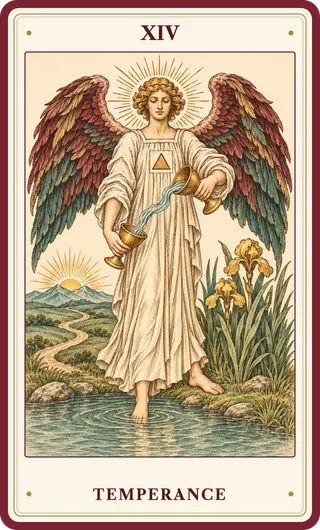
Winged angel
The angel is a guide from beyond the ordinary self, often read as Archangel Michael. Its calm, androgynous look shows opposites resting in harmony.
One foot in water, one on land
The water side stands for feeling and the unconscious, the land side for practical, physical life. Temperance asks you to live in both at once.
Two cups with flowing water
Liquid pours between the cups in a steady arc, defying gravity. It shows that mixing and exchange can be done calmly and without spilling.
Triangle inside a square
The symbol on the angel's chest joins spirit (the triangle) with the material world (the square). It points to the work of bringing higher purpose into everyday form.
Sun mark on the forehead
A small circle with a dot sits on the angel's brow. It marks clear awareness and a connection to something larger than the moment.
Irises
These flowers grow at the water's edge and are named for Iris, goddess of the rainbow and messenger between worlds. They add a note of hope and communication.
Path to the glowing crown
A road leads from the pool toward distant mountains and a radiant crown on the horizon. It suggests a long-term goal that you reach by steady walking, not leaping.
Temperance as advice, outcome and feelings
Where Temperance lands in a spread changes how you read it. As advice, it is direct: slow down, stop forcing, blend and moderate. It often means the answer lies in combining two options instead of choosing one extreme.
As an outcome, it points to a settled, balanced result that comes through patience. As a present-moment card, it describes a time of adjustment and healing. In a past position, it can show that you recently went through a period of recovery or compromise that is still shaping the situation.
When Temperance describes how someone feels about you, it suggests a calm, steady and sincere fondness. They may not be dramatic about it, and they are likely to prefer gradual closeness. Reversed, their feelings can be mixed or unevenly expressed. The full breakdown is in our guide to Temperance as feelings, but the principle is the same: look for quiet commitment, not high intensity.
Temperance as a yes or no answer, and timing
Upright, Temperance leans yes, but it is a patient yes. It says the matter can work out if you proceed gradually and keep things balanced. Reversed, it usually means not yet, or not in the current form, and it asks you to adjust something first.
Read it with the question in mind. If you ask whether to quit a job tomorrow, Temperance upright would likely say to plan a measured transition. If you ask whether a rushed deal is wise, the card leans toward no. You can read more detail on this in Temperance as a yes or no answer.
For timing, Temperance suggests slow, gradual development: weeks to months rather than days. It does not promise a date. In astrological timing, its Sagittarius link points to late November through late December, which can add a seasonal note to a question about when something will settle.
Where Temperance sits in the Major Arcana
Temperance follows Death and comes before The Devil. This order tells a story. After an ending and transformation, Temperance is the stage of recovery, where you mix what remains with what is new and find a steady way forward. Then The Devil shows what happens when balance is lost to compulsion and excess.
That sequence explains why Temperance often appears after a big change. It is the calm after the storm, when you are rebuilding with more care. It is also why the reversed card can echo The Devil: out-of-balance habits can grow into something harder to shake.
It also helps to separate Temperance from The Star, which follows later. Temperance is hands-on and present: you are adjusting proportions. The Star is about restored faith and openness after hardship. Both are healing cards, and both show a figure beside water, but Temperance is about the practice of balance while The Star is about the hope that follows.
Temperance, astrology and numerology
In the Golden Dawn system, Temperance is linked to Sagittarius, a mutable fire sign ruled by Jupiter. That fits the card’s long view: Sagittarius is the sign of higher learning, big-picture vision and seeking meaning, and Temperance carries the same sense of purpose, expressed through patience rather than restlessness. If you like to compare systems, our page on tarot and astrology explains how these correspondences work and where they differ.
Numerically, Temperance is 14, which reduces to 5 (1 + 4). Five is the number of change and adaptation, so the card is about flexible adjustment, not rigid control. In the Thoth deck, the card is called Art, which stresses the creative craft of combining things well. Alchemical readers also link it to the principle of dissolving and recombining.
Common misreadings of Temperance
The first misreading is that Temperance means being moderate about everything. It does not call for blandness or for flattening your passions. It asks for the right proportion, and sometimes the right proportion is a lot of something you love.
The second is that Temperance means passively waiting. In fact the angel is working, so the card asks for steady action at a sustainable pace. The third is that it is a weak or boring card. Temperance is quiet, but it deals with real skill: managing conflict, recovering from burnout and making long-term plans survive.
A fourth mistake is expecting instant results. If you want a quick answer, Temperance can feel frustrating, because it speaks of gradual change. Try reading that as reassurance: the slow pace is a feature of what you are building.
Temperance with other cards
Temperance pairs well with cards of action and emotion because it steadies them. Next to The Chariot, it tempers drive with control. Beside The Lovers, it suggests a relationship that thrives on balance and compromise. With Strength, it reinforces gentle, patient mastery.
With harder cards, Temperance acts as a soothing influence. Near the Tower, it suggests rebuilding with care after a shock. With the Ten of Swords, it points to slow recovery. Next to The Devil, it asks you to restore moderation where a habit has taken over.
To practise, try a 3 card tarot reading with Temperance as the middle card. Place the situation on the left, Temperance in the centre as your approach, and the outcome on the right. The way the outer cards lean will show you which side of your life needs more attention.
Try this: Draw three cards and pick the two that feel most opposed. Imagine Temperance’s angel pouring between them, and write one sentence about what a blend of the two would look like in practice.
A simple way to remember Temperance
If you only keep one idea, keep this: Temperance is the card of the right mix. Each time you see it, ask whether you are pouring too much into one cup and too little into the other. That single question covers love, work, health and money.
Then look at the figure itself. It stands calmly with one foot in each world and does not rush. When your reading features this card, you are being invited to do the same: stay grounded, stay open, move at a pace you can keep, and let things combine in their own time.
Questions readers ask
What does the Temperance tarot card mean?
Temperance means balance, patience and moderation. It asks you to blend opposing forces, such as work and rest or logic and feeling, into something steady and sustainable.
Is Temperance a good card?
Yes, it is a gentle and positive card, especially in love, health and long-term plans. It rarely brings fast results, though, so the good news tends to arrive slowly.
What does Temperance reversed mean?
Reversed, Temperance points to imbalance, excess, impatience or a mismatch between two parts of your life. It is a prompt to find what is out of proportion and adjust it, not a sign of disaster.
Is Temperance a yes or no card?
Upright, Temperance leans yes, with the note that the answer comes through patience and gradual progress. Reversed, it usually means not yet, or not in this form.
What zodiac sign is Temperance?
In the Golden Dawn system, which many modern readers follow, Temperance corresponds to Sagittarius, a mutable fire sign ruled by Jupiter. Some decks and readers use other correspondences.
What is the difference between Temperance and The Star?
Temperance is about active balance and integration in the present, while The Star is about hope and renewal after hardship. Temperance blends and adjusts, and The Star restores faith.