
Temperance as a Yes or No Answer

- Arcana
- Major Arcana, card 14
- Element
- Fire, Sagittarius
- Yes or no
- Yes
balancemoderationpatienceblending
excessimbalanceimpatience
Temperance is a yes in a yes or no tarot reading, but it is a patient, conditional yes. When it appears upright, the answer is favourable as long as you stay balanced, move at an even pace and avoid extremes. Reversed, Temperance leans toward no, or more accurately “not yet”, because something is out of proportion and needs adjusting first.
Most cards give a clean answer. Temperance gives a yes with instructions attached. This page explains how to read that yes in love, work, money and health, when Temperance turns into a no, how the cards around it change the verdict, and how long the answer usually takes to arrive.
Why Temperance is a yes, with conditions
Temperance is card fourteen of the Major Arcana, and its whole subject is blending: mixing two things carefully until they make something better than either alone. A question that can be answered by patience, compromise or steady effort fits that image well, so the card responds with a yes. It is one of the gentler positive cards in the deck, and it reads as support more than celebration.
The condition matters, though. Temperance does not say “yes, rush ahead”. It says yes to the version of your plan that is moderate, well paced and fair to everyone involved. If you ask about something that depends on a grand gesture, a dramatic leap or squeezing a result out of a short window, the card’s yes becomes weaker, because that is not how Temperance works.
A useful way to hold it: the yes is real, and the pace is part of the answer. If you want the full picture of the card beyond yes or no, the Temperance tarot card meaning covers its history, symbolism and every reading position.
Temperance upright: yes, and what it asks of you
Upright, the card tells you the situation can work out. Things that look unlike each other, such as two people with different temperaments, a job and a home life, or a budget and a wish, can be brought into harmony. The answer to “will this come together?” is yes.
What it asks in return is consistency. Temperance favours the person who keeps showing up calmly over the person who burns bright for a week. If you can keep up a moderate effort over a long stretch, your yes holds. If you know your plan only works at a sprint, you should hear a quiet caution inside the yes.
This is also a card of healing and fairness. Questions about recovering, mending a rift, finding a fair arrangement or settling a dispute tend to draw its best answers. It rewards the question “can this be made to work?” more than “will I win?”
Temperance reversed: no, or not yet
Turn the card upside down and the water spills. Reversed Temperance points to excess, impatience, mismatch or a life that has swung too far in one direction. In a yes or no draw this reads as a no, or a “not yet”, and the second reading is usually the more accurate one.
Look at what the question is pushing. If you are trying to force a timeline, overcommitting, or ignoring a clear imbalance between what you give and what you get, reversed Temperance is naming that. It rarely says the goal is impossible. It says the current way of pursuing it will not hold.
That makes the reversal useful rather than discouraging. The fix is typically to reduce what is in excess, slow the pace, or restore a neglected part of your life, then ask again. For a deeper read on the card turned over, see Temperance reversed, and if reversals are new to you, how to read reversed tarot cards explains the basics.
Try this: Before you draw, write your question on paper and underline anything that sounds like an extreme, such as “finally”, “everything” or “right now”. Rephrase it in a more measured form and draw Temperance (or any card) on that version.
Read Temperance for your question
Upright: Yes to a relationship that grows through patience, honest compromise and steady care, and no to anything built on drama or speed.
Reversed: No, or not yet: one of you is overdoing it, pulling back too much, or the two of you are out of step.
Upright: They feel calm, fair and committed to making things work, and they would rather build slowly than rush.
Reversed: Their feelings are mixed or swinging, and they may be too tense, too intense or too unsure to meet you in the middle.
Upright: Yes to steady progress, teamwork, mediation and roles that reward calm judgement, but not to a overnight leap.
Reversed: No for now: overwork, impatience or a poor fit between your role and your life is throwing things off.
Upright: Yes to a moderate, well-paced plan, such as budgeting, saving a fixed share and spreading risk.
Reversed: No to the risky or excessive option: overspending, all-in bets or a plan that ignores your limits.
Upright: Find the middle path, go at an even pace and blend what you have instead of choosing extremes.
Reversed: Stop forcing it, cut back what is in excess and reset your routine before you decide.
Upright: Yes to recovery through moderation, steady habits, rest and a balanced routine.
Reversed: No to extremes: crash plans, burnout and overindulgence are working against you, so rebalance first.
Temperance yes or no in love
In love, Temperance is a confident yes for relationships that can deepen through patience. Think of couples learning to compromise, partners finding a shared rhythm, or a new connection that is growing steadily and honestly. Questions like “Is this relationship healthy?” or “Can we make this work?” get a warm answer.
It is a weaker yes for questions that assume fireworks. “Is he my soulmate?” or “Will we be engaged by spring?” ask for something more dramatic than Temperance usually offers. The card will tend to answer with calm reassurance and a reminder that the bond is built, not delivered.
Reversed in love, the answer leans no or not yet. One partner may be giving too much, the two of you may be out of sync, or arguments may be swinging between extremes. For how the card reads as someone’s emotions, see Temperance in love and as feelings.
Temperance yes or no for an ex or reconciliation
Questions about getting back together are among the most searched Temperance questions, and the card handles them with care. Upright, it says reconciliation is possible if it happens slowly: honest conversation, genuine change on both sides and a gradual rebuilding of trust. The yes belongs to a calm repair, not a dramatic return.
If the situation is one of constant contact followed by blow-ups, or if one person is pushing while the other holds back, Temperance is not endorsing it. In that case its answer shifts toward no for now, with a suggestion to let things settle and see whether balance appears.
Reversed, it often means the two of you are not ready, or that old patterns would return quickly. It does not close the door permanently, but it does ask you to deal with the imbalance that ended things before reopening it.
Temperance yes or no for career and work
At work, Temperance says yes to steady progress. Applying for a role that fits your skills, taking on a collaborative project, moving into mediation, teaching, counselling, healthcare or any job that rewards calm judgement: these get a positive nod. It also supports a sensible, step-by-step career plan over a risky jump.
The card is especially good for questions about workload and fit. “Can I handle this new role alongside my other commitments?” gets a yes if you build in balance and a caution if you plan to run on empty. Temperance cares about sustainability as much as success.
Reversed, it often points to burnout, a role that is pulling your life out of proportion, or a team where one person carries too much. The answer to a push for promotion or a heavier schedule is not yet. Rebalance first, then ask again.
Temperance yes or no for money
Money questions suit Temperance well, because its core idea is moderation. Upright, it says yes to a measured plan: a realistic budget, a regular savings habit, a diversified approach or a purchase you can afford without strain. If you are asking whether your current financial plan is sound and you draw Temperance, the answer is yes, stay the course.
It is not an encouraging card for get-rich-quick questions or big concentrated bets. If you ask “Should I put everything into this?” the card tends to answer with a no to the “everything” part. A smaller, spread-out version of the same idea may get its yes.
Reversed, it warns of overspending, poor budgeting or lopsided decisions. The practical advice is to cut back what is excessive and rebuild a routine before taking on more.
Temperance yes or no for health
For health and wellbeing, Temperance is a positive sign of recovery through balance. Questions such as “Will my routine help me feel better?” or “Am I on the right track with rest, food and exercise?” tend to receive a yes when the approach is steady and sustainable.
It does not replace medical advice, and a tarot card should never be used to decide on treatment. Think of it as a reflection of your habits: Temperance upright says your pace is healthy, reversed says you are overdoing something, whether that is work, indulgence or strict dieting.
If you are in crisis or worried about symptoms, speak to a qualified professional rather than leaning on a card for the answer.
Temperance card symbols
Choose a symbol to read what it means on the card.
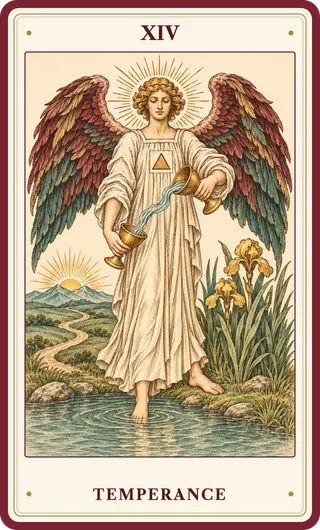
The angel
A winged figure stands calmly at the centre of the card, a guide who blends opposites without effort. In a yes or no reading it signals that the answer comes through care and skill, not force.
Two cups with flowing water
The angel pours water between two cups in an unbroken stream, mixing one thing into another. It shows that the outcome depends on blending, patience and a steady hand.
One foot in water, one on land
The angel keeps one foot in the pool and one on solid ground. It stands for balancing feeling and practicality, so the yes works only when both are respected.
Triangle inside a square on the chest
The triangle sits inside a square on the angel's robe, spirit working within the material world. It suggests a yes that is grounded and workable, not just hopeful.
The sun mark on the forehead
A small solar symbol sits on the angel's brow, a sign of clear awareness and higher purpose. It says the answer is guided by calm perspective instead of impulse.
The winding path to the mountain
A path runs from the pool toward distant mountains under a glowing crown. It means the yes leads somewhere real, but you arrive step by step.
Irises by the water
Irises grow at the water's edge, named for the Greek messenger goddess of the rainbow. They hint at good news and a bridge between two states, delivered gently.
How long does a Temperance yes take?
Temperance is a slow card. The usual timeline is weeks to months, and it tends to describe a process of gradual improvement more than a single event. If you want a quick date, this is not the card to ask. Its answer is that things will settle as you maintain the balance.
Numerology gives a hint: the card is number 14, which reduces to 5 (change) while sitting in a sequence about adjustment after endings. Astrologers link Temperance to Sagittarius, but you do not need that to read it. A simpler rule is better: the more steady effort your situation needs, the longer the yes takes.
For more detail on how to read timing across the whole deck, see tarot timing.
Try this: Draw Temperance (or think of a recent draw) and write down the smallest steady action you could repeat every day for two weeks. Check in at the end and see whether the situation has shifted.
What the symbols say about the answer
The Rider-Waite-Smith image carries the verdict in plain sight. An angel pours water between two cups in a continuous stream, which is the blending at the heart of the card. One foot is in the pool and one on dry land, so the answer holds when feeling and practicality are both respected.
A triangle inside a square on the angel’s chest shows spirit working within the material world, which is why this yes is grounded rather than wishful. Behind the figure, a path winds toward distant mountains under a glowing crown. That path is the answer in picture form: yes, there is somewhere to arrive, and you get there one step at a time.
The irises at the water’s edge belong to the messenger goddess Iris, a nod to good news arriving gently. Nothing in the image is hurried, which is the quickest way to remember what kind of yes this is.
Questions Temperance answers badly
Some yes or no questions do not suit this card. If your question is built on an extreme, such as “Will I get everything I want?”, “Is this the one big chance?” or “Should I cut them off completely?”, Temperance does not have much to say, or it will gently push back against the wording.
It is also a poor fit for urgent, either-or decisions that have no middle ground. Temperance is a card of blending, so when you draw it for a hard fork in the road, take that as a hint that a third option or a compromise may exist.
Finally, avoid asking it the same question repeatedly until it says what you want. A balanced card will give a balanced answer, and repeated draws usually just muddy things. Ask once, read carefully, and act on what you learn.
How the cards around Temperance change the answer
Temperance rarely appears alone, and its neighbours can sharpen or soften the yes. A few common patterns:
- With cards of rest or delay (such as the Four of Swords), the yes comes with a pause first.
- With cards of fear or feeling stuck (such as the Eight of Swords), the yes becomes a maybe until the worry eases.
- With cards of fast action (such as the Knight of Wands or Eight of Wands), the pace clashes with the card’s nature, so slow down.
- With cards of fulfilment (such as the Ten of Cups or the Sun), the yes strengthens and points to a happy settling.
- With cards of control or excess (such as the Devil), the yes depends on loosening an unhealthy pattern.
In a spread, position matters too. Temperance in the “outcome” spot is a good sign. In the “obstacle” spot, it can mean that your own imbalance is the issue. The 3 card tarot spread is a simple way to see this, with one card for the situation, one for the challenge and one for the likely result.
Temperance after Death: why it follows an ending
In the Major Arcana, Temperance comes straight after Death, and that sequence is useful for yes or no readings. Death is a clearing away. Temperance is what you do afterwards: restore, recover and find a measured way forward.
So when Temperance answers a question about life after a breakup, a job loss or a big change, its yes is about healing at a human pace. It is not an instant fresh start, but it is a real one. The card after Temperance is the Devil, which is a reminder of what happens when moderation is lost to obsession or excess. That makes Temperance a good check on whether your current plan is sustainable.
How to ask a question and read the draw
Temperance works best with questions that suit a measured answer. Open with “Can this work if I go about it steadily?” rather than “Will this happen by Friday?” Start from clear wording, because a vague question gives a vague card.
- Write the question in a form that can be answered yes or no.
- Shuffle while holding that single question in mind.
- Draw one card, and note whether it is upright or reversed.
- Read the verdict (patient yes, or no/not yet), then the condition the card attaches.
- Decide on one action that reflects the balance Temperance asks for.
If you would like a quick draw to practise on, the yes or no tarot reading tool gives you a card and an answer, and you can then use this page to read the nuance.
Temperance yes or no at a glance
A short summary you can keep to hand:
- Upright: yes, with patience and moderation.
- Reversed: no, or not yet, until balance returns.
- Love: yes for slow, caring growth, and no for drama.
- Work and money: yes for steady, sustainable plans, and no for all-in moves.
- Timing: weeks to months, not days.
The most reliable way to use Temperance is to treat the yes as a green light for the calm version of your plan. If you can imagine yourself carrying on at the same steady pace a year from now, the card is almost certainly on your side.
Questions readers ask
Is Temperance a yes or no card?
Upright, Temperance is a yes, but a patient and conditional one. It says the outcome is good if you stay balanced, take the middle path and do not rush.
Is Temperance reversed a no?
Usually it leans to no, or more often not yet. Something is out of balance, such as excess, impatience or a mismatch, and it needs fixing before the answer can turn positive.
Does Temperance mean yes in love?
Yes, for a relationship that can grow slowly through compromise, kindness and trust. It is not a promise of instant passion or a fast commitment.
Does Temperance mean an ex will come back?
It can, but only through a slow, healthy repair with calm communication on both sides. If the pull is dramatic or one-sided, Temperance points away from a quick reunion.
How long does a Temperance yes take to arrive?
Expect weeks or months, not days. Temperance describes a gradual process, so the timeline is set by steady effort rather than a sudden event.
Can I trust Temperance for a big decision?
Use it as a steady pointer, not a verdict. It is a good sign for measured, well-planned choices and a warning against all-or-nothing moves, so weigh it alongside facts and the cards around it.