
Justice Tarot Card Meaning (Upright & Reversed)

- Arcana
- Major Arcana, card 11
- Element
- Air, Libra
- Yes or no
- Maybe
fairnesstruthcause and effectlaw
unfairnessdishonestyavoiding accountability
The Justice tarot card means fairness, truth, accountability and cause and effect. When it appears upright, it tells you a decision is being weighed honestly and the outcome will match what you have put in. Reversed, it points to bias, dishonesty or someone (often you) avoiding responsibility for a choice.
Justice is not a card of luck or fate. It is a card of consequences, and that is why it feels so direct. This guide covers what it means in every position and area of life, how the numbering works (it is card 11 in most decks, and sometimes 8), how to read the imagery, and what to do when it turns up in your spread.
Justice at a glance
Here are the core facts you need to place the card quickly in a reading:
- Number: XI (11) in the Rider-Waite-Smith deck, VIII (8) in older decks
- Element: Air
- Zodiac sign: Libra, with Venus as its ruling planet
- Upright keywords: fairness, truth, accountability, cause and effect, balance, law
- Reversed keywords: unfairness, bias, dishonesty, avoidance, imbalance, delay
Justice sits in the Major Arcana, the 22 cards that mark the big lessons of a life. If you are new to the split between the two halves of the deck, our page on the major and minor arcana explains how they work together.
The simplest way to remember Justice is this: you reap what you sow, and you get a fair hearing. It is calm, formal and unsentimental. It does not take sides, and it does not care how you wish things had gone.
What the Justice card shows
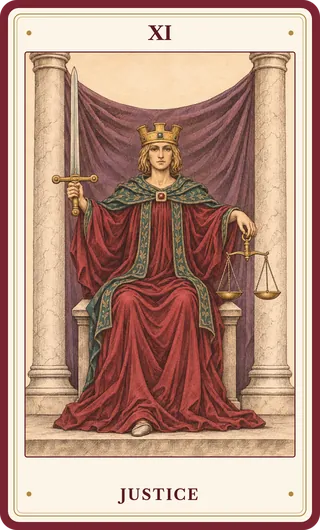
In the Rider-Waite-Smith image, a figure in a red robe and green cloak sits upright on a throne between two grey pillars. The figure faces you directly, which is unusual for a tarot card. In one hand there is a sword pointing straight up, and in the other there are balanced scales. A purple curtain hangs behind, and a crown with a small square jewel sits on the head.
Everything in the picture is level and symmetrical. The pillars match, the scales are even and the sword is vertical. Nothing is moving. This is the stillness of someone who has already looked at all the evidence and is ready to give a ruling.
The sword and scales work as a pair. The scales are for weighing, and the sword is for cutting through confusion and acting on what you find. Justice teaches that you need both: a fair assessment and the willingness to follow it through, even when it costs you something.
Smaller details worth noticing
The edge of a white shoe shows beneath the robe, a small sign that this figure is grounded and ready to rise. The purple curtain behind suggests that not everything is visible yet. Justice shows you the facts available now, and it will not guess at what is still hidden.
Why Justice is number 11 (and sometimes 8)
If you have more than one deck, you may notice that Justice is numbered differently. Justice is card number 11 in the Rider-Waite-Smith tarot and card number 8 in many older decks. In the Tarot de Marseille tradition, Justice follows The Chariot and Strength comes later at 11.
The change was made for astrological reasons. The switch matched the astrological correspondences of the Hermetic Order of the Golden Dawn, which link card 8 with Leo and card 11 with Libra. A.E. Waite followed that arrangement, so Strength became 8 and Justice became 11. Many English-language decks now use this order, so check the number printed on your own deck before you compare notes with another reader.
The new number also has a symbolic payoff. The renumbering puts Justice at the exact centre of the 22 trumps. The card of balance sits at the midpoint of the Major Arcana, and readers often see this as the place where the story turns from external adventures to inner accountability. For the lion-tamer card that swapped places with it, see Strength.
Read Justice for your question
Upright: A fair, honest relationship where both people pull their weight, speak plainly and keep their word.
Reversed: Lopsided effort, hidden truths or one person keeping score instead of talking.
Upright: They see you clearly, want to treat you fairly and are weighing where things really stand.
Reversed: They are judging you harshly, avoiding the truth or struggling to be honest about what they feel.
Upright: Fair treatment, clear contracts and a decision that goes the way your effort has earned.
Reversed: Bias, unclear terms, a delayed ruling or a boss or colleague dodging accountability.
Upright: Balanced books, honest dealings and settled debts, taxes or agreements.
Reversed: Unfair terms, hidden fees, unpaid obligations or money decisions made without the full facts.
Upright: Tell the truth, own your part and make the decision you can stand behind.
Reversed: Stop blaming others, look at the facts again and put right what you have left unbalanced.
Upright: A steady, balanced routine where sleep, food, work and rest are weighed fairly against each other.
Reversed: Habits that have tipped out of balance, or a tendency to ignore symptoms and avoid honest check-ups.
Justice upright meaning
Upright Justice says that truth is coming out and a fair result is on the way. You may be waiting on a decision, an agreement, a review or a conversation that settles an old question. The card promises that the outcome will follow the facts, not the loudest voice in the room.
It also puts the responsibility back in your hands. Justice asks what you have actually done, what you have promised and what you owe. If you have acted with integrity, the card is a relief and a green light. If you have cut corners, it is a calm but unmistakable prompt to put things right before someone else does it for you.
A. E. Waite’s original wording is blunt: equity, rightness, probity, and the triumph of the deserving side in law. Modern readers often soften this into “get your facts straight and be fair,” which is a more useful way to apply it to everyday life.
Justice reversed meaning
Reversed Justice shows fairness slipping. That can mean a one-sided decision, a person who will not own their mistake, or a situation where the full truth has not come out. Sometimes it describes something done to you: bias, favouritism or terms that were never fair. Sometimes it describes you: justifying a choice you know was off, or judging someone more harshly than you would judge yourself.
Reversed Justice rarely means that things are hopeless. It usually means imbalance, delay or avoidance, and each of those can be corrected once someone is willing to look honestly at the facts. Waite’s own reversed meaning mentions legal complications, bias and excessive severity, so a harsh or overly rigid stance can be part of the picture as well.
For a longer look at how this plays out in different areas of life, see our page on Justice reversed. If you want to understand how to approach upside-down cards in general, reading reversed tarot cards is a good place to start.
Try this: Pull Justice and write two lists: what you have done in this situation, and what you have said you would do. Where the lists do not match, you have found the imbalance.
Justice in love
In a love reading, Justice asks for honesty and equal effort. Upright, it often describes a relationship where both people say what they mean, keep their promises and carry their share. It can also mark a moment of clear decision: committing, setting a boundary or agreeing on terms that feel fair to both.
For singles, Justice usually points to a connection that grows through clear communication, not chemistry alone. You may meet someone through work, shared values or a sensible introduction. It also advises you to be honest about what you want, and to choose a partner who treats you fairly, not just excitingly.
Reversed in love, the card flags imbalance: one person doing most of the emotional work, keeping score, or hiding something that matters. It can also describe a breakup or separation that feels unfair. The fix is the same as upright: honest talk, with each person taking responsibility for their own part. When the card is pulled to describe someone’s attitude, Justice as feelings goes deeper.
What Justice means as feelings
When Justice describes how someone feels about you, it points to a person who is thinking carefully, not acting on impulse. They see you clearly. They want to be fair, and they are probably weighing where the relationship stands before they speak or act. This is not the card of a wild crush. It is the card of a considered opinion.
That can be reassuring or sobering. If the relationship is honest, Justice says their respect for you is real. If there are unresolved issues, it says they have noticed them and are measuring them.
Reversed, Justice as feelings suggests someone who is judging you harshly, avoiding an honest conversation, or struggling to be fair about what they feel. The cleanest response is to ask a direct question and listen to the answer without trying to win the point.
Justice in career
At work, Justice is the card of fair treatment, clear contracts and decisions that follow the evidence. It often appears around job offers, performance reviews, contract negotiations, HR matters and anything involving formal terms. Read the paperwork carefully, ask for things in writing and do not rely on verbal promises.
It also says your professional integrity is on show. If you have done honest, well-prepared work, upright Justice is encouraging: a fair assessment, recognition that matches your effort or a clean resolution to a dispute. If you have been casual about details, it is a nudge to tighten them.
Reversed, Justice can point to bias at work, unclear job terms, a delayed decision or a colleague who will not take responsibility. Document what happened, stick to the facts and avoid trading blame. If you are the one at fault, owning it early is far less costly than being found out later. People often compare this card to the calm authority of the King of Swords, who also rules by clear logic and fair judgement.
Justice in money and finances
In finances, Justice stands for honest dealings and balanced books. It can appear when you are settling a debt, filing taxes, signing a loan or lease, dividing shared assets or reviewing an agreement. The message is to look at the numbers as they are, not as you hope they are.
Upright, it suggests a fair financial outcome and clear terms. It supports decisions made with full information and written records. Pay what you owe and expect to be paid what you are owed.
Reversed, Justice warns of unfair terms, hidden costs, unpaid obligations or a decision made without the full facts. Slow down, read everything and get qualified advice for anything significant. A tarot card can highlight a pattern, but it does not replace a lawyer, an accountant or a financial adviser.
Justice in health
In health readings, Justice is about balance and honest self-assessment. Upright, it points to a routine where sleep, food, movement, work and rest are weighed fairly against each other, or to a clear result from a check-up. It encourages you to make choices you can stand behind.
Reversed, it suggests habits that have tipped out of balance, or a tendency to ignore something you already know needs attention. It is a prompt to be honest about what your body and mind are telling you, and to book the appointment you have been putting off.
Tarot cannot diagnose or predict a medical outcome. Treat Justice here as a mirror for your habits, and take any physical or mental health concern to a qualified professional.
Justice card symbols
Choose a symbol to read what it means on the card.
The upright sword
The sword points straight up in the figure's right hand and has two edges. It shows that truth and consequence cut both ways, and that clear thinking is the tool for settling things.
The scales
The scales hang in the figure's left hand, level and still. They stand for weighing evidence before acting, and for the balance that follows when you do.
The red robe and green cloak
Red suggests conviction, action and accountability you can feel. The green cloak behind it softens the figure with a touch of fairness and growth.
The crown with a square jewel
The crown marks authority that comes from principle, not personality. The square at its centre points to stability and solid, grounded judgement.
The two grey pillars
Justice sits between pillars like a court or temple gateway. They echo the structure of law and the idea that fair outcomes need firm boundaries.
The purple curtain
A purple veil hangs between the pillars, hiding what lies behind it. It reminds you that Justice shows what is in front of you, while deeper context may still be unfolding.
The tip of a white shoe
A small white shoe peeks out from under the robe. It hints at a figure who is grounded and ready to step forward the moment a decision has been made.
Is Justice a yes or no card?
Upright, Justice is a conditional yes. The answer is yes if you have been honest, fair and prepared, because the card promises that you will receive what you have earned. If you have cut corners or hidden something, the honest answer is that things will not go your way until you put that right.
Reversed, Justice leans towards no or not yet. Something is unresolved, undisclosed or being weighed by people beyond your control. That is rarely a permanent refusal. It is more often a sign that the full picture has not been seen.
For a quick answer in the moment, see our page on Justice as a yes or no answer. Yes or no spreads work best when you ask a specific, honest question, and Justice rewards exactly that kind of question.
Justice and legal matters
Because of its imagery, Justice is the card most readers connect with courts, lawyers, contracts and official decisions. When it appears in a question about a legal case, it usually signals that the facts will carry weight and that a ruling is coming. It does not tell you who will win. It tells you that the matter will be judged on what is true and documented.
The card works best as a prompt to prepare: gather evidence, tell the truth, read every document and keep your behaviour clean. Treat it as a reflection of the process, not a verdict. Tarot is not legal advice, and no reading can replace a qualified lawyer.
Justice can also point to simple agreements that need to be clear: a tenancy, a prenup, a freelance contract. Even there, the lesson is the same: put terms in writing and make sure each side understands them.
Justice as a person
When Justice stands for a person, it describes someone fair, principled and measured. This could be a judge, lawyer, mediator, auditor, HR manager or simply a friend who is known for giving honest, balanced advice. They listen to both sides before deciding and expect others to hold themselves to the same standard.
They may not be the warmest person in the room. Their care shows up as honesty and reliability, not flattery. If you ask them for feedback, you will get it straight.
Reversed, the person can be rigid, biased or hypocritical, or someone who holds others to rules they do not follow themselves. In some readings it points to you: someone who has been unusually critical lately and needs to apply the same standard to their own conduct.
The spiritual meaning of Justice: karma and integrity
Spiritually, Justice is the card of karma in its simplest sense: actions have consequences, and those consequences are not punishment but a natural result. It sits in the Major Arcana as one of the three classical virtues, alongside Strength and Temperance, and it represents the virtue of acting rightly.
The card invites a daily kind of integrity. It asks whether your actions match your values, whether you are fair to people who cannot repay you and whether you tell the truth when a lie would be easier. These are small tests, and the card suggests they add up.
It is also useful to separate Justice from Judgement, a card people often mix up with it. Justice is about weighing facts and making fair decisions in the present. Judgement is about a larger awakening, a call to rise and answer who you have become. One is the courtroom, the other is the calling.
Try this: At the end of the day, ask yourself one question: “Where did I act in line with my values today, and where did I not?” Write one sentence for each, with no excuses and no self-attack.
Justice with other cards
Justice reads strongly alongside the cards around it, because it clarifies cause and effect. Next to The Hanged Man, the card that follows it in the Major Arcana, it describes a pause that is part of a fair process: you wait while a decision is considered. See The Hanged Man for how that suspended stillness works.
With Swords cards, Justice leans towards communication, evidence and decisions. With Pentacles it highlights contracts, payment and practical outcomes. With Cups it brings honesty into feelings, and with Wands it asks whether ambition is being pursued fairly.
When you see Justice in a past position, it often describes a decision that is still shaping your life. In the present, it shows what is being weighed now. In the future, it shows the outcome that will follow from the choices already made. A simple past, present and future layout from our 3 card tarot guide shows this clearly.
How to work with Justice when it appears
Justice always asks for action, not just reflection. Use these steps when the card turns up:
- Name the situation that needs a fair decision.
- List the facts you know, separate from what you assume or feel.
- Identify your own part, including anything you have avoided.
- Decide what action would be fair to everyone involved, including you.
- Do it, and accept the result without reopening the case.
The last step matters. Justice does not offer endless appeals. Once you have made an honest decision, the card suggests you accept it and move on.
If the card keeps appearing across several readings, treat it as a pattern. There is probably a decision you have not made, a truth you have not said or an agreement you have not clarified. Give it your attention, and the card tends to move on by itself.
When Justice shows up in timing
Justice does not give a fixed timeline, but it often points to formal timeframes: court dates, contract deadlines, review periods or the weeks it takes for an official decision to arrive. Because it is a Libra card, readers also link it to Libra season, which runs from late September to late October.
Reversed, it suggests delay, because the process is stuck on missing information or someone avoiding responsibility. Supply the missing facts, and things tend to move.
A good rule is to treat Justice as a “when everything is in order” card, not a “by next Tuesday” card. Pay attention to what is outstanding, and the timing usually follows.
Try this: Pull one card and ask, “What fair decision am I putting off?” If Justice appears, take that as your cue to decide this week, not just think about it.
Questions readers ask
What does the Justice tarot card mean?
Justice means fairness, truth, accountability and cause and effect. It tells you that your choices are being weighed honestly and that the outcome will reflect what you have actually done.
Is Justice a good card in tarot?
It is a good card if you have acted honestly, because it promises a fair result. It can feel uncomfortable if you have been avoiding something, since it asks you to face the facts and take responsibility.
What number is the Justice tarot card?
In the Rider-Waite-Smith deck Justice is card 11 (XI). In older decks such as the Tarot de Marseille it is card 8 (VIII), and Strength takes the other number.
Is Justice a yes or no card?
Upright, Justice is a conditional yes: yes if you have been fair and honest, and the outcome will be what you have earned. Reversed, it leans towards no or not yet, because something is unresolved, hidden or biased.
What does Justice mean in a love reading?
In love, Justice points to honesty, equal effort and clear commitments. It can describe a relationship that is fair and balanced, or a moment when two people need to talk plainly about what each of them gives and expects.
What zodiac sign is the Justice tarot card?
Justice belongs to Libra, the sign of the scales, which is ruled by Venus. Its element is Air, which fits a card about clear thinking, truth and measured decisions.