
Justice in Love & as Feelings

- Arcana
- Major Arcana, card 11
- Element
- Air, Libra
- Yes or no
- Maybe
fairnesstruthcause and effectlaw
unfairnessdishonestyavoiding accountability
Justice as feelings means the person’s feelings are considered, honest and carefully weighed. They are thinking about you with a clear head, they care about being fair, and they will not act on a feeling until they have checked it against the facts. It is rarely a rush of passion. It is closer to a verdict, reached slowly and meant to last.
Readers do disagree about this card. Some call it warm, some call it neutral and some call it cold, and each is right in some readings. The sections below explain why, and how to tell which version you have, whether you are asking about a crush, a partner or an ex. For the card’s wider meaning, see the full Justice tarot card meaning.
What Justice Means as Feelings
Justice is card XI in most modern decks (VIII in some older ones). It shows a figure with scales in one hand and a sword in the other, and both tools do the same job: they separate what is true from what is merely felt. When the card lands in a feelings position, that job is done on emotions. The person is sorting out what they feel, why they feel it and whether it is fair to act on it.
So the core message is clear-headed emotion. Their attraction, respect or hurt has been through a filter of honesty. You are being seen as you are, not as a fantasy, and that is a rare and quite intimate kind of attention even when it does not look romantic.
The card also carries cause and effect. People’s feelings toward you are shaped by how you have behaved toward them, and Justice is one of the few cards that says so plainly. If you have been kind, direct and reliable, that tends to come back to you. If you have been careless or evasive, the same rule applies.
Why Justice Is Not a Gushing Card
If you want to hear “they are crazy about you,” Justice will disappoint you. Compare it with the sweeping emotion of The Lovers or the delight of the Ace of Cups. Justice is calm. It describes someone who talks in measured sentences, avoids grand declarations and prefers to show feeling through consistent, fair behaviour.
That calm is where the disagreement comes from. A reader who expects warmth sees coolness and calls the card negative. A reader who values honesty sees integrity and calls it a good sign. Both are describing the same person, who simply processes feelings through the mind first.
A useful rule: Justice tells you how someone feels, not how much. Their feelings may be deep and still sound quiet. What the card rules out is impulsive, unexamined emotion, and that is often good news if you want something lasting.
Upright Justice as Feelings for a Crush or New Person
If you have just met someone or are still in the early stages, upright Justice says they are evaluating. They like what they see, or they are open to it, but they want evidence before they commit their heart. They may ask direct questions, notice whether your actions match your words and take their time before making a move.
This is not rejection. It is someone being careful, often because they have been burned before or because they simply value honesty. If you have been open and consistent, the scales are likely tipping in your favour. If you have been playing games or keeping them guessing, expect them to notice.
In the same position, the card can also mean the connection is more neutral than you hoped. When there is no history to weigh, “weighing” can mean they have no strong feelings yet. Read the surrounding cards: warm company points to growing interest, while cool company points to indifference.
Try this: Before you draw, write your question in one sentence, such as “How does Sam feel about me right now?” Draw Justice’s neighbouring cards first and note the mood they set. Then read Justice as the quality of the feeling, not the strength of it.
Read Justice for your question
Upright: A fair, honest relationship where both people carry equal weight, or a clear decision about whether the match is right.
Reversed: One person is giving more than the other, blame is going back and forth, or something important is being left unsaid.
Upright: Their feelings are considered and sincere: they have weighed you up carefully and want to treat you fairly.
Reversed: They feel the relationship is unfair or out of balance, and they may be guarded, resentful or holding back a judgment.
Upright: Fair treatment, clean contracts and a decision that rewards honest work.
Reversed: Bias, dodged responsibility or a deal that favours one side.
Upright: Debts, taxes and agreements get settled fairly, and your accounts reflect what you have actually earned.
Reversed: Unequal splits, unclear paperwork or a financial decision made on poor information.
Upright: Tell the truth, weigh the facts and act in a way you can stand behind.
Reversed: Stop avoiding accountability, and check whether you are judging yourself or someone else too harshly.
Upright: Balance is the aim: regular routines, honest check-ups and habits that match your real needs.
Reversed: Lifestyle is out of balance, and a symptom or test result needs a straight look instead of avoidance.
Upright Justice as Feelings in an Established Relationship
In a long-term relationship, Justice upright is usually a good sign. It describes a partner who feels the relationship is fair, who respects you and who trusts that you act in good faith. Their loyalty comes from values, not only chemistry, which makes it sturdy.
It can also show a partner who is weighing a decision: whether to move in, get engaged, have children or recommit after a rough patch. The card does not say what they will decide. It says they are taking it seriously, and that your behaviour counts. A fair, honest conversation now is worth more than any grand gesture.
If the relationship has felt lopsided, Justice upright can be a gentle nudge. The other person may feel a quiet need for more balance and will say so calmly, if you give them room. Treat that as information, not an attack.
Justice as an Ex’s Feelings
When you ask what an ex feels, upright Justice suggests they are looking back honestly. They are likely reviewing what happened, who did what and what they would do differently. It often shows someone who has reached a fair-minded view of the breakup, with respect for you and no urge to rewrite history.
That does not automatically point to reconciliation. Justice is about facts, and the facts may be that the relationship ended for good reasons. If you want to know whether a reunion is possible, look at the cards next to it. Pairing it with The Two of Cups shows mutual respect that could grow into something, while pairing it with the Five of Cups shows a settled regret and no move to repair things.
If you ended things badly, Justice can also say your ex feels the consequences were deserved. That sounds harsh, but it also means they are not holding on to a fantasy of you. Seeing the situation clearly is the first step toward either closure or an honest second try.
Justice Reversed as Feelings
Reversed Justice shifts the same energy into imbalance. The person may feel that the relationship is unfair, that they are giving more than they get, or that something has been hidden. Their feelings can come across as guarded, resentful or critical, and they may be keeping a judgment to themselves until it is ready to come out.
It can also describe someone who feels judged by you, or who is dodging responsibility for their own part. In some readings it points to a secret or a lie that tips the scales, and the sense of unfairness is a reaction to that. In others it is simply a person who is hurt and has not yet found words for it. The Justice reversed page goes deeper on these themes.
For an ex, reversed Justice usually means bitterness about how things ended. They may feel wronged, or they may be struggling to admit their own role. This is not the best card for a reunion, but it is a good one for finally understanding why things went the way they did. If you want a general method for reading cards that fall upside down, how to read reversed tarot cards covers it.
Reading Justice by Position and Question
The meaning shifts slightly with where the card falls. In a “what they feel about me” position, read it as described above. In a “what is blocking us” position, it points to a lack of fairness or honesty. In an outcome position, it suggests the relationship ends up where your actions have led it.
The way you ask matters as well. “Does he love me?” and “How does he see me?” are different questions, and Justice answers the second one better. It is a card of perception and judgment, so it tells you how you are being viewed, not how swept away someone is.
If you are using a layout built for couples, the relationship tarot spread gives Justice a clear job: it shows up in the position that describes how each person sees the other. Look at whether the card is fair to both of you, and whether the other cards back it up.
Justice card symbols
Choose a symbol to read what it means on the card.
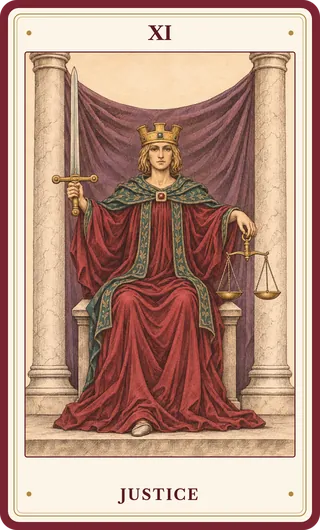
The scales
The scales in the left hand stand for weighing evidence and emotion equally. In feelings readings they show someone measuring what you mean to them before they commit.
The upright sword
The double-edged sword in the right hand cuts both ways, so truth applies to everyone, including the person holding it. It shows a person who values clarity over comfortable stories.
The red robe
Red is the colour of passion, held here inside a formal, structured garment. It suggests real feeling that is kept under control.
The square crown jewel
The square on the crown signals order, logic and a fixed standard. This person's mind is part of how they love.
The grey pillars
Two pillars frame the figure, as in The High Priestess, marking a boundary between two sides. They hint at a decision with a before and an after.
The purple curtain
The curtain behind the figure is a veil that has been drawn tight. It shows that what is hidden in a situation is being brought into the open.
The white shoe
A small white shoe peeks out from under the robe, a hint of something gentler beneath the formal exterior. It is a reminder that a calm, fair person still has a heart.
Justice as Your Own Feelings
When Justice describes you, it often means you are thinking instead of feeling. You may be building a case, listing pros and cons or telling yourself you are being reasonable while something deeper goes unspoken. That is not wrong, but the card asks whether your head has had the final word too early.
It can also mean you already know the truth and are looking for the nerve to say it. If you drew Justice while asking about someone, ask yourself what you would decide if no one were watching. Your answer is often the verdict.
Try this: Take two columns on a page. In one, write what you think about the situation. In the other, write what you feel, even if it is messy. If the columns do not agree, that gap is what Justice wants you to look at.
Cards That Change What Justice Feels Like
Justice rarely stands alone, and its neighbours colour the verdict. A few pairings come up often:
- Justice with Two of Cups or Ten of Cups: a fair, mutual, lasting affection, with honesty at the centre.
- Justice with the Queen of Swords: someone who is direct, perceptive and expects the same of you. See the Queen of Swords for her character.
- Justice with Three of Swords or Five of Swords: a painful or competitive dynamic where fairness has been lost.
- Justice with Seven of Swords: a hint that something is being kept back or rationalised.
Court cards add a person. The King of Swords next to Justice is a very logical partner, while the King of Cups beside it shows emotion and fairness in balance. A Knight card can show action: the Knight of Swords, for example, may state the verdict aloud, abruptly.
The Major Arcana speak to timing and scale. Justice followed by the Judgement card can mean a long-considered feeling is about to become a decision, a pairing worth comparing with Judgement as feelings. Justice next to The Tower suggests a truth that breaks open a situation fast.
How to Tell Which Kind of Justice You Have
Because the card is so context-dependent, a few questions help you decide whether you are looking at warmth, neutrality or resentment.
- Is it upright or reversed? Upright leans toward honest and considered. Reversed leans toward guarded or resentful.
- How do the neighbouring cards feel? Cups cards soften Justice, while Swords cards sharpen it.
- How have you treated this person lately? Justice reflects cause and effect, so be honest with yourself.
- What does their behaviour show? A person who feels Justice toward you will usually be consistent, fair and direct, even if they are not effusive.
If your answers point in different directions, trust the pattern across several cards instead of reading Justice alone. A single card is a snapshot, and this one is especially sensitive to the cards around it.
What to Do When Justice Shows Up
Respond to Justice the way it asks to be treated: honestly and calmly. If you want to know what someone feels, ask them directly, and be ready to hear a measured answer. Clear, unpressured questions suit the person this card describes better than hints or tests.
Check your own side of the scales too. Are you giving what you hope to receive? Have you been transparent about what you want? Justice is a reminder that how a relationship feels to someone depends heavily on how it is treated, and small acts of fairness count for more than they seem.
If the card is reversed, do not jump to the worst conclusion. Reversed Justice is often an invitation to name an imbalance before it hardens. A calm, specific conversation about what feels unequal can turn a resentful verdict into a fairer one.
Common Mistakes When Reading Justice as Feelings
The first mistake is reading Justice as “they love me” or “they do not love me.” It is neither, because it describes how someone evaluates you, not the size of the emotion. The second is overlooking the cause-and-effect side. If the person feels wary, there is usually a reason in the history between you, and ignoring it leads to confusion.
A third mistake is forgetting that the card can describe you. Many people pull Justice for someone else’s feelings when their own reasoning is the real subject. Asking “whose scales am I looking at?” can save you a lot of misreading.
The last is expecting a fixed answer. Justice describes the current verdict, and verdicts can be appealed. If you change how you act, or the other person gains new information, the feelings can shift. For a quick yes-or-no read on a related question, the Justice yes or no page is a useful companion.
Justice, Balance and Why It Suits Honest Love
Justice is the card of Libra, the sign of partnership and balance, which is why it keeps showing up in love readings even though it looks unromantic. It reminds you that love lasts when it is fair: when both people are honest, both pull their weight and both feel seen. The figure’s gaze is level and unflinching, and being looked at that way can be a gift.
If someone feels Justice toward you, they are likely taking you seriously. That is not the dazzle of a first spark, but it is the kind of regard that tends to hold up under pressure. Read the card with that in mind, check it against the surrounding cards, and let the facts, not the fantasy, guide your next step.
Try this: Pull one extra card as clarifier and ask, “What would make this fairer for both of us?” Write one small action from the answer and do it this week.
Questions readers ask
What does Justice mean as feelings?
It means the person's feelings are considered, honest and carefully weighed. They are thinking clearly about you and want things to be fair, but they are not swept away by emotion.
Does Justice mean someone loves me?
Not automatically. Justice shows that someone is taking your connection seriously and judging it honestly. Whether the verdict is love depends on the cards around it, the question and how the two of you have treated each other.
What does Justice reversed mean as feelings?
It usually points to resentment, guardedness or a sense that something between you is unfair or dishonest. The person may be holding back a judgment they have not shared yet.
What does Justice mean as an ex's feelings?
Upright, it suggests your ex is looking back honestly at what happened and what each of you contributed. Reversed, it points to bitterness or a feeling that the ending was unfair.
Is Justice a positive card for feelings?
It is neither positive nor negative by itself. It is a verdict card, so the result reflects what has really happened between you, and it tends to favour honest, fair behaviour.
What if I draw Justice for my own feelings?
It often means you are thinking your way through a feeling instead of letting yourself feel it. Make space for both the logic and the emotion before you decide anything.