
King of Swords Tarot Card Meaning (Upright & Reversed)

- Arcana
- Minor Arcana, Suit of Swords
- Element
- Air
- Yes or no
- Yes
authorityintellecttruth
confusionrecoveryrelease of mental strain
The King of Swords is the tarot card of clear thinking, fair judgement and authority built on real expertise. When he appears, you are being asked to decide with your head, tell the truth plainly and hold yourself to a high standard. He also describes a person who is disciplined, intelligent and ethical, often someone who works with laws, rules, data or advice.
This guide covers the card upright and reversed, then goes through love, feelings, career, money, health, spiritual meaning, yes or no answers, astrology and the cards that change his message. It also covers what separates him from the other Swords courts, so you can tell his voice from the Queen’s.
King of Swords at a glance
The King of Swords is the fourth and highest court card in the suit of Swords, which belongs to the element of Air: thought, language, logic, truth and conflict. Where the Page asks questions and the Knight charges at answers, the King has done the learning and now rules with what he knows. If you are new to the suit as a whole, the Swords suit overview shows where he sits among the fourteen cards.
Here are the core ideas to carry with you:
- Upright keywords: clarity, truth, authority, fairness, strategy, expertise, integrity, decisiveness
- Reversed keywords: coldness, manipulation, harsh judgement, abuse of power, rigidity, poor judgement
- Element: Air
- Zodiac link: Gemini, Libra and Aquarius (the air signs)
- Yes or no: usually yes upright, usually no or not yet reversed
What the card shows
In the Rider-Waite-Smith image, the King sits on a stone throne and looks out at you, his body upright and still. His right hand holds a double-edged sword pointing to the sky, and his other hand rests calmly on the throne. Nothing about the pose is hurried. He looks like someone who has already considered the question and is waiting for you to catch up.
The details add a gentler layer. The throne is carved with butterflies and a winged figure, which are symbols of transformation and of the mind’s higher reach. His blue tunic points to honest speech and thought, and the purple cloak suggests wisdom and rightful rule. Behind him are a pale cloudy sky, a few birds and thin bare trees. The whole scene is cool and open, much like the way he thinks.
Compare him with the Queen, whose sword points up too but whose face is turned to the side and whose hand is open. The King is square on and ready to rule on the matter. That frontal stance is why this card so often shows up when a decision or a verdict is on the table.
Upright meaning
Upright, the King of Swords is mastery of the mind. You can see a situation without letting fear, wishful thinking or other people’s moods distort it, and you are ready to act on what you see. The card often appears when you have to make a call, set a boundary, deliver an honest verdict or take charge of something that needs a steady hand.
His authority is earned. He does not rule through charm or volume but through knowledge, consistency and fair play. He keeps his word, applies the same rules to everyone, and would rather be respected than liked. If you feel torn between what is easy and what is right, he sides with what is right and can be explained.
The card also asks something of you. It may be time to speak more directly, to back your opinion with facts, or to stop letting emotion write your decisions. It does not ask you to become cold. It asks you to think first and feel second, so that both get a fair hearing.
Read King of Swords for your question
Upright: A relationship built on honesty, fairness and clear agreements, with a partner who shows care through reliability more than romantic gestures.
Reversed: Emotional distance, harsh criticism or a partner who argues to win, with logic used as a shield against intimacy.
Upright: Calm, considered feelings: they have thought this through and mean what they say, even if they say it plainly.
Reversed: Feelings held back behind coldness, control or sarcasm, or a mind so busy judging that the heart goes unheard.
Upright: Expert leadership, sound decisions and a boss or mentor who rewards competence and expects high standards.
Reversed: An overbearing or unfair authority, a power struggle, or your own reluctance to step into a role you are ready for.
Upright: A clear-eyed, disciplined approach to money, with good advice from an accountant, lawyer or planner.
Reversed: Poor financial judgement, ignored contracts and fine print, or advice that serves someone else's interest.
Upright: Decide on facts, speak plainly, keep your word and stay fair, even when it is uncomfortable.
Reversed: Check whether your certainty is hardening into stubbornness, and use your authority to guide rather than to dominate.
Upright: A rational, structured approach to health, with clear information from a trusted professional and steady routines.
Reversed: Overthinking, mental strain and stress held in the head and jaw, or a habit of ignoring symptoms until they are hard to dismiss.
The King of Swords as a person
As a court card, the King often stands for a real person. He is typically a mature, experienced adult who is rational, articulate, self-disciplined and principled. He might be a lawyer, judge, doctor, professor, engineer, accountant, consultant, senior manager or any expert whose job is to give a reliable answer. Gender and age are not fixed: a woman or a young person can carry his energy, and so can you.
Read him by behaviour rather than job title. He listens, asks sharp questions and does not flatter. He is fair but not soft, and his praise is rare enough to mean something. People often come to him for advice because they know he will tell them the truth, even if it stings.
His shadow is emotional reserve. He may find it hard to talk about feelings, to admit he is wrong or to comfort someone without trying to fix them. If the card is describing someone in your life, ask how they treat people when they are under pressure. That answer tells you which side of him you are dealing with, and you can check it against the King of Swords reversed description.
King of Swords in love
In a love reading, the King of Swords points to a relationship grounded in honesty, respect and clear agreements. This is rarely the card of sweeping romance. It is the card of the person who turns up when they say they will, says what they mean and treats commitment as a decision rather than a mood. For a couple, that can mean a steady, mature partnership where both people feel safe because nothing is hidden.
If you are single, he may describe a partner who is thoughtful, articulate and independent, someone who attracts you through their mind. He can also say you are ready to date with more standards and less drama. You may be choosing partners based on character instead of chemistry alone, and that is a healthy shift.
The challenge is warmth. A King can be so rational that his partner feels analysed rather than loved. If this card appears in a relationship with problems, the message is to talk directly about what is wrong, avoid blame and agree on practical steps. Honest conversation is the way forward, but it has to be delivered with care.
Try this: Think of one conversation you have been avoiding. Write down the single fact you most need to say, then say it in one calm sentence without an apology or an accusation. Choose a time to have the talk this week.
King of Swords as feelings
When the King of Swords describes what someone feels about you, the answer is measured. They have thought about it, they take it seriously and they will not play games. Their feelings are real but expressed through actions, consistency and straight talk rather than gushing words. If they say something warm, they mean it.
That can be frustrating if you want emotion on display. Someone drawing this card may be keeping a tight rein on their feelings because they dislike being vulnerable or want to be sure before they speak. Do not mistake that restraint for indifference. Look for follow-through: do they keep plans, respect your boundaries and tell you the truth?
If the card describes your own feelings, it suggests you are seeing your emotions with unusual clarity. You may have finally decided what you want. It can also mean you are thinking your way around a feeling rather than sitting with it, so ask yourself whether you are reasoning or avoiding.
King of Swords in career
Career is where the King of Swords is most at home. He is the competent leader, the expert, the person whose judgement others trust. The card can show a promotion, a new leadership role, a decision you are fully qualified to make or a mentor who will push you to improve. It also fits any work involving law, regulation, finance, medicine, education, research, writing or strategy.
In practice, he asks you to bring structure to your work. Define the goal, gather the facts, decide, and communicate the decision clearly. If a project has been drifting, he wants a plan, deadlines and accountability. If you manage people, he asks you to be consistent and fair, and to explain your reasons rather than just giving orders.
If the card represents your boss or a colleague, expect high standards and little tolerance for excuses. That can be a gift if you are prepared and a strain if you are not. For a leader with a different flavour of power, compare the fire and vision of the King of Wands with this one’s logic and rules.
King of Swords in money and finance
With money, the King of Swords is a cool head. He says to look at the numbers, read the contract, compare options and avoid decisions made in a rush of emotion. He is often a financial advisor, accountant, solicitor or tax specialist, and the card can suggest getting professional advice before you commit to something large.
It also favours discipline over thrill. Budgets, clear records, fair negotiation and an honest assessment of risk are all his territory. He is not as earthy as the King of Pentacles, who builds wealth through steady material growth, but the two share a sense that money should be managed responsibly.
Where this card appears with legal or financial matters, it is generally a good sign that a fair outcome is possible if the facts are on your side. Keep documents in order, put agreements in writing and be precise in what you promise.
King of Swords in health
For health, the King of Swords stands for a rational, informed approach. It encourages getting clear information from a qualified professional, asking direct questions and following a plan with discipline. He values evidence over guesswork, so it is a good card for making an appointment rather than searching worriedly online.
He also points to the mind itself. A busy, analytical, overworked head can lead to tension, poor sleep and a body that is ignored in favour of a to-do list. The card can be a reminder to treat mental rest as part of your routine, and to give feelings somewhere to go instead of filing them away.
Tarot cannot diagnose or replace medical care, and the King of Swords himself would say so. Use the card as a prompt to seek good information and make steady decisions, not as a verdict on your health.
Spiritual meaning and advice
Spiritually, the King of Swords is the discipline of honesty. He represents living by clear principles, speaking truth without cruelty and checking that your beliefs stand up to scrutiny. His butterfly-covered throne is a quiet reminder that the sharpest mind still grows by changing.
As an advice card, he gives a short list of instructions:
- Gather the facts and set aside assumptions.
- Decide what is fair, not only what is convenient.
- Say it clearly and kindly, once.
- Keep your word, and expect others to keep theirs.
- Leave room for the heart to be heard.
Try this: Pull the King of Swords as your daily card and note three decisions you make today. For each one, write the reason in a single sentence. If the reason is only a feeling or a fear, pause and find a fact.
King of Swords card symbols
Choose a symbol to read what it means on the card.
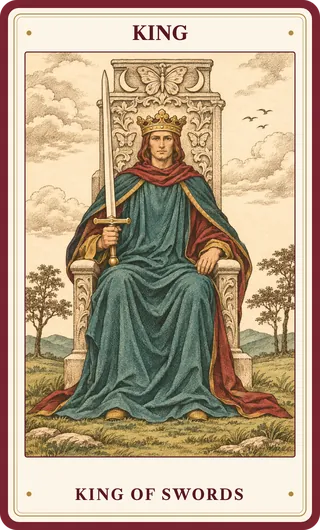
Upright double-edged sword
The sword is raised and steady in his right hand, showing judgement that is ready to be used. Its two edges mean truth cuts both ways, so he must be as fair to himself as to others.
Throne
He sits on a carved throne, which marks settled, earned authority rather than a role he is still chasing. The throne also shows that his decisions carry weight and consequences for others.
Butterflies and winged figure
Butterflies and a winged figure are carved into the throne and crown, hinting that his mind has been transformed by experience. Even this strict ruler is shaped by change and by something higher than logic.
Blue tunic and purple cloak
Blue is the colour of thought, truth and clear speech, while the purple cloak adds wisdom and a sense of rightful rule. Together they say his authority rests on understanding, not force.
Crown
The crown marks him as the master of the suit of Swords, the one who has fully developed the mind. It also reminds you that mastery of thought is a responsibility, not only a privilege.
Cloudy sky and birds
The pale, cloud-streaked sky is the element of Air, the home of ideas, words and judgement. The small birds in the distance suggest thoughts that fly free once they are clear.
Bare trees
Slim trees stand at the edge of the scene, simple and unadorned like his thinking. They show a life stripped down to what is true and necessary.
King of Swords reversed
Reversed, the King of Swords shows authority that has soured or stalled. It can describe someone who is cold, controlling, sarcastic or manipulative, using clever words to win rather than to find the truth. It can also describe a boss or partner who bends the rules, abuses a position of power or refuses to listen. The full breakdown is in the guide to King of Swords reversed.
The reversal can point inward too. You may be too harsh on yourself, hiding behind logic to avoid your feelings, or doubting your right to lead when you are quite capable. Sometimes it means the opposite problem: acting on half-formed opinions without checking the facts. If reversals are new to you, the guide to reading reversed tarot cards explains the different ways to interpret them.
The reversed King is not a lost cause. The fix is usually humility and warmth: ask real questions, admit what you do not know, and use your skill to help rather than to dominate.
Is the King of Swords a yes or no card?
Upright, the King of Swords generally leans towards yes. It supports decisions that are fair, well reasoned and based on facts, such as signing an agreement after you have read it, taking a leadership role or having an honest conversation. He is less supportive of impulsive choices, because he wants evidence behind the yes.
Reversed, he leans towards no or not yet. Something is unfair, rushed, controlled by someone else or based on poor information. Check the facts, find out who benefits and ask again after you have done your homework. You can read more on this in the dedicated page on the King of Swords as a yes or no answer.
As always, the question matters. Ask clear, specific questions such as “Is this contract a good decision?” rather than vague ones such as “Will things work out?” The King rewards precision.
Astrology, element and numerology
The King of Swords belongs to Air, so he is linked to the three air signs: Gemini, Libra and Aquarius. Libra fits his fairness and sense of balance, Gemini his quick, articulate mind, and Aquarius his independent, principled thinking. Some systems give him Aquarius as his main sign, while others treat him more broadly as the Air king with no single sign. Both approaches are used, so choose the one that fits the way you work.
In many modern systems he is also connected with Saturn through his structure and self-discipline, although this is less standard than the elemental link. Use it as a flavour, not a rule.
As the King, he is the culmination of the suit’s number cycle: the Ace is the spark of an idea, and the King is the idea fully matured and put into practice. If you enjoy number patterns, the tarot numerology guide explains how court cards fit in.
King of Swords with other cards
Court cards are shaped by their neighbours. These pairings are among the most useful:
- With the Ace of Swords: a fresh truth or insight that you are ready to act on. See the Ace of Swords for the idea in its raw form.
- With Justice: a fair ruling, legal clarity or a decision made on the facts. The Justice card shares his values.
- With the Three of Swords: a painful truth that must be spoken, delivered with care. The Three of Swords shows the hurt involved.
- With the Seven of Swords: be alert for hidden motives or someone who is not being straight with you.
- With the Magician: skill, communication and the power to turn a plan into results.
If you read the cards as a pair, ask whether the second card softens or sharpens him. A warm Cups card suggests the heart is being included, while another heavy Swords card may mean the mind is dominating the whole picture.
King of Swords vs the Queen, Knight and Page
The four Swords courts handle the same element at different stages. The Page is curious and still learning, the Knight rushes in with ideas and arguments, the Queen speaks truth shaped by personal experience and the King rules by principle and objective fact. Knowing this helps you place the card when it turns up in a spread.
The Queen of Swords is the closest match, and people often mix the two up. She is sharp too, but her judgement comes from lived experience and emotional insight, and she draws firm boundaries through honesty. The King is more systemic: he thinks in rules, structures and consequences, and he is usually in a position to enforce them.
For more on how the court cards work together, including their roles and how to read them as people or as qualities, see the guide to court cards in tarot.
How to use the King of Swords in your life
You do not have to wait for the card to appear. His energy is something you can build, particularly if you are facing a decision or a difficult conversation. Slow down, gather the relevant facts and decide what a fair outcome looks like. Then communicate it simply and kindly.
Be careful about the shadow too. If you notice you are winning arguments but losing closeness, or being right but feeling isolated, soften the delivery. A true statement said coldly can do as much damage as a lie. The best version of the King tells the truth in a way that the other person can hear.
Try this: Choose one decision you are facing and divide a page into three columns: facts, feelings and fair outcome. Fill in the facts first, then the feelings, then decide what a fair outcome looks like for everyone involved.
Questions to ask when the King of Swords appears
A card is more useful when you ask it something specific. When the King of Swords shows up, ask yourself whether you have the facts, what the fairest decision is, and where honesty is being avoided. You can also ask whose authority you are following and whether it deserves your trust.
If the card describes another person, ask how they use their power: to protect, to guide or to control. If it describes you, ask whether your thinking has room for compassion. If you want more prompts for readings, the list of questions for tarot reading can help you frame your next question.
You can also practise with a single card pull, such as a draw from the random tarot card generator, and see whether the King’s themes match your day.
Questions readers ask
What does the King of Swords mean in a tarot reading?
The King of Swords stands for clear thinking, fair judgement, expertise and authority that rests on principle. He asks you to decide with your head, speak truthfully and take responsibility for your choices.
Is the King of Swords a good or bad card?
He is mostly a positive card, because he brings fairness, clarity and competence. His weakness is coldness, so he is best read as a call to balance honesty with warmth rather than as a good or bad omen.
What does the King of Swords mean as a person?
He is usually a mature, intelligent and self-disciplined person such as a lawyer, judge, doctor, manager or advisor. He is honest and fair, but can seem detached or stern. The gender does not matter: it describes a style of authority.
What does the King of Swords mean for love?
In love he points to honesty, respect and mature commitment, with a partner who shows care through reliability and straight talk. The risk is emotional reserve, so the card also asks you to make room for feelings.
Is the King of Swords a yes or no card?
Upright, he leans towards yes, especially when the question concerns a fair, well-planned decision. Reversed, he leans towards no or not yet, usually because someone is being rigid, unfair or ill-informed.
What zodiac sign is the King of Swords?
His element is Air, so he is linked with the air signs Gemini, Libra and Aquarius. Different systems favour different signs, with Aquarius and Libra the most common choices.