
King of Swords Reversed: Meaning in Love, Work & Life

- Arcana
- Minor Arcana, Suit of Swords
- Element
- Air
- Yes or no
- Yes
authorityintellecttruth
confusionrecoveryrelease of mental strain
The King of Swords reversed means intellect and authority gone wrong. Most often that looks like a cold, controlling or manipulative use of power: someone using logic, rules or sharp words to dominate instead of to be fair. It can describe a person in your life, or it can be a mirror held up to your own behaviour.
There is a second, quieter reading that many guides skip. Reversed, this king can also lose his decisiveness, so the card points to overthinking, stalled decisions and a mind that cannot settle on a verdict. This article covers both sides, how to tell which one you are looking at, and what the card says in love, work, money and health. For the upright version, see the King of Swords meaning.
Why the King of Swords reversed has two meanings
Upright, the King of Swords is the most balanced of the Swords court cards. He thinks clearly, speaks honestly, judges fairly and acts on what he knows. His strength comes from keeping head and heart in working order, with the head in charge.
When the card turns upside down, that balance breaks in one of two directions. Either the authority hardens into tyranny (too much control, too little empathy), or the clarity dissolves into doubt (too much analysis, too little action). The Swords suit is about the mind, so both versions are mental problems: a mind that has become a weapon, or a mind that has become a maze.
Your question and the cards around it usually tell you which side you are on. If the situation involves power, conflict or someone’s behaviour, expect the tyrant. If it involves a choice you cannot make, expect the overthinker. If you are new to how reversals work in general, the guide to reversed tarot cards explains the different ways to read them.
The tyrant: misuse of power
This is the best-known meaning. The reversed King of Swords can be cold, domineering, sarcastic and ruthless. He wins arguments by being louder, quicker or more qualified, and he does not care who is left bruised. He may hide cruelty behind phrases like “I’m just being honest” or “I’m only being logical.”
The core lesson of this version is that intelligence without compassion turns into cruelty, and authority without ethics turns into control. The card does not say the person is stupid. It usually says the opposite: they are clever, and they use that cleverness to leverage, confuse or intimidate.
Watch for the subtle forms too. Manipulation dressed as reason is harder to spot than shouting. Gaslighting, moving the goalposts, rules that apply to everyone but him, and endless “debates” that exist only to wear you down all belong to this card. If something feels off but the other person can always produce a tidy argument, the reversed King of Swords may be the reason it is hard to name.
The overthinker: indecision and mental paralysis
The other face of the reversal is a king who cannot rule. He has the information, perhaps too much of it, but he cannot reach a verdict. He weighs every option, asks for one more opinion and watches the opportunity pass.
This reading fits when you are facing a decision and feel lost about which direction is best. The upright king trusts his judgement. The reversed king second-guesses it, talks in circles or tries to reason his way out of something that actually needs emotional honesty. It sits close to the strain of the Nine of Swords, where worry takes over the mind.
The advice here is simple but not easy. Set a deadline, list what you know and what you are only assuming, and choose. A good-enough decision made on time often beats a perfect one that never arrives.
Read King of Swords for your question
Upright: Honest, fair and steady, a partner who communicates clearly and keeps their word.
Reversed: A cold, controlling or dishonest dynamic, where logic is used to win arguments instead of building trust.
Upright: They think carefully about you and say what they mean.
Reversed: They are conflicted, guarded or shutting down, and may hide behind facts, sarcasm or silence.
Upright: A fair, decisive leader or mentor whose judgement you can rely on.
Reversed: A dominating boss, an unfair system, or your own indecision and harshness at work.
Upright: Clear-headed financial decisions based on facts and good advice.
Reversed: Poor discipline, controlling behaviour around money, or a decision stalled by overanalysis.
Upright: Decide with a cool head, speak plainly and act with integrity.
Reversed: Check your motives, soften your tone and stop using intellect as a weapon or a hiding place.
Upright: A clear diagnosis, good medical advice and a calm, rational plan.
Reversed: Mental strain, stress held in the head and neck, or feeling powerless in the face of a health decision.
Quiet power: when restraint is the point
Some readers see the reversed King of Swords as quiet power: authority that does not need to announce itself. In this reading, the reversal is not a failure at all. It shows someone with real expertise who stays out of the spotlight, or a moment when the wise move is to listen rather than rule.
This is a minority reading, so use it only when the surrounding cards are gentle and the question supports it. If the cards nearby are harsh (Swords in the Three, Five or Ten family), the shadow meanings come first. If the neighbouring cards are calm, such as Temperance or the Hermit, the quiet-power reading becomes more likely.
A related and common variation is the show-off intellectual. This is the person who uses big words and obscure topics to look clever, not to communicate. That is the king’s knowledge turned into costume.
King of Swords reversed in love
In a love reading, this card often points to a relationship that has become cold, controlling or emotionally dishonest. Conversations feel like cross-examinations. One person always has to be right. Feelings get dismissed as irrational, and apologies, if they come, arrive wrapped in explanations.
It can describe your partner, but be honest about the possibility that it describes you. Ask whether you have been using logic to avoid vulnerability, or whether you tend to win arguments at the cost of closeness. The card does not condemn you for this. It names the pattern so you can change it.
For singles, the reversed king can describe someone who looks impressive on paper but is emotionally withheld, or a dating pattern in which you keep choosing people who judge you. It can also mean you are over-analysing a new connection instead of letting it unfold. If you want to explore a relationship question further, the Relationship Tarot Spread gives each person’s side its own position.
Try this: Think of your last disagreement in a relationship. Write one sentence of what you said that was accurate, and one sentence of what you said that was kind. If the second one is missing, that is where the King of Swords reversed is working.
King of Swords reversed as feelings
When this card describes what someone feels about you, it suggests confusion and conflict. They may care but be unable to express it, or they may be guarded, defensive and hiding behind facts. You may get mixed signals: sharp remarks one day, silence the next.
It can also mean they are trying to stay in control of a situation that feels emotionally risky. A person with this energy often shows affection through fixing, advising or correcting, and withholds it through criticism. That is not the same as having no feelings, but it can feel the same from the outside.
Do not read the card as a verdict on their heart. Read it as a description of how hard it is for them to be open. If you want clarity, the reversed king asks you to stop decoding hints and have a plain, calm conversation.
King of Swords reversed in career
At work, the reversed King of Swords is often a dominating boss, a power-hungry senior colleague or an organisation that uses its rules unfairly. You may be dealing with bullying, favouritism, harsh criticism or decisions made without transparency. The card can also point to an unfair verdict in a dispute.
If it describes you, look at how you lead or collaborate. Are you correcting people in public? Are you holding on to control because you do not trust others to do the work? Do your emails read as accurate but chilly? The upright king leads with fairness, and fairness is what is missing here.
The overthinking version appears when you cannot decide whether to take a job, make a hire, give a ruling or launch a project. Gather what you need, consult one trusted advisor rather than five, and commit. If you are being underused and want to grow, the Queen of Swords reversed shows the more personal and emotional side of the same suit’s work-related struggles.
King of Swords reversed in money and legal matters
The King of Swords governs contracts, rulings and sound judgement, so a reversal around money often points to poor discipline or unfair terms. Be careful with agreements that are heavy on small print, with advisors who talk down to you, and with financial decisions made from ego or pressure.
It can also show someone in your household controlling the money in an unhealthy way, or you refusing to look at your finances because the numbers feel overwhelming. In either case, structure is the cure: a written budget, a clear record, and professional advice from someone who explains things plainly.
In legal matters, the card suggests things may not go in your favour, or that the process is slow, biased or unclear. This is not a prediction of a loss. It is a nudge to double-check documents, keep records and make sure you understand every step. For a card focused on fairness and consequences, compare it with Justice reversed.
King of Swords reversed in health
In a health reading, the reversed king usually points to mental strain: stress held in the head, jaw and neck, racing thoughts, poor sleep or the sense of being powerless. It can also reflect a difficult relationship with a doctor or system that feels cold or dismissive.
It may encourage you to ask more questions, get a second opinion or keep a clear written list of symptoms and advice. If the card is about overthinking, it asks you to stop researching in circles and book the appointment.
Tarot is not a diagnostic tool, so use this card as a prompt to look after your mental load, not as a medical prediction. Any real health concern belongs with a qualified professional.
King of Swords reversed as a person
As a person, the reversed King of Swords is usually a mature, authoritative figure, often (but not always) a man, who is cold, critical, cynical or controlling. He may be a boss, parent, lawyer, judge, teacher or partner. He can be brilliant, which is part of why his behaviour is hard to challenge.
Gender is not the point. Tarot court cards describe qualities, so this king can be a woman, a non-binary person or an institution. What matters is the style: rule by logic with no warmth, power exercised without accountability.
It can also be a version of yourself. If this figure appears in a self-focused reading, ask where you are being rigid, harsh or emotionally closed off. The honest answer is the useful part of the reading.
King of Swords card symbols
Choose a symbol to read what it means on the card.
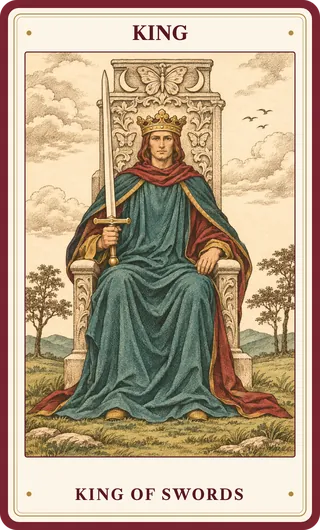
The upright sword
The double-edged blade points to the sky, showing truth that cuts both ways. Reversed, it becomes a question of whether the blade is serving justice or being swung at people.
The throne
He sits in a seat of formal authority, facing the viewer with a steady gaze. Turned upside down, the throne suggests power that has lost its footing or is being clung to too tightly.
Butterflies on the throne
Carved butterflies are a sign of the mind in transformation and a link to the Queen of Swords. Reversed, they hint at thinking that has stopped changing and become rigid.
Clouds and open sky
The sky belongs to the element of Air, the home of thought, words and ideas. Reversed, the weather turns stormy: clouded judgement, mixed messages and mental fog.
Blue tunic and flowing cloak
Blue stands for calm, clear communication and a controlled mind. When the card is reversed, that calm can harden into coldness or slip into confusion.
Bare trees and birds
The windswept trees and a few distant birds show a high, exposed vantage point. Reversed, this is the loneliness of someone who has put distance between their head and their heart.
Is it you or them? How to tell
Because the card can describe someone else or you, it helps to test the reading instead of guessing. These questions work well:
- Who in the situation holds the power, and how are they using it?
- Whose tone has become sharper, colder or more controlling lately?
- Am I the one who cannot decide, or the one who decides for everyone?
- Do I feel afraid to disagree with this person, or do others feel afraid to disagree with me?
- Do the surrounding cards describe my own behaviour or someone else’s?
The position in the spread also helps. In a “you” position, the card is about your own habits. In an “other person” or “outside influences” position, it describes them. In a Celtic Cross, check whether it lands in the “hopes and fears” spot, where it may point to a fear of being judged or of losing control.
Try this: Draw one more card as a clarifier and ask, “What would the upright King of Swords do here?” Write the answer as a single action you can take within a day.
Is the King of Swords reversed a yes or no?
In a yes or no reading, the reversed king leans towards no, or at least “not like this.” The card signals that something is unfair, unclear or not yet thought through. It rarely supports a rushed decision.
If the question is “Will this person treat me fairly?” or “Should I sign this?”, the answer is cautious. If the question is “Should I stay silent?”, the card may say no, since honesty is the king’s gift. For a quick pull, the King of Swords yes or no page gives the upright answer to compare with.
Treat any yes or no as a pointer, not a ruling. The reversed card is more helpful as an invitation to ask, “What would make this fair, clear and honest?”
What the reversed imagery tells you
The Rider-Waite-Smith King of Swords sits on a throne, facing forward, with an upright sword in his hand, a blue tunic, a flowing cloak, a sky of clouds and a few birds. Turn the card over and each element changes tone. The sword that pointed to truth now looks like a threat, or a weapon that has been dropped.
The butterflies carved into the throne are worth noticing. They are a symbol of the changing mind, and they link him to the Queen of Swords. A reversed king has forgotten how to change his mind, or cannot decide which way to turn.
The windswept sky and distant trees make the setting feel high and exposed. That is the loneliness of command, and in the reversed position it becomes isolation: the king who has put such distance between himself and others that nobody can reach him.
Cards that sharpen the meaning
Neighbouring cards tell you which version of the king you are dealing with. A few pairings come up often:
- Five of Swords: conflict where someone wins at others’ expense. See the Five of Swords reversed for the aftermath.
- Ten of Wands: a power-holder who has taken on too much and become short-tempered.
- The Hermit: the quiet-power reading, or someone withdrawing to think.
- Eight of Swords: feeling trapped, either by a controlling person or by your own thinking.
- Justice: a fair outcome is possible if you act with integrity.
Court cards often describe people in the same situation, so read the king alongside the other court cards in the spread. The court cards guide explains how to read them together, and how a King of Swords reversed fits with a Knight or Page of the same suit.
How to bring the king back upright
The reversed King of Swords is a prompt for a repair, whichever side you are on. If you are the tyrant, soften the tone and ask what the other person needs before you correct them. If you are the overthinker, shrink the decision and make a choice. If you are on the receiving end, name the behaviour clearly, document it where it matters and seek support from someone outside the situation.
A simple routine helps:
- Write the facts of the situation, separate from your interpretation.
- Ask what a fair outcome would be for everyone involved.
- Decide on one action and a date for doing it.
- Say what you mean in plain words, without sarcasm or hedging.
Healthy authority has two parts: clarity and care. The upright king has both. When the card is reversed, one of them has gone missing, and your task is to find out which.
Try this: Choose one sentence you have been rehearsing in your head for days. Rewrite it so it is true, brief and kind, then say it or send it today.
King of Swords reversed compared with the upright card
Upright, the card is the wise judge: fair, honest, strategic and trusted. Reversed, it is the same mind and authority without the ethics, or without the confidence. The knowledge is intact, but the way it is used has gone wrong.
This is why the reversal is rarely about lacking intelligence. It is about what intelligence is doing: shielding vulnerability, claiming status, avoiding choices or controlling people. A good reading names that function and gives you a way to redirect it.
If you want to see how this king sits among his suit, from the first spark of an idea in the Ace of Swords to the seeker’s first clumsy attempts in the Page of Swords, the Suit of Swords overview shows the whole path from thought to mastery.
Common mistakes when reading this card
The first mistake is assuming the card is always about someone else. The reversed King of Swords is as likely to describe your own tone or habits as another person’s. Read it with curiosity, not accusation.
The second is treating it as pure negativity. Even in its shadow form, the card holds the same gifts as the upright king: clarity, fairness, honest speech. Reversed, those gifts are blocked, and the reading is about unblocking them.
The third is ignoring the question. A reversed king in a career spread, a love spread and a health spread can say three very different things, so tie the interpretation back to what you actually asked.
Questions readers ask
What does the King of Swords reversed mean in a tarot reading?
It usually means intellect or authority being misused: coldness, manipulation, harsh criticism or controlling behaviour. It can also mean the opposite problem, a mind so tangled in analysis that it cannot reach a decision.
Is the King of Swords reversed a bad card?
It is a warning card rather than a doom card. It shows where logic and power have lost their ethics or their direction, and it gives you the chance to correct course.
Does the King of Swords reversed mean a person is toxic?
It can describe someone who is controlling, cutting or emotionally unavailable, but it can equally describe your own behaviour. Look at the pattern in the situation and your question before deciding who the card points to.
What does the King of Swords reversed mean for feelings?
It suggests the person is guarded, conflicted or hiding behind logic. They may care but struggle to say so, or they may be using distance and sarcasm to stay in control.
Is the King of Swords reversed a yes or no?
Leaning no, or at least not yet. The card points to unfair terms, unclear thinking or a decision that has not been thought through, so pause and check the facts.
How do I fix a King of Swords reversed energy?
Slow down, separate facts from assumptions and ask whether your words are fair as well as accurate. Then make one clear decision, or one honest statement, instead of circling the problem.