
9 of Swords Tarot Card Meaning: Upright and Reversed

- Arcana
- Minor Arcana, Suit of Swords
- Element
- Air
- Yes or no
- No
anxietyworrysleepless nights
confusionrecoveryrelease of mental strain
The 9 of Swords (also written Nine of Swords) is the tarot card of anxiety, worry, guilt and sleepless nights. It shows a person sitting up in bed in the dark, face in hands, with nine swords on the wall behind them. The pain is mental: thoughts that circle, grow and turn on you when you are alone and tired.
It is one of the cards people dread seeing, but it is more useful than frightening. It names something many of us hide, the 3 a.m. kind of fear that feels like fact but often is not. Below you will find what the imagery shows, how the card reads upright and reversed, what it says in love, work, money and health, and what to actually do when it turns up.
9 of Swords at a glance
Here are the core details in one place, so you can find what you need quickly.
- Upright keywords: anxiety, worry, fear, guilt, nightmares, insomnia, mental anguish, despair
- Reversed keywords: releasing worry, recovery, facing the truth, hidden fears, inner turmoil
- Suit and element: Swords, Air (the mind, thoughts and words)
- Number: 9, the near end of a cycle
- Astrology: Mars in Gemini in the Golden Dawn system
- Yes or no: leans no, or not yet
In the Golden Dawn tradition, which shaped the Rider-Waite-Smith deck, this card was called the Lord of Despair and Cruelty. That title is harsh, but the card in practice is gentler than the name. It points to a mind in pain, and almost always to a way out.
What the 9 of Swords card shows
Pamela Colman Smith’s image is simple and very precise. A figure sits upright in bed against a black background, hands covering the face. Nine swords hang horizontally in the darkness above, staggered like bars on a rack. Not one of them touches the person.
That detail is the key to the whole card. The swords are suspended, not stabbing. They represent thoughts, memories, fears and what-ifs, and they feel as dangerous as real blades because the mind treats them that way. The suffering is real, but its source is usually inside the room, not outside it.
The bed itself carries two small clues. The quilt is patterned with roses and astrological signs, so some warmth and meaning is still present. The carved panel on the bed frame shows a figure beaten down by another, which many readers take as an old defeat the mind keeps replaying. A full list of these images appears in the symbols section of this page.
9 of Swords upright meaning
Upright, the 9 of Swords says that worry has taken over. You are probably replaying conversations, imagining worst cases, or carrying guilt that will not settle. It often arrives when something has already gone wrong and your mind keeps rehearsing it, but it also appears when nothing has gone wrong at all, and fear is manufacturing the problem.
The card names two things at once. The distress is real: you are not being dramatic, and the sleeplessness or dread deserves care. And the thoughts are not always accurate: the mind at night is a poor judge of probability. Both statements can be true together, and the card asks you to hold them together.
Another thread is guilt and shame. Many people who draw this card are not frightened of the future so much as haunted by something they did, said or failed to do. If the worry has a “should have” in it, the 9 of Swords is often about conscience, not about danger.
Try this: Keep a pen and paper by your bed tonight. When a swords-thought wakes you, write the exact sentence, then write one fact that supports it and one that does not. Most fears look smaller once they are on paper.
Read Nine of Swords for your question
Upright: Anxiety, jealousy or unspoken fear is eating at the relationship, and the worry is louder than the facts.
Reversed: You start talking honestly about what scares you, and the relationship (or your heart) begins to settle.
Upright: They are lying awake, overthinking, and feeling guilty or afraid about something they may not be saying out loud.
Reversed: Their worry is easing, or they are finally ready to admit what has been weighing on them.
Upright: Work stress has followed you into the night, and dread about performance or job security is draining you.
Reversed: The pressure lifts, or you finally ask for help, set a boundary or face the problem you were avoiding.
Upright: Financial worry is out of proportion to your actual numbers, or the numbers really are frightening and you are avoiding them.
Reversed: You look at the real figures, make a plan, and the dread starts to loosen.
Upright: Stop trying to think your way out at 3 a.m. Write the fears down, tell someone, and check them against facts in daylight.
Reversed: Keep going with whatever is helping you recover, and do not hide the last of the fear because it feels embarrassing.
Upright: Poor sleep, anxiety, low mood or stress-related symptoms need real attention, including professional support.
Reversed: Rest, therapy or treatment is starting to work, though deep-seated worry may still need patient care.
9 of Swords reversed meaning
Reversed, the card usually softens. The worst may be passing, and you may be starting to see the situation more clearly. Sleep improves, the fear loses its grip, or you finally tell someone what has been sitting in your chest. It can mark the first morning after a long bad stretch.
It does not always mean relief, though. Reversed, the 9 of Swords can also show worry pushed down rather than resolved: smiling through it, staying busy, and refusing to look. If the situation around it in the spread feels tense, ask whether you are calm or just quiet. For a full breakdown by area of life, see Nine of Swords Reversed.
If you are newer to reversals, they do not flip a card into its opposite. They usually soften, block or turn the energy inward, and our guide to reading reversed cards explains how to decide which one applies in your spread.
9 of Swords in love
In a love reading, the upright 9 of Swords points to anxiety in the relationship. That may be fear of being left, suspicion without proof, guilt over a mistake, or a conflict nobody has said out loud. The feelings are heavy, but the card often says the fear is running ahead of reality.
If you are in a relationship, ask what you are not saying. This card thrives on silence. A conversation that feels terrifying at night often looks manageable at the kitchen table. It can also point to grief after a breakup, when hindsight and regret replay every detail.
If you are single, the card usually describes your own mind more than a partner. It can show anxious attachment, fear of being hurt again, or a habit of imagining rejection before anyone has said no. Reversed in love, it suggests honest conversations, reassurance and trust slowly returning.
9 of Swords as feelings and what someone thinks of you
When this card describes another person’s feelings, it shows someone who is troubled and mentally overloaded. They may care a great deal, and that care may be the source of the worry. They may also be dealing with guilt, secrets or stress they have not shared with you.
Do not assume the distress is about you. The 9 of Swords often reflects a person absorbed in their own anxiety, which can make them withdrawn, irritable or hard to reach. It does not by itself say they have stopped caring.
As a person, the card can describe someone who lies awake over everything, over-apologises, or carries heavy responsibility alone. Gentle questions and patience work better than pressure.
9 of Swords in career
At work, the 9 of Swords describes stress that has outgrown the office. You may be dreading Monday, fearing a layoff, replaying a mistake, or feeling like an impostor who is about to be found out. Burnout is a common shadow here.
The card does not say you will fail. It says the pressure on your mind is out of balance with what you can sustain. Look at your workload honestly, name the specific fears (a deadline, a manager, a skill gap), and decide which are real problems and which are noise.
Reversed, it suggests the pressure is easing, or that you are finally asking for help, taking leave or setting a limit. If you are job hunting, it can show interview anxiety that needs preparation more than reassurance.
9 of Swords in money
In a money reading, the 9 of Swords is financial dread. That may be debt you avoid looking at, a drop in income, or a general feeling that there will never be enough. The key question is whether the fear matches the numbers.
Sometimes the answer is yes, and the card is asking you to face a real problem. Often the anxiety is bigger than the reality, and a clear budget or a call to a lender or adviser shrinks it a lot. Either way, avoiding the figures feeds the fear.
Reversed, it shows that you have started to look, to plan and to talk to someone. Compare it with the steadiness of the Four of Pentacles if you want to see how a calmer relationship with money reads in a spread.
9 of Swords and health
Health is where this card needs to be taken most seriously. It speaks of insomnia, anxiety, low mood, panic and stress-related symptoms. The message is that mental health is health, and that “just stop thinking about it” is not a plan.
A tarot card cannot diagnose anything, and this one is not a substitute for care. If worry, sleeplessness or dark thoughts are affecting your daily life, talk to a doctor or a mental health professional. If you ever feel unsafe or think about harming yourself, contact local emergency services or a crisis line right away. In the United States you can call or text 988.
Reversed, the card points to recovery, rest and treatment starting to help. It can still show that old worries linger, so keep up the support that is working.
Is the 9 of Swords a yes or no card?
The 9 of Swords usually leans no, or at least not yet. Fear is distorting the question, so an answer drawn now would reply to your dread rather than your situation. Reversed, it softens toward a tentative yes once the panic has settled.
A useful way to use it: treat the card as telling you the timing is poor for a big decision. Sleep, talk to someone you trust, check the facts, and ask again later. Our dedicated 9 of Swords yes or no page covers how it answers in different kinds of questions.
Nine of Swords card symbols
Choose a symbol to read what it means on the card.
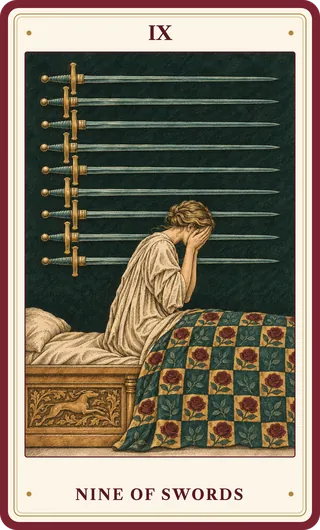
The seated figure
The person sits bolt upright in bed, having woken from sleep or never slept at all. The posture shows alarm, not collapse: the mind is wide awake and running.
Hands over the face
Covering the face shows grief, shame and a wish to shut out what is in the mind. It also shows the person is alone with this, with nobody else in the frame.
Nine swords on the wall
The swords hang in a staggered row in the dark, above the person, not in the body. They are thoughts, fears and memories that feel sharp, yet none has actually struck.
Black background
The darkness is the night itself, and also the narrow view fear creates. Everything outside the bed has dropped out of sight.
The rose and zodiac quilt
The blanket carries red roses and astrological symbols, hinting at love, passion and the larger patterns of a life. It is a small comfort sitting right beside the distress.
The carved bed panel
The bed frame shows a carved scene of one figure overcome by another. It suggests an old defeat, loss or injury that the mind keeps replaying.
The bed
A bed is meant for rest and safety, which makes the scene a sharp contrast. The danger here is not outside the room.
Spiritual meaning: the dark night
Spiritually, this card is often linked to the dark night of the soul, a stretch when meaning feels absent and the mind turns on itself. It is a lonely time, but the tradition around it is that it passes and often clears the ground for something truer.
There is also a quieter spiritual reading. The figure is awake. Waking in the dark is uncomfortable, but it is also a moment of honesty, when the busy self drops away and what has been avoided arrives. The card invites you to meet that without self-punishment.
Practices that suit this card are grounding ones: slow breathing, journaling, prayer or meditation if you use them, time outside, and speaking to a trusted person. Nothing grand is needed, only a way to bring the mind back to the body and the present room.
9 of Swords vs 10 of Swords and 8 of Swords
These three neighbours in the suit are often confused. The 8 of Swords is feeling trapped, with the mind building bars that seem real. The 9 of Swords is anguish and dread, with the swords overhead. The 10 of Swords is the painful ending itself, after which nothing more can fall.
Put simply, in the 8 of Swords you cannot see the way out, in the 9 of Swords you cannot stop the thoughts, and in the 10 of Swords the worst has happened and recovery can begin. If you draw the 9, you are often being told the cycle can still be interrupted, before it reaches that third stage.
The 9 also differs from grief cards. The Three of Swords is heartbreak caused by a specific event, while the 9 is the sleepless aftermath, or the dread before one.
9 of Swords in past, present and future positions
In the past position, it shows a time of anxiety, guilt or sleeplessness that still shapes how you react. Look for what you learned and what you have not yet let go of.
In the present, it says that worry is the main weather right now. Check the neighbouring cards for the cause and for any help on offer. In the future position it is a heads-up rather than a sentence: a stressful period may be ahead, so build your support and coping habits early.
As an outcome card, it warns that unchecked worry or secrecy leads to mental strain. It is a call to act while there is still time, and rarely a prediction that disaster will arrive.
9 of Swords card combinations
Neighbouring cards tell you where the anxiety comes from and what could ease it. A few common pairings:
- With The Devil: worry tied to compulsion, addiction or a habit you feel unable to break
- With the Eight of Swords: feeling trapped by your own thinking, with little sense of a way out
- With the Three of Swords: grief and heartbreak feeding the sleepless nights
- With The Star: hope arrives, and healing is possible after the dark hours
- With the Four of Swords: the need for real rest, retreat and recovery
For a wider look, our guide to the Star shows the card that most directly answers this one. Reading the 9 of Swords alone is fine, but pairs add useful context.
What to do when you draw the 9 of Swords
The card is a prompt, so respond to it practically. You do not need to fix everything. You need to interrupt the loop.
- Name the worry in one clear sentence, in writing.
- Separate what is a fact from what is a fear or a guess.
- Tell one person you trust what you have been carrying.
- Do one small, concrete thing today about the part you can influence.
- Protect your sleep: screens off earlier, a steady routine, and professional help if it persists.
If you drew it for a decision rather than for your state of mind, wait for a calmer moment before acting on anything. A sound choice rarely survives being made at 3 a.m.
Try this: Pull the 9 of Swords and sit with the image for two minutes. Then ask, “Which sword is actually real?” Choose one thing you can act on this week and write down the first step.
9 of Swords numerology, element and astrology
Nine is the last single digit, a number of nearly finished cycles. In the Swords suit it shows the mind close to the end of a hard run, which is why the card can mean both peak distress and the edge of release. The 10 comes next, and with it a clear break. You can read more about how digits shape each card in our guide to tarot numerology.
The suit of Swords belongs to Air: thought, language, logic and conflict. The 9 of Swords is Air at its most turned in, intelligence working against its owner. The Golden Dawn linked it with Mars in Gemini, a restless mind driving itself hard. For all the other cards in the suit, see the Suit of Swords.
Modern readers sometimes add that this card suits late-night readings and moon cycles, but these are personal practices rather than core meaning. The strongest thing you can bring to the card is honesty about what keeps you awake.
Common misreadings of the 9 of Swords
The first mistake is reading it as a death or disaster card. Waite’s older notes mention death, failure and loss, but modern practice reads it mostly as mental suffering, and the swords never touch the figure.
The second is dismissing it as “just overthinking.” Some of what keeps people up is real: debts, illness, a dying relationship. The card asks you to check each worry rather than wave them all away.
The third is assuming reversed means fixed. Reversed can mean release, but it can also mean denial. Tone, position and surrounding cards help you tell which.
Try this: Next time the card appears, ask it two questions in a row: “What am I afraid of?” and “What do I actually know?” Draw one card for each and compare the answers.
Questions readers ask
What does the 9 of Swords mean in tarot?
The 9 of Swords means anxiety, worry, guilt and sleepless nights. It shows a mind that has turned on itself, usually in the dark when there is nothing to distract you from your fears.
Is the 9 of Swords a bad card?
It is an uncomfortable card, but not a doom card. It describes mental suffering that is real yet often larger in the mind than in the facts, and it appears so you can deal with it before it grows.
What does the 9 of Swords mean reversed?
Reversed, it can mean the worst of the anxiety is passing, or that you are finally facing and speaking about what frightened you. It can also mean worry is being buried, so check whether it is relief or suppression.
Is the 9 of Swords a yes or no card?
Usually it leans no, or at least not yet, because fear is distorting the question. Treat the answer as 'calm down and gather facts first' rather than a final verdict.
What is the difference between the 9 of Swords and the 10 of Swords?
The 9 of Swords is suffering inside the mind, with the swords still hanging overhead. The 10 of Swords is the painful ending itself, after which the only way forward is up.
What does the 9 of Swords mean for someone's feelings?
It points to a person who is anxious, guilty or consumed by worry, often about the relationship or about something they feel unable to say. Their distress is usually about their own fears more than about a lack of care.