
Nine of Swords as a Yes or No Answer

- Arcana
- Minor Arcana, Suit of Swords
- Element
- Air
- Yes or no
- No
anxietyworrysleepless nights
confusionrecoveryrelease of mental strain
The Nine of Swords is a No in a yes or no reading when it appears upright. It is the card of anxiety, guilt and sleepless nights, and in answer to a question it usually says not now, not like this, or not while fear is making the decision. Reversed, it softens to a cautious Maybe, because the worst of the dread is lifting even if the matter is not settled.
The important detail is what this no is about. The Nine of Swords describes the state of your mind more than a fixed outcome in the world. It is a signal to slow down, look at the worry directly and then ask again. This page covers how to read the answer upright and reversed, how it changes by question, and what to do when it turns up.
Why the Nine of Swords leans no
Yes and no answers in tarot come from the general feel of a card. Cards with momentum, openness and growth lean yes. Cards with blockage, loss or delay lean no. The Nine of Swords shows someone sitting up in bed in the dark, face in their hands, with nine swords hanging on the wall behind. Nothing in that picture is moving forward.
It also belongs to the suit of Swords, which rules thought, language and judgment. Nine is the number of near-completion, so the card sits right before the final, hardest swords card. Here the mind is at its most overloaded. A question asked in that state tends to get a no, because a clear yes needs steady footing and this card has none.
If you want the full picture of the card beyond its yes or no answer, the Nine of Swords meaning page covers it in depth. Here the focus is on how to use it when you need an answer.
What the no actually means
Many people pull the Nine of Swords and assume the answer is a warning that something terrible will happen. That is a misreading. Look again at the image: the swords are on the wall, not in the bed. The person is hurting, but nothing has struck them. The card points to suffering created by fear, guilt and overthinking.
So the no is best heard as one of three messages. The first is “not yet”, because you are too stressed to judge well. The second is “not from this fear”, because the thing you want may be fine but the reason you want it is panic. The third is “not what you imagine”, because the situation is less bleak than the 3 am version in your head.
This is why the card works better as a reading of your inner weather than a ruling on fate. A no from the Nine of Swords still deserves respect. It just asks you to deal with the worry before acting on the question.
Nine of Swords reversed as a yes or no
Turned upside down, the card changes direction. The swords fall away from the wall and the person is waking up, still tired but no longer trapped in the nightmare. In a yes or no reading, the reversed Nine of Swords leans Maybe, with a gentle tilt toward yes as time passes.
Why not a plain yes? Because recovery is gradual. The anxiety is easing, but old fears can come back, and a reversed card can also mean someone is hiding or suppressing their worry instead of dealing with it. If your instinct says the calm feels fragile, trust that and treat the answer as “not yet”.
The reversed Nine of Swords is a good moment to ask again after a few days of rest and a clearer head. For more on how reversals work in general, see how to read reversed tarot cards, and for the full meaning of this one, read Nine of Swords reversed.
Read Nine of Swords for your question
Upright: No, at least not yet: anxiety, jealousy or guilt is driving the question, so the relationship cannot answer cleanly until the worry is faced.
Reversed: Maybe: the fear is loosening and a calmer, more honest conversation is possible, but it is not finished.
Upright: They, or you, are lying awake with worry, guilt or dread, which makes a confident yes unlikely right now.
Reversed: The anguish is easing and feelings are settling, though old fears may still flare up.
Upright: No for now: stress, self-doubt and overwork are clouding the decision, so wait until you can think straight.
Reversed: Maybe: burnout is lifting and you can reassess the role with a clearer head, ideally after rest.
Upright: No while you are acting from panic: the fear about money is louder than the facts, so check your real numbers first.
Reversed: Maybe: you are facing the figures and the dread is shrinking, which makes a sensible plan possible.
Upright: Pause, name the worry, and ask someone you trust before you decide anything.
Reversed: Keep going with whatever is helping you recover, and ask for support if the worry returns.
Upright: Stress and poor sleep are the theme, so treat rest and support as the priority (and see a professional for persistent symptoms).
Reversed: Recovery is under way: sleep, calm and perspective are slowly returning.
How the answer shifts by question type
The core answer stays the same, but the flavour changes with the topic. A question about love brings up insecurity. A question about work brings up pressure. A question about money brings up scarcity fears. Matching the card to the subject helps you give a more useful reading than a bare “no”.
Reading the card well means asking what exactly is being worried about. The following sections go through the most common areas. In each case the card is describing the mental state around the question, and that is where the useful advice sits.
Love questions
Ask “Will they text me back?” or “Is this relationship right for me?” and the Nine of Swords says no, mainly because jealousy, guilt or overthinking is steering the question. It rarely means the relationship is doomed. More often it shows that a worry is eating at you and has not been said aloud.
If the question is about a new connection, the card suggests the situation is not clear enough yet. If it is about a long relationship, it points to an unspoken fear that needs a calm conversation. Reversed, it suggests the anxiety is easing and an honest talk is now possible.
Career and money questions
For “Should I take this job?” or “Will I get the promotion?”, the upright card says no for now. Stress, self-doubt or overwork has taken over, and a big decision made at this point is likely to be reactive. It is also common for this card to appear around burnout.
For money, the Nine of Swords says no to acting out of panic: borrowing in a rush, selling at the bottom, or making a large purchase to feel better. Check the real numbers first, because the fear is almost always bigger than the facts. Reversed, you are facing the figures at last, and a measured plan is possible.
Health and sleep questions
Tarot cannot diagnose anything, and no card should replace medical advice. In health readings the Nine of Swords usually points at stress, anxiety and poor sleep. As a yes or no, it says no to pushing through and yes to rest and support.
If worry or insomnia has become constant, speaking to a doctor or therapist is the practical reading of this card. The image itself shows someone alone in a room, and the card is asking you not to stay that way.
Try this: Before you pull a card, write your worry in one plain sentence. Then write the same question without any fear in it. Pull again for the second version and compare the two answers.
When the Nine of Swords can lean toward yes
There are a few situations where the card can read as a soft yes. They all involve the question being about the anxiety itself, instead of an outcome that the anxiety might distort. In these cases the card is confirming what you suspected: that you are carrying something heavy and it is time to deal with it.
Examples include:
- “Should I talk to someone about how I have been feeling?”
- “Should I confess what I have been feeling guilty about?”
- “Is it time to stop ignoring this?”
In these cases, the card says yes to facing the fear and no to carrying on in silence. The wording of your question decides which reading is right. If you ask about the situation, you get the mood around it. If you ask about the worry, the card can give you real guidance.
How to ask so the card answers the question, not the fear
The Nine of Swords often shows up when the question itself is anxious. “Will I be okay?” and “Did I ruin it?” are questions asked at 3 am, and the card reflects exactly that. Better questions are narrow, factual and tied to a single choice.
Compare “Will everything go wrong if I take this job?” with “Is accepting this job offer a good decision for me this month?” The second is easier to answer and less likely to return the Nine of Swords for emotional reasons. A single decision, a clear time frame and a question you can act on all help. If you want help with wording, the questions for tarot reading page has plenty of examples.
Ask once, and avoid asking the same question over and over in the same sitting. Repeated pulls feed the anxiety loop that the card is describing, and the first card is usually the honest one. If you want a simple tool for quick answers, the yes or no tarot reading page is built for it.
Reading it with neighbouring cards
In a spread, the cards around the Nine of Swords change how firm the no is. A supportive card can turn the answer from a hard no into “not yet”, while a heavy card can confirm the situation really is difficult. Read the cards as a short story, not as separate votes.
- Sun, Star or Temperance: the worry is passing and the answer improves with time.
- Ace of Swords: a clear, honest thought cuts through the fog, and the answer shifts toward yes once you see the truth.
- Three of Swords or Five of Cups: real grief sits under the worry, so the no is softer but more emotional.
- Eight of Swords or Two of Swords: you are stuck in indecision, and the answer is “not until you stop freezing”.
- Ten of Swords: the low point has arrived, and the card is telling you the worst is behind you.
If you see it next to the Ten of Swords, the pattern is a familiar one: the dread of the Nine often comes right before the ending of the Ten. That ending is a relief as much as a loss, because the fear finally has nowhere left to grow.
Nine of Swords card symbols
Choose a symbol to read what it means on the card.
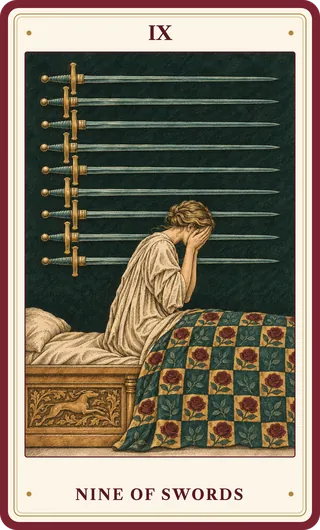
Figure sitting up in bed
The person has just woken from a nightmare, or cannot sleep at all. It shows that the suffering is happening inside the mind, in the quiet of the night.
Hands covering the face
The hands hide the eyes and show grief, shame or exhausted dread. They also show that the person is cut off from help and from a clear view of the situation.
Nine swords on the black wall
The swords hang in a neat row above the bed, yet nothing touches the sleeper. They stand for thoughts that feel sharp and dangerous but are not physically pressing down.
Black background
The dark wall is the 3 am mood: everything looks bigger and bleaker at night. Morning light changes how the same problems look.
Quilt of roses and zodiac signs
The patchwork cover is made with roses and astrological symbols, hinting at love, care and the larger patterns of life. It suggests comfort and perspective are still within reach.
Carved bed panel
The carving shows one figure defeated by another, an image of struggle and loss. It points to a painful memory or guilt that feeds the worry.
White bedsheets and bare room
The plain, empty space shows isolation, with no one else in the picture. It reminds you that the first step out of this card is reaching toward another person.
Using it in a three-card yes or no spread
A single card is quick, but the Nine of Swords is a good example of why a short spread is more reliable. Because the card describes a state of mind, one card can leave you with an answer to the wrong question. A three-card spread lets you separate the worry from the situation.
Try these positions: the first card is what you are afraid of, the second is what is actually true about the situation, and the third is the best next step. If the Nine of Swords lands in the first position, it is simply naming the fear, and the answer depends on the other two cards. If it lands in the second, the situation really is heavy. In the third, it is advice to stop and rest.
Try this: Draw three cards and name them Fear, Fact and Next step. If the Nine of Swords is the fear card, treat the other two cards as your real yes or no.
What the symbols in the picture say about the answer
The imagery explains the no better than any list of keywords. The black wall and the figure alone in bed place the scene in the middle of the night. The nine swords are lined up neatly, and nothing is pressing on the sleeper. The cause of pain is thought, not an attack.
The quilt is covered in roses and zodiac signs, a small detail of beauty and cosmic order that suggests comfort is still available. The carved panel on the bed shows a scene of struggle, which many readers connect to guilt over something in the past. Together these details say that the problem is real to the person experiencing it, but it is rooted in the mind and can be eased.
For a yes or no, that matters: you are not being told the door is locked. You are being told you cannot see the door right now.
Common mistakes with this card
The first mistake is treating the no as permanent. The Nine of Swords describes a moment, and moments pass. If you ask the same question a week later after sleep and some distance, the answer may change entirely.
The second mistake is ignoring the card because it feels unwelcome. People sometimes redraw until they get a card they like, which defeats the purpose. The third is reading it as a prediction of external disaster. Nothing in the image suggests an event is about to strike, only that the mind is turning small things into huge ones.
A fourth mistake is overlooking your own bias. If you walked into the reading already frightened, the card is mirroring you. That is useful information, but it means the answer applies to your state, not necessarily to the other person or the outcome.
What to do after you draw it
The Nine of Swords is practical once you stop reading it as a verdict. A short, simple routine can turn the no into progress.
- Write down exactly what you are afraid of, in one or two sentences.
- Separate what is known from what you are imagining.
- Tell one trusted person, or write it out in a letter you do not send.
- Sleep, eat and move before making the decision.
- Return to the question in a few days with a narrower version.
This works because the card is a call for self-compassion, not action. Often the question you asked becomes much easier once the pressure is gone, and sometimes the answer changes from no to yes without anything outside you changing.
Should you pull again?
Usually not on the same question, at least not straight away. A second draw rarely adds clarity when you are anxious, and it tends to turn into bargaining with the deck. If the first answer was no and you are unsure, give it a day.
A better approach is to draw a different kind of card: one for what you need right now, or one for what the worry is hiding. You could also pull a card for the situation once you feel calmer, such as one from the suit of Swords to explore the thinking behind it. The aim is to deepen the answer, not to overturn it.
Quick reference
Upright, the Nine of Swords says No or “not yet”, because anxiety and guilt are in charge of the question. Reversed, it says Maybe, with a slow lean toward yes as the worry fades. In every case, it describes a mind under strain more than a future event.
Take the answer seriously and gently. Name the fear, give yourself rest, and then ask again with a clearer question. The card shows the darkest hour of the night, and the next part of the picture is morning.
Questions readers ask
Is the Nine of Swords a yes or no card?
Upright, the Nine of Swords is a no, or at least a not yet. It describes anxiety and dread around the question, and a decision made from that state is rarely a good one. Reversed, it softens to a maybe.
Does the Nine of Swords mean something bad will happen?
Usually not. The card shows the pain of worrying, not a disaster arriving from outside. A no here often means the fear is distorting the situation, not that the outcome is doomed.
What does the Nine of Swords reversed mean as a yes or no?
Reversed, it leans toward a cautious maybe. The anxiety is easing and recovery has started, but the situation is not fully clear yet. Ask again once you feel calmer.
Can the Nine of Swords ever mean yes?
Occasionally, when your question is about ending the worry itself, such as seeking support, speaking up or letting go of guilt. Then the card can read as a yes to facing the fear. For ordinary questions about outcomes, it stays a no.
Should I redraw if I get the Nine of Swords for a yes or no question?
It is better not to redraw the same question. Instead, rephrase it to be more specific or draw a second card for what is behind the worry. The first answer is useful information about your state.
How does the Nine of Swords answer love yes or no questions?
It leans no, because jealousy, insecurity or guilt is clouding the situation. It rarely means the relationship is over. It says the worry needs to be spoken about before you can get a trustworthy answer.