
Nine of Swords Reversed: Meaning in Love, Work & Life

- Arcana
- Minor Arcana, Suit of Swords
- Element
- Air
- Yes or no
- No
anxietyworrysleepless nights
confusionrecoveryrelease of mental strain
The Nine of Swords reversed means that mental anguish is starting to loosen its grip. Anxiety, guilt and sleepless worry are easing, a fear is being faced, or you are finally letting someone help. It can also mean the opposite side of the same coin: distress that is being hidden, so that nobody around you knows how much you are carrying.
That double meaning is what makes this card worth reading carefully. Upright, the Nine of Swords is a person sitting up in bed in the dark, overwhelmed by their own thoughts. Reversed, the story moves on. The question becomes what happens next: does the person lie back down and rest, or do they stay sitting there alone with the swords on the wall? If you want the starting point first, the upright Nine of Swords explains the original scene.
What the Nine of Swords reversed means in general
The core message is relief that is still being earned. The Nine of Swords reversed rarely says the problem has vanished. It says the way you relate to it is changing. The thoughts that kept you awake are being questioned, talked about, treated or simply outlasted, and the picture they paint is becoming less extreme.
Common keywords are recovery, release, facing fears, asking for support, and shame or guilt that is starting to lift. Many readers also connect it to the end of a rough patch, where you can see a little light for the first time in a while.
There is a second, quieter reading. Reversed Swords often point inward, so this card can describe worry that is repressed rather than resolved. You smile at work, say you are fine, and lie awake at 3 a.m. with the same thoughts. Both readings are valid. The skill is deciding which one fits your situation, and the later sections show how.
Reading the image upside down
The Rider-Waite-Smith scene is stark: a figure with their face in their hands, nine swords on a black wall, a bed with a carved panel and a quilt of roses. Turn it over and the first thing to notice is that the swords are not in the bed. They are hung on the wall, a row of thoughts rather than actual injuries. Reversed, this is the part of the picture that matters most, because it suggests the threat is smaller than it feels.
The roses and zodiac symbols on the quilt are easy to overlook. They say that love and a larger pattern are present even in the worst night. In a reversal, that comfort becomes available: a friend answers the phone, a therapist helps you sort the thoughts, or you simply notice that the morning came again.
The carved panel at the foot of the bed, with one figure overcome by another, points to an older wound. When the card is reversed, ask whether that old story is being rewritten or whether you are still letting it narrate the present. Those two options map onto the two main readings of the card.
Easing or hidden: which reading applies?
Think of the card as asking one question: is the pain being released or being buried? Several clues in a reading help you tell.
- Easing: the surrounding cards are calmer (Temperance, the Star, Four of Swords, Six of Swords), or the question is about recovery, therapy, a decision finally made, or news that resolves a worry.
- Hidden: the nearby cards involve secrecy or withdrawal (Seven of Swords, the Hermit, Two of Swords, the Moon), or you are reading for someone who says they are fine but does not look it.
- Mixed: you feel better in daylight and worse at night, or better in one area of life and worse in another. This is common and normal.
A useful test is to ask yourself what changed. If something real has shifted, such as a conversation, a diagnosis, a payment, a decision, then easing is likely. If nothing has changed except that you stopped talking about it, the hidden reading is more honest. For the general principle behind this, see how to approach reversed tarot cards.
Try this: Write down the three thoughts that visit you most at night. Next to each, write one fact that supports it and one fact that does not. Notice how many of the swords are still hanging after that.
Read Nine of Swords for your question
Upright: Relationship anxiety, jealousy and midnight overthinking about whether the bond is safe.
Reversed: Fears are easing and being spoken aloud, or they are being hidden from a partner and growing in private.
Upright: They care deeply and feel anxious, guilty or afraid of losing you.
Reversed: They are calming down and working through old worries, or masking how distressed they really are.
Upright: Dread, burnout and a mind that replays every possible work failure.
Reversed: Job stress is lifting as you get support and perspective, or you are pushing through exhaustion in silence.
Upright: Sleepless worry about bills, debt or a financial mistake.
Reversed: The panic is fading and a plan is forming, or avoidance is keeping you from looking at the numbers.
Upright: Name the fear, then check it against facts and tell someone you trust.
Reversed: Keep going with whatever is helping, and stop hiding your struggle from people who can support you.
Upright: Insomnia, panic, nightmares and a nervous system stuck on high alert.
Reversed: Slow recovery, better sleep and treatment starting to work, or distress that needs proper help.
Nine of Swords reversed in love
In a relationship reading, this card often describes fears about the bond starting to quiet. Maybe you have stopped replaying an argument, stopped checking their phone for reassurance, or finally had the conversation you were dreading. Because Swords rule communication, the healing here usually arrives through words: saying the worry out loud, hearing the other person’s side, and discovering that the reality is less frightening than the story in your head.
The reversal can also show that one or both of you are hiding anxiety. A partner who says “nothing’s wrong” while lying awake, or you swallowing jealousy because you do not want to seem needy, fits this version. Here the advice is to say the true thing, gently, before it turns into distance.
If you are single, the card often points to healing from a past breakup or betrayal and learning to trust again. You may be getting ready for something new, but the card does not promise a person is about to appear. It describes readiness, not a delivery date. If you are asking about an ex, treat it as a prompt to ask whether you are missing them or missing relief from the anxiety.
The Nine of Swords reversed as feelings
When you ask what someone feels about you, the reversed Nine of Swords suggests they have been anxious and are now calming down. They may have worked through guilt, fear of rejection, or confusion about where you stand. It can be a sign that they are becoming more open and more able to show up, especially if the cards beside it are warm.
It can also mean they feel a lot and are not saying it. This person is not cold, but they may be overwhelmed, ashamed or afraid of making things worse. The card does not show a lack of feeling. It shows feeling that is stuck behind worry.
As your own feelings, it describes a growing sense of release. Old fears about a relationship, or about yourself within one, are losing their charge. If instead you feel the card is accurate in a heavier way, take that seriously and consider talking to someone you trust.
Nine of Swords reversed in career
At work, the card shows pressure that is finally starting to shift. The deadline you were dreading passed, the conversation with your manager went better than expected, or you learned that the mistake you obsessed over was small. It can also show a person who has found a more sustainable way to work after burnout.
The reversed card often reveals that the fear was bigger than the facts. Many people with this card have been catastrophising: rehearsing being fired, being exposed as a fraud, or letting the team down. When the mind quiets, the practical question becomes clear. What can actually be done, and who can help with it?
The hidden reading shows up as a person who looks composed in meetings and is quietly exhausted. If that is you, the card is a nudge to tell someone, whether a trusted colleague, a mentor or a doctor. It can also point to a toxic workplace that is feeding the anxiety, in which case relief may require a change of situation, not more coping. The Eight of Cups can be a helpful companion if walking away is on the table.
Nine of Swords reversed in money
Financial anxiety is a classic Nine of Swords theme. Reversed, it usually means the panic is peaking and passing. You have looked at the numbers, made a plan, called the creditor, or realised the situation is manageable. The relief often comes from facing the problem rather than from the problem vanishing.
The shadow side is avoidance. Not opening the post, not checking the account, not telling a partner about the debt: this is how worry turns into a secret. If the card feels like that, it is asking you to look, because the fear of the unknown is nearly always worse than the number.
For a clearer picture, pair it with practical cards. An Ace of Pentacles nearby suggests a fresh, workable start, while a Five of Pentacles suggests the hardship is real and support is needed. As with all Swords, the card describes your mind about money more than the money itself.
Health and mental wellbeing
Tarot is not a diagnostic tool and should never replace medical or mental health care. With that said, the reversed Nine of Swords is often read as recovery from anxiety, insomnia, nightmares or a depressive spell, especially when treatment, rest or support is in place. It is a card of therapy breakthroughs, better sleep and the first good week after a bad month.
It can also describe the opposite: symptoms that are being suppressed, masked or left untreated. If the card lands on a time when you are struggling to sleep, having panic attacks, or feeling hopeless, treat that as a sign to reach out to a doctor, a counsellor or a crisis line in your area. You do not have to wait until it is unbearable.
Gentle practical steps fit the card well: a regular sleep routine, writing worries down before bed, moving your body, cutting back on late-night scrolling, and telling one person the truth about how you are doing.
Spiritual meaning and the night
Spiritually, the Nine of Swords reversed is the dark night beginning to end. It speaks to the moment after a crisis of faith, grief or identity, when you stop fighting the thoughts and start to understand them. Many people find it appears when they begin meditation, therapy, journaling or shadow work.
It also carries a lesson about the mind as a storyteller. The nine swords are the same image repeated, a row of similar thoughts. Reversed, the card invites you to notice repetition: how many of these fears are really the same fear in different clothes?
Dreams are part of the card’s territory. A reversed Nine of Swords can mark a change in dreams, such as fewer nightmares or a recurring dream finally shifting. Keep a notebook by the bed if that interests you, and see which symbols repeat.
Try this: Before sleep, write one line about the worry you are carrying, then one line about the first small action you will take tomorrow. Close the notebook. The job of the pen is to hold it so your mind does not have to.
Nine of Swords card symbols
Choose a symbol to read what it means on the card.
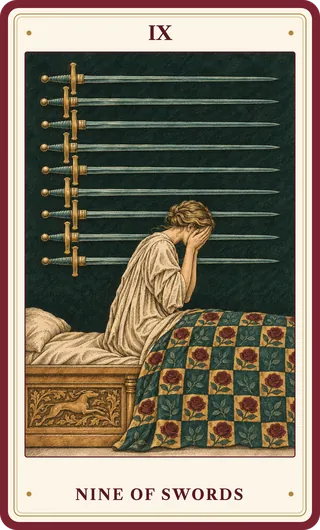
Figure sitting up in bed
The person has just woken from a nightmare and is sitting upright in the dark. Reversed, this is the moment the spell starts to break: either they lie back down and rest, or they keep sitting there alone.
Hands covering the face
The hands show shame, exhaustion and the instinct to hide. Reversed, they can be lowering as someone finally lets themselves be seen, or pressing harder as the worry goes underground.
Nine swords on the black wall
The swords hang in a row, floating above the bed rather than touching the sleeper. They stand for thoughts that feel like blades but are not yet wounds, which is why facing them often shrinks them.
Black background
The dark space is night, the hour when worries are loudest. Reversed, it hints at dawn approaching, though the sky in the picture itself stays dark.
Quilt of roses and zodiac signs
The blanket is stitched with roses and astrological symbols, a sign of love, comfort and a bigger pattern. It reminds you that care and support are already in the room, even when the mind insists otherwise.
Carved bed panel
The carving at the foot of the bed shows one figure defeated by another. It points to an old struggle or a past hurt that still shapes how the present feels.
Bed and bare room
The bed is the place of rest and the place where worry gets loudest. Reversed, it asks whether this space is becoming safe again or whether you are still lying awake.
The Nine of Swords reversed as advice
As advice, this card says: stop carrying it alone. It encourages you to say the worry aloud, ask for perspective, and let go of self-punishment that is not helping anyone. The reversed Nine does not demand positive thinking. It asks for honest thinking, with some kindness in it.
Here are a few practical readings of the advice, depending on the situation:
- If you are recovering, protect what is working, such as routine, support and rest, and do not rush back to full speed.
- If you are hiding, choose one safe person and tell them one true sentence about how you are.
- If you are spiralling, separate fact from fear on paper and act only on the facts.
Notice also that the card is not telling you to power through. Pushing past exhaustion is the hidden version of the Nine of Swords, and it rarely ends well. The Nine of Wands shows what that stubborn endurance looks like in a different suit.
The Nine of Swords reversed as a person
As a person, the reversed Nine of Swords often describes someone in recovery: working through anxiety, grief or trauma and learning how to cope. They may be sensitive, thoughtful and self-critical, someone who has learned the hard way how loud the mind can get.
It can also describe a person who hides their struggles. They seem reliable and calm, yet they do not ask for help, and they are likely to say “I’m fine” before you have finished asking. If this is someone in your life, patience and low-pressure kindness will do more than advice.
If the card represents you, it is worth asking which of those two people you are today. Neither is a failing. Both are human.
Is the Nine of Swords reversed a yes or no?
For yes or no questions, the card leans towards a soft yes when the question is about relief, healing or an end to worry. “Will this anxiety ease?” or “Am I recovering?” gets a cautiously positive answer. It tends towards no or maybe when the question is “Is everything fine?” and you suspect the real answer is being avoided.
Because Swords deal with thoughts, the card is not great at predicting external events. It is better at telling you about your state of mind and what that state is doing to the situation. For a quick pull on a simple question, the Nine of Swords yes or no page gives a fuller breakdown.
How the Nine of Swords reversed fits with other cards
Neighbouring cards decide the tone. Here are some common pairings:
- With the Four of Swords or Temperance: genuine rest and recovery. The Four of Swords especially shows the body and mind taking the break they need.
- With the Ten of Swords reversed: you are coming out of a painful ending, and the aftershock of anxiety is easing. See the Ten of Swords reversed for what the recovery looks like.
- With the Eight of Swords reversed: you are freeing yourself from a mental trap, and the fear that went with it is following. The Eight of Swords reversed covers that release.
- With the Moon or Seven of Swords: hidden worry, avoidance or secrets. The anxiety may be real but unspoken.
- With the Star: hope returns after the worst of it, often slowly and with a feeling of being cared for.
In a 3 card tarot spread, try the Nine of Swords reversed in the middle position to see what is being released or hidden, with the past card showing what triggered it and the future card showing what comes next.
Nine of Swords upright versus reversed
Upright, the card is the nightmare itself: panic, dread and a mind that will not stop. Reversed, it is the morning after, or the next night when the dread arrives a little softer. The suffering is real in both, but in a reversal you are no longer at the very bottom of it.
The other difference is visibility. Upright, everyone can tell you are struggling, and the card has a raw honesty. Reversed, the struggle may be more private, either because you are healing quietly or because you are hiding. That is why the reversed card needs more context to read than the upright one.
If you want to compare the two sides, read the upright meaning on the Nine of Swords page and the reversal here, then notice which keywords feel closer to your own situation today.
Questions to ask yourself when it appears
A reversed card works best when you answer it honestly. Here are a few questions that fit the Nine of Swords reversed well:
- What is the worry that has been waking me up, and what is the smallest true thing I know about it?
- Who knows how I am really doing, and who could I tell?
- What has genuinely changed in the last few weeks, and what have I only stopped talking about?
- Am I judging myself more harshly than I would judge a friend in the same position?
- What would help me feel safe enough to rest?
If you pulled the card for someone else, resist the urge to reassure them quickly. The reversed Nine of Swords is a card that responds to being listened to. Ask what they have been carrying and let the answer come at its own pace.
When the card keeps showing up
If the Nine of Swords reversed appears repeatedly, treat it as a pattern worth looking at. It may mean the worry has become a habit, a way your mind tries to feel prepared. It may also mean you keep returning to the same fear because it has never been properly addressed.
Look at what is similar each time you draw it: the time of day, the topic you were asking about, the person involved. Often the repeated card is pointing at one specific unspoken thing. Naming it is usually the first real relief.
Consider keeping a short tarot journal and pairing the card with other Swords for context. The suit of Swords as a whole deals with thought, truth and conflict, and reading the surrounding cards in that light makes the reversed Nine much clearer.
Try this: Draw one more card tonight and ask, “What helps me rest?” Whatever appears, write one sentence about how you could bring that quality into the next 24 hours.
Questions readers ask
What does the Nine of Swords reversed mean?
It usually means anxiety is beginning to ease, a fear is being faced, or you are recovering from a hard stretch of worry. It can also mean the distress has gone underground and you are hiding it from other people. The cards around it show which.
Is the Nine of Swords reversed a good or bad card?
It is more hopeful than the upright card, because the worst of the mental storm is passing or can be shared. It is not a guaranteed all-clear, though. If you keep hiding your fears, it can describe worry that is still going strong.
What does the Nine of Swords reversed mean in love?
In love it points to relationship fears loosening, honest conversations, and healing from past heartbreak. It can also warn that you or a partner are bottling up worries instead of saying them. Either way, openness is the theme.
What does the Nine of Swords reversed mean as feelings?
As someone's feelings, it suggests they are releasing anxiety about you or the connection, or working through their own baggage. It can also mean they feel more than they show and are struggling quietly. Look at the neighbouring cards for warmth or distance.
Is the Nine of Swords reversed a yes or no?
It leans towards a gentle yes when the question is about relief, recovery or an end to worry. For questions about getting what you want, it is closer to a maybe, because Swords describe thoughts and the outcome depends on what you do next.
How is the Nine of Swords reversed different from the Ten of Swords reversed?
The Nine is about the anxiety before the worst, and reversed it shows that anxiety easing or hiding. The Ten is about the ending itself, and reversed it shows recovery after a painful collapse. The Nine is mental pressure, the Ten is the aftermath.