
Ten of Swords Reversed (Meaning in Love, Work & Life)

- Arcana
- Minor Arcana, Suit of Swords
- Element
- Air
- Yes or no
- No
painful endingrock bottomrelease
confusionrecoveryrelease of mental strain
The 10 of Swords reversed means recovery. Something painful has ended, the worst is behind you, and the swords are slowly coming out. It can also mean the opposite side of the same coin: you are refusing to admit that something is over, or you are bracing for a disaster that has not actually arrived. Which of the two you are seeing depends on the question, the position in the spread and the cards around it.
The upright Ten of Swords is the card of rock bottom. Reversed, you are no longer lying face down in the dark. You are turning over, catching your breath and starting to notice the light. This guide covers what the reversal means in love, work, money and health, how to tell recovery from resistance, and how to read it as a person, as advice and as a yes or no answer.
What the Ten of Swords reversed means
At its core, this card describes the stretch of time after the blow. The shock has worn off, the damage is known and you are beginning to deal with it. That is why the keywords most readers attach to it are recovery, regeneration, survival and release. Nothing about it is fast or tidy. It is the first morning when you wake up and the grief is not the first thing you feel.
The second meaning is resistance. A reversed card often shows an energy that is blocked or turned inward, and with the Ten of Swords that can mean you are holding onto an ending. You may be telling yourself it was not that bad, hoping it will fix itself, or replaying the moment of impact long after it happened. The card is not scolding you. It is pointing out that the pain is lasting longer than it needs to because the ending has not yet been accepted.
A third, less common meaning is the near miss. Sometimes the reversed Ten of Swords shows a collapse that was narrowly avoided, or a feared outcome that never materialised. The relief that follows is real, though it often comes with a quiet instruction to learn from how close it was.
Why reversed is usually better news than upright
The upright card is blunt: it is over, and nothing you do will reverse it. Reading tarot sensibly means taking that seriously, which is why the upright Ten has a reputation as one of the hardest cards in the deck. Reversed, the same story keeps going. The ending has happened, and now the question is what you do with the time after it.
That shift from finality to recovery is the whole value of this card. It tells you the lowest point does not have to be a permanent address. If you want a refresher on how reversals work in general, the guide to reading reversed tarot cards explains the common approaches, such as weakening, blocking or internalising a card’s energy. For the Ten of Swords, most readers find the “easing and recovering” approach fits best.
One caution is worth keeping. Reversed does not mean the pain was imaginary. The reversal does not cancel the ending, and it does not ask you to be cheerful. It marks the point where healing becomes possible, and healing is usually slower and more uneven than people hope.
Recovery or resistance: how to tell which one you have
Because the card holds two meanings, the most useful skill is knowing which one is showing up. The clearest guide is the question you asked. If you asked “Will I get through this?” or “What is happening after the breakup?”, recovery is almost always the answer. If you asked “Can I save this?” or “Why do I feel stuck?”, resistance is more likely.
The surrounding cards give you the rest. Soft, forward-moving neighbours point to recovery. Cards of denial, delay or looping thoughts point to resistance. Here is a quick way to sort the signals:
- Recovery looks like: sleeping a little better, talking about the event without falling apart, small appetite for plans, asking what you want next.
- Resistance looks like: rehearsing the same argument, checking an ex’s profile, avoiding paperwork or a hard conversation, insisting nothing needs to change.
- Mixed cases are normal. Many people are recovering in some areas of life while stubbornly clinging in one.
Try this: Write two columns, “Already over” and “Still hoping.” Fill each with three honest lines. The column that is longer tells you which meaning of the card is louder right now.
Read Ten of Swords for your question
Upright: A heartbreak, betrayal or breakup lands with finality and there is nothing left to rescue.
Reversed: You are beginning to heal from heartbreak, or you are still clinging to a relationship that has already ended.
Upright: Emotional exhaustion, grief and the sense that the worst has already happened.
Reversed: Relief and tentative hope are arriving, though some pain or denial may still be mixed in.
Upright: A job loss, failed project or burnout brings a hard stop to a chapter of work.
Reversed: You are recovering from a setback and rebuilding, or you are delaying an ending you know is coming.
Upright: A financial collapse, debt crisis or major loss leaves little room to manoeuvre.
Reversed: The worst of the money trouble has passed and you can start a slow, realistic rebuild.
Upright: Stop fighting what is finished, rest, and let the ending be an ending.
Reversed: Stop prolonging the pain, accept what happened, and take the first small step upward.
Upright: A crisis point, severe exhaustion or a low that needs real rest and proper care.
Reversed: The acute phase is passing and recovery is underway, so pace yourself and follow through on care.
The reversed image and what it changes
On the Rider-Waite-Smith card, a figure lies face down by a dark shore with ten swords in their back. The sky is black, but a band of golden light sits on the horizon. When the card is drawn reversed, that light moves to the top and the swords seem to lift away from the body. Many readers treat this literally: the picture itself shows the ending releasing its grip.
The quiet details matter too. The water behind the figure is calm, which suggests that the storm is no longer the problem and the aftermath is. The mountains in the distance are steady and unmoved, a reminder that a stable life exists beyond this moment. Even the figure’s raised fingers read as a small gesture of dignity at the bottom.
Notice that nothing in the image says the figure was foolish. This is a card about being hit hard, not a card about being punished. That tone carries into the reversal: recovery here is not a reward for good behaviour but a natural process of a battered person getting up.
Ten of Swords reversed in love
In love, the reversed Ten of Swords most often means healing after heartbreak. If you are single, it can describe the first stretch when a breakup no longer takes over every hour of your day. You may still be sore and cautious, but you can think about love again without flinching. The card suggests going gently rather than leaping into something new to cover the pain.
If you are in a relationship, it can show a partnership coming through a crisis, such as an affair, a long silence or a period of cruelty. Recovery is possible, but only if both people accept what actually happened. A relationship that survives this card usually does so with real changes and real honesty. A relationship that tries to skip the honesty tends to stay in resistance.
The reversal also has a harder reading. When the cards around it are heavy, it can mean a relationship is already finished and one person is holding on. If the question concerns a harmful or controlling partner, treat this card as a prompt to look at your safety rather than as a promise that things will quietly improve. Contact a trusted person or a support service if you are afraid of someone you love.
What it means for an ex, reconciliation and their feelings
When people ask about an ex, the reversed Ten of Swords tends to point to the person’s recovery rather than a return. If it describes how someone feels about you, they may be dealing with the aftermath of the split, with regret, relief or exhaustion, rather than planning a comeback. It rarely says “they want you back.” It more often says “they are still absorbing what happened.”
For reconciliation questions, read the cards beside it. The Six of Swords suggests a calmer passage forward, which supports a gentle reunion or a clean parting. The Sun suggests warmth and a real fresh start. Heavier neighbours suggest the old pattern would simply repeat.
As a feelings card, it can also describe your own state: tired, tender, wary and a little relieved. If it appears when you are asking how you feel about a partner, ask whether the fatigue comes from the relationship or from the way it ended. Those are different problems.
Ten of Swords reversed at work
In a career reading, the reversed Ten of Swords says you are climbing out of a setback. That could be a layoff, a failed launch, a toxic manager or burnout that finally forced you to stop. The worst has happened and you are now rebuilding, usually with sharper judgement than before. Updating your CV, retraining or taking a smaller role you can actually sustain all fit this card.
It can also describe a situation that is dragging on because nobody will call it. A project that is clearly dead, a business model that no longer pays or a job that has stopped being tenable can all show up here. The reversal asks why you are paying the cost of delay when the ending is already obvious.
If you are expecting bad news at work, the card can reassure you that the outcome may be milder than you fear. Even then, it is wise to prepare. The Four of Swords is a good companion to look for, since rest is often the missing step after a professional crash.
Try this: Name one work situation you already know is finished. Write the first practical step toward closing it, such as sending the email or booking the meeting, and do it within 48 hours.
Money and finances
For money questions, the card describes the stage after a financial blow. You may have lost income, taken a heavy hit from debt or watched an investment collapse. Reversed, it says the freefall is over and you can start working with what is actually in front of you. That means an honest look at the numbers, not a hopeful guess.
It can also show a disaster averted at the last moment: a bill you finally managed to cover, a sale that came through, a job offer that arrived in time. If that is your situation, treat it as a warning and not a green light to relax. The card asks you to learn from how close you came.
Resistance shows up in money as avoidance. Unopened letters, unchecked accounts and the belief that things will sort themselves out are classic signs. If the reversed Ten appears next to cards of denial or delay, the advice is to look at the full picture today, even if it is uncomfortable.
Health and wellbeing
In health readings, the reversed Ten of Swords generally points to recovery in progress. An acute phase of illness, injury or exhaustion is passing, and the body or mind is beginning to restore itself. The practical advice is to keep resting, follow medical guidance and avoid rushing back to full speed before you are ready. Relapse is more likely when people mistake “feeling better” for “fully recovered.”
On the mental side, the card can describe anxiety loosening its grip or the end of a period of intense stress. It can also show fear-driven thinking about health that does not match your actual condition. Tarot cannot diagnose or replace professional care, and a card should never be used to decide whether to continue treatment.
If you are struggling with thoughts of harming yourself, please contact local emergency services or a crisis line in your country right away. Tarot can help you reflect, but it cannot be your only support at a time like that.
The Ten of Swords reversed as a person
As a person, this card describes someone who has been through a major low and is slowly coming back. They may seem quieter than before, a little guarded and unusually perceptive about other people’s pain. They have survived something and often carry hard-won wisdom, which can make them very supportive friends or colleagues.
There is also a shadow version. The reversed Ten can describe someone who builds an identity around what happened to them and finds it hard to let anyone else see them as anything other than wounded. This is not a judgement. It is a pattern that makes recovery longer, and it can be softened by kindness and time.
If the card represents you, ask whether you want sympathy or progress right now. Both are valid. They simply call for different actions.
Ten of Swords card symbols
Choose a symbol to read what it means on the card.
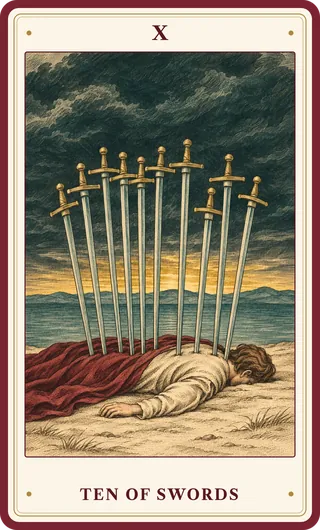
Ten swords
The swords are the full weight of a painful ending, planted in the back where the figure cannot see them. Reversed, they appear to be lifting away, which is why this position so often speaks of release.
The fallen figure
The person lies face down, completely spent, with no more fight left. Turned upside down, the body seems to be rising or being turned over, a sign that the collapse is no longer the end of the story.
Black sky
The darkness stands for grief, shock and the feeling that nothing could be worse. Reversed, the dark sits at the bottom of the image and the eye is drawn to what is above it.
Golden dawn
A band of yellow light glows on the horizon, the one promise in the picture. Reversed, it moves to the top of the card, so the light is now what you see first.
Still water
Calm water lies behind the figure, showing that the storm has passed and the surface is settling. It suggests emotions that are quietening and giving you room to think.
Distant mountains
The mountains in the background are solid, far off and unbothered by the drama in front of them. They hint at a stable future you cannot yet walk to but can already see.
Raised fingers and red cloak
The hand gesture resembles a blessing, as if the figure keeps some dignity even at the bottom. The red cloth is the last splash of life and vitality, the part of you that survives the ending.
The Ten of Swords reversed as advice
As advice, the card says: stop prolonging the pain. That means accepting what has happened, letting yourself grieve and then taking the smallest sensible step forward. It does not ask for forgiveness, a grand reinvention or a positive attitude. It asks for honesty and a bit of rest.
Practical applications include ending a draining contact, closing an account, finally having the conversation you have avoided, or simply sleeping more. Treat the card as permission to stop re-living the worst moment and to start living in the aftermath.
When it appears as advice with other swords nearby, such as the Nine of Swords, the message is even more specific: worry is the thing keeping you stuck, not the original event. Name the worry, then check whether it is based on what is real today.
Spiritual meaning
Spiritually, the reversed Ten of Swords represents a dark night of the soul that is beginning to lift. You have learned something about what you can survive, and you may feel quieter and more humble than before. Many people find that old beliefs, roles or relationships quietly fall away at this stage, leaving room for something more honest.
It is also a card of shedding. The ten swords are the stories, grievances and expectations that no longer serve you, and reversed they are being withdrawn one at a time. That process often hurts as it happens, but the result is a lighter way of living.
Numerology backs this up. Ten completes a cycle, and it reduces to one, the number of beginnings. The ending and the new start are built into the number itself.
Is the Ten of Swords reversed a yes or no?
For most questions, the reversed Ten of Swords leans toward a cautious yes when you are asking about recovery, healing, survival or starting again. “Will I get through this?” and “Is the worst over?” both generally get a yes. The word cautious matters: the recovery is slow, and the card does not promise comfort on any particular schedule.
It leans toward no when you are asking about saving something that has already ended, or about restoring a situation to exactly how it was. The upright card is a firm no in those cases, and the reversal softens the tone without changing the answer. For a fuller look at both positions, see the Ten of Swords yes or no guide.
If you want to check your reading with a quick pull, the same pattern applies. Pair it with another card to clarify, and treat the answer as a direction rather than a verdict.
When the feared disaster did not happen
Sometimes this card appears when you are expecting the worst. It can mean the situation is not as final as you believe. A conversation you dread may go better than you imagine, or a crisis may turn out to be reversible.
Do not use this as a reason to ignore real problems. The card is not saying “relax.” It is saying that your fear may be larger than the facts, and the best way to find out is to deal with those facts directly. Making a plan for the worst case usually shrinks the dread.
It can help to separate what has actually happened from what you are afraid will happen. Write them as two lists. The first is evidence, the second is prediction, and only the first is truly a Ten of Swords.
Card combinations to watch for
The reversed Ten of Swords is strongly shaped by its neighbours. A few pairings come up often:
- With The Sun: a decisive return of joy and energy. The recovery is fast and real. See The Sun for more on that brightness.
- With the Six of Swords: a gradual move away from pain toward calmer water.
- With the Four of Swords: rest as the central part of recovery.
- With the Three of Swords: grief is still fresh, and the healing is just beginning.
- With the Eight of Cups: you are deliberately leaving what has ended behind.
When in doubt, use the neighbouring cards to decide whether the card describes recovery or resistance. Soft and forward-moving cards support the first, and cards of delay or denial support the second.
How to read it in a spread
Position changes the emphasis. In the past position, the reversed Ten says a painful ending has already happened and left a lasting mark. In the present position, it shows that you are in the early stages of recovery, or in the stage of resisting. In the future position, it promises that a hard period eases, with the caveat that the ending itself may still need to happen first.
As an outcome card, it points toward release and healing, but not an instant fix. In a three card spread it works well as the middle card, showing what you are moving through. For a deeper look at how a position can shift a card’s tone, see the guide to how to read tarot.
These questions help when you pull it:
- What has actually ended, and have I admitted it?
- What am I still doing to keep the pain alive?
- What is the smallest step toward the light on this card?
- Who or what can support me while I recover?
Try this: Draw one more card and place it above the Ten of Swords reversed. Treat it as the “light on the horizon” and ask what it is telling you to move toward first.
Common mistakes when reading this card
The most common mistake is assuming that reversed means worse. The Ten of Swords is already at the bottom, so its reversal usually moves in the direction of improvement. Reading it as an escalation almost always misses the point, unless the whole spread is clearly pointing that way.
The second mistake is ignoring the resistance side. If the card appears and you only focus on the hopeful reading, you may miss a real instruction to stop clinging. A reading that consoles you without asking anything of you is only half a reading.
The third is expecting a timeline. This card measures emotional progress, not days on a calendar. Recovery tends to take weeks or months and will include setbacks. Allow for that and you will be less thrown when a hard day arrives after a good one.
If you are new to the suit, the overview of the Suit of Swords shows how this card fits into the broader story from the clarity of the Ace to the collapse of the Ten.
Questions readers ask
What does the Ten of Swords reversed mean?
It usually means recovery. The worst of a painful ending is behind you and you are slowly getting back up. It can also mean you are resisting an ending that is already real, so the surrounding cards decide which meaning applies.
Is the Ten of Swords reversed a good card?
Mostly yes. It is far gentler than the upright card because it points toward healing, relief and rebuilding. The warning side is denial: staying attached to something finished, or dreading a disaster that may never arrive.
What does the Ten of Swords reversed mean in love?
For many people it means healing after a breakup, betrayal or long emotional strain. In a relationship it can show a rough patch easing, or a partnership that cannot move forward until both people stop pretending the damage did not happen.
Is the Ten of Swords reversed a yes or no?
It leans toward a cautious yes for questions about recovery, healing and starting over. It leans toward no if you are asking whether something finished can be saved exactly as it was.
Does the Ten of Swords reversed mean things will get worse?
Rarely. The reversed card most often shows that you have already passed the lowest point. The exception is when it appears with other heavy cards and the question is about avoiding a final blow, in which case it asks you to face the truth sooner rather than later.
What does the Ten of Swords reversed mean for a person?
It describes someone who has been through a serious low and is slowly recovering, or someone who cannot accept a loss. They are often tired, wiser and quietly resilient, but may still lean on the story of what was done to them.