
Page of Swords Tarot Card Meaning (Upright & Reversed)

- Arcana
- Minor Arcana, Suit of Swords
- Element
- Air
- Yes or no
- Maybe
curiositynew ideasvigilance
confusionrecoveryrelease of mental strain
The Page of Swords tarot card means curiosity, a fast and questioning mind, and news or new ideas arriving. Upright, it asks you to learn, ask honest questions and say what is true. Reversed, it points to gossip, sharp words, scattered thinking or a mind that watches for trouble so closely it cannot settle.
This card is also called the Knave of Swords in some decks. It is the youngest court card in the suit of Air, so it speaks about the beginning of a mental process: noticing, wondering, researching and speaking up. Below you will find how it reads in love, work, money and health, how to tell it from the Knight, and how to use it when it appears in your spread.
What the Page of Swords means in tarot
The Page of Swords is a student of the mind. It stands for the first spark of curiosity about a subject, a person or a problem, and for the energy that goes into asking questions before anyone has answers. It often shows up when you are reading, researching, writing, studying or simply watching a situation carefully.
At its best this card is honest, alert and eager. It has not yet learned the diplomacy of the Queen or the authority of the King, so it can be blunt, and it often says out loud what others are thinking. That directness is a gift when the facts are on your side and a risk when they are not.
The card also carries messages. A text, an email, a letter, an offer of information or a piece of gossip that turns out to be true can all fit the Page of Swords. The news is usually small and quick, a first piece of the picture, rather than a final verdict.
Other names: the Knave of Swords
You may see this card labelled the Knave of Swords, and in some decks the Princess of Swords. Page, Knave and Princess all name the same court rank: the youngest member of the suit, associated with messages, study and the earth element within Air. The card has the same meaning whichever label your deck uses.
Knave is the older English word for a boy or young servant, and it has no negative sense in tarot. It is the rank that appears in traditional playing cards as the Jack. If your deck uses Princess, such as in many Thoth based decks, the imagery may differ, but you can still read it as a curious, quick and still learning energy.
If you want to see how this rank works across all four suits, the court cards guide explains Pages, Knights, Queens and Kings together.
What you see on the Rider-Waite-Smith card
In the Rider-Waite-Smith image, a young person stands on a windy, rocky hilltop with a sword held upright. The body leans forward, yet the head turns to one side, so the Page seems to be moving and listening at once. Clouds race behind, birds cross the sky and the trees bend in the wind. Everything about the scene suggests quick, restless thought.
Compare this with the Knight of Swords, who gallops straight at his target. The Page does not charge. He walks, he watches, and he is not sure yet where the sword will be needed. Arthur Waite’s own notes describe vigilance, examination and secret service, which is where the “spy” reading of this card comes from.
The sky is as important as the figure. Clouds and wind show a mind in motion, and the high ground shows perspective. The Page can see a lot, but has little cover, so he is vulnerable to being seen, challenged or wrong.
Read Page of Swords for your question
Upright: Someone is curious about you, wants real conversation and honest answers, and the connection grows through talking before touching.
Reversed: Gossip, mixed messages or sharp words wear down trust, or someone asks endless questions without ever opening up themselves.
Upright: They feel intrigued and mentally drawn to you, and they are still gathering information before they commit to a feeling.
Reversed: They feel guarded or critical, may be saying one thing and thinking another, or are overthinking what they feel.
Upright: You are learning fast, asking good questions and spotting what others miss, which suits study, research, writing, and new roles.
Reversed: Scattered focus, office gossip or a careless email can undermine you, and you may be talking more than you are finishing.
Upright: Research before you spend or invest, because information, a budget review or a financial message is the real next step.
Reversed: Poor information, rumours or a rushed decision put your money at risk, so check every figure before you act.
Upright: Ask the question, read the fine print, and say what you actually think in plain words.
Reversed: Stop spying on the situation, stop rehearsing arguments, and choose one fact-checked step to take.
Upright: Mind and nerves are active, so you are likely to benefit from fresh air, movement, and learning more about what your body is telling you.
Reversed: Anxiety, racing thoughts and poor sleep come from too much mental noise, and rest plus a calmer information diet will help.
Page of Swords upright meaning
Upright, the Page of Swords is about curiosity and communication. You may be learning something new, starting a course, researching a decision or looking at an old problem with fresh eyes. The card encourages questions, because a good question is often worth more than a quick answer.
It also advises honesty. The Page of Swords says what is true in plain language and wants the same in return. If you have been avoiding a straight conversation, this card suggests you can start it now, and that doing so does not need to be dramatic.
Typical upright keywords include:
- Curiosity and a quick mind
- New ideas and mental energy
- Messages, news and communication
- Study, research and learning
- Honesty, directness and vigilance
- Wit and playful debate
Try this: Write down the three questions you most want answered about your situation. Cross out any that are really complaints in disguise. Then take one remaining question and find a source or person who can answer it this week.
Page of Swords reversed meaning
Reversed, the Page of Swords shows the shadow side of a quick mind. Curiosity turns into nosiness, honesty turns into cutting remarks, and the habit of watching turns into anxiety, suspicion or gossip. A reversed Page may also be someone who talks a great deal and acts very little, or who changes their story depending on the audience.
The reversal can also describe a mind that cannot switch off. You keep scanning for the next problem, rehearsing conversations, checking messages or reading the worst into a vague comment. The sword is up, but there is nothing in front of it.
A third reading is simpler: you are unprepared. Waite linked the reversal with being caught off guard, so it can mean a message arrives before you have your facts, or you speak before you have thought. For a full breakdown in love, work and daily life, see Page of Swords reversed.
Page of Swords in love
In a love reading, the upright Page of Swords is the card of the first conversations. It describes someone who is interested in you because of how you think, what you say and how you answer them. Texting, banter, long talks and witty exchanges are typical of this card, and the attraction is often more mental than physical at first.
If you are single, it suggests meeting someone through ideas, classes, work, online chat or friends. If you are in a relationship, it asks you to talk more honestly and to check your assumptions before you argue. It is a good sign for a new couple learning about each other, and a useful nudge for a long term couple who have stopped asking each other real questions.
The reversed Page in love can point to gossip, teasing that hurts, mixed signals or someone testing you with questions but offering nothing about themselves. For a deeper look at relationships and how it reads from a partner’s point of view, see Page of Swords in love.
Page of Swords as feelings
When the Page of Swords describes what someone feels for you, it usually means curiosity. They find you interesting and want to know more, but they may not yet know what they feel. This is a person who prefers to observe and ask questions first, so their interest can seem slightly detached.
You will often see this person looking for reasons to talk to you, remembering details from conversations and asking pointed questions. They may be honest to the point of bluntness. They are rarely subtle romantics, and they often show care through attention rather than gifts.
Reversed, it can mean they are guarded, confused or unsure whether to trust their own interest. Check what they do, not only what they say, since this card can describe someone with a lot of words and little follow through.
Page of Swords in career
The Page of Swords is an excellent career card for learners. It suggests a trainee, a junior role, a new course, a research project or a change in direction that begins with study. Work involving writing, analysis, law, communication, tech, teaching, journalism or customer service suits its energy well.
It also points to quick thinking in meetings and sharp observation. You may be the person who spots the error in the spreadsheet, asks the question no one else will ask or sees where a plan will break. Your task is to be clear and fair, and to back up what you say with evidence.
Reversed, the card warns of office gossip, a careless email, scattered attention or promising more than you can deliver. It may also describe a colleague who talks a lot and reports back on others. Keep your wording precise and keep your records tidy.
Try this: Before your next important message at work, reread it once as if you were the recipient. Remove anything sharper than it needs to be, and add one concrete fact that supports your point.
Page of Swords in money
In finance, the Page of Swords is about information. Read the terms, compare the options, ask the bank or adviser your questions, and learn the basics before committing money. It can also describe news about money arriving, such as a statement, a quote or an answer to an application.
It favours study and planning over big action. This is a good card for building a budget, researching an investment, learning about taxes or checking what you actually spend. It is not the card of large leaps.
Reversed, it cautions against rumours, poor advice and quick decisions made from half the facts. If you are tempted by a tip from someone who sounds confident but cannot show their sources, slow down. For more grounded money cards, you can look through the suit of Pentacles, which covers material matters in detail.
Page of Swords and health
Tarot is not a diagnostic tool, so treat any health reading as reflection and not as medical advice. In that spirit, the Page of Swords usually points to the mind and nervous system: busy thoughts, restlessness, quick energy and a need for information. It can encourage you to ask questions of your doctor, learn about a condition or track your symptoms in a notebook.
It also suggests that you will do better with movement and fresh air than with sitting and worrying. A walk, light exercise or a change of scene suits this card.
Reversed, it can show anxiety, insomnia, overthinking or stress from constant news and messages. The remedy is usually less input, regular sleep and talking to someone you trust. If symptoms are persistent or worrying, speak to a qualified professional.
Page of Swords card symbols
Choose a symbol to read what it means on the card.
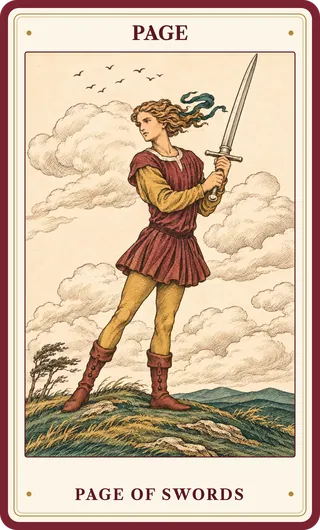
Raised sword
The sword held upright is the mind made ready: truth, logic and the power of words. The Page grips it like someone still practising, which is why this card is potential rather than mastery.
Turned head
He moves forward but glances to the side, as if he has heard something. This shows a watchful, curious nature that notices what others overlook.
Windswept clouds
Clouds gather and rush across the sky, showing Air, thought and change. Ideas are arriving quickly and the weather of the mind is not yet settled.
Birds in the sky
A flock of birds flies high above him, a classic image of messages, ideas and perspective. They suggest news travelling on the wind.
Bending trees
The trees lean in the breeze, showing that the whole scene is in motion. Nothing here is still, and that matches the Page's restless attention.
Rugged hilltop
He stands on uneven, rocky ground rather than a smooth path. His position is exposed but high, which gives a wide view and little shelter.
Light tunic and boots
He is dressed for movement, not for ceremony. The Page is ready to scout, run, and report back.
Page of Swords as a person
As a person, the Page of Swords is often a young adult, student, apprentice or messenger, but age matters less than attitude. It can be someone of any age who is curious, quick, witty, a little restless and always asking why. They love ideas, debate and finding out how things work.
Their strengths are honesty, intelligence and a refreshing willingness to question. Their weakness is that they may speak before thinking, argue for the pleasure of it, or lose interest when a topic stops being new. Reversed, the same person can be sarcastic, evasive or unreliable with confidences.
In some readings, the card describes you at the start of learning a skill, even if you are experienced elsewhere. That is a healthy way to read it: you are allowed to be a beginner with the sword.
Page of Swords as advice
As advice, the Page of Swords says to find out more before you act. Ask the clear question, read the document, listen to the other side and check what you have been told. It also says to be honest and to choose words carefully, because you can cut without meaning to.
It suggests curiosity over certainty. If you are stuck, treat the situation as something to study rather than a verdict to defend. A simple research step, a conversation or a list of facts will move things forward better than another round of worry.
In a spiritual sense the card represents learning with an open mind: reading, journaling, questioning beliefs and finding language for your inner life. It suits people who approach intuition through study and reasoning, and it suggests you should test ideas against experience.
Is the Page of Swords a yes or no card?
The Page of Swords is a cautious yes upright and a no or not yet when reversed. It is a good yes for questions about learning, communicating, asking, applying or getting news. It is a weaker answer for questions that ask for a final commitment, because this card is about gathering information, not completing the process.
If your question is “Should I ask them?” or “Should I look into this?”, the Page says yes. If your question is “Will this work out?” it more often says that you need more facts. Reversed, take it as a sign to wait, check your information or stop gossiping about the matter.
For a quick answer and a closer look at each position, see Page of Swords as a yes or no answer.
Page of Swords in past, present and future positions
In the past position, the card describes a time of curiosity, study or a message that set things in motion. You may have learned something that changed your thinking, or a conversation began a pattern you are still living with.
In the present position, it shows that you are in an information gathering phase. Something is being examined, and you are not yet at the point of action. In the future position, it promises news, a new idea or a learning opportunity, and it advises you to prepare questions and keep your attention open.
As an outcome, the Page of Swords is a good sign for communication and a modest one for resolution. It tells you the matter will become clearer, though it may not be finished. If you want a simple structure to work with, try this card in a three card spread.
Element, astrology and numerology
The Page of Swords belongs to the suit of Swords, which is Air, so it deals with thoughts, words, logic and truth. As the Page it is the earth part of Air: the grounded, practical, learning stage of the element. Many systems link the court card to Gemini, Libra and Aquarius, and Aquarius is the sign most often used.
Pages are also tied to messages and beginnings. In numerology some readers give court cards a rough connection to the number 11, which is a master number of insight and perception, though the Page itself has no fixed number in the Rider-Waite-Smith deck. You do not need any of this to read the card well, but it helps you see why a Page of Swords feels like both a beginning and a spark of intelligence.
The Page is a good place to start learning all of the suit. For more on how the suit works, see the suit of Swords and the other Air cards.
Page of Swords compared with other cards
The nearest card is the Knight of Swords, and the difference is speed. The Page watches and learns, while the Knight of Swords charges in and acts on his thoughts. If you pull the Page, you are still in the research stage. If you pull the Knight, you are already acting.
Compared with the Page of Cups, the Page of Swords asks and analyses, where the Page of Cups feels and imagines. The Page of Cups brings an emotional message, such as an invitation, a sentiment or a creative idea. The Page of Swords brings a factual or mental one: information, a question or a plan.
Compared with the Ace of Swords, the Page is the person and the Ace is the breakthrough. The Ace gives sudden clarity, and the Page is the curious mind that goes looking for it.
How to work with the Page of Swords
When this card appears, treat it as a prompt to ask better questions. It works well as a one card daily draw, because it points to something you can do today: read, ask, write or listen. You can also draw it from a random card generator if you are practising, though you do not need a tool to use it well.
Check what the surrounding cards say about tone. Next to cups the Page is gentle and curious. Next to the Five of Swords it can mean gossip or an argument over facts. Next to the Three of Swords it can bring painful news, and next to a Pentacles card it points to practical study or a work message.
Try this: Pull the Page of Swords out of your deck and sit with the image for two minutes. Then write down one question you have been avoiding, one fact you need and one honest sentence you could say to someone. Do the first small step the same day.
The most useful habit this card teaches is to separate information from interpretation. Write down what you know, then what you are guessing, and notice how much of the worry belongs in the second list.
Questions readers ask
What does the Page of Swords mean in tarot?
The Page of Swords means curiosity, a sharp young mind, new ideas and news on the way. It asks you to learn, question and speak plainly, while staying aware that you are still a beginner with the sword.
Is the Page of Swords a yes or no card?
Upright, it leans towards a cautious yes for questions about learning, communicating or getting information. It often means "not yet" if you want a final decision, because the card is about gathering facts first. Reversed, it leans towards no.
What does the Page of Swords mean in love?
It points to a connection that begins with conversation, banter and curiosity. In an existing relationship it asks for honest talking and fewer assumptions. Reversed, it warns of gossip, mind games and careless words.
What is the Knave of Swords?
The Knave of Swords is simply another name for the Page of Swords. Some older and modern decks, including the Thoth deck family and some Marseille style decks, use Knave or Princess instead of Page, but the meaning is the same.
Does the Page of Swords mean someone is spying on me?
Not literally, although the traditional Waite reading includes vigilance and watching. In most readings it describes someone who is curious, observant or asking a lot of questions. Reversed, with other difficult cards, it can suggest gossip or snooping.
What zodiac sign is the Page of Swords?
The Page of Swords is the Earth of Air card, and it is most often linked with the air signs Gemini, Libra and Aquarius. It is especially tied to Aquarius in some systems and to Gemini in others, so go with the system your own deck uses.