
Page of Swords as a Yes or No Answer

- Arcana
- Minor Arcana, Suit of Swords
- Element
- Air
- Yes or no
- Maybe
curiositynew ideasvigilance
confusionrecoveryrelease of mental strain
The Page of Swords is usually a yes in a yes or no tarot reading, but it is a yes with conditions. Upright, it says go ahead and ask, research, speak up and learn more. Reversed, it leans towards no or not yet, because the thinking is rushed, the facts are shaky or the words are likely to land badly.
That conditional quality is the thing to remember. This is the youngest card of the suit of air and mind, so it answers with energy and curiosity, not with a guarantee. Below you will find how to read it for love, work, money, health and timing, what the surrounding cards change, and how to ask a question that gives this card something useful to say.
The short answer: yes, with conditions
Treat the upright Page of Swords as a yes to moving forward, provided you do it with clear information. It is a green light for the next step, not for the final outcome. If your question is “Should I apply?”, “Should I ask?”, “Should I find out?” or “Should I say something?”, this card is a strong yes.
If your question is “Will this definitely work out?”, the Page can only tell you that the situation is alive, active and worth testing. That is still a positive answer. It just comes with homework.
For the full card, including its imagery and wider meanings, see the Page of Swords tarot card meaning. This page focuses only on how it behaves as a yes or no card.
Why the Page of Swords leans yes
The Page is a student, and students move towards things. The card carries air energy: curiosity, fresh ideas, alertness and a hunger to know. In the Rider-Waite-Smith image, a young figure stands with a raised sword while wind pushes clouds and bends the trees. Nothing here is stuck. Things are in motion and the Page is paying attention.
Yes or no readings tend to favour cards that show movement, openness and new beginnings. The Page fits that pattern. It is an opening card, not a closing or blocking one. Compare it with cards of stalling or withdrawal, which read as no or wait, and you can see why the Page sits on the positive side.
There is one more reason. Swords cards deal with truth, and truth is usually a good thing to seek, even when it is uncomfortable. When you draw the Page, the cards are often saying that you will be better off knowing, asking and speaking plainly than staying vague.
What the yes actually means
Think of the Page of Swords yes as a yes to engagement. It supports the act of asking, learning and communicating. It does not promise that the other person will agree, that the interview will be offered or that the numbers will add up.
Here is a useful way to hear it: yes, this is worth pursuing, and yes, you have what you need to start, but you still have to do the thinking. Court cards are people or attitudes as much as events, and the Page is a beginner. Beginners make progress by trying, checking and adjusting. If you want more on how the court cards behave in readings generally, the guide to court cards in tarot covers it.
This is why some readers describe the Page as a “yes, and pay attention” card. The answer holds as long as you stay curious and honest. If you start acting from ego, gossip or assumption, the same card turns sharp.
Read Page of Swords for your question
Upright: A cautious yes: the connection can grow if both people are honest, curious and willing to talk things through.
Reversed: A not yet or a no: mixed messages, gossip or sharp words are getting in the way of real communication.
Upright: They are curious, mentally engaged and keen to know you better, though they may not say it directly.
Reversed: Their feelings are guarded or confused, and what they say may not match what they think.
Upright: Yes to applying, pitching, studying or asking the hard question, as long as you prepare first.
Reversed: No for now: the plan is half researched, or you are about to speak or act before you are ready.
Upright: A yes to researching, comparing options and reading the small print before you commit.
Reversed: A no to anything rushed, unclear or based on rumour, tips or unchecked numbers.
Upright: Ask, learn, gather facts and say what you actually mean, then act on what you find.
Reversed: Slow down, check your sources, and think before you send, post or say the sharp thing.
Upright: A yes to getting information, booking the appointment and asking questions until you understand.
Reversed: A no to self diagnosing, gossip about symptoms or overthinking; get a qualified opinion instead.
Page of Swords reversed as a yes or no answer
Reversed, the Page of Swords leans towards no, or at least not yet. The typical problems are speaking before thinking, repeating hearsay, jumping to conclusions, or putting a half-finished plan into action. The sword is no longer held steady, and someone could get cut, including you.
That does not make it a hard, permanent no. More often it says that the question is not ready to be answered yes. The research is missing, the message is badly worded, or you are reacting emotionally and calling it logic. Fix the gap and ask again later.
There is also a gentler reading. A reversed Page can mean the answer is yes but you are doubting your own mind, holding back questions you should ask, or hiding something you know. In that case the “no” is internal: you are not yet ready to hear or say the truth. For more on how to weigh reversed cards generally, see how to read reversed tarot cards, and for the full picture of this card upside down, read Page of Swords reversed.
Try this: Before you pull a card, write your question as one clear sentence. If you cannot say it plainly, the Page of Swords has likely already answered: clarify first.
Love questions: a cautious yes
In love, the upright Page of Swords is a yes that depends on communication. It suits questions like “Will we be able to talk this through?”, “Is this connection worth exploring?” or “Should I ask them out?” The card favours wit, honesty and mental chemistry. It is less a grand romantic yes and more a yes to getting to know each other properly.
Be realistic about what it does not promise. This is a young, light card, not a symbol of lifelong commitment. For “Will they marry me?” it says that the relationship has a conversation to get through before any such answer is possible. It can also point to a newer or still developing bond, where both people are still testing ideas and boundaries.
Reversed, in love, the answer leans no or not yet. Expect miscommunication, teasing that stings, crossed wires or someone saying things they have not thought through. If the question is about a potential partner, treat the reversed Page as a warning not to build on gossip, social media impressions or assumptions. You can read more about this card’s romantic side in Page of Swords in love and as feelings.
Career and work: a strong yes to prepared action
Work is where the Page of Swords is at its best. Upright, it says yes to applying for the role, pitching the idea, starting the course, writing the proposal or having the direct conversation with a manager. The card rewards preparation, sharp communication and willingness to learn.
It is especially good for questions about study, exams, writing, research, journalism, law, tech, teaching and anything that depends on information and clear language. It can also point to news arriving: an email, a message or a document that moves things forward.
Reversed, it is a no for now. The risk is acting without enough information: sending the resignation email in anger, pitching an unfinished idea or spreading office gossip. If you are drawing it reversed about a job question, check the details, reread what you wrote and sleep on it before you act.
Money: yes to research, no to rushing
For money questions, the upright Page of Swords says yes to the careful kind of progress. That means comparing options, reading contracts, asking questions of advisers and learning the terms before committing. It is rarely a “yes, buy it now” card. It is more “yes, find out whether it makes sense”.
If you are asking whether to invest, borrow or sign, the card supports a yes only after you have checked the facts yourself. It is a card of information, so look for what you have not yet read or asked.
Reversed, the answer is a firm no to anything rushed. This includes tips from strangers, unclear offers, deals that rely on pressure and any decision made from rumour. The Page reversed can also hint at dishonest information, so verify claims independently. For money questions where you want more detail, a dedicated spread helps, though one card like this works well for a quick check.
Health: a yes to asking, never to self diagnosing
Tarot cannot diagnose or treat anything, and a yes or no card should never replace medical advice. With that said, the Page of Swords upright is a reasonable yes to questions like “Should I book that appointment?” or “Should I ask for a second opinion?” It encourages you to get information, ask questions and understand your options.
The card can also point to mental health in a gentle sense, since swords relate to the mind. It may suggest that talking, writing things down or learning more about what is happening will help, particularly if you have been overthinking quietly.
Reversed, it cautions against self diagnosing through internet searching, comparing symptoms with strangers or worrying in circles. The answer there is no to guessing, yes to a proper professional. If anxiety is part of your question, the reversed Page may also describe racing thoughts, and a calm conversation with someone qualified will serve you better than another card pull.
Page of Swords card symbols
Choose a symbol to read what it means on the card.
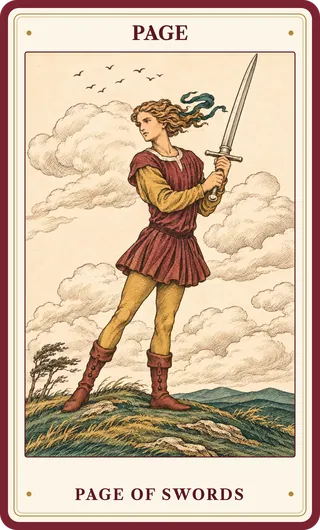
Upright sword
The Page grips the sword with both hands, pointing it skyward. It shows a mind that is ready and alert but still practising its skill.
Windswept clouds
Clouds rush across the sky behind the figure. They show restless thoughts, new information and a situation that is still moving.
Birds in flight
A small group of birds crosses the sky. They stand for ideas, messages and fast mental activity.
Bending trees
The trees lean in the wind, a classic sign of the Air element. They show that change is already in the air and the Page has to stay balanced in it.
Rocky, uneven ground
The Page stands on a rough hillside, not a smooth path. It hints that the answer holds up but the footing is not yet secure.
Forward-ready stance
One foot is set ahead as if about to step or turn. It shows eagerness to act and a need to look before moving.
Pale blue sky
The sky is clear above the stormy clouds. It points to clarity that is available once the thinking settles.
When the Page of Swords is about someone’s feelings
People often draw this card for questions like “Does he like me?” or “Will she text me?” Here the Page of Swords upright leans yes to interest, in the form of curiosity. The person is thinking about you, noticing you and likely to be curious about what you say. It is mental attraction first.
It does not always show deep emotional commitment, so keep your question specific. “Is she interested in talking to me?” gets a strong yes. “Is he in love with me?” gets a lighter, less certain answer, because this card speaks to the mind more than the heart.
Reversed, it suggests mixed signals, guardedness, a person who says one thing and thinks another, or someone who is distracted. Be careful about reading too much into the reversed Page, because it often describes confusion, not rejection.
How fast does a Page of Swords yes arrive?
Pages are messengers, and the suit of swords moves quickly. When the Page appears in a timing question, expect news, a message, a conversation or a decision within days or a couple of weeks, not months. It is a card of fast mental activity, so the thing you are waiting for is usually an answer or piece of information, not a long process finishing.
As a rough guide, many readers link the Page to a short stretch: a few days to a few weeks. Treat that as a pattern, not a rule. Different decks and readers assign different time scales, and you will find your own once you track your readings.
Reversed, timing stretches or turns uncertain. Delays often come from unclear messages or missing information, so the wait shortens once you clarify. If timing is central to your questions, the tarot timing guide explains how to ask about it clearly.
What surrounding cards change
In a single card draw, you simply take the Page’s lean. In a multi card yes or no spread, the neighbouring cards can strengthen or weaken the yes. Look at the following when you see the Page next to other cards:
- Another strong swords card, such as the Ace, supports a clear and honest yes. The Ace of Swords yes or no page covers that pairing’s own lean.
- Cards of delay, secrecy or confusion turn the yes into “yes, but find out more first”.
- Cards of endings or heavy loss suggest the situation may be bigger than a simple yes allows.
- A cluster of reversed cards weakens the answer and points to a need to wait.
If the Page lands in the final or outcome position, read it as “yes, if you keep communicating”. If it lands in the middle as a challenge position, it may describe the obstacle itself: too much talk, too little action, or the reverse.
Questions that suit this card, and ones that don’t
The Page of Swords gives its best answers to questions about information, communication and starting something. It struggles with questions that need deep emotional or long-term certainty. Asking well makes a real difference, and the guide to questions for a tarot reading offers a lot of examples.
Questions that suit the Page:
- Should I send this message or have this conversation?
- Should I apply, enrol or submit this?
- Is it a good idea to research this further before deciding?
- Will I get the information I’m waiting for soon?
Questions that suit it less well:
- Will this person be my soulmate?
- Will I be rich in ten years?
- What is the cause of my illness?
For the second list, rephrase so the card can speak to the next step: “What should I do about this?” or “Is now a good time to ask?”
Try this: Take a vague question like “Will I get the job?” and rewrite it as “Should I send a follow up email this week?” Draw the Page of Swords with the second version in mind and see how much clearer the answer feels.
How to use the Page of Swords in a yes or no reading
Keep the process simple. A yes or no reading works best with a clear question and a firm rule for reading the answer before you draw. If you want to try a ready made method, the yes or no tarot reading tool lets you draw instantly.
- Write one specific question that can be answered yes or no.
- Decide in advance how you will read the cards: upright as yes, reversed as no, or a third option for “maybe”.
- Shuffle while holding the question in mind and draw one card.
- If the Page of Swords appears upright, take the yes and note the condition: what do you need to learn or say?
- If it appears reversed, ask what is unclear, then wait and redraw only after something has changed.
Avoid repeating the same question until you get the answer you want. If a card feels wrong, that is a sign to look at the question or your own hopes, not to pull again.
Page of Swords compared with other swords cards
The Page is the beginner in a family of swords court cards, and each one answers yes or no a little differently. The Knight charges ahead, so the Knight of Swords yes or no page leans fast and forceful, where the Page is curious and still learning. The Queen is clear and discerning, and the King is authoritative and decisive.
This difference helps when you are deciding which card you need. The Page says “yes, begin by asking”. A Knight says “yes, act now”. The Queen and King say “yes, if it is honest and fair”. If you drew the Page, you are being asked to learn and speak before taking big steps.
It also helps to remember that Pages in general carry messages and fresh starts. The Page of Swords is the message about truth, ideas and words, which makes it different from Pages of other suits that carry emotional, practical or creative news.
If the answer feels wrong
Sometimes the Page of Swords appears and your gut says no. Take that seriously. The card says yes to a process, so check whether your question is really about a process. If you asked “Will he come back?” and received a bright, cheerful Page, the card may be telling you to talk, not wait.
You can also test whether your doubt is fear or information. Fear says, “I might be rejected.” Information says, “I have no evidence this is true.” The Page of Swords encourages you to separate the two.
Finally, remember that tarot reflects a moment and a mindset, not a fixed fate. A yes from the Page is permission to try, and a reversed Page is a prompt to prepare. Both give you something to do, and both work best when you act on them with a clear head.
Try this: Draw the Page of Swords for a question, then write down the one thing you need to find out before acting. Do that task today, and notice whether the yes starts to feel firmer.
Questions readers ask
Is the Page of Swords a yes or a no?
Upright, the Page of Swords is usually a yes, though a conditional one. It supports asking questions, gathering facts and speaking honestly. Reversed, it leans towards no or not yet.
What does the Page of Swords mean as a yes or no answer in love?
It is a cautious yes. The relationship or connection has potential, but it depends on honest and open communication. If the card is reversed, expect mixed signals or a need to clear the air first.
Is the reversed Page of Swords a no?
Often it is a no for now rather than a final no. It warns of rushed words, gossip, scattered thinking or a plan that has not been checked properly. Fix those and the answer can change.
Can the Page of Swords mean maybe?
Yes, when it lands among cards of delay, secrecy or confusion. The card itself leans yes, but the neighbouring cards can turn it into a yes if you learn more first.
How soon does a Page of Swords yes happen?
Usually quickly, in days or a few weeks, because it is a fast, air energy card. The news or answer tends to arrive through a message, a conversation or a document.
Should I rely on the Page of Swords for health or legal questions?
No. Use it to decide to ask questions and get proper information, then follow qualified professional advice. Tarot cannot diagnose or replace a doctor, lawyer or financial adviser.