
Knight of Swords Yes or No: What the Card Answers

- Arcana
- Minor Arcana, Suit of Swords
- Element
- Air
- Yes or no
- Yes
ambitionhastedirect action
confusionrecoveryrelease of mental strain
The Knight of Swords is a yes when it lands upright in a yes or no reading. It is a fast, direct, forward-moving yes that says go, and go now. The catch is that the answer is only as good as your preparation, because this knight rewards clear thinking and punishes recklessness. Reversed, the card leans towards no, or at least not like this.
That is the short version. The longer one matters, because the Knight of Swords is a card of speed, and a quick yes with no plan behind it can turn into a quick mistake. Below you will find how to read the answer for love, work, money, health and timing, how to spot when it flips, and how to ask a question that suits it. For the full card description, see the Knight of Swords meaning page.
The short answer: yes, if you move with a plan
Upright, the Knight of Swords says yes to action. It answers questions that start with “should I go for it”, “should I say something”, “should I apply” and “should I start”. The card is about courage, intellect and a determined push toward a goal, so it supports questions where momentum is what you need.
The answer is not soft. If you pull this card for a clear yes or no question, you are not being told to wait and see. You are being told the path is open and that moving fast will help you.
Reversed, the same drive turns against you. The card then points to impatience, aggression, scattered effort or a plan that has been started without enough thought. In a yes or no spread that reads as no, or at least not in this form. You can read more about that in the Knight of Swords reversed guide.
Why the Knight of Swords reads as a yes
The Knight of Swords belongs to the suit of Swords, which is linked to Air, thought, language and decision. The knight is the action-taking court card of that suit, so he brings thought into motion. Nothing in his picture suggests hesitation: the horse is at a gallop, the sword is raised and the face is set forward.
Cards that show movement, clarity and commitment tend to read as yes. Cards that show waiting, withdrawal or heaviness tend to read as no. The Knight of Swords sits firmly in the first group. His question is never “should I?” but “how fast can I get there?”
That is also why this card makes a good answer to bold, time-sensitive questions. If a decision has to be made this week, or a door is closing, the Knight of Swords is one of the most fitting cards to see. For a wider comparison, the yes or no tarot card reading page shows how single cards are usually sorted.
The condition attached to the yes
Every strong yes in tarot has a “but”, and this one is specific. The Knight of Swords is brilliant at starting and charging. He is poor at pausing, checking or finishing. So the yes comes with a quiet requirement: you need to bring the plan.
Before you act on the answer, run through these checks:
- Have you got the facts, not just a feeling or a fast opinion?
- Can you say what you want to say without anger?
- Are you prepared to follow through after the first burst of energy fades?
If you can say yes to all three, take the card at face value. If you cannot, treat the answer as “yes to moving, but fix the gaps first”. That is not a contradiction. It is how a fast card is best used.
Try this: Write your question and the single next action the Knight of Swords would take. Set a timer for ten minutes and do that action, whether it is sending the message, filling in the form or making the call. Notice how it feels to move on a yes.
Read Knight of Swords for your question
Upright: Yes to making the first move and saying what you feel, as long as you can keep the same energy once the chase is over.
Reversed: No to rushing, ghosting or pushing for an answer; the approach is too sharp or too scattered for this to land.
Upright: They are keen, direct and mentally absorbed in you or the situation, and they want to act on it now.
Reversed: Their interest is erratic, defensive or blunt to the point of hurting; words and actions are not matching.
Upright: Yes to the bold application, pitch or career move, provided you have done the groundwork.
Reversed: No to a hasty resignation or an angry email; slow down and fix the plan first.
Upright: Yes to decisive action, such as negotiating, closing a deal or paying off a debt in one push.
Reversed: No to impulse spending or a quick-win investment; the speed is hiding a risk.
Upright: Go now, stay focused and keep your tone clear, because hesitation costs more than a small mistake.
Reversed: Stop, breathe and rethink before you charge in, because the current plan runs on adrenaline rather than facts.
Upright: Yes to starting the new routine with real energy, as long as you build in rest.
Reversed: No to overdoing it; burnout, tension and stress-driven habits need to ease off.
Knight of Swords reversed as a yes or no
Reversed, the knight’s speed has lost its direction. He may be charging the wrong way, charging without armor, or running out of steam halfway across the field. In a yes or no reading, that makes the answer no, or “not yet”.
The reversed Knight of Swords usually appears when someone is being reckless, when conversations are turning into arguments, or when you are acting out of frustration and calling it decisiveness. It can also show the opposite: stalled energy, where you know what to do and cannot begin. In both cases, the card is not telling you the goal is wrong. It is telling you the current method is.
Treat it as a pause with a purpose. Slow down, get the missing information, calm the tone, and ask again later. If you want a general method for reading flipped cards, the guide to reversed tarot cards explains the main approaches. Some readers skip reversals altogether, in which case read the Knight of Swords as a yes with a firm reminder to temper the pace.
Knight of Swords yes or no in love
In love, the upright Knight of Swords is a yes for honesty, pursuit and clear communication. If your question is “should I ask them out”, “should I tell them how I feel” or “will they reply”, the card encourages a direct approach. It favors the person who says what they mean rather than the one who drops hints.
The caution is about staying power. This knight loves the pursuit and the conversation, but he is not a card of steady nurturing. For questions such as “will this become a lasting relationship”, read the yes as “yes to the spark and the contact, and the rest will depend on whether both people can slow down”.
Reversed in love, the answer is no to pressure, ultimatums and sudden decisions. It can also point to someone who runs hot and cold, or who says too much in anger. If you are asking whether to reach out right now in the middle of an argument, the reversed Knight of Swords says wait.
The Knight of Swords as feelings and intentions
Asked what someone feels or intends, the upright Knight of Swords shows a person who is interested, mentally engaged and ready to act. They may be quick to message, quick to make plans and direct about what they want. The feeling is real, but it is often expressed through words and activity rather than softness.
The honest limit is that the card describes energy and speed, not depth. A person shown by this knight may be thrilled by the pursuit and then lose pace. If your question is “do they like me”, the answer is likely yes. If it is “will they stay”, add another card for clarity.
Reversed, the card shows scattered feelings, defensiveness, sarcasm or blunt words that hurt. Someone might be interested and unable to say so kindly. A court cards reading can help you work out whether the Knight is describing a person or simply the tone of the situation.
Knight of Swords yes or no for career
Work is where this card is strongest. Upright, it is a clear yes for applications, pitches, interviews, bold proposals and fast-moving projects. It supports ambition and competitiveness, and it favors anyone willing to speak up and act.
The same condition applies: preparation. The card says yes when you have done the homework. If you have not, the knight will carry you into the room and leave you without answers. Use the yes to speed up, not to skip steps.
Reversed, it says no to the hasty resignation, the heated reply to a colleague or the pitch that is not ready. It can also point to an aggressive boss or rival. If you are weighing whether to quit in anger, wait a day before you decide. When the plan is clear and you are calm, you can ask again.
Knight of Swords yes or no for money
For money questions, the upright Knight of Swords is a yes to decisive action: negotiating a better rate, closing a deal, paying off a balance in one push or taking a clear opportunity before it passes. It rewards quick, informed choices.
It is less comfortable with slow wealth-building questions. If you ask “should I invest steadily for the next ten years”, the card’s speed is a poor fit, and you may prefer an earthier card for that kind of reading. The knight suits sprints, not marathons.
Reversed, it warns against impulse buying, risky gambles and quick-win schemes. The speed is hiding a gap in the facts. Hold off on any financial move that has a countdown timer attached, and check the details first.
Knight of Swords yes or no for health
In health readings, the upright card is a yes to starting something with energy: a new training plan, a new routine, a decision to see a doctor and get answers. Mental determination is on your side.
The warning is burnout. The knight does not rest, and neither does a person who treats their body like a project to conquer. Pair the yes with recovery time. Tarot cannot diagnose or replace medical advice, so use the card for motivation and not as a verdict on any condition.
Reversed, it points to tension, overwork, racing thoughts and stress-driven habits. The answer is no to pushing harder and yes to easing off. If anxiety or a racing mind is part of your question, speak to a qualified professional rather than relying on a card.
Knight of Swords card symbols
Choose a symbol to read what it means on the card.
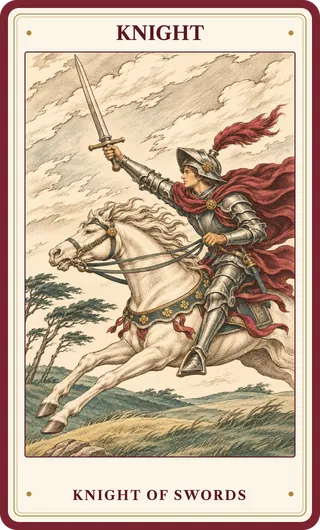
Charging white horse
The horse is at full gallop, which shows pure momentum and a mind that has already decided. White points to clear intent, though the speed leaves little room for caution.
Raised sword
The knight holds his sword high and ready, the Swords suit's sign of intellect, truth and words. It says this energy cuts straight to the point, sometimes too sharply.
Bent trees
The trees lean hard in the wind, as if the knight's rush is bending the landscape around him. It shows force that others have to adjust to.
Stormy sky
Clouds and wind fill the sky, the element of Air at its most restless. Mental energy is running high, and calm is not yet in sight.
Butterflies and birds
These decorate the knight's tunic and the horse's harness, hinting at ideas, change and a lightness beneath the armor. They suggest his drive is mental and quick to shift.
Armor and visor-less face
He is fully armored but his face is exposed, showing courage without much self-protection. He commits openly and does not hold back.
Bare ground
The landscape beneath him is sparse and rough, with no settled home or garden in view. This card travels light and is better at arriving than staying.
Timing: how fast is the Knight of Swords?
Few cards are as quick. When this knight appears, things usually move in days or a few weeks, not months. A message arrives soon, a decision comes fast, or a situation changes quickly once you start. Some readers link it to short spans such as a week or two.
That makes it a helpful card for time-bound questions. If you ask “will I hear back this week”, the upright knight is a strong sign. Reversed, the timing can be disrupted: delays caused by haste, mixed messages or a rushed start that needs to be redone.
If you want a closer look at how readers estimate time with the cards, the tarot timing page covers the common methods. Treat any timing as a guide to the pace of events and not a promise.
Try this: Ask, “What happens in the next seven days if I act on this?” and pull one card. If the Knight of Swords appears, write down one thing you expect to change by the end of the week and check back then.
When the Knight of Swords is a no even upright
The card is not an automatic yes on every question. Some questions need patience, tenderness or a long view, and this knight has none of those. If you ask “will my friend forgive me if I give them time” or “is it right to wait for a slow-moving situation”, the knight’s urgency cuts against the question.
In these cases, read the card as a no, or as advice to change tactics. The answer might be “do not wait, act”, which can feel like a no to the question you actually asked. This is why the exact wording of the question matters so much.
Also watch for cases where the yes would cost others. The knight can be forceful and blunt. If the move would hurt someone through haste or harsh words, the card is asking you to examine your approach even if the answer is technically yes.
How surrounding cards change the answer
A single card gives a quick answer, but the cards beside it can sharpen or soften the Knight of Swords. In a three-card reading, the neighbors often tell you whether the yes is clean or conditional.
- With the Ace of Swords or the Magician: a strong, clear yes, with focus and skill behind the speed.
- With the Four of Swords, the Hanged Man or the Two of Pentacles: slow down; the yes becomes “not yet” or “after a pause”.
- With the Five of Swords or the Tower: conflict is likely, so the yes comes with a price or a fight.
- With another Knight, such as the Knight of Wands: a lot of momentum, and a risk of burning out before the finish.
In a Celtic Cross or other long spread, read the position first. As an outcome, the Knight of Swords can mean a quick result. As a past card, it shows a rush that has already happened and may need cleaning up.
How to ask a question the Knight of Swords can answer
The card responds best to questions about action and decisions. Closed questions beginning with “should I” or “will I” work well. Open questions such as “what is going to happen in my life” are better answered with a longer spread.
Good wording makes the verdict easier to trust. Compare these:
- “Should I send the message today?” The knight gives a clear yes or no.
- “Will they ever understand me?” The card is a poor fit, since the question is about slow change.
- “Should I apply for this role before Friday?” A natural fit for the knight.
If you want help phrasing, the list of questions for tarot reading has ideas that work well for single-card draws. Ask once, draw once, and avoid re-drawing until you get the answer you want.
The Knight of Swords compared with the other knights and pages
The Knight of Swords is often compared with the Knight of Wands, since both are fast. The difference is the engine: Wands run on passion and Swords run on thought and conviction. The Wands knight leaps for the thrill; the Swords knight charges because he has decided he is right.
Next to the Page of Swords, who is curious and still learning, the knight is the page grown bold, putting ideas into action. The Page is a cautious maybe; the Knight is a decisive yes. After the Knight comes the Queen of Swords, whose answer is more measured and based on experience.
This progression helps when you are unsure how strongly to take the answer. If the Knight feels too hasty, ask again in a calmer frame and see whether the Queen or King of Swords turns up. Their yes is usually slower and steadier.
What the picture tells you about the answer
Look at the card itself. The knight rides in full armor on a white horse, sword raised, under a stormy sky with trees bent by the wind. Everything points one way, and nothing on the card suggests rest. That visual urgency is where the yes comes from.
Now look at the small details. The butterflies and birds on the knight’s clothing and the horse’s harness suggest ideas that move quickly and sometimes change course. The bare ground says there is no settled home here. The exposed face shows courage without a lot of protection.
Together these details explain the condition on the yes. The knight has the nerve and the speed, but the bent trees show the cost: force, noise and a wake of things disturbed. Read the answer as a green light with a reminder to watch your wake.
Common mistakes when reading this card as a yes or no
The most common mistake is to treat the yes as permission to skip thought. The card is about quick decisions, not careless ones, and the best use of the yes is to move faster on something you have already considered.
The second mistake is overlooking tone. Many readers hear “yes” and forget that the Swords suit is about language. A true yes that is delivered harshly can damage a relationship or a deal. Pay attention to how you act, not just whether.
The third is reading every Knight of Swords as a person. Sometimes it is simply a description of pace. If you are unsure, draw a clarifying card, or look at the full Knight of Swords meaning for the broader picture. Keep the answer simple, and let the situation tell you whether the speed is a gift or a warning.
Try this: Draw the Knight of Swords for a question, then write down three things you would do if you took the yes seriously and three things you would check before you start. Compare the two lists and act on the shorter one first.
Questions readers ask
Is the Knight of Swords a yes or no card?
Upright, the Knight of Swords is a yes, and a fast one. The yes carries a condition: it holds when you have prepared and can keep your temper and focus.
Is Knight of Swords reversed a yes or a no?
Reversed, it leans no. The card points to rushing, arguing or acting without enough information, so pause and rethink before going ahead.
How fast does the Knight of Swords say things will happen?
It is one of the fastest cards in the deck, usually pointing to days or a few weeks. Expect quick contact, quick decisions and quick movement.
Does the Knight of Swords mean yes in love?
Yes for attraction, honesty and making a first move. Be careful with questions about lasting commitment, because this knight is better at pursuit than patience.
What if the Knight of Swords answers a question about waiting?
Then it usually means no. The card wants action, so if your question needs patience or slow nurturing, it points away from that approach.
Can the Knight of Swords mean no even when upright?
Yes, when the question depends on gentleness, time or careful planning. Surrounding cards such as the Four of Swords or the Hanged Man can also turn the answer to no or not yet.