
Knight of Wands as a Yes or No Answer

- Arcana
- Minor Arcana, Suit of Wands
- Element
- Fire
- Yes or no
- Yes
energyadventureimpulsiveness
delayslost motivationscattered energy
The Knight of Wands is a yes in a yes or no reading. Upright, it is a fast and confident yes to action, travel, pursuit and any bold step you have been putting off. Reversed, it shifts to a slow down, or a no for now, because the energy is real but rushed, scattered or running ahead of the plan.
That is the short version. The longer one matters, because this card says yes to speed and does not always say yes to success. How firmly it backs your question depends on what you asked, which way up it fell and what sits beside it. The sections below cover love, work, money, timing and the situations where the Knight’s yes needs a condition attached.
The short answer: a fast, conditional yes
Think of the Knight of Wands as a green light with a note taped to it. The light is green: go, start, speak, book the ticket. The note says that this card cares about momentum, so the yes is strongest when your question is really about whether to move.
In a simple ranking, the upright Knight of Wands sits among the strongest yes cards in the Minor Arcana. It is the fire of the suit at its most active. If you ask “Should I apply?” or “Will this trip happen?” and he appears, you can take it as a clear affirmative with real energy behind it.
The yes gets thinner when the question is about things that need to be still, slow or durable. “Will this relationship be stable?” and “Will my savings grow safely?” are not his territory. He may still answer yes, but expect a yes with excitement in it and few guarantees about the long run.
Why the Knight of Wands reads as a yes
The reasoning comes from the card’s image and its place in the deck. In the Rider-Waite-Smith card, a knight in armour and a bright yellow tunic holds a leafy wand and rides a horse caught mid-rear, with a desert and pyramids behind him. He is not planning or waiting. He has already decided, and everything about the picture points forward.
The Wands suit is the suit of fire: will, drive and ambition. The knights are the court cards that move, and the Knight of Wands is fire of fire, so his action is the most direct in the suit. Where the Page of Wands brings a spark of curiosity and a first idea, the Knight takes that idea and rides at it. Cards that describe taking action read as yes because the question is being answered by movement.
There is a second reason, and it is practical. A yes or no spread is often asked by someone who is hesitating. The Knight of Wands cuts through hesitation, so he reads as a yes with a push in it: stop gathering opinions and act.
Upright Knight of Wands: what the yes covers
Upright, the yes covers a wide set of questions. Any question that starts with “Should I go?” tends to get a strong answer from him. It includes asking someone out, launching a project, changing cities, applying for a role, taking a trip, having the difficult conversation or finally starting the thing you keep describing but never begin.
He is especially clear on questions where the real risk is doing nothing. If you have already done the thinking, and the remaining obstacle is nerve, his appearance says the nerve is available to you. Charm, confidence and a willingness to be seen are all part of his package, so he also supports questions about pitching, performing, networking and putting yourself forward.
What the upright yes does not cover is the finish. He gives you the start and the first stretch of the ride. Whether you will see it through is a different question, and the card is largely silent on it. If you want the full picture of the card, the Knight of Wands meaning page goes through the personality, the court-card reading and the timeline.
Read Knight of Wands for your question
Upright: A passionate yes to chemistry, pursuit and making a first move, though the intensity may burn hotter than it lasts.
Reversed: A shaky yes at best: mixed signals, ghosting or a fling that fades unless someone slows down and commits.
Upright: Strong, excited attraction that wants to act on itself right now.
Reversed: Interest that flares and cools, or feelings that are real but scattered and unreliable.
Upright: A yes to bold moves, a pitch, a relocation or a fast-moving project where nerve counts more than caution.
Reversed: A no for now: the plan is half-built, you are overcommitted or burnout is close.
Upright: A yes to a calculated risk or a push for more income, as long as you act while the opening exists.
Reversed: A no to impulse spending or get-rich-quick moves; the numbers have not been checked.
Upright: Go, start, say it, book it: hesitation is now the bigger risk.
Reversed: Pause, finish what you started and plan the route before you set off again.
Upright: A yes to exercise, new routines and recovering your drive, with a nudge to rest between sprints.
Reversed: A no to pushing harder: restlessness, overtraining or ignoring tiredness needs attention first.
Reversed Knight of Wands: slow down, or no for now
Reversed, the Knight of Wands changes the answer from a go to a wait. Readers split a little here. Some read it as a plain no, and others as a yes that has lost its footing. Both readings agree on the reason: the energy is there, but it is badly aimed.
In practice the reversed Knight often shows up as a rushed decision, a plan that skipped the boring middle, a person who is all in on Monday and gone by Friday, or someone who is already tired from sprinting. Ask yourself whether you have actually done the groundwork. If the honest answer is no, read the card as a no for now. If the groundwork exists and you are only nervous, it is closer to a yes with a slower pace.
A good rule is to read the reversed Knight as “not like this” instead of “never”. For a fuller look at what the card says in each area of life, see the Knight of Wands reversed guide. If reversals are new to you, the page on how to read reversed cards explains the different approaches, including reading every card upright if you prefer.
Try this: Before your next yes or no draw, decide in advance how you will read reversals: as a flat no, as a “slow down” or as upright only. Write the rule down first, so you do not bend it once you see the card.
How strong is the yes?
Not every yes is the same size. One way to measure it is to ask how well the question fits the Knight’s strengths. The closer the fit, the louder the yes.
- Strong yes: starting, travelling, speaking up, pitching, flirting, competing, moving house.
- Moderate yes: ongoing projects, existing relationships, jobs that need both courage and follow-through.
- Weak yes or maybe: anything that depends on someone else changing their mind, or on waiting.
- No or not yet: questions about security, rest, patience, healing or commitment that needs time to prove itself.
This is a useful habit because it keeps the card honest. The Knight of Wands has an easy confidence, and it is tempting to read every draw as a triumph. Matching the question to the card’s real subject keeps your reading grounded and makes the answer more useful.
Knight of Wands yes or no in love
In love, the upright Knight of Wands is an enthusiastic yes for new attraction. If you ask “Does this person like me?” or “Should I ask them out?”, he points to chemistry, pursuit and a good chance that the interest is mutual. Of all the knights, he flirts the most and hesitates the least.
The caution is about duration. His passion is real, but it can be intense and short-lived, so the yes is often a yes to the spark, not to the long term. If you are asking whether something will become serious, look at the cards around him. A grounded card nearby suggests the fire could settle into something steady. If it sits near other restless cards, treat it as a lively beginning with no promise attached.
Compare him with the Knight of Cups, who answers love questions with romance and sincerity, and the Knight of Wands with desire and action. If you want to be told that someone is emotionally serious, the Cups knight is the likelier bearer of that news. The Wands knight tells you they are interested and in motion.
Existing relationships, exes and mixed signals
For a relationship that already exists, the Knight of Wands gives a more careful yes. He can mean renewed passion, a trip together, a bold conversation or a fresh start. He can equally describe a partner who is restless, busy or always one step out of the door, so look at the wording of your question.
If you ask about getting back together with an ex, expect a hesitant yes at most. The Knight returns easily, because he is the sort to ride back in with a grand gesture. But he is also the sort to leave again, so the card does not tell you whether the second attempt will last. A yes here means contact or a spark is likely, not that the problems have been solved.
Reversed in love, the Knight is the classic picture of mixed signals: warmth one week, silence the next, big plans that never get a date. Read that as a no to the question “Is this person reliable?” even if the attraction is genuine.
Career and money questions
At work, the upright Knight of Wands says yes to bold moves. Apply for the role, pitch the idea, ask for the project, take the transfer or start the business on the side. He suits fast-paced settings and any question where visibility and confidence count. A promotion question gets a probable yes if you are ready to push for it, since he rarely rewards waiting for someone to notice you.
Money questions need more care. He supports a calculated risk and a push for more income, such as a new client, a sales push or a move into a better-paid area. He does not favour caution or saving, and he can describe impulsive spending, so check what the question actually is. “Will I earn more if I take this job?” is a fair yes. “Is this investment safe?” is outside his remit, and the Ace of Pentacles or a similar grounded card would speak better to it.
Reversed, the Knight advises against quitting in a burst of temper, overcommitting or starting three things at once. The answer to “Should I do this right now?” becomes no. The answer to “Should I do this at all?” can stay open.
Knight of Wands card symbols
Choose a symbol to read what it means on the card.
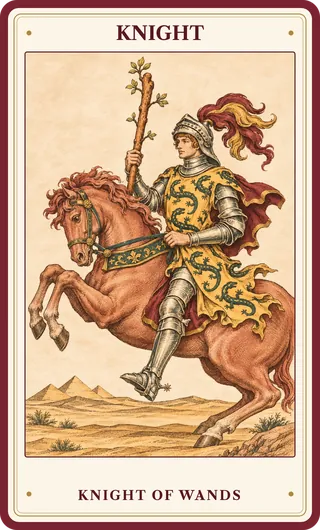
Rearing horse
The horse is mid-leap, which shows energy that is ready to burst forward. It also shows how little control this rider keeps over his own speed.
Wand in a gloved hand
He grips the wand like a lance, a sign of purpose and readiness to fight for what he wants. The small green leaves on it suggest that his drive can still grow into something lasting.
Salamanders on the tunic
The salamander is the classic creature of fire, so the pattern marks him as fire in motion. Its link to transformation hints that his passion can change him, for better or worse.
Plumed helmet
The red-orange plume streams behind him in the wind, a flag of confidence and showmanship. It adds to the sense that he wants to be seen charging in.
Desert and pyramids
The dry, empty land stretches behind him with pyramids on the horizon. It points to travel, distance and big goals, and also to the fact that nothing is yet built here.
Yellow tunic and armour
Bright yellow suggests optimism and a lively mind, while the armour shows he expects a contest. He rides out ready for action, not for a long wait.
Timing: how soon does the yes arrive?
The Knight of Wands is the fastest card in the suit, and in timing terms he usually points to days or a few weeks, not months. If the Knight is answering a yes or no question about an event, expect movement soon, often with little warning. He is linked in many traditions to fire signs, especially Sagittarius, which reinforces the idea of quick, outward motion.
If the thing you are waiting for has no sign of life after several weeks, the Knight’s energy may not be the one governing the situation. That is worth noticing, since it can tell you the real answer is slower than the card suggests. For a wider look at reading time in a spread, the tarot timing guide covers suits, numbers and seasons.
Reversed, timing stretches. Delays, stalls and false starts are the pattern, and the same event may take far longer than hoped, or begin and then stop.
When the Knight’s yes is a trap
A yes is only as good as the question. The Knight of Wands can mislead when the question rewards patience and his answer rewards speed. The most common case is a person asking whether to quit, move, text or confront, all in the middle of strong emotion. The card says “go”, and the reader hears “go now”. Sometimes the better reading is “go, but not tonight”.
Another case is asking whether something will last. The Knight stands for beginnings and bursts, and he has no obvious stamina. A yes there can be a yes to a vivid start and nothing more. If you want to know about endurance, the Eight of Wands shows rapid progress arriving, and cards like the Ten of Pentacles speak for long-term security.
Finally, watch for the yes you wanted to see. If you drew the Knight because you were hoping for it, look again at the first card and ask what the Knight is asking of you, as well as what he is promising.
Try this: Take your Knight of Wands yes and write the first action it points to, small enough to do within 48 hours. If you cannot name one, the answer is probably not as clear as you thought.
Cards nearby that change the answer
In a single-card draw, the Knight’s yes stands on its own. In a spread, the surrounding cards can strengthen it, add a condition or turn it into a delay. Here are patterns worth watching for.
- With Aces or the Magician: a very strong yes. The Knight carries a fresh opportunity and the skill to use it.
- With Pentacles cards: a yes that can be built into something lasting, since the speed meets a plan.
- With Swords cards: a yes complicated by arguments, overthinking or sharp words. The speed may cause conflict.
- With heavy, slow cards such as the Four of Swords or the Hanged Man: a yes that is delayed, or a request to pause first.
- With the Seven of Wands or Five of Wands: a yes that involves competition or defending your position.
If you are reading more than one card, a simple past-present-future layout from the 3 card tarot page is a clean way to see whether the Knight is where the situation starts, where it is now, or where it is heading.
How to phrase the question for a clear answer
Yes or no tarot works best when the question has a single clear subject and a clear action. “Will I get the job?” asks a different thing from “Should I apply?”, and the Knight of Wands answers the second far better. He is a card of what you do, so questions about your own next step suit him.
Avoid stacked questions such as “Will I get the job and will I like it?” and open ones such as “What will happen with my career?” If you want more than one answer, draw one card per question. For help with question wording, the list of questions for tarot reading has examples, and the yes or no tarot reading tool lets you draw a card directly.
Ask your question only once per session. Drawing again and again until you get a yes teaches you nothing, and the Knight of Wands will tell you the same thing in the end: stop circling and decide.
Knight of Wands compared with other knights
The four knights carry the same basic energy of movement, and they differ in what moves. In a yes or no reading, the difference shows up in how reliable the answer is. The Knight of Wands says yes to action driven by desire and ambition. The Knight of Cups says yes to action driven by feeling. The Knight of Swords says yes to action driven by thought, often with more force than care. The Knight of Pentacles is the slowest, and says yes to steady work and patience.
If your question is about passion and starting something, the Wands knight is the best match. If your question is about long-term reliability, he is the weakest of the four, and you might expect a different knight to answer more honestly.
What to do after a Knight of Wands yes
Treat the yes as an instruction to begin. Choose one concrete action, do it soon and see what happens. The Knight’s strength is in the first move, and often the next move becomes clearer only once you have made it.
Then add what he leaves out. Set a budget, a plan B, a date to review the situation or a friend who will tell you the truth. He supplies the courage, so you supply the structure. That pairing is what turns a quick yes into one that holds.
If the answer you were hoping for was a no, notice your reaction. A Knight of Wands that makes you uneasy often means you were looking for permission to stay put. That is useful information too, and worth a calmer look before you act or decline. For a wider view of the suit he belongs to, see the suit of Wands overview.
Try this: Draw the Knight of Wands in a three-card yes or no spread and ask what you are rushing, what you are avoiding and what you should do next. Compare the three answers before you act.
Questions readers ask
Is the Knight of Wands a yes or no card?
The Knight of Wands is a yes card. Upright it is a confident, fast yes to action, travel and bold moves. It is less certain about anything that depends on patience, stability or a long wait.
What does the Knight of Wands reversed mean as a yes or no answer?
Reversed, the Knight of Wands leans toward no, or at least not yet. It points to haste, scattered effort or a plan that skipped the groundwork. Many readers treat it as a yes that needs a slower pace and a clearer plan.
Does the Knight of Wands mean yes in love?
Usually yes for new attraction, flirting and making a first move. It is a more cautious yes for settled relationships and a hesitant one for reconciling with an ex. The excitement is real, but the card does not promise staying power.
How fast does the Knight of Wands answer come true?
Quickly. Most readers expect movement within days to a few weeks, since this is the fastest card in the suit. If the situation drags on for months, the Knight's energy is probably not the one in charge.
What if I draw the Knight of Wands again and again?
Repeated draws usually mean the answer is a clear yes and you are still hesitating. Check whether you are waiting for certainty that will never arrive. Then pick one small action and take it.
Is the Knight of Wands a yes in a work or money question?
Yes, if the question is about starting, pitching, moving or taking a measured risk. It is a weaker yes for questions about steady, long-term security. Back the Knight's speed with a budget or plan.